SPC vs WPC Vinyl in Tampa Bay: Which Core Holds Up in Florida
SPC (Stone Plastic Composite) and WPC (Wood Plastic Composite) are both 100 % waterproof luxury vinyl flooring products. From the top, they can look identical. But beneath the wear layer, the core material is completely different — and in Tampa Bay’s climate, that core determines how long the floor lasts and how well it performs under daily heat, humidity, and AC cycling.
The short answer: SPC has a denser, harder core that outperforms WPC in Florida’s temperature extremes and high-humidity conditions. WPC is softer and more comfortable underfoot, making it a better fit for interior rooms with consistent climate control. SPC usually costs more, but the right choice depends entirely on where you are installing.
What Is SPC Vinyl Flooring?
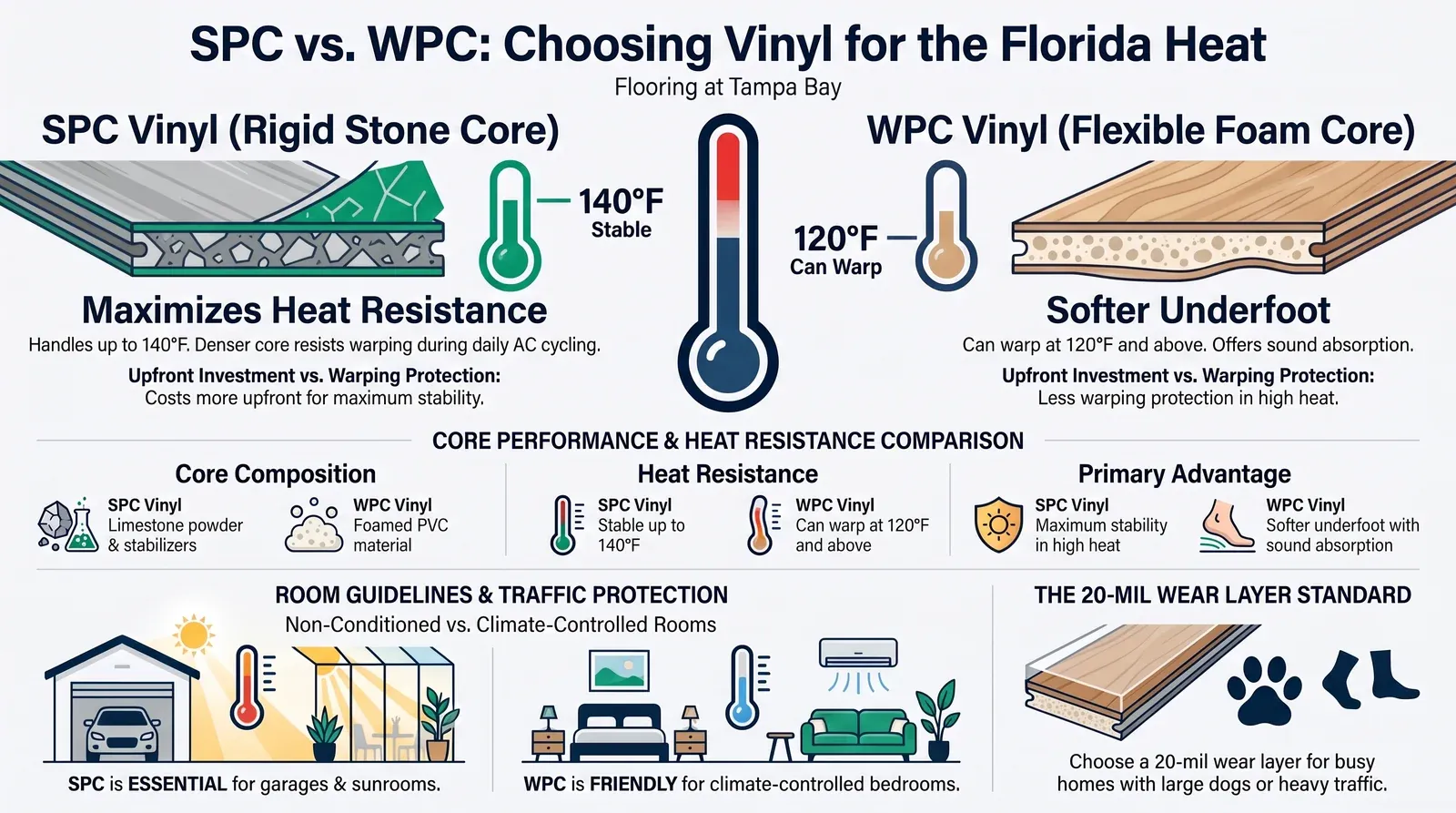
SPC stands for Stone Plastic Composite. The core is made from limestone powder, polyvinyl chloride, and stabilizers — a dense, rigid material that gives the floor its structural strength. SPC has almost no flexibility, which is one of its primary advantages: it does not expand or contract meaningfully with temperature or humidity changes.
- Temperature tolerance: typically rated from 32 °F to 140 °F — covers garage and sunroom conditions in Tampa Bay.
- Dimensional stability: minimal expansion and contraction under Florida’s humidity fluctuations.
- Feel underfoot: harder than WPC. Some homeowners notice the difference in bare feet.
- Price: typically higher than WPC, both for product only and installed.
What Is WPC Vinyl Flooring?
WPC stands for Wood Plastic Composite. Despite the name, there is no actual wood in most modern WPC flooring. The core is a foamed PVC material that is lighter and slightly flexible, giving WPC its most appealing characteristic: it is warmer and softer underfoot than SPC.
- Temperature sensitivity: WPC can expand in high-heat spaces. In enclosed garages or sunrooms that reach 120 °F+, warping can occur.
- Comfort: the foam core absorbs more impact than SPC — better for long periods of standing.
- Sound absorption: WPC is quieter underfoot — less hollow click sound when walking.
- Price: typically lower than SPC, both for product only and installed.
How Do SPC and WPC Perform in Florida’s Heat and Humidity?
Florida’s climate stresses vinyl flooring in two distinct ways: sustained heat in non-conditioned spaces and daily humidity swings driven by air conditioning cycling on and off. SPC and WPC respond very differently to each stressor, and the difference matters more in some rooms than others.
| Factor | SPC | WPC |
|---|---|---|
| Core material | Limestone powder + PVC | Foamed PVC |
| Temperature range | 32°F–140°F | Softens above 100°F sustained |
| Dimensional stability | Minimal movement through humidity cycles | Slight expansion and contraction over time |
| Feel underfoot | Harder, more rigid | Softer, warmer |
| Relative installed cost | Higher | Lower |
| Best fit | Garages, sunrooms, kitchens | Bedrooms, living rooms with stable AC |
Non-conditioned spaces (garages, sunrooms, Florida rooms)
Garages and sunrooms can reach 110–130 °F in summer. WPC’s foam core can soften and deform at sustained temperatures above 100 °F. SPC’s stone core maintains its shape through these conditions. If any part of the installation is in a non-conditioned space, SPC is the only appropriate choice.
Daily AC cycling
Tampa Bay homes cycle humidity between 40 % and 80 % RH daily in summer. SPC’s dimensional stability means it does not respond to these swings. WPC can show slight expansion and contraction over time, though it is significantly more resistant than laminate or hardwood.
Which Performs Better in Specific Rooms?
Room-by-room selection matters more than a single whole-home choice, since the right core material depends on how much temperature swing and moisture exposure a given space actually sees throughout the year.
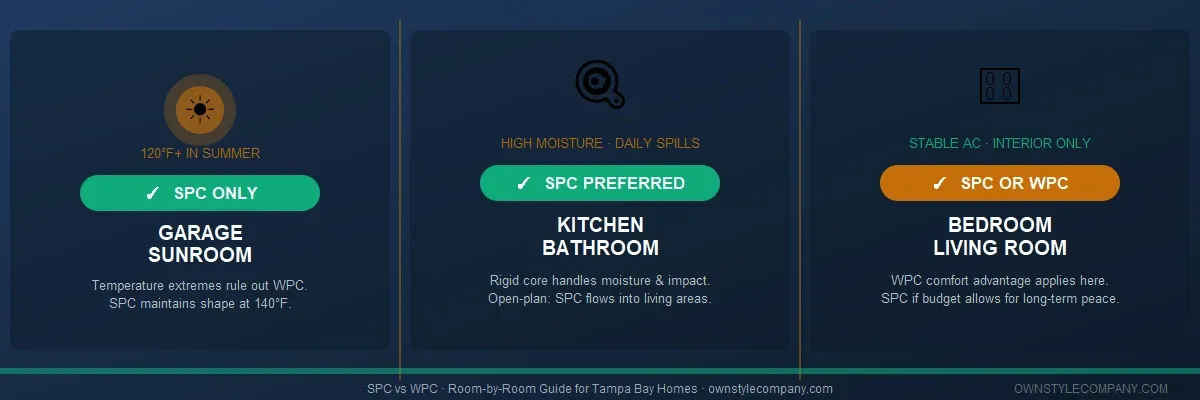
- Kitchens and bathrooms: SPC. Rigid core handles spot moisture and temperature variations better.
- Bedrooms and living areas with consistent AC: either works well. WPC’s comfort advantage becomes relevant here.
- Garages, sunrooms, Florida rooms: SPC only. Temperature swings in these spaces will compromise WPC over time.
- Multi-room installation across living areas and kitchen: SPC for visual continuity and consistent performance.
Does the Price Difference Actually Matter?
On a whole-home installation, SPC’s higher material cost adds up across every square foot. If you have a fully conditioned home with consistent AC and your installation is interior-only, WPC can serve well for 15–20 years at lower cost.
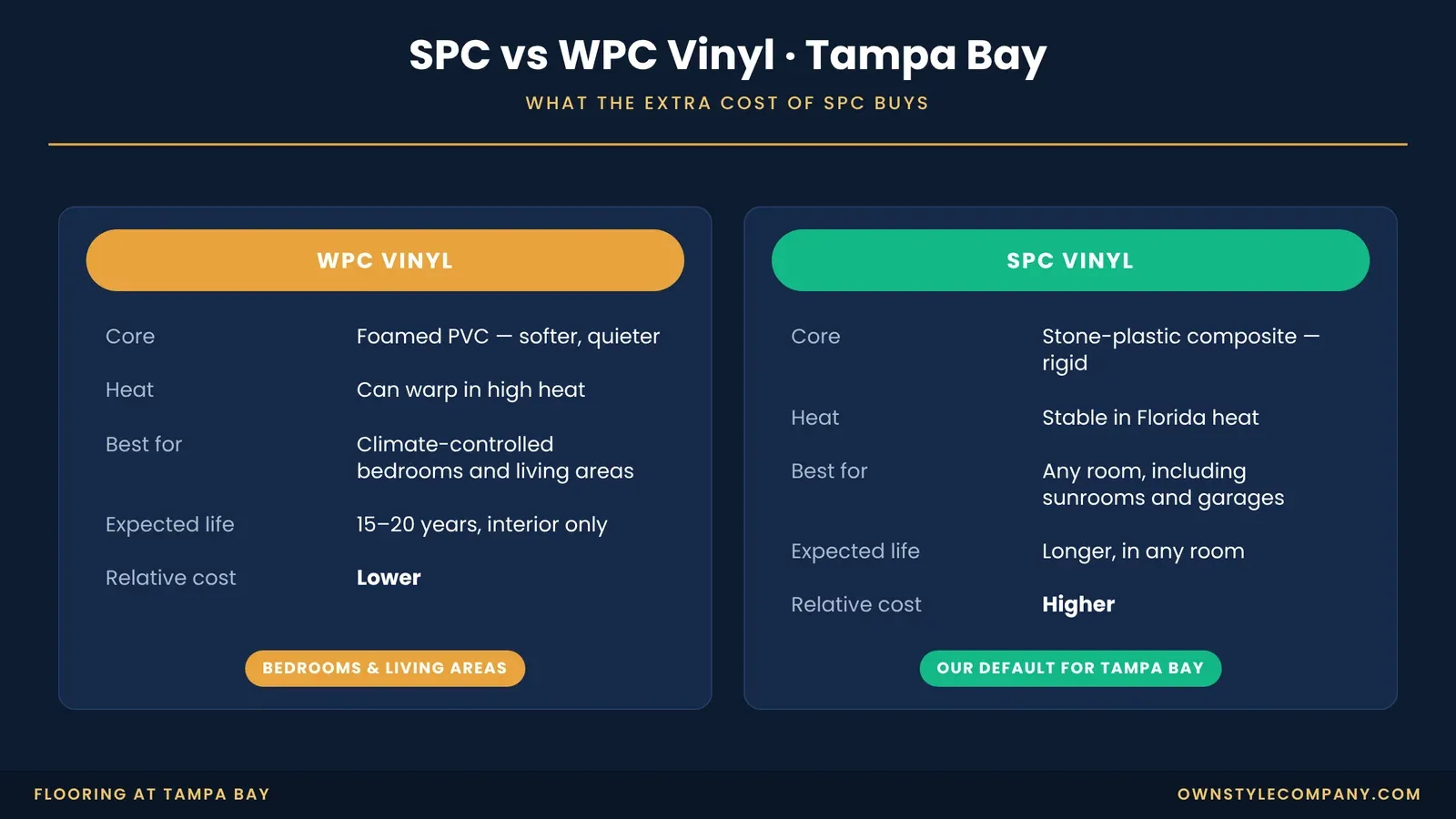
If your installation spans any non-conditioned areas, the extra cost of SPC buys significant protection against premature failure. To see the real numbers for your project, request a free photo estimate.
Which Vinyl Type Is the Default Recommendation for Tampa Bay Homes?
The default recommendation for Tampa Bay homeowners is SPC. Tampa Bay’s climate is simply harder on flooring than most of the country. SPC’s dimensional stability is the right specification for these conditions. Most homeowners underestimate how hot their non-conditioned spaces get — and WPC installed in a space that proves too hot creates a warranty claim that is hard to resolve.
What Mistakes Do Tampa Bay Homeowners Make Choosing Between SPC and WPC?
Most SPC-versus-WPC regrets trace back to a handful of avoidable assumptions rather than a defect in either product, and each one is easy to check before signing a contract.
- Assuming WPC’s comfort advantage matters in every room. A soft, warm underfoot feel is only relevant in rooms where bare feet spend real time — a garage or laundry room does not benefit from WPC’s cushioning.
- Choosing WPC for a Florida room based on price alone. A Florida room that hits 120 °F+ in summer will warp WPC’s foam core within a season or two, turning the savings into a full replacement.
- Skipping the wear layer spec entirely. A 12 mil wear layer is the residential minimum; homes in Brandon or Riverview with large dogs or heavy daily traffic need 20 mil regardless of core type.
- Mixing SPC and WPC across an open floor plan without a transition plan. The two cores expand at different rates, and a hard transition strip prevents the seam between them from telegraphing that difference over time.
- Not budgeting for SPC’s price premium during 2026 remodel planning. SPC’s higher material cost is easy to overlook during initial budgeting and becomes a point of friction mid-project if it was never priced in.
Checking these five points during the estimate phase, not after installation day, is what keeps a vinyl floor performing as expected through its first Florida summer and every hurricane season after it.
Planning a flooring project in Tampa Bay? Every quote starts with a moisture reading of the slab, at no cost. Get your free photo estimate or call (813) 455-5756.
Frequently asked questions
What is the difference between SPC and WPC vinyl flooring?
SPC (Stone Plastic Composite) has a rigid core made from limestone powder, PVC, and stabilizers — denser, harder, and more temperature-stable than WPC. WPC (Wood Plastic Composite) has a foamed core that is softer and more comfortable underfoot but less resistant to extreme heat. Both are 100 % waterproof.
Which is better for Florida homes — SPC or WPC vinyl?
For most Tampa Bay homes, SPC is the better choice. Its rigid core handles Florida's temperature swings, high humidity, and AC cycling more consistently than WPC. WPC works well in bedrooms and living areas with stable climate control, but in garages or sunrooms with temperature spikes, SPC is significantly more stable.
Why does SPC vinyl typically cost more than WPC?
The price difference reflects the denser limestone-filled core material and additional manufacturing complexity. Over the life of the floor in a Florida home, the durability advantage of SPC typically justifies the premium — especially in high-traffic or temperature-variable spaces.
Can SPC vinyl be installed in Tampa Bay garages or sunrooms?
Yes. SPC is rated from 32 °F to 140 °F, covering the extremes in Florida enclosed spaces. WPC can expand and develop ridges in spaces that heat significantly when the AC is not running, which is common in garages and sunrooms during summer.
What wear layer thickness do I need for SPC or WPC vinyl in Tampa Bay?
For residential homes with normal foot traffic, a 12 mil wear layer is the minimum. Homes with large dogs, children, or heavy traffic should use 20 mil. Commercial or mixed-use spaces should use 28 mil or higher.


US standard for measuring relative humidity inside a concrete slab using in-situ probes drilled to 40% of slab depth, read after 72 hours of equilibration.
US standard for measuring moisture vapor emission from a concrete slab using anhydrous calcium chloride, expressed in pounds per 1,000 sq ft per 24 hours.
US standard practice for preparing concrete floors to receive resilient flooring. Covers flatness, cleanliness, and moisture condition before installation.
The building code in force across Florida, including moisture and structural requirements that apply to slab-on-grade residential construction.
European deep-core moisture test that reacts a slab sample with calcium carbide and reads the resulting gas pressure. Supporting knowledge: the applicable US standards are ASTM F2170 and F1869.
Supporting knowledge — not the standard we work toGerman standard series for floor screeds, source of the widely cited 2.0% CM cement and 0.5% CM anhydrite thresholds. Supporting knowledge, not the applicable US standard.
Supporting knowledge — not the standard we work toHigh-Density Fiberboard: the compressed wood-fiber core of most laminate planks. It absorbs water vapor and swells irreversibly, which is why slab moisture matters.
Stone Plastic Composite: rigid vinyl core made of limestone powder and PVC. Dimensionally stable under humidity swings and unaffected by water.
Wood Plastic Composite: vinyl core with wood flour and foaming agents. Softer and warmer underfoot than SPC, and less dimensionally stable.
Luxury Vinyl Plank: multi-layer vinyl flooring in plank format. Fully waterproof as a material, though the subfloor beneath still governs installation.
Abrasion Class rating for laminate wear resistance, from AC1 to AC6. AC4 suits normal residential use; AC5 handles heavy traffic and light commercial.
A sheet layer placed between slab and flooring to block ground moisture vapor. Required over slab-on-grade construction regardless of surface dryness.
Foundation type where the concrete slab sits directly on the ground, dominant in Florida residential construction. Ground moisture migrates upward continuously.
The permitted deviation of a subfloor across a given span. The common benchmark is 3/16 inch over 10 feet; beyond that, deviation transfers into the locking joints.
A pourable cement-based compound that flows to a level surface, used to correct slab deviation. Needs 24 to 72 hours of cure before flooring goes down.
The 8 to 10 mm clearance left between a floating floor and every fixed vertical surface, absorbing seasonal expansion. Bridging it transfers stress to the joints.
Conditioning flooring material inside the room where it will be installed, 48 to 72 hours before installation, so it reaches interior temperature and humidity.
An angle-in locking profile that joins planks without adhesive. The insertion angle is specified by the manufacturer; forcing it deforms the profile permanently.
The raised ridge that forms along plank edges when a floating floor expands without room to move. In Florida the usual causes are slab moisture or a bridged expansion gap.