Tile vs LVP in Tampa Kitchens and Bathrooms: Where Each One Wins
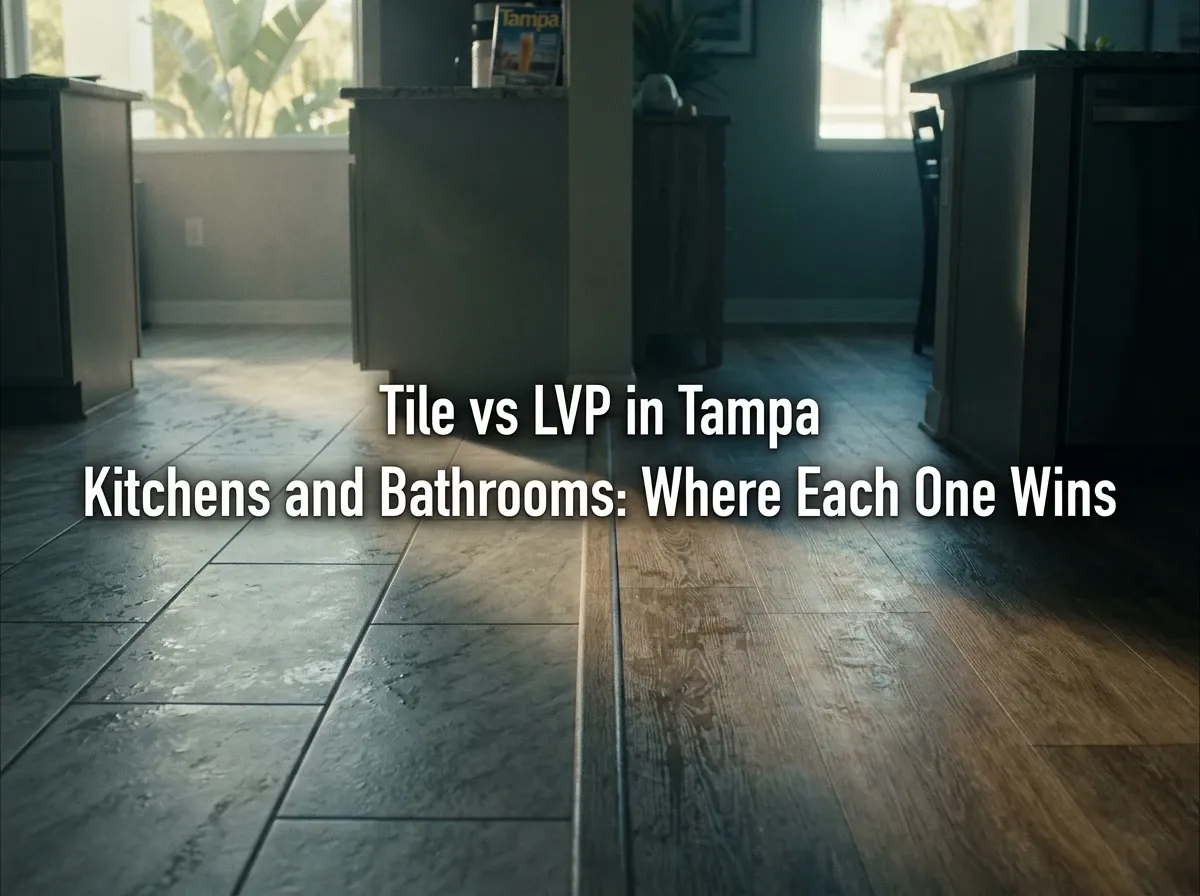
Both tile and LVP (Luxury Vinyl Plank) are fully waterproof and technically appropriate for Tampa Bay kitchens and bathrooms. In most flooring conversations, both materials pass the first filter. The real question is where each one wins — and where the other is the smarter choice.
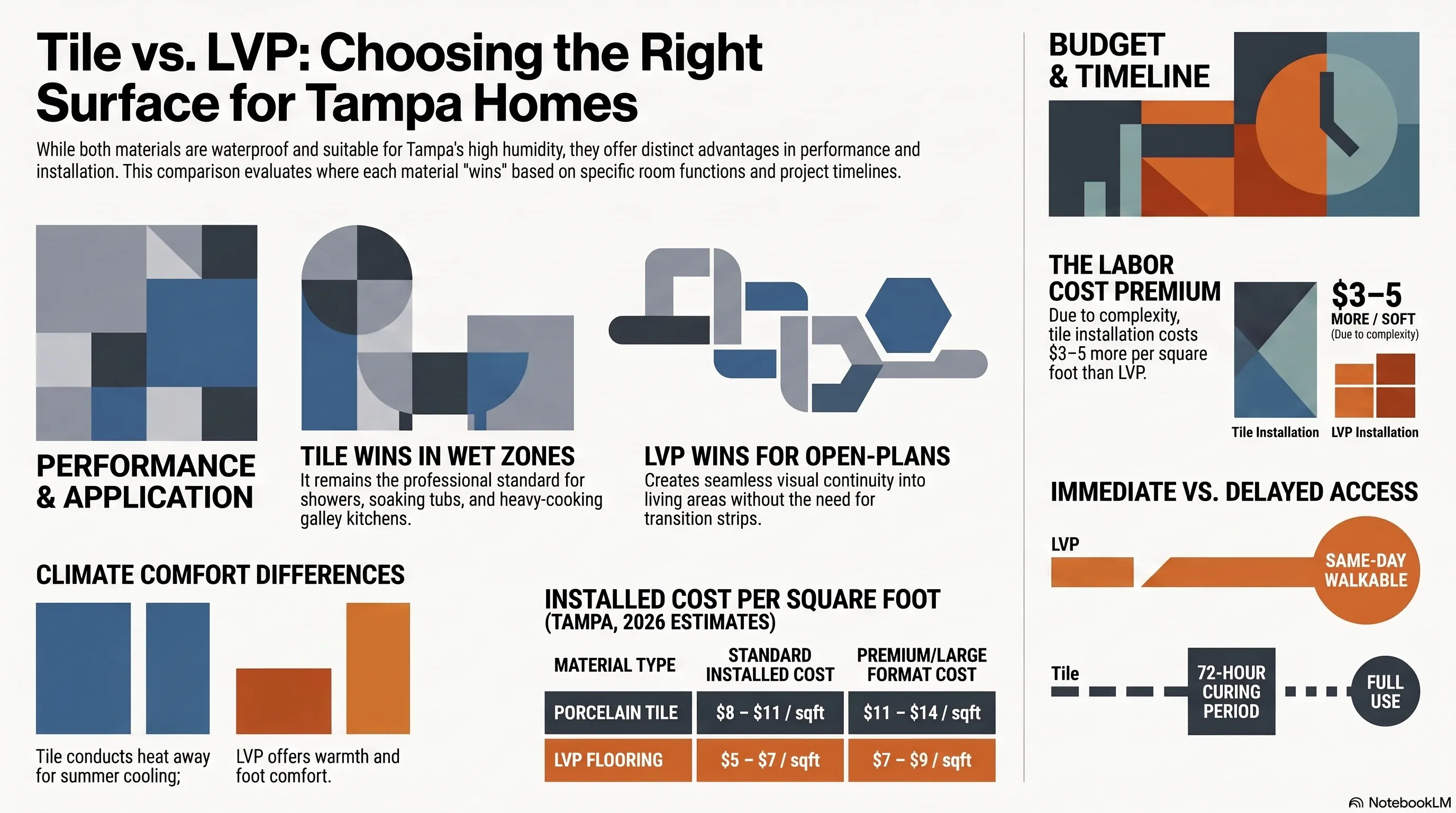
The short answer: tile wins on durability and raw heat and moisture resistance. LVP wins on budget, comfort, installation speed, and visual continuity with adjacent living spaces.
What Makes Both Good Options in Tampa Bay?
Tile and LVP share four characteristics that make them the two materials worth comparing seriously for Tampa Bay kitchens and bathrooms, while nearly everything else gets ruled out by the region’s humidity and water exposure before cost or style enters the conversation.
- High ambient humidity: both handle this without warping or absorbing moisture.
- Frequent water exposure: Tampa Bay families track in rain, pool water, and condensation year-round. Both are fully waterproof at the surface.
- Open-plan design trends: many Tampa Bay homes built after 2000 have kitchens opening directly into living rooms. LVP handles visual continuity better than tile.
- Long cooling seasons: cold tile underfoot is a daily experience. LVP’s warmer feel is a real comfort advantage across the cooling season.
Tile vs LVP in Tampa Bay Kitchens
Kitchens split into two distinct categories that favor different materials, and the deciding factor is usually how the kitchen connects to the rest of the home rather than the cooking habits of the household living in it.
When tile wins in the kitchen
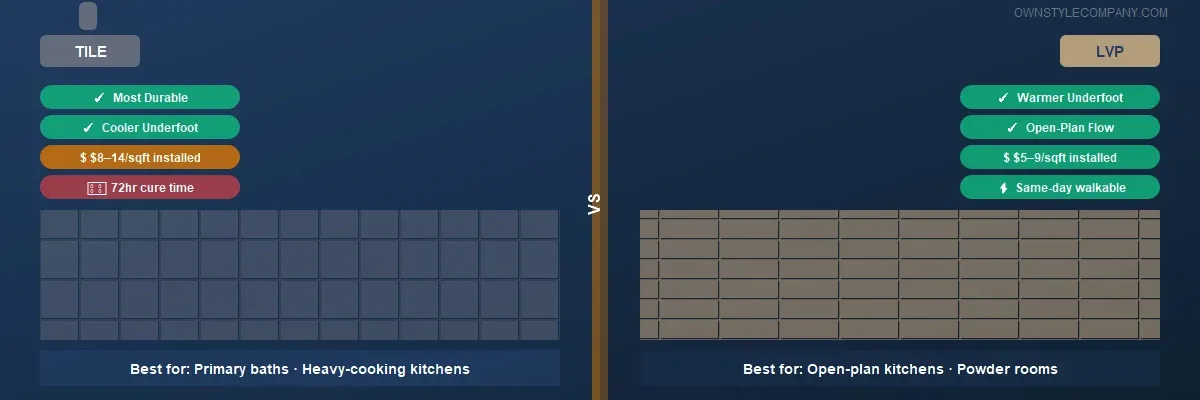
Tile is the professional standard for heavy-cooking kitchens. It handles hot items dropped from the stove, grease splatter, and heavy foot traffic better than any other material. Large-format tiles (18×18 or 24×24) reduce grout lines and cleaning effort. For galley kitchens or any space where the stove and oven are central to daily life, tile holds up better over a 20-year horizon.
When LVP wins in the kitchen
For open-plan kitchens that flow into living rooms, LVP creates a seamless floor without transition strips. If the living area has LVP or wood-look flooring, continuing it into the kitchen avoids visual breaks that make smaller Tampa Bay homes feel chopped up. LVP is also faster to install — no mortar curing time — and noticeably warmer underfoot after hours of standing while cooking.
Tile vs LVP in Tampa Bay Bathrooms
Bathrooms split by water exposure level rather than by size, and the same room type — primary, guest, or powder — can call for a different material depending on how much standing water actually reaches the floor each day.
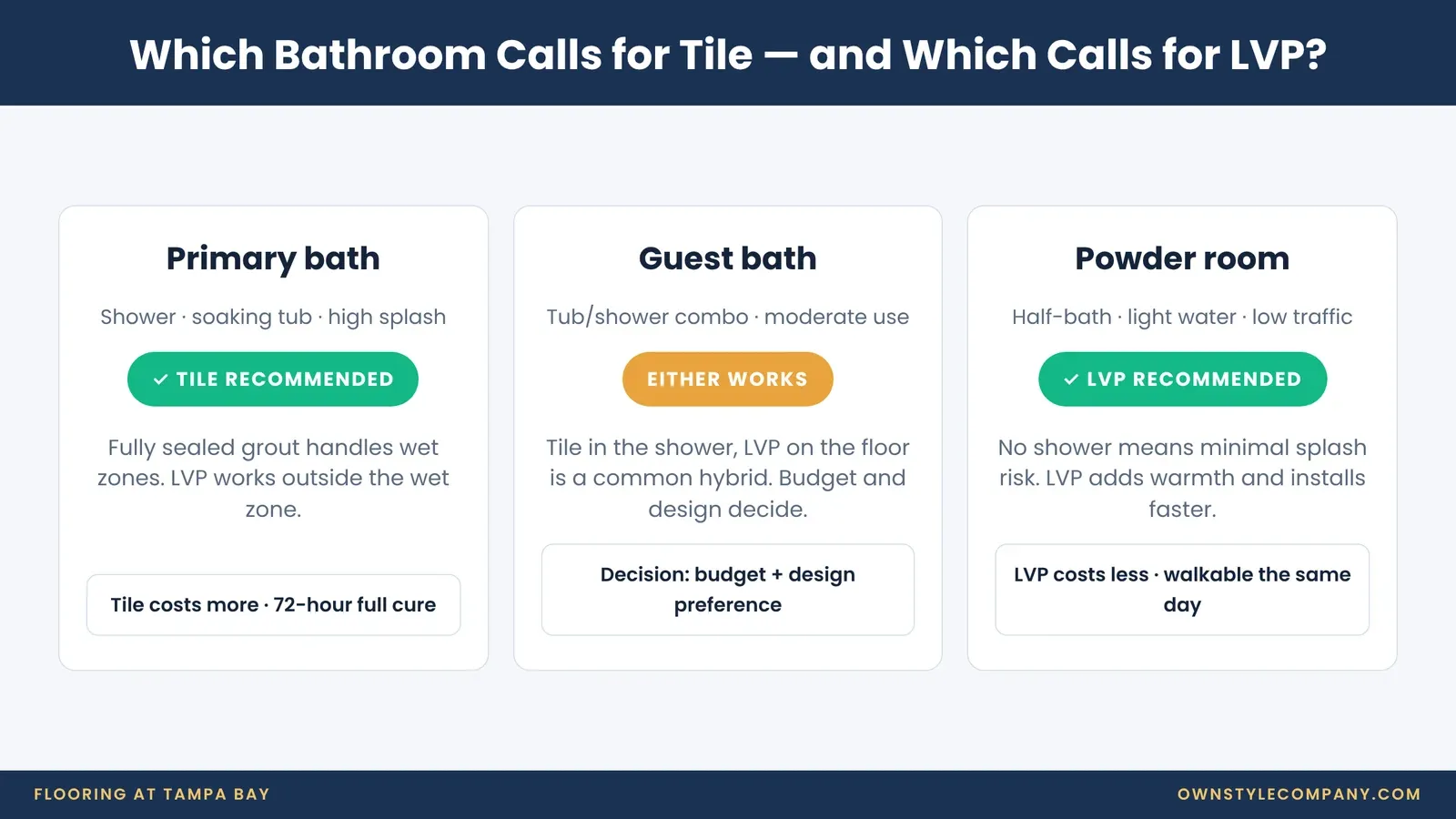
Primary bathrooms with showers or soaking tubs
Tile is the professional standard. Shower areas, wet zones around freestanding tubs, and high-splash areas near vanities need a fully sealed surface. Tile with properly applied grout and sealer creates that seal. LVP should not be installed directly in wet shower zones — water penetrates at seams and can damage the subfloor beneath it.
Powder rooms and half-baths
LVP is an excellent choice for powder rooms with light water exposure. No shower means minimal splash risk, and the visual warmth of LVP makes these spaces feel more finished. Installation is faster and cost is lower.
Guest bathrooms with a tub/shower combo
Either material works well in this layout. Tile inside the shower or tub surround, paired with LVP outside the wet zone and separated by a proper transition strip, is a common and practical compromise that balances cost against durability where it actually matters.
What Does Each Option Cost Installed in Tampa Bay in 2026?
Installed cost varies more by tile size and LVP wear layer thickness than by material category alone, and the table below breaks out both materials across their common price tiers in Tampa Bay.
| Material | Tier | Relative Installed Cost |
|---|---|---|
| Tile | 12×12 or 18×18 standard | High |
| Tile | Large format 24×24 or pattern (herringbone, chevron) | Highest |
| LVP | Mid-range 20 mil wear layer | Lowest |
| LVP | Premium SPC 28 mil wear layer | Moderate |
Our installation labor is $8 per square foot for tile and $2 per square foot for LVP; see our published prices for the full list.
Which Is Harder to Install — and Does That Affect Your Timeline?
- Tile: subfloor preparation, mortar, layout, setting, grout, sealing. The area is unusable for 24–48 hours after grouting. Full cure: 72 hours.
- LVP: subfloor preparation, 48-hour acclimation, click-lock installation, transition strips. Walkable immediately after installation.
In a kitchen renovation, the tile vs LVP timeline difference can be 3 to 5 days of additional downtime. For a primary bathroom serving a family, that is a meaningful practical consideration.
What Is the Room-by-Room Recommendation for Tile vs LVP?
The recommendation is always room-specific. Master bathroom: tile in wet zones. Open-plan kitchen: LVP for visual continuity. Galley kitchen: tile for durability. Powder rooms: LVP. Guest bathrooms: budget and design preference decide.
What Mistakes Do Tampa Bay Homeowners Make Choosing Between Tile and LVP?
Most tile-versus-LVP regrets trace back to a handful of avoidable assumptions rather than either material actually underperforming, and each one is easy to check before signing a contract.
- Choosing tile for an open-plan kitchen purely on durability. A hard transition strip between tile and the LVP or wood-look flooring in the adjoining living room breaks the visual continuity that many Tampa Bay homeowners specifically want in an open floor plan.
- Installing LVP directly inside a shower pan. LVP handles splash and incidental moisture well but is not rated for standing water at seams; a wet shower zone still needs tile or a fully waterproofed alternative.
- Skipping subfloor leveling before either material. Both tile and LVP telegraph an uneven slab through the finished surface, and tile is far less forgiving of deviation than LVP’s click-lock system.
- Underestimating cure time in a renovation schedule. A Brandon or Riverview homeowner planning a kitchen remodel around a fixed move-in date often forgets tile’s 24–72 hour cure window, when the LVP alternative would have been walkable the same day.
- Assuming grout maintenance is a one-time task. Grout in a Wesley Chapel or Tampa Bay kitchen needs resealing every 12–18 months to keep its water resistance; skipping this turns a durable floor into a moisture entry point at the grout lines.
Checking these five points during the planning phase, not after installation day, is what keeps either material performing as expected for its full service life.
Planning a flooring project in Tampa Bay? Every quote starts with a moisture reading of the slab, at no cost. Get your free photo estimate or call (813) 455-5756.
Frequently asked questions
Is tile or LVP better for Tampa Bay kitchens?
Both are waterproof and appropriate. Tile is more durable under heavy impact and high heat near stoves. LVP is warmer underfoot, quieter, faster to install, and flows naturally into adjacent living areas without a transition strip. For open-plan kitchens connected to living rooms, LVP creates visual continuity. For galley or heavy-cooking kitchens, tile is the harder-wearing choice.
Is tile or LVP better for Tampa Bay bathrooms?
For primary bathrooms with heavy water exposure — showers, soaking tubs, wet zones — tile is the professional standard. LVP handles incidental moisture well but should not be installed directly in shower areas. For powder rooms and guest baths with minimal water exposure, LVP is a practical and cost-effective choice.
What is the cost difference between tile and LVP installed in Tampa Bay in 2026?
Tile usually costs more per square foot installed than LVP, and the gap grows with tile size, pattern complexity, and subfloor preparation. Our installation labor is $8 per square foot for tile and $2 per square foot for LVP; material is quoted separately by product.
Does tile feel cold underfoot in a Tampa Bay home?
Tile conducts heat away from feet and feels cooler. Many Tampa Bay homeowners appreciate this in summer. In winter mornings, tile can feel cold. LVP with a foam underlayer retains some warmth. An area rug or in-floor radiant heating solves the cold-tile concern.
Which is harder to install — tile or LVP?
Tile requires mortar, grout, sealing, and a 24–48 hour cure before the area can be used. LVP click-lock can be completed and walked on the same day. This difference in labor is one reason tile costs more per square foot installed.


US standard for measuring relative humidity inside a concrete slab using in-situ probes drilled to 40% of slab depth, read after 72 hours of equilibration.
US standard for measuring moisture vapor emission from a concrete slab using anhydrous calcium chloride, expressed in pounds per 1,000 sq ft per 24 hours.
US standard practice for preparing concrete floors to receive resilient flooring. Covers flatness, cleanliness, and moisture condition before installation.
The building code in force across Florida, including moisture and structural requirements that apply to slab-on-grade residential construction.
European deep-core moisture test that reacts a slab sample with calcium carbide and reads the resulting gas pressure. Supporting knowledge: the applicable US standards are ASTM F2170 and F1869.
Supporting knowledge — not the standard we work toGerman standard series for floor screeds, source of the widely cited 2.0% CM cement and 0.5% CM anhydrite thresholds. Supporting knowledge, not the applicable US standard.
Supporting knowledge — not the standard we work toHigh-Density Fiberboard: the compressed wood-fiber core of most laminate planks. It absorbs water vapor and swells irreversibly, which is why slab moisture matters.
Stone Plastic Composite: rigid vinyl core made of limestone powder and PVC. Dimensionally stable under humidity swings and unaffected by water.
Wood Plastic Composite: vinyl core with wood flour and foaming agents. Softer and warmer underfoot than SPC, and less dimensionally stable.
Luxury Vinyl Plank: multi-layer vinyl flooring in plank format. Fully waterproof as a material, though the subfloor beneath still governs installation.
Abrasion Class rating for laminate wear resistance, from AC1 to AC6. AC4 suits normal residential use; AC5 handles heavy traffic and light commercial.
A sheet layer placed between slab and flooring to block ground moisture vapor. Required over slab-on-grade construction regardless of surface dryness.
Foundation type where the concrete slab sits directly on the ground, dominant in Florida residential construction. Ground moisture migrates upward continuously.
The permitted deviation of a subfloor across a given span. The common benchmark is 3/16 inch over 10 feet; beyond that, deviation transfers into the locking joints.
A pourable cement-based compound that flows to a level surface, used to correct slab deviation. Needs 24 to 72 hours of cure before flooring goes down.
The 8 to 10 mm clearance left between a floating floor and every fixed vertical surface, absorbing seasonal expansion. Bridging it transfers stress to the joints.
Conditioning flooring material inside the room where it will be installed, 48 to 72 hours before installation, so it reaches interior temperature and humidity.
An angle-in locking profile that joins planks without adhesive. The insertion angle is specified by the manufacturer; forcing it deforms the profile permanently.
The raised ridge that forms along plank edges when a floating floor expands without room to move. In Florida the usual causes are slab moisture or a bridged expansion gap.