Click-Lock vs Glue-Down Installation in Tampa Bay: Pros, Cons, and Which to Choose
Click-lock (floating) installation and glue-down installation are the two primary methods for installing LVP and laminate flooring in Tampa Bay homes. From the outside, the finished floors look identical. Under the surface, the installation method determines how the floor responds to Florida’s humidity, how repairs are handled, and what it costs to put down.
What Is Click-Lock (Floating) Installation?
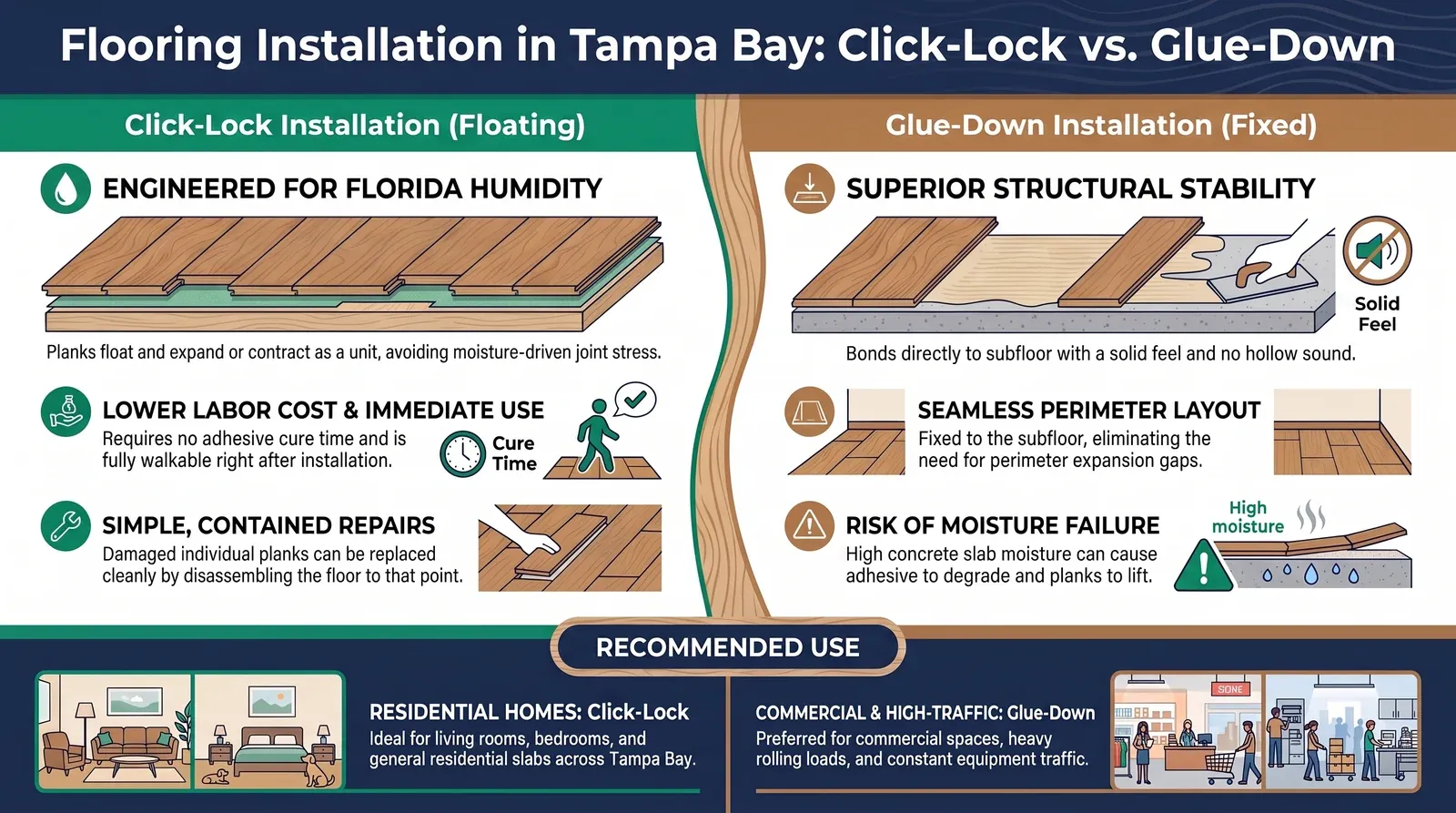
In click-lock installation, each plank connects to adjacent planks through a precision-machined tongue-and-groove locking system. The planks lock together to form a continuous surface. The floor as a whole floats over the subfloor — it is not glued, nailed, or stapled to it.
- Movement accommodation: the floor expands and contracts as a unit in response to temperature and humidity changes without stressing individual planks or joints.
- No adhesive: eliminates the risk of adhesive failure due to moisture, temperature, or incompatible products.
- Faster installation: no adhesive cure time. The floor is walkable immediately after installation.
- Easier repairs: a damaged plank can be replaced by disassembling the floor back to that point.
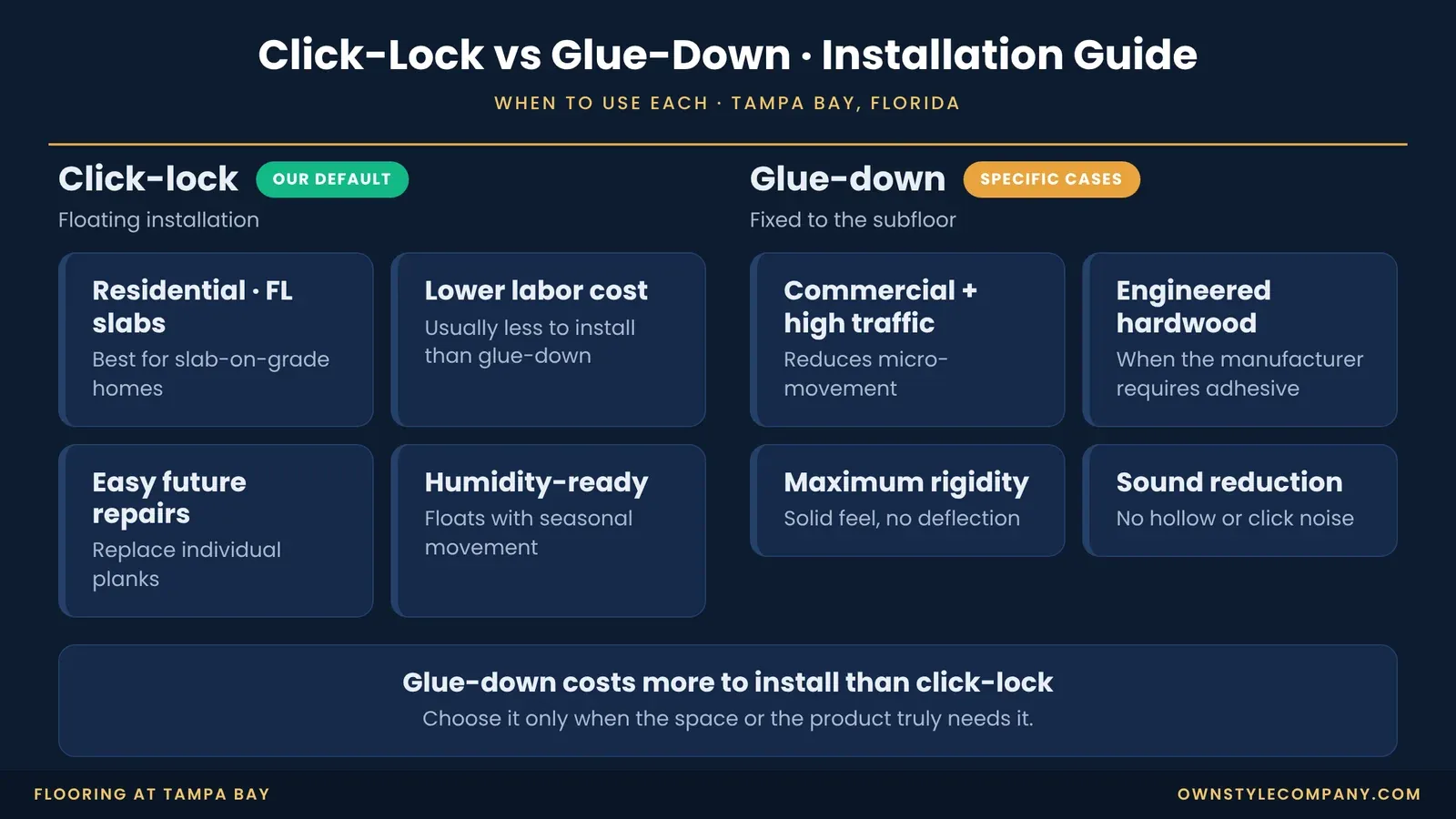
- Lower labor cost: typically less than glue-down, which needs extra preparation, adhesive, and application time.
What Is Glue-Down Installation?
In glue-down installation, each plank is bonded directly to the subfloor using a flooring adhesive. There is no floating — the floor is fixed to the subfloor. This creates a floor with more rigidity, less deflection underfoot, and a more “solid” feel.
- Stability in high-traffic areas: in commercial spaces with heavy foot traffic, glue-down reduces micro-movement that can eventually loosen click-lock joints.
- Sound reduction: glue-down eliminates the hollow or clicking sound that some floating floors produce.
- No expansion gaps needed: glue-down floors do not require the perimeter expansion gap that floating floors need.
How Do Repairs Differ Between the Two Methods?
A damaged plank exposes the biggest practical difference between the two systems, and it shows up months or years after installation rather than on install day. Click-lock repairs typically stay contained to a small area; glue-down repairs almost always spread beyond the damaged plank itself.
- Click-lock repair: the floor is disassembled back to the damaged plank, working from the nearest wall or transition, the plank is swapped, and the floor is reassembled. No adhesive, no waiting for cure time.
- Glue-down repair: the damaged plank must be cut out and pried loose, which frequently damages the wear layer of adjacent planks in the process. Old adhesive residue has to be scraped and leveled before the replacement plank goes down, then the new adhesive needs cure time before the area is walkable again.
- Cost difference: a single-plank click-lock repair typically costs considerably less than the same repair on a glue-down floor, which carries added labor and adhesive removal.
Which Rooms Favor Each Installation Method?
Room function, not personal preference, should drive the choice between the two methods in most Tampa Bay homes. A few patterns hold consistently across residential projects.
- Bedrooms and living rooms: click-lock is the default. Lower cost, easier future repairs, and no adhesive moisture risk over a Florida slab.
- Kitchens with heavy rolling loads: glue-down reduces the micro-movement that heavy appliances and rolling furniture can create at click-lock joints over time.
- Commercial or high-traffic spaces: glue-down’s rigidity holds up better under constant foot traffic and equipment movement than a floating floor.
- Rooms with irregular or out-of-square walls: click-lock’s expansion gap tolerance handles wall irregularities more forgivingly than a glue-down layout, which is less forgiving of small dimensional errors.
How Does Florida’s Humidity Affect Each Method?
Click-lock in Florida humidity
Click-lock handles humidity-driven movement by design. When the floor expands in high humidity, the planks shift slightly as a unit. The critical requirement is that proper expansion gaps are left at all perimeter walls — typically 1/4 inch minimum — to allow for this movement without binding.
Glue-down in Florida humidity
Glue-down on concrete slabs in Florida has specific risks. Adhesive moisture sensitivity is a real concern: Florida slabs that test acceptable in December can exceed the adhesive’s moisture limits in August. An adhesive failure results in planks lifting and separating. Removal is also labor-intensive — adhesive residue bonds strongly to concrete.
Which Is Better for Concrete Slabs in Tampa Bay?
For concrete slab installations in Brandon, Riverview, and across Tampa Bay residential homes, click-lock floating installation is the more reliable method in most cases. Florida slabs vary in moisture output by season. Click-lock accommodates this variability without adhesive concerns. If moisture causes a problem, floating floors can be lifted and the moisture source addressed without a full demolition.
What Does Each Method Cost Installed in Tampa Bay in 2026?
- Click-lock LVP, residential: the lower-cost option — product plus labor. Our installation labor for LVP is $2 per square foot.
- Glue-down LVP, residential: costs more installed — product plus adhesive plus additional labor for preparation and application.
- Labor difference: on a whole-house project, the extra labor for glue-down adds up to a meaningful amount. See our published prices for current labor rates.
| Factor | Click-lock | Glue-down |
|---|---|---|
| Relative installed cost (residential LVP) | Lower | Higher |
| Relative repair cost, single plank | Lower | Higher |
| Cure time before walkable | None | Adhesive-dependent, typically 24 hours |
| Expansion gap required | Yes, 1/4 inch minimum | Not required |
| Best fit | Bedrooms, living rooms, most residential | Commercial, heavy rolling loads |
Can Either Method Be Installed Over Existing Flooring?
Click-lock tolerates an existing hard-surface floor underneath it more easily than glue-down does, as long as that surface is flat, clean, and structurally sound. Floating over existing tile or vinyl is common in Tampa Bay renovations where removing the old floor would add unnecessary cost and mess.
Glue-down requires a bare, properly prepared subfloor for the adhesive to bond correctly — installing it over existing flooring risks a weak bond that fails prematurely, since most adhesives are not rated to bond reliably to another finished floor surface underneath.
What Does Flooring at Tampa Bay Recommend?
The default recommendation for Tampa Bay residential LVP and laminate is click-lock floating installation. The reasons: better long-term performance in Florida’s climate, lower cost for the homeowner, easier repair access if any individual plank is damaged, and no adhesive moisture compatibility concerns over Florida slabs.
Glue-down still has a place in the right project. A ground-floor commercial space with rolling equipment, a room with unusually irregular wall geometry, or an engineered hardwood product that specifies glue-down in its warranty terms are all legitimate reasons to choose it over click-lock, even with the added cost and repair complexity that comes with the trade-off.
Planning a flooring project in Tampa Bay? Every quote starts with a moisture reading of the slab, at no cost. Get your free photo estimate or call (813) 455-5756.
Frequently asked questions
What is click-lock (floating) flooring installation?
Click-lock installation connects flooring planks to each other using tongue-and-groove locking systems. The floor floats over the subfloor without being attached to it. This allows the floor to expand and contract as a unit in response to humidity and temperature changes — important in Florida's climate. It is the most common installation method for LVP and laminate in Tampa Bay residential homes.
What is glue-down flooring installation?
Glue-down installation bonds each plank directly to the subfloor using adhesive. The floor does not float — it is fixed to the subfloor. Glue-down creates a more rigid floor with less deflection, less noise, and a more solid feel underfoot. It is preferred for commercial spaces, high-traffic areas, and some engineered hardwood applications.
Which installation method is better for Florida's humidity?
Click-lock (floating) installation handles Florida's humidity better for most residential applications. Because the floor floats, it can expand and contract as a unit without stressing individual planks. Glue-down installations in Florida can experience adhesive failure if the adhesive is not rated for high-humidity environments or if concrete slab moisture exceeds the adhesive's tolerance.
Does click-lock or glue-down flooring last longer in Tampa Bay?
Both can last 20+ years when properly installed over a prepared subfloor. Click-lock occasionally develops separation at joints with significant movement, which can be corrected without full replacement. Glue-down installations that fail due to adhesive issues typically require full removal and reinstallation.
Is click-lock or glue-down more expensive to install in Tampa Bay?
Click-lock (floating) installation typically costs less in labor than glue-down. Glue-down requires more preparation time, adhesive cost, and application time, and that difference adds up quickly on a whole-house project. Our published prices list the current installation labor rates.


US standard for measuring relative humidity inside a concrete slab using in-situ probes drilled to 40% of slab depth, read after 72 hours of equilibration.
US standard for measuring moisture vapor emission from a concrete slab using anhydrous calcium chloride, expressed in pounds per 1,000 sq ft per 24 hours.
US standard practice for preparing concrete floors to receive resilient flooring. Covers flatness, cleanliness, and moisture condition before installation.
The building code in force across Florida, including moisture and structural requirements that apply to slab-on-grade residential construction.
European deep-core moisture test that reacts a slab sample with calcium carbide and reads the resulting gas pressure. Supporting knowledge: the applicable US standards are ASTM F2170 and F1869.
Supporting knowledge — not the standard we work toGerman standard series for floor screeds, source of the widely cited 2.0% CM cement and 0.5% CM anhydrite thresholds. Supporting knowledge, not the applicable US standard.
Supporting knowledge — not the standard we work toHigh-Density Fiberboard: the compressed wood-fiber core of most laminate planks. It absorbs water vapor and swells irreversibly, which is why slab moisture matters.
Stone Plastic Composite: rigid vinyl core made of limestone powder and PVC. Dimensionally stable under humidity swings and unaffected by water.
Wood Plastic Composite: vinyl core with wood flour and foaming agents. Softer and warmer underfoot than SPC, and less dimensionally stable.
Luxury Vinyl Plank: multi-layer vinyl flooring in plank format. Fully waterproof as a material, though the subfloor beneath still governs installation.
Abrasion Class rating for laminate wear resistance, from AC1 to AC6. AC4 suits normal residential use; AC5 handles heavy traffic and light commercial.
A sheet layer placed between slab and flooring to block ground moisture vapor. Required over slab-on-grade construction regardless of surface dryness.
Foundation type where the concrete slab sits directly on the ground, dominant in Florida residential construction. Ground moisture migrates upward continuously.
The permitted deviation of a subfloor across a given span. The common benchmark is 3/16 inch over 10 feet; beyond that, deviation transfers into the locking joints.
A pourable cement-based compound that flows to a level surface, used to correct slab deviation. Needs 24 to 72 hours of cure before flooring goes down.
The 8 to 10 mm clearance left between a floating floor and every fixed vertical surface, absorbing seasonal expansion. Bridging it transfers stress to the joints.
Conditioning flooring material inside the room where it will be installed, 48 to 72 hours before installation, so it reaches interior temperature and humidity.
An angle-in locking profile that joins planks without adhesive. The insertion angle is specified by the manufacturer; forcing it deforms the profile permanently.
The raised ridge that forms along plank edges when a floating floor expands without room to move. In Florida the usual causes are slab moisture or a bridged expansion gap.