Salt Air, Sand, and Pets: Flooring for Tampa Bay Coastal and Pet-Heavy Homes
Tampa Bay homes near the coast face a combination of conditions most flooring was not designed to handle at the same intensity: salt air, sand abrasion, and pet damage. The short answer: 12 mil or thicker LVP with an SPC core is the best all-around choice.
South Tampa near the bay and Riverview close to the water see this combination more intensely than inland Tampa Bay neighborhoods, where at least one of the three stressors is usually absent or milder.
What Does Salt Air Do to Flooring in Coastal Tampa Bay Homes?
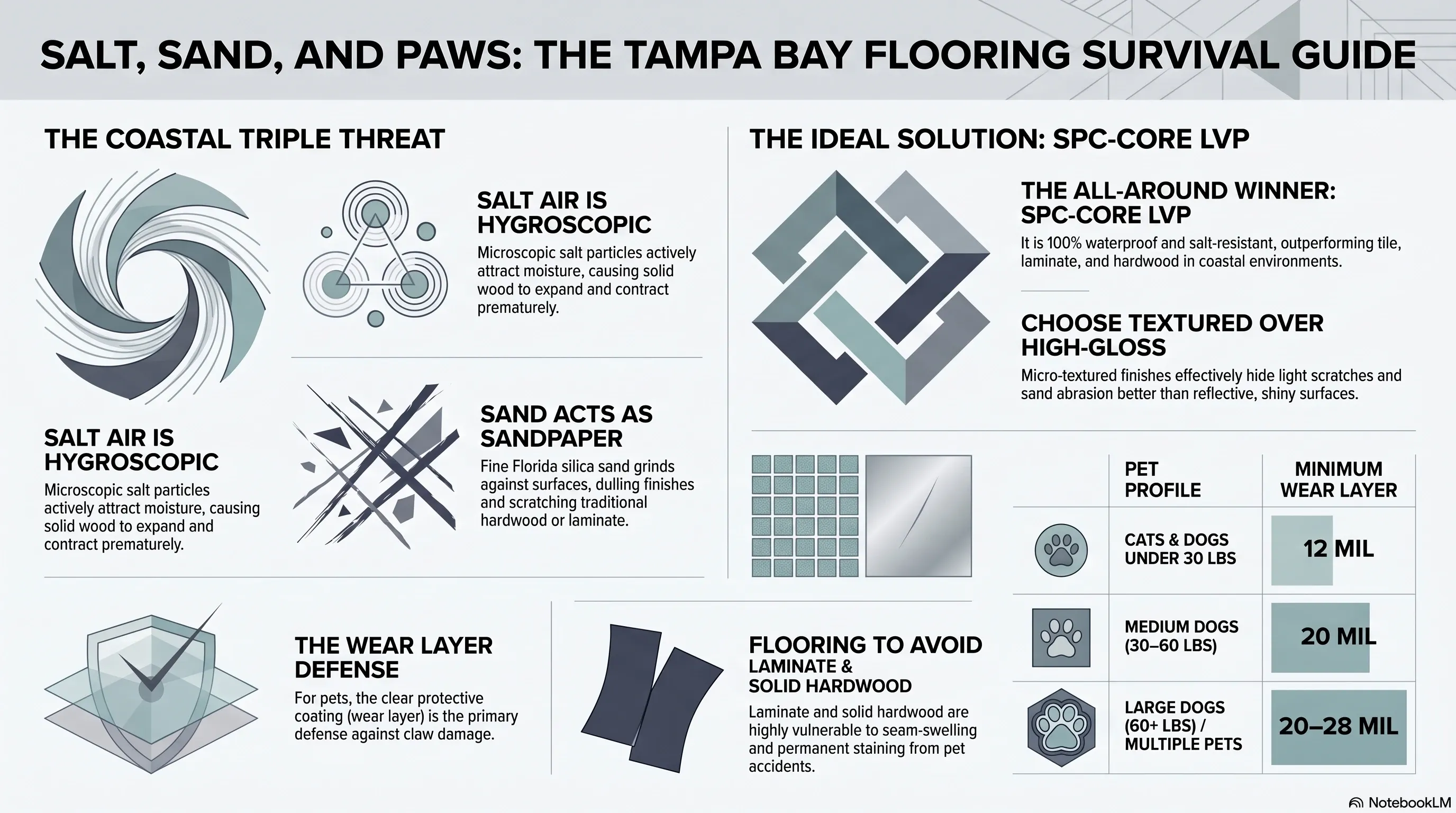
Salt air carries microscopic salt particles that are hygroscopic — they actively attract and retain moisture from the surrounding air. When salt deposits settle on flooring surfaces or penetrate through doors and windows, they create micro-environments of sustained moisture on the floor surface.
- Solid hardwood: salt air accelerates the expansion-contraction cycle and interacts with wood finishes, causing premature dulling and finish failure.
- Laminate: the top layer resists surface salt, but salt that penetrates through seams reaches the HDF core, which absorbs moisture and swells.
- LVP: the vinyl surface is resistant to salt deposits and the stone or plastic core does not absorb moisture. The most durable option in salt-air environments.
- Tile: unaffected by salt at the surface. Grout lines can accumulate salt deposits over time if not regularly cleaned.
What Does Sand Do to Your Floors Over Time?
Florida’s soil is predominantly fine silica sand. When tracked onto a floor and not swept immediately, each step grinds the sand particles against the floor surface. On LVP, this gradually dulls the wear layer. On hardwood, it scratches the finish. On laminate, it creates micro-abrasions in the top coating that increase over time.
- Entry mats at every exterior door — the single most effective intervention. Reduces tracked sand by an estimated 60–70 %.
- More frequent sweeping: in sandy areas, sweep or dust-mop every other day rather than weekly.
- Textured LVP finish: micro-textured surfaces hide light scratches and sand abrasion better than high-gloss finishes.
Which Flooring Types Survive Pets in Florida Homes?
Pet damage falls into two categories that matter for flooring choice: physical wear from claws and paws, and moisture damage from accidents. The four common flooring types perform very differently across both categories, which is why a single “pet-friendly” label rarely tells the full story.
LVP — best overall for pets
LVP handles the two primary pet hazards — accidents and claw scratches — better than any other material. It is 100 % waterproof, so urine that is cleaned up promptly does not penetrate the surface. Choose textured finishes over high-gloss — they hide scratches better.
Tile — durable but demanding
Tile is scratch-proof and fully waterproof. But grout lines accumulate pet hair, dander, and dried urine that is difficult to clean thoroughly. Large-format tiles with minimal grout lines are better for pet owners.
Laminate — not recommended for pet-heavy homes
Even one untreated accident that soaks into a seam can swell the HDF core and permanently damage the boards in that area. Homes with multiple pets or incontinent animals should not install laminate.
Hardwood — the most vulnerable option
Solid hardwood is poorly suited for Tampa Bay pet homes. Dog claws scratch hardwood faster than any other surface, and the scratches are permanent without sanding and refinishing. Pet urine causes black staining that penetrates deeply.
What Wear Layer Thickness Do You Need for Pets?
Wear layer thickness scales directly with the size and number of pets in the home, since heavier animals apply more point pressure through their claws with every step. Getting the spec wrong shows up as visible scratching within the first year rather than a gradual, decades-long process.
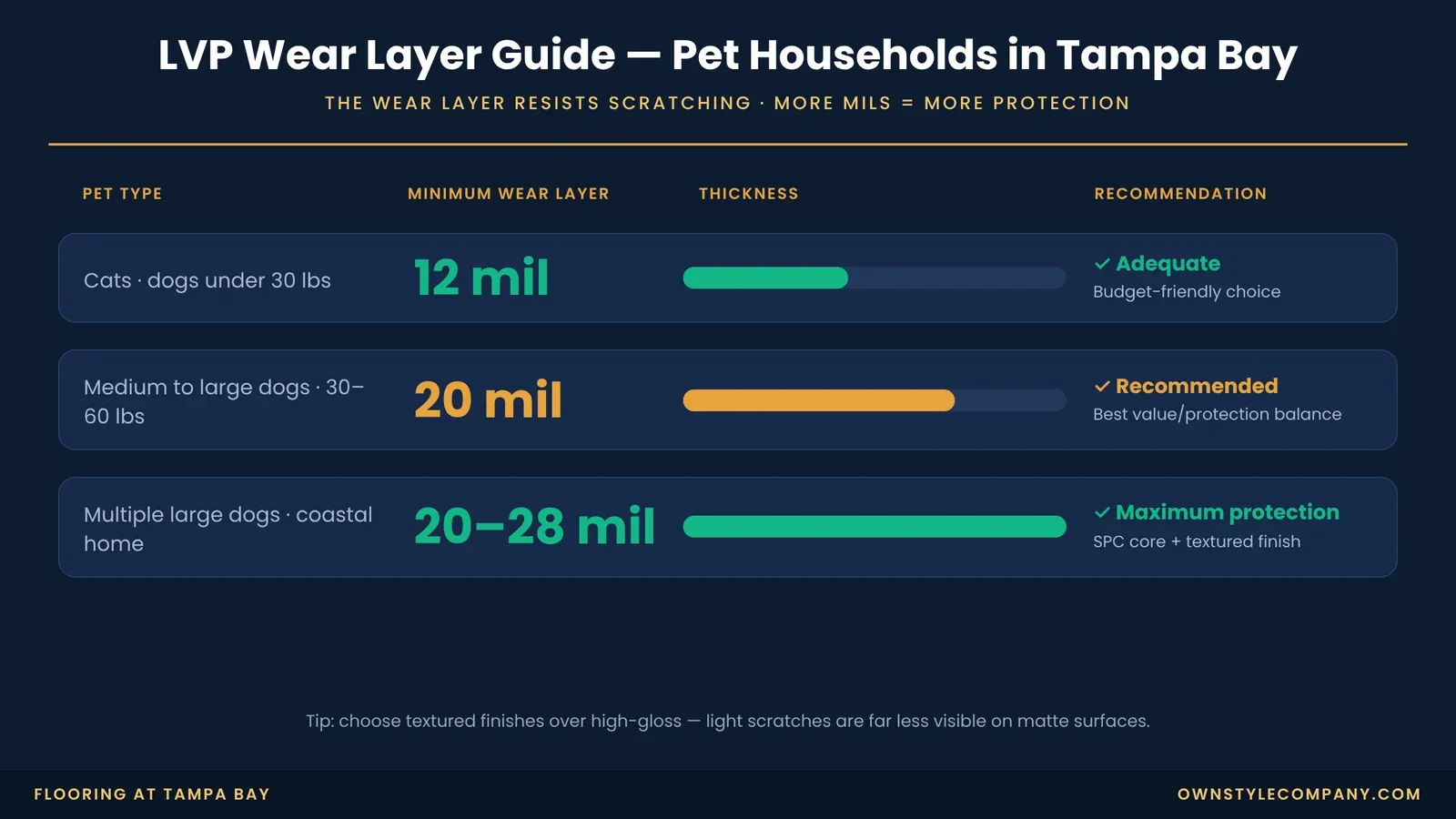
- Cats and dogs under 30 lbs: 12 mil minimum.
- Medium dogs (30–60 lbs): 20 mil recommended.
- Large dogs (60+ lbs) or multiple dogs: 20–28 mil.
- Commercial pet facilities (groomers, veterinary offices): 28 mil or above.
| Household type | Minimum wear layer | Recommended finish |
|---|---|---|
| Cats only, no dogs | 12 mil | Textured, any sheen |
| One dog under 30 lbs | 12 mil | Textured |
| One dog 30–60 lbs | 20 mil | Textured, matte preferred |
| Multiple large dogs | 20–28 mil | Textured, matte |
| Commercial pet facility | 28 mil+ | Textured, high-traffic rated |
What Are the Best Flooring Options for Coastal Tampa Bay Homes in 2026?
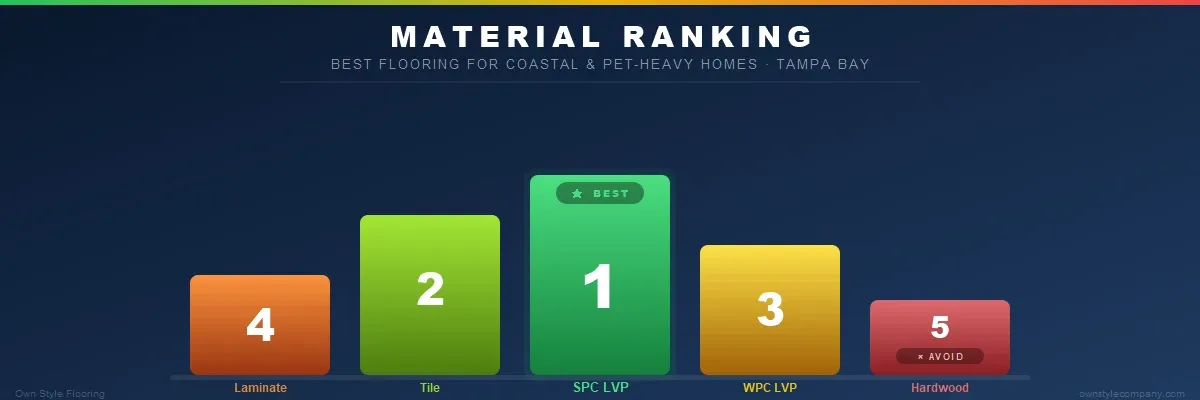
Coastal conditions, sand, and pets combined narrow the realistic options down to a short list, and the ranking below reflects performance under all three stressors at once rather than any single factor in isolation.
- First choice: SPC-core LVP, 20 mil wear layer, textured finish, click-lock installation. Handles salt air, sand abrasion, pet accidents, and AC cycling.
- Second choice: Porcelain tile with large format and minimal grout lines, epoxy grout. Indestructible surface but harder underfoot and more demanding to clean in pet homes.
- Conditional: WPC-core LVP for interior-only rooms with consistent climate control. Softer underfoot, which benefits large dogs that rest on the floor.
- Avoid for these conditions: laminate, solid hardwood, engineered hardwood in rooms that open to outdoor coastal areas.
How Should Entryways Near the Coast Be Designed to Reduce Sand and Salt?
The entry zone does more work than any other single design choice in a coastal Tampa Bay home, since it is the only point where sand, salt residue, and wet paws can be intercepted before reaching the main flooring.
- A recessed or built-in walk-off mat at least 4 feet long captures the majority of loose sand before it reaches the hard flooring
- A secondary mat just past the door catches what the first mat misses, particularly effective for wet dog paws after a beach walk
- Hard-surface flooring, not carpet, in the entry zone itself, since carpet fibers trap both sand and salt residue rather than releasing them to a mat or mop
- A boot and paw-wiping station near coastal-facing doors reduces what gets tracked onto the main floor in the first place
Homes with direct beach or dock access benefit from treating the entryway as a dedicated transition zone rather than an extension of the main living space, both in flooring material and in daily cleaning routine.
A quarterly deep-clean of grout lines and seams catches whatever the daily entryway routine misses, particularly important in homes that combine coastal salt exposure with pet traffic, since both leave residue that accumulates gradually rather than all at once.
Planning a flooring project in Tampa Bay? Every quote starts with a moisture reading of the slab, at no cost. Get your free photo estimate or call (813) 455-5756.
Frequently asked questions
What does salt air do to flooring in coastal Tampa Bay homes?
Salt air particles are hygroscopic — they attract and hold moisture. On wood-based flooring, this creates constant elevated surface moisture that accelerates the expansion-contraction cycle. Salt deposits also etch floor finishes over time. LVP is resistant to salt air at the surface; solid hardwood and laminate are significantly more vulnerable.
What does sand do to floors in Tampa Bay homes?
Florida sand is fine but abrasive. When tracked indoors, it acts like sandpaper with every step, gradually dulling wear layers and floor finishes. Entry mats at all exterior doors and frequent sweeping are essential in sandy Tampa Bay environments.
What is the best flooring for homes with dogs in Tampa Bay?
SPC-core LVP with a 20 mil or thicker wear layer is the top choice for most dog-owning households. It is waterproof, scratch-resistant, and easy to clean after accidents or muddy paws. Choose textured finishes rather than high-gloss, since scratches and light wear show up far less on a textured surface.
What wear layer thickness do I need for pets?
Cats and dogs under 30 lbs: 12 mil minimum. Medium to large dogs (30–60 lbs): 20 mil minimum. Multiple large dogs: 20–28 mil. The wear layer is the clear protective coating over the printed design — it is what resists scratching.
Can LVP flooring handle pet urine in a Tampa Bay home?
LVP is 100 % waterproof at the plank surface. Clean accidents promptly to prevent seepage through seams to the subfloor. In homes with frequent pet accidents, ensure seams are tight and apply seam sealer at high-risk areas.
US standard for measuring relative humidity inside a concrete slab using in-situ probes drilled to 40% of slab depth, read after 72 hours of equilibration.
US standard for measuring moisture vapor emission from a concrete slab using anhydrous calcium chloride, expressed in pounds per 1,000 sq ft per 24 hours.
US standard practice for preparing concrete floors to receive resilient flooring. Covers flatness, cleanliness, and moisture condition before installation.
The building code in force across Florida, including moisture and structural requirements that apply to slab-on-grade residential construction.
European deep-core moisture test that reacts a slab sample with calcium carbide and reads the resulting gas pressure. Supporting knowledge: the applicable US standards are ASTM F2170 and F1869.
Supporting knowledge — not the standard we work toGerman standard series for floor screeds, source of the widely cited 2.0% CM cement and 0.5% CM anhydrite thresholds. Supporting knowledge, not the applicable US standard.
Supporting knowledge — not the standard we work toHigh-Density Fiberboard: the compressed wood-fiber core of most laminate planks. It absorbs water vapor and swells irreversibly, which is why slab moisture matters.
Stone Plastic Composite: rigid vinyl core made of limestone powder and PVC. Dimensionally stable under humidity swings and unaffected by water.
Wood Plastic Composite: vinyl core with wood flour and foaming agents. Softer and warmer underfoot than SPC, and less dimensionally stable.
Luxury Vinyl Plank: multi-layer vinyl flooring in plank format. Fully waterproof as a material, though the subfloor beneath still governs installation.
Abrasion Class rating for laminate wear resistance, from AC1 to AC6. AC4 suits normal residential use; AC5 handles heavy traffic and light commercial.
A sheet layer placed between slab and flooring to block ground moisture vapor. Required over slab-on-grade construction regardless of surface dryness.
Foundation type where the concrete slab sits directly on the ground, dominant in Florida residential construction. Ground moisture migrates upward continuously.
The permitted deviation of a subfloor across a given span. The common benchmark is 3/16 inch over 10 feet; beyond that, deviation transfers into the locking joints.
A pourable cement-based compound that flows to a level surface, used to correct slab deviation. Needs 24 to 72 hours of cure before flooring goes down.
The 8 to 10 mm clearance left between a floating floor and every fixed vertical surface, absorbing seasonal expansion. Bridging it transfers stress to the joints.
Conditioning flooring material inside the room where it will be installed, 48 to 72 hours before installation, so it reaches interior temperature and humidity.
An angle-in locking profile that joins planks without adhesive. The insertion angle is specified by the manufacturer; forcing it deforms the profile permanently.
The raised ridge that forms along plank edges when a floating floor expands without room to move. In Florida the usual causes are slab moisture or a bridged expansion gap.