LVP vs Laminate: Why Most Tampa Bay Homeowners Are Switching
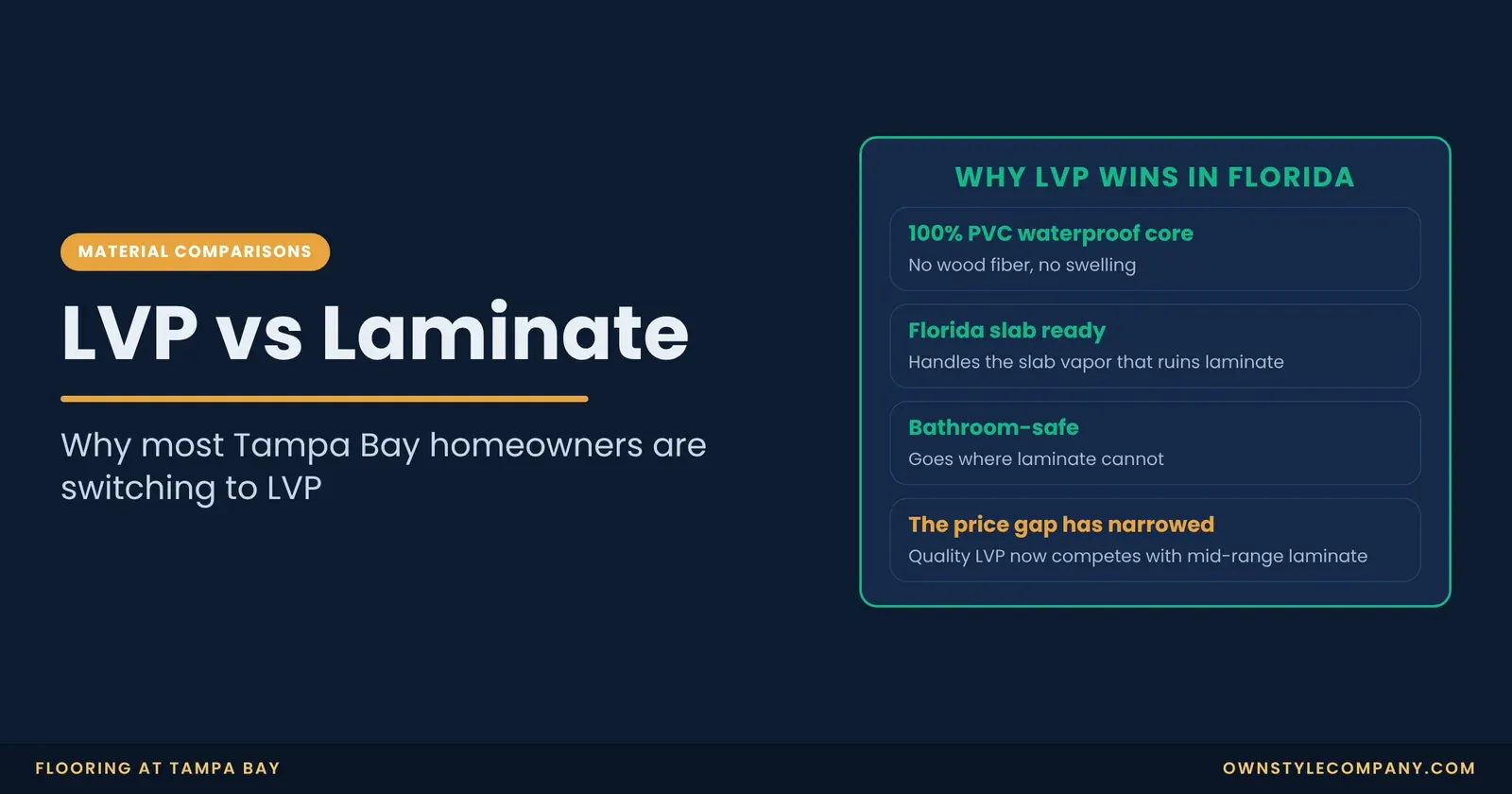
Over the past five years, LVP (luxury vinyl plank) has overtaken laminate as the most-installed floor in Tampa Bay residential projects. The switch is driven by two converging factors: LVP’s superior moisture performance in Florida’s climate, and a significant reduction in LVP pricing that has narrowed the cost gap with laminate.
Across Tampa Bay’s service area, an estimated 60–70% of homeowners who initially consider laminate ultimately choose LVP after a full assessment of their space, moisture exposure, and budget.
What changed in the Tampa Bay market to shift homeowners toward LVP?
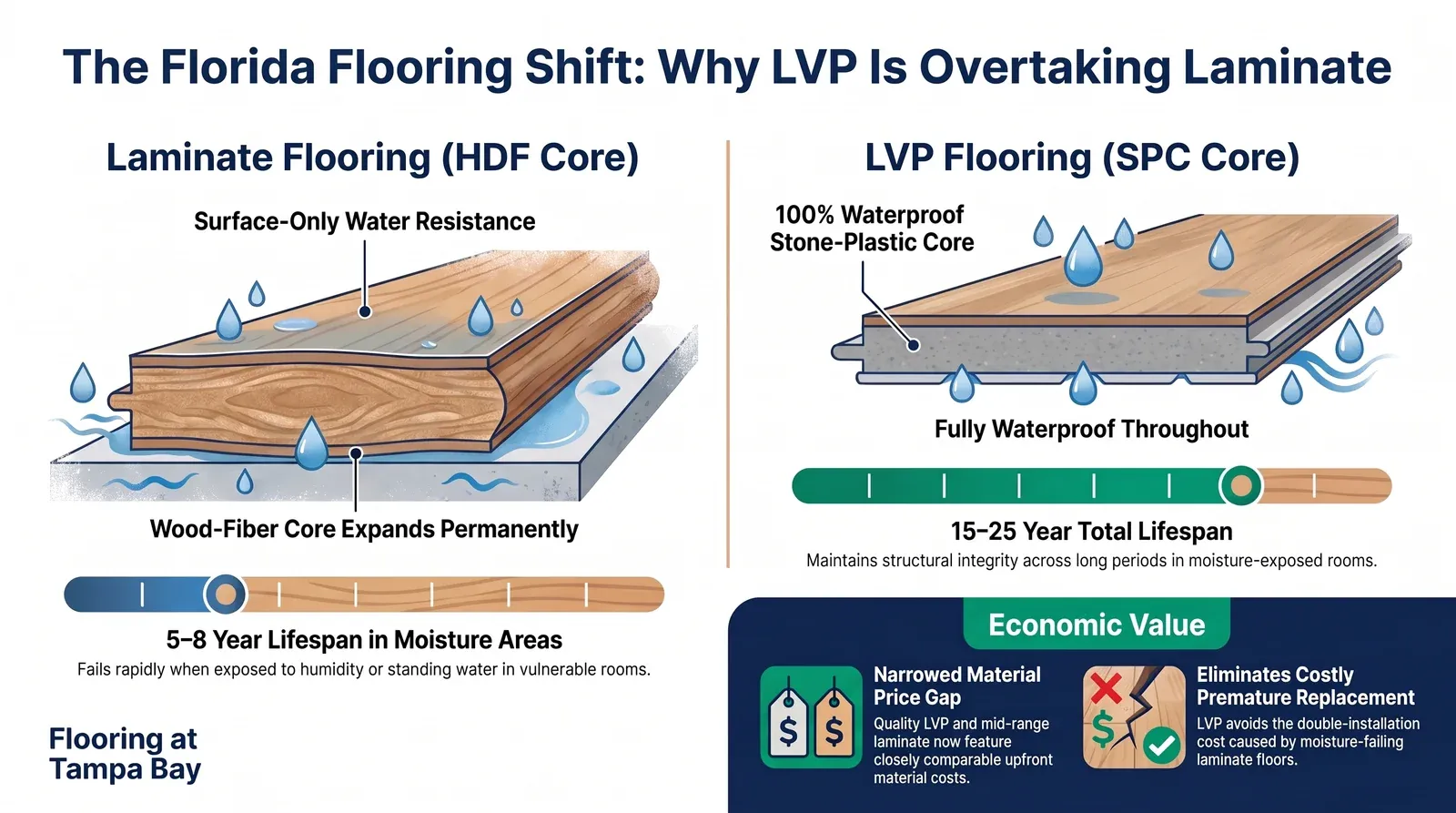
Five years ago, LVP cost considerably more than laminate for comparable quality — that premium was the primary reason many homeowners chose laminate despite the known moisture performance difference. As LVP manufacturing scale increased — particularly SPC (stone-plastic composite) core products from major manufacturers — that premium shrank significantly.
In 2026, quality LVP is often directly comparable in total cost to mid-to-upper-range laminate, when accounting for the longer replacement cycle of LVP in moisture-exposed conditions.
The second factor is firsthand experience. Tampa Bay homeowners in 2026 are more likely than in 2018 to have had a laminate floor fail due to moisture and replaced it with LVP. Paying twice — for the failed laminate and its LVP replacement — has become a significant driver of LVP selection on subsequent installations.
What is the core technical difference that drives the switch?
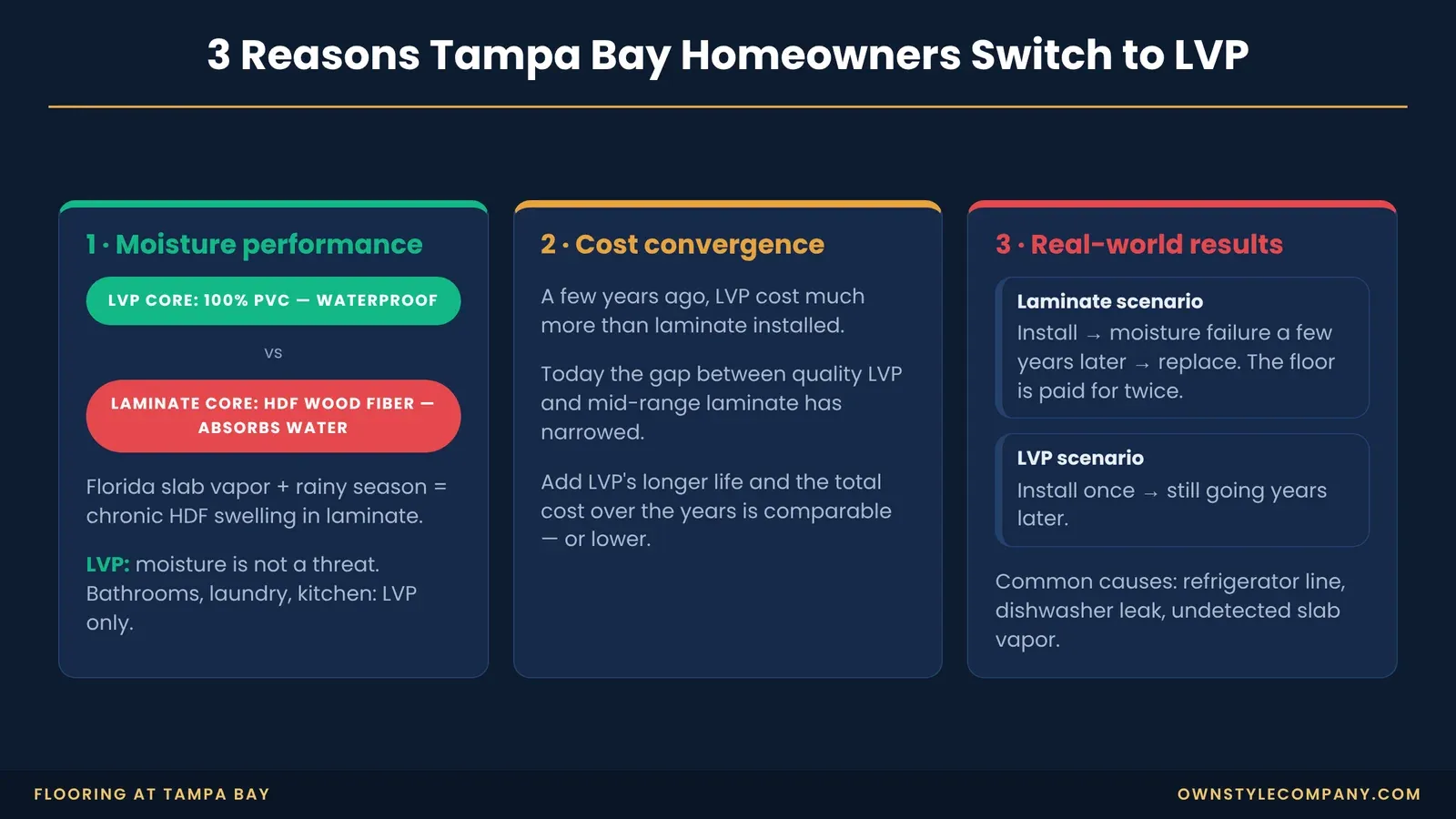
The single technical reason LVP outperforms laminate in Tampa Bay is the core material. LVP is 100% plastic from top to bottom — there is no wood fiber in the product. When water reaches any part of an LVP plank, the plastic core does not absorb it, does not swell, and does not fail.
Laminate has a high-density fiberboard (HDF) core — compressed wood fiber that absorbs moisture and expands permanently when exposed to standing water, slab vapor, or chronic high humidity.
In Tampa Bay’s climate, the combination of slab-on-grade construction, daily AC cycling, and the June–September rainy season creates the exact conditions that attack HDF cores over years. A correctly installed LVP floor on a Tampa Bay slab is immune to these conditions.
| Feature | Laminate | LVP (SPC core) |
|---|---|---|
| Core material | HDF (wood fiber) | 100% PVC + limestone filler |
| Water resistance | Surface and seams only | Fully waterproof throughout |
| Slab moisture tolerance | Requires <2.0% CM | Tolerates higher moisture levels |
| Our installation labor | $2.25/sqft | $2/sqft |
| Relative installed cost | Lower | Higher |
| Lifespan moisture-exposed room | 5–8 years | 15–25 years |
| Lifespan dry climate-controlled room | 10–15 years | 15–25 years |
| Appropriate for bathrooms | No | Yes |
The CM (calcium carbide) method is the European reference, standardized under DIN 18560-4. In the United States the governing standards are different instruments measuring different quantities: ASTM F2170 reads relative humidity inside the slab through in-situ probes set at 40% of slab depth, with a ceiling of 75% RH under ASTM F710, and ASTM F1869 measures surface moisture vapor emission with anhydrous calcium chloride, with a ceiling of 3 lb per 1,000 sq ft per 24 hours. The three readings are not convertible into one another.
What are the SPC and WPC LVP types, and which is correct for Florida slabs?
LVP is not a single product — two core types are available at different price and performance levels, and choosing the wrong one for a Florida slab is a common, avoidable mistake:
SPC (stone-plastic composite) contains limestone filler in the PVC matrix, producing a denser, more rigid, and more dimensionally stable plank. SPC is the correct specification for Florida slab-on-grade installations because its higher density resists micro-movement from slab temperature fluctuations.
WPC (wood-plastic composite) contains some wood content in the core — still fully waterproof, warmer and softer underfoot, but slightly less dimensionally stable under temperature and humidity cycling.
SPC is the default LVP core specification for all slab-on-grade installations in Tampa Bay as of 2026.
When does laminate still make sense in a Tampa Bay home?
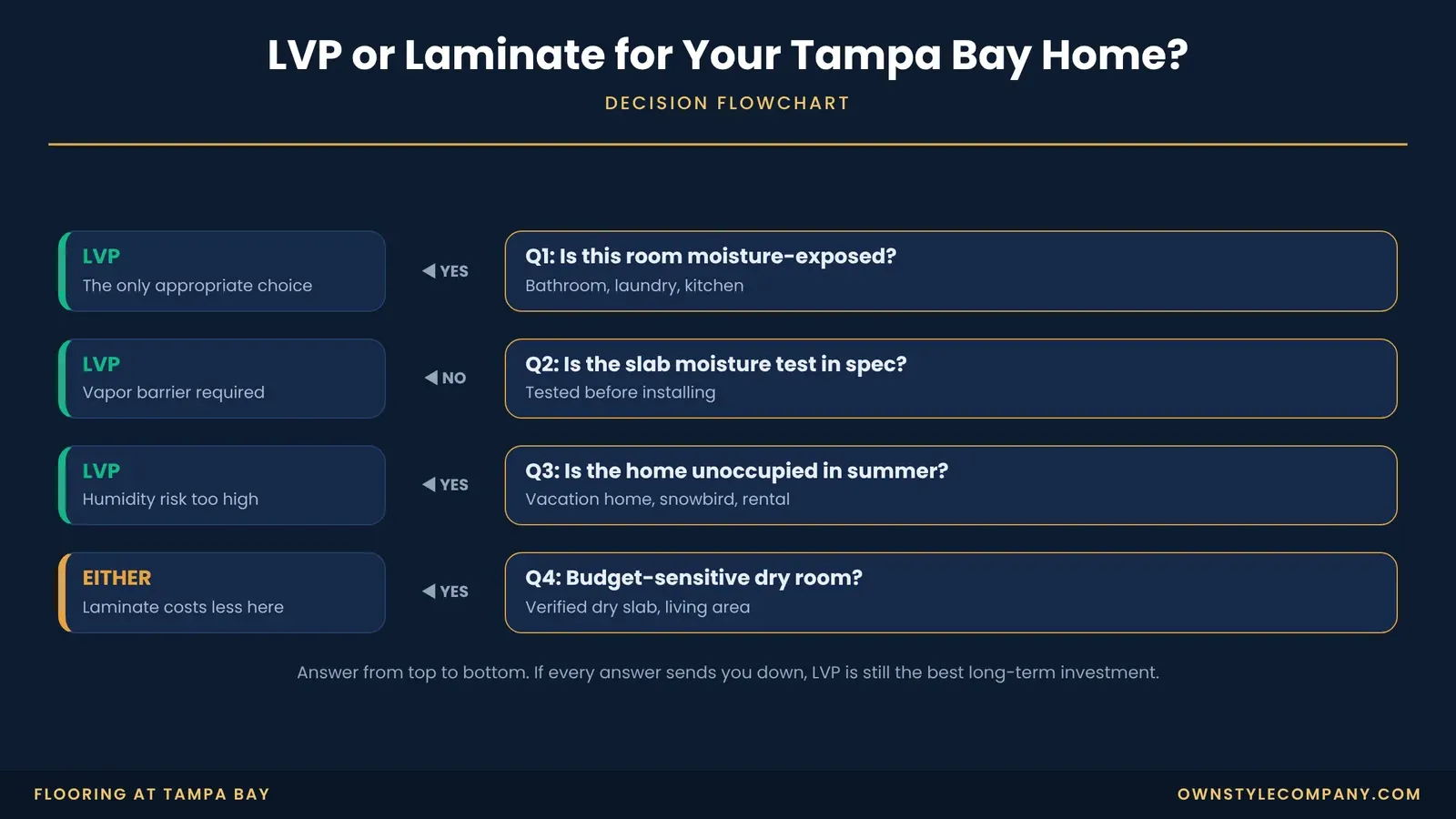
Laminate remains the correct specification in three Tampa Bay scenarios as of 2026, each defined by controlled moisture exposure and budget priorities rather than by room type alone, provided the slab has been tested and confirmed dry:
-
Dry, climate-controlled living areas and bedrooms in homes with slab moisture readings below 2.0% CM, consistent AC coverage, and no history of moisture issues. In these conditions, quality laminate at 8–12 mm performs comparably to LVP and costs less installed.
-
Budget-constrained renovations where the cost difference is material and the rooms have demonstrably low moisture risk.
-
Rental properties with an expected 8–10 year replacement cycle where the lower upfront cost improves ROI and moisture conditions are managed through tenant protocols.
The consistent boundary: any room with moisture risk — bathroom, laundry, kitchen without reliable spill control, slab reading above 2.0% CM — specifies LVP regardless of budget.
What does the five-year ownership perspective show for Tampa Bay homeowners?
For a 1,000 sqft living area, the five-year ownership comparison between quality laminate and quality SPC LVP as of 2026 breaks down differently depending on whether the room carries any realistic moisture exposure:
Laminate (dry room with controlled moisture): the lower installed cost, no replacement within 5 years. Total at year 5: the original installation only.
LVP (same dry room): a higher installed cost, no replacement within 5 years. Total at year 5: the original installation only.
Laminate (room with moderate moisture exposure): the lower installed cost, then a potential replacement at year 3–4 that means paying for demolition and a second installation. Total at year 5: roughly two floors.
LVP (same room with moisture exposure): a higher installed cost, no replacement needed. Total at year 5: the original installation only. To put real numbers on your own rooms, start with a free photo estimate.
The five-year analysis shows laminate and LVP roughly equivalent in cost for dry rooms, and LVP substantially lower in total cost for any room with moisture exposure.
What Are the Early Signs a Laminate Floor Is Already Failing from Moisture?
Homeowners who eventually switch to LVP often notice the same warning signs on their laminate months before the floor becomes visibly unusable.
- Slight edge lift near exterior walls or sliding doors — an early sign the HDF core is absorbing moisture from below.
- A musty smell that returns after the AC has been off for a few days, common in homes in Brandon, Riverview, and Wesley Chapel that sit empty during travel.
- Seams that feel slightly raised or rough underfoot, indicating the core has already swelled at the joint.
- Visible gaps that widen each dry season and close each wet season, a normal cycle until the gap stops closing completely.
Catching these signs early is what allows a homeowner to plan an LVP replacement on their own timeline instead of reacting to a floor that has already buckled.
Planning a flooring project in Tampa Bay? Every quote starts with a moisture reading of the slab, at no cost. Get your free photo estimate or call (813) 455-5756.
Frequently asked questions
Why are Tampa Bay homeowners switching from laminate to LVP?
The primary reason is moisture performance. LVP has a 100% PVC plastic core that is fully waterproof, while laminate has a wood-fiber HDF core that absorbs moisture permanently. The secondary reason is price convergence — quality SPC LVP has narrowed the installed cost gap with mid-range laminate.
Is LVP better than laminate in Florida?
LVP is better than laminate for any room with moisture exposure — bathrooms, laundry rooms, kitchens, rooms over high-moisture slabs. For dry, climate-controlled living areas with tested slab moisture below 2.0% CM, quality laminate performs comparably and costs less upfront.
What is SPC LVP, and why is it recommended for Tampa Bay?
SPC (stone-plastic composite) is the denser, more dimensionally stable LVP core type — made from PVC and limestone filler. SPC resists micro-movement from slab temperature fluctuations and maintains stability through Tampa Bay's daily temperature swings, which is why it is the default specification for slab-on-grade installations region-wide.
Does LVP feel different from laminate underfoot?
Standard LVP on concrete can feel slightly less dense than laminate, particularly in thinner profiles. SPC-core LVP at 6 mm or thicker significantly reduces this difference. Laminate's HDF core produces a warmer, more rigid feel closer to real wood.
How much does LVP installation cost in Tampa Bay compared to laminate?
Quality SPC LVP usually costs more installed than mid-range laminate. Our installation labor is $2.25 per square foot for laminate and $2 per square foot for LVP, with material priced separately. The premium for LVP produces lower five-year total cost in any room with moisture exposure, because LVP does not require premature replacement.
US standard for measuring relative humidity inside a concrete slab using in-situ probes drilled to 40% of slab depth, read after 72 hours of equilibration.
US standard for measuring moisture vapor emission from a concrete slab using anhydrous calcium chloride, expressed in pounds per 1,000 sq ft per 24 hours.
US standard practice for preparing concrete floors to receive resilient flooring. Covers flatness, cleanliness, and moisture condition before installation.
The building code in force across Florida, including moisture and structural requirements that apply to slab-on-grade residential construction.
European deep-core moisture test that reacts a slab sample with calcium carbide and reads the resulting gas pressure. Supporting knowledge: the applicable US standards are ASTM F2170 and F1869.
Supporting knowledge — not the standard we work toGerman standard series for floor screeds, source of the widely cited 2.0% CM cement and 0.5% CM anhydrite thresholds. Supporting knowledge, not the applicable US standard.
Supporting knowledge — not the standard we work toHigh-Density Fiberboard: the compressed wood-fiber core of most laminate planks. It absorbs water vapor and swells irreversibly, which is why slab moisture matters.
Stone Plastic Composite: rigid vinyl core made of limestone powder and PVC. Dimensionally stable under humidity swings and unaffected by water.
Wood Plastic Composite: vinyl core with wood flour and foaming agents. Softer and warmer underfoot than SPC, and less dimensionally stable.
Luxury Vinyl Plank: multi-layer vinyl flooring in plank format. Fully waterproof as a material, though the subfloor beneath still governs installation.
Abrasion Class rating for laminate wear resistance, from AC1 to AC6. AC4 suits normal residential use; AC5 handles heavy traffic and light commercial.
A sheet layer placed between slab and flooring to block ground moisture vapor. Required over slab-on-grade construction regardless of surface dryness.
Foundation type where the concrete slab sits directly on the ground, dominant in Florida residential construction. Ground moisture migrates upward continuously.
The permitted deviation of a subfloor across a given span. The common benchmark is 3/16 inch over 10 feet; beyond that, deviation transfers into the locking joints.
A pourable cement-based compound that flows to a level surface, used to correct slab deviation. Needs 24 to 72 hours of cure before flooring goes down.
The 8 to 10 mm clearance left between a floating floor and every fixed vertical surface, absorbing seasonal expansion. Bridging it transfers stress to the joints.
Conditioning flooring material inside the room where it will be installed, 48 to 72 hours before installation, so it reaches interior temperature and humidity.
An angle-in locking profile that joins planks without adhesive. The insertion angle is specified by the manufacturer; forcing it deforms the profile permanently.
The raised ridge that forms along plank edges when a floating floor expands without room to move. In Florida the usual causes are slab moisture or a bridged expansion gap.