Laminate vs Luxury Vinyl in Florida: An Honest Guide from a Tampa Installer
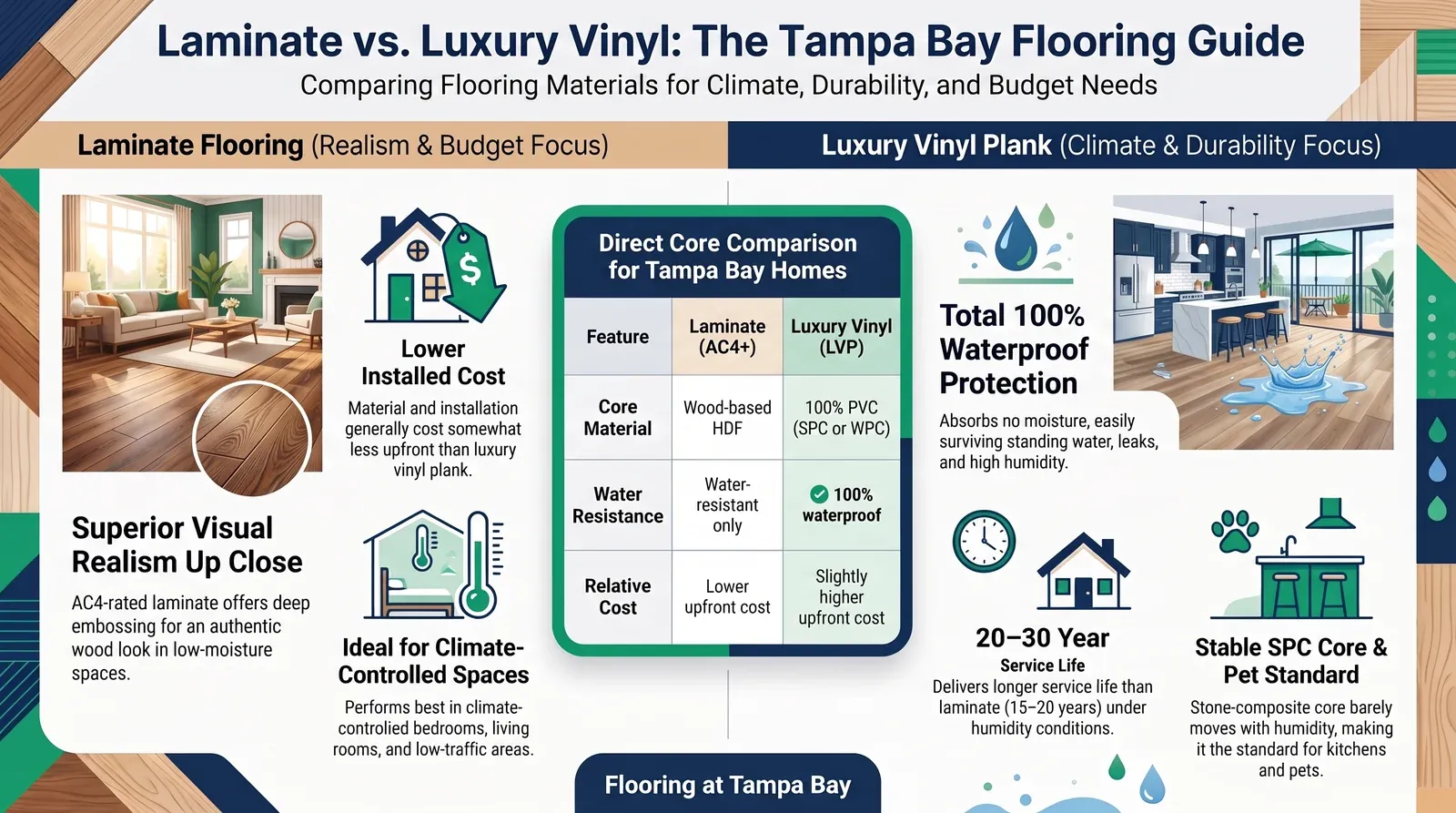
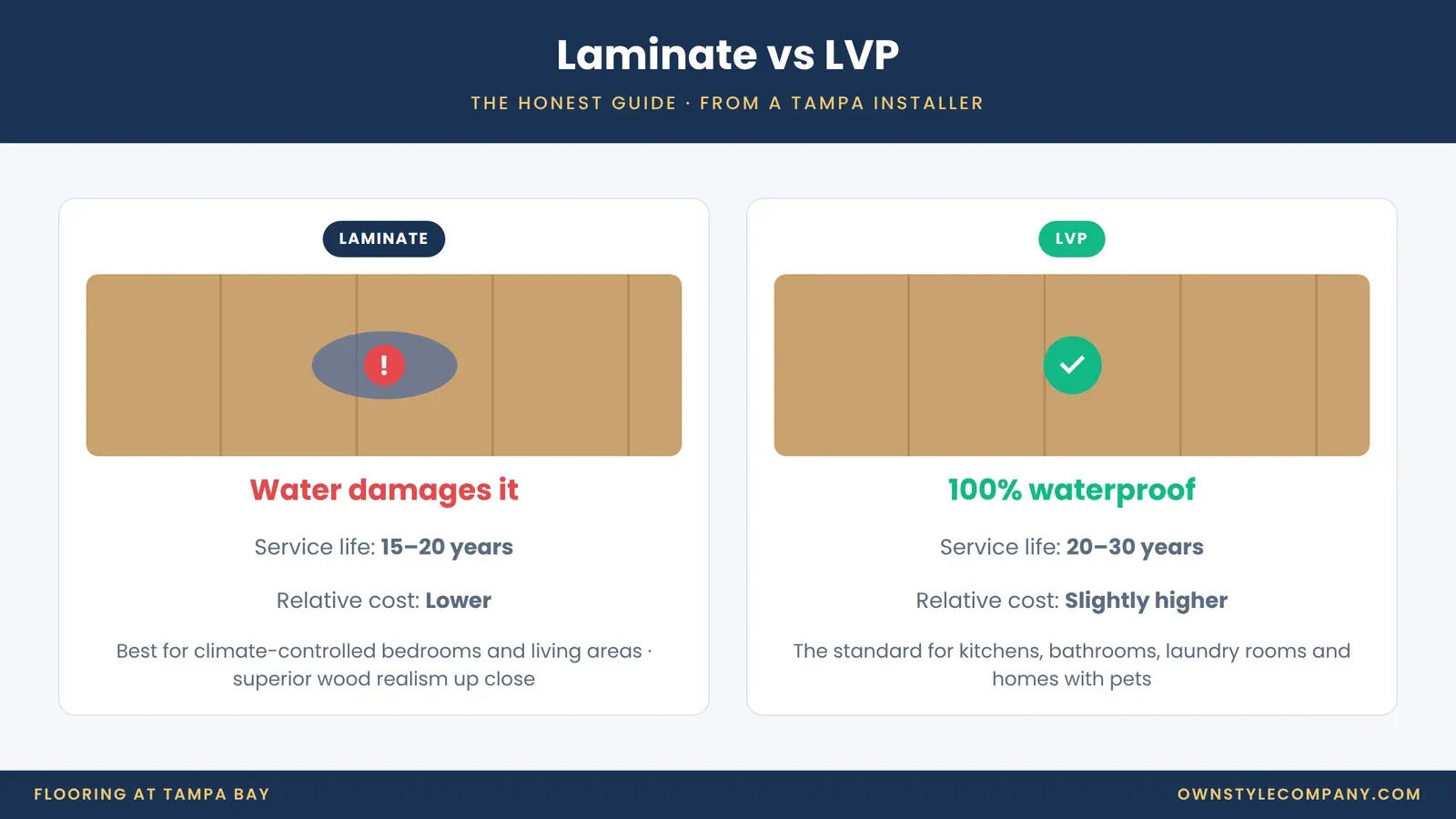
In Florida, luxury vinyl plank (LVP) outperforms laminate in the three conditions that matter most: humidity resistance, flood survival, and A/C cycling tolerance. Laminate still has two advantages — it often looks more like real wood up close, and AC4-rated laminate usually costs somewhat less than LVP once installed.
For most Tampa Bay homes, especially any home with children, pets, or a history of moisture issues, LVP is the right choice. For specific rooms in climate-controlled, low-traffic homes, premium laminate can still make sense.
What is laminate flooring, exactly?
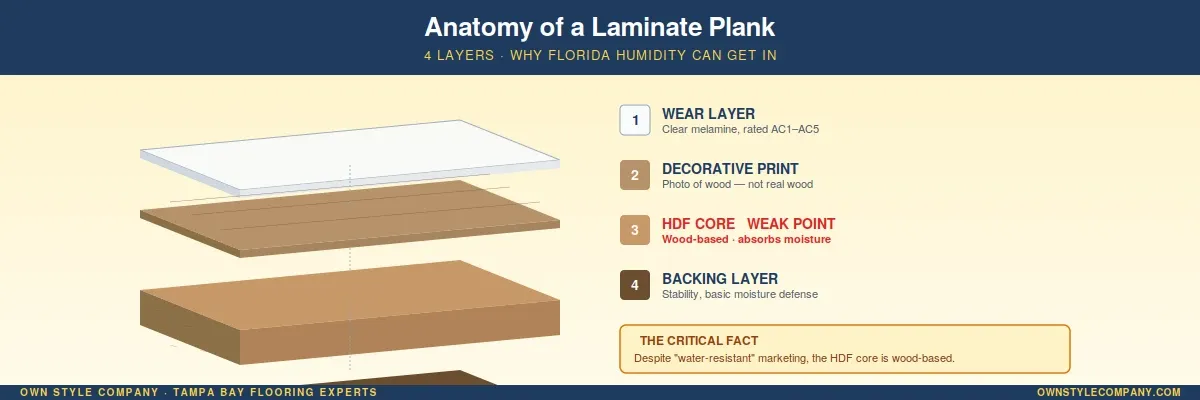
Laminate is a multi-layer product built around a high-density fiberboard (HDF) core. A printed decorative layer (usually a photo of wood) sits on top of the core, and a clear wear layer protects the print. Modern laminate is rated AC1 (light residential) through AC5 (heavy commercial).
The critical fact: the HDF core is wood-based. Despite “water-resistant” marketing, no laminate is truly waterproof over time. Flooding destroys it. Standing water for hours swells it. Daily humidity swings cycle it.
What is luxury vinyl plank (LVP)?
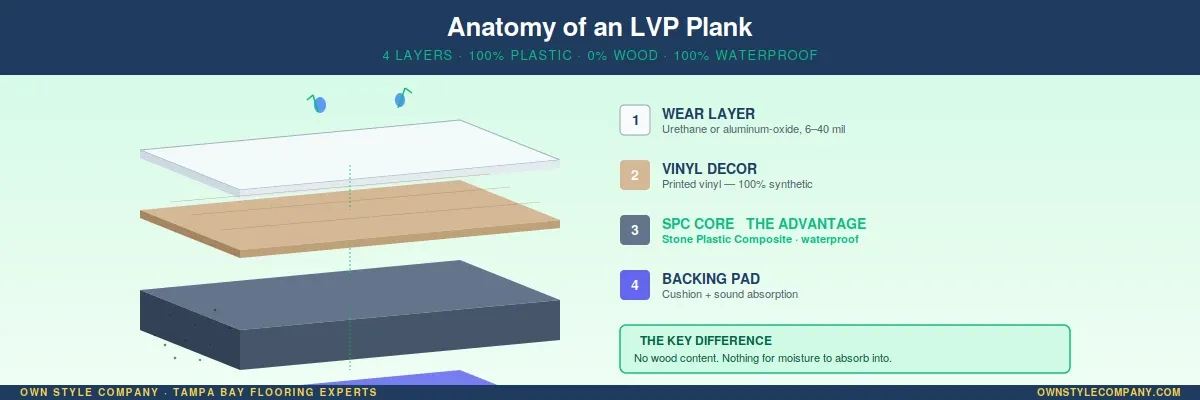
LVP is 100 % plastic. No wood content at all. The core is either WPC (Wood Plastic Composite — slightly softer, warmer underfoot) or SPC (Stone Plastic Composite — harder, more dimensionally stable). A vinyl decorative layer is fused to the core, protected by a clear urethane or aluminum-oxide wear layer measured in mils.
Because there is no wood, LVP does not absorb moisture. It can sit underwater for days and survive. It barely moves through humidity cycles. In Florida, this is not a minor advantage — it is the advantage.
Laminate vs LVP — the direct comparison
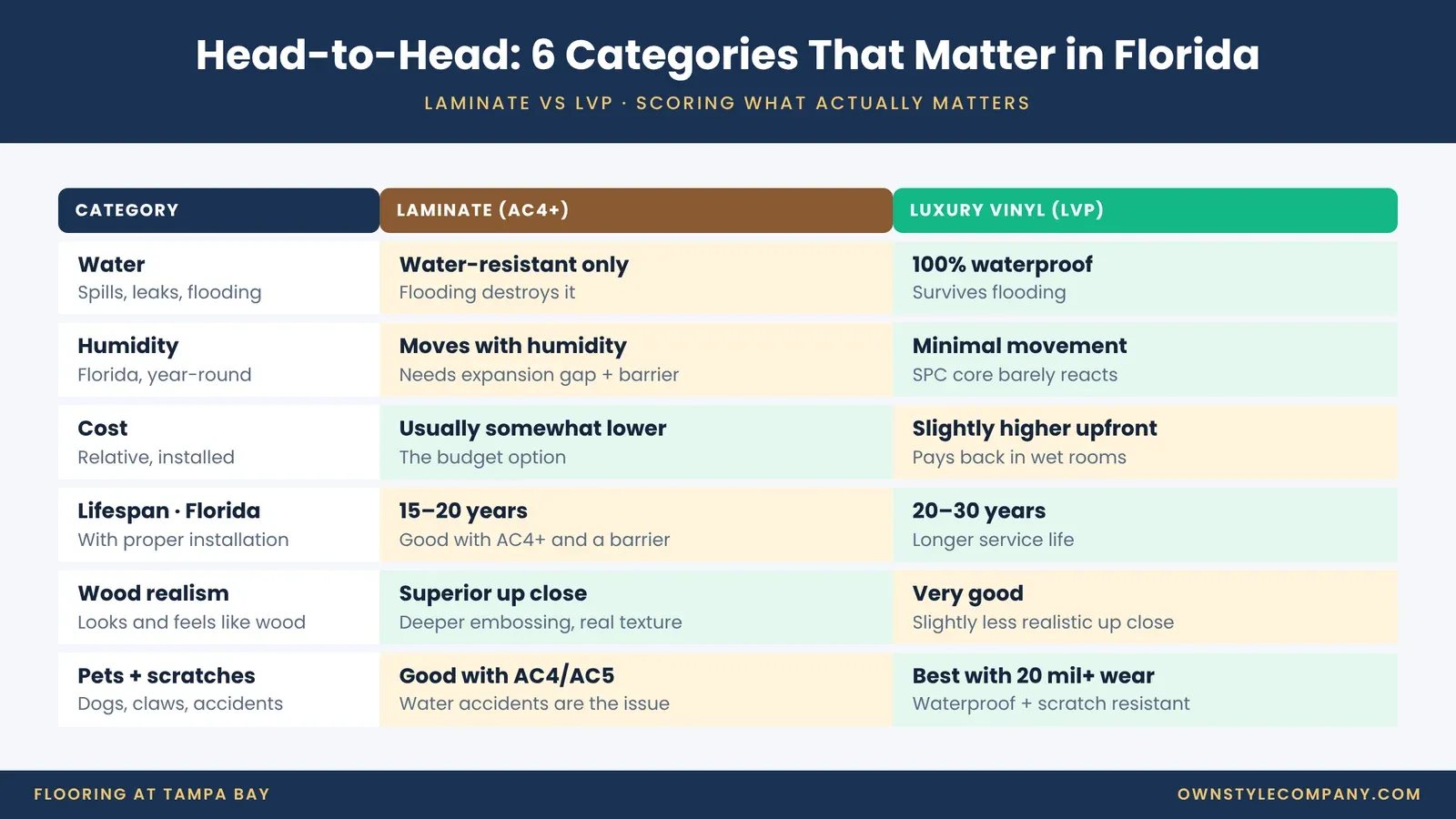
The comparison below lines up laminate and LVP across the seven categories that decide most flooring choices in Tampa Bay: water resistance, humidity tolerance, cost, feel underfoot, wood-look realism, lifetime, and scratch resistance. Reading it side by side makes the trade-off clearer than either material’s marketing sheet does alone.
| Category | Laminate (AC4+) | Luxury Vinyl (LVP) |
|---|---|---|
| Water resistance | Water-resistant for short spills. Fails with standing water or flooding. | 100 % waterproof. Survives flooding and standing water. |
| Humidity tolerance | Moves with Florida humidity. Needs expansion gap + moisture barrier. | Minimal movement. SPC core barely reacts to humidity. |
| Installed cost | Usually somewhat lower than LVP. Our labor: $2.25/sqft. | Usually somewhat higher than laminate. Our labor: $2/sqft. |
| Feel underfoot | Harder, slightly hollow sound without underlayment. | Softer (WPC) or similar to laminate (SPC). Warmer in A/C. |
| Realism of wood look | Typically superior up close. Deeper embossing. | Very good with 2024+ SPC. Slightly less realistic at arm’s length. |
| Lifetime in Florida | 15–20 years with proper install. 2–5 years with bad install. | 20–30 years with proper install. |
| Scratch resistance | Good with AC4+. Excellent with AC5. | Good with 20-mil+ wear layer. Fair below 12-mil. |
Where laminate still wins in Tampa Bay
Laminate is not obsolete in Tampa Bay, even with LVP’s clear advantages in wet areas. It wins in a narrower set of scenarios where wood-look realism and lower material cost outweigh the humidity risk, provided the installation details are handled correctly:
- Budget is tight and the home stays climate-controlled year-round.
- The homeowner specifically wants a high-realism wood look and is comparing LVP vs laminate samples in-person.
- The rooms are low-moisture (living rooms, bedrooms, home offices — never bathrooms or kitchens).
- The installation budget allows for proper AC4+ product and a 6-mil moisture barrier, not the cheapest shortcut on the shelf.
Where LVP wins clearly in Tampa Bay
LVP is the right answer in most of these scenarios, and laminate is rarely the better fit in any of them. The pattern across successful and failed installations in Tampa Bay points to five recurring situations where the waterproof core removes risk that laminate simply cannot match:
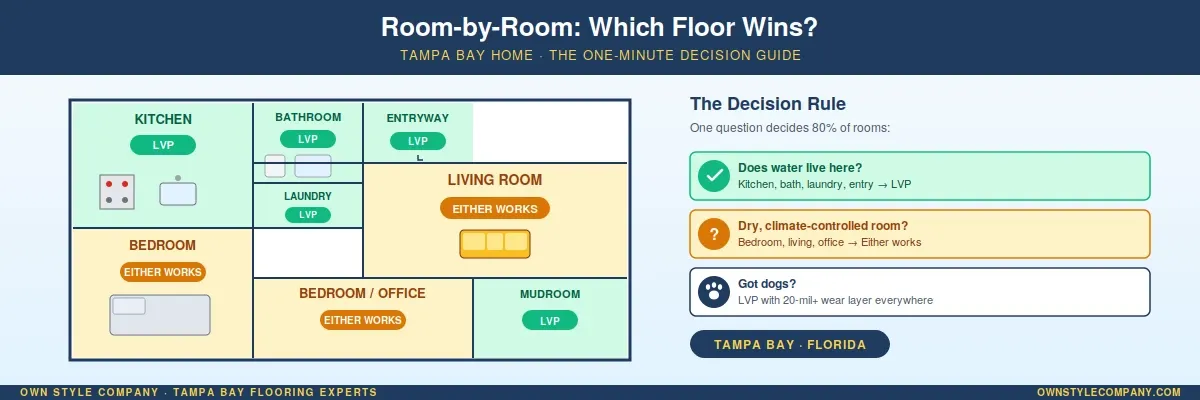
- Kitchens, bathrooms, laundry rooms, entryways — anywhere water lives.
- Homes with dogs or cats (claws + occasional accidents).
- Rental properties and Airbnb units (LVP’s damage tolerance reduces turnover cost).
- Homes near the coast (St. Petersburg, Apollo Beach, Tampa Bay waterfront) where humidity is even higher than inland.
- Homes with a history of flooding, even minor.
What installation looks like for each product
Both products install similarly, since click-lock floating installations dominate residential work in Tampa Bay regardless of which material a homeowner chooses. The eight-step sequence below stays consistent whether the crew is laying laminate or LVP, with only the moisture barrier step changing based on material:
- Subfloor inspection and moisture test (handheld meter on slab).
- Acclimation — flooring sits in the home for 48–72 hours.
- Demolition of existing flooring, or overlay if the existing floor is structurally sound.
- Subfloor leveling if needed (deviation greater than 3/16″ over 10 feet).
- Moisture barrier (6-mil poly on slab for laminate; optional for most SPC LVP).
- Underlayment, if not already attached to the plank.
- Click-lock installation with ¼″–⅜″ expansion gap at all walls.
- Transitions, quarter-round, final inspection.
A straightforward 1,500 sq ft install in a Tampa home typically takes 1–2 working days. A larger or more complex job can still be completed in a single day with the right crew.
What Voids a Laminate or LVP Warranty in a Tampa Bay Home?
Warranty claims on both materials get denied for the same handful of installation mistakes, and knowing them before the crew starts protects the investment more than any brand comparison does.
- Skipping the moisture test on a laminate install. Most manufacturers require documented proof the slab tested below 4 % moisture content before laminate goes down; a warranty claim without that reading is often denied outright.
- Standing water left on either product for hours. LVP survives brief exposure, but pooled water sitting overnight — from a missed pet accident or an appliance leak — can still seep into the seams and undermine the subfloor beneath it.
- Undersized expansion gaps. A gap smaller than ¼″ along a wall in a large Tampa Bay room is a common, avoidable cause of buckling that most warranties classify as an installation defect rather than a product defect.
- Installing over a subfloor deviation beyond spec. Both laminate and LVP click systems telegraph an uneven slab through the finished floor, and warranties typically require the subfloor to meet flatness tolerances before installation, not after a complaint.
- Direct sunlight exposure without a UV-rated finish. South- and west-facing Florida rooms with large windows can fade or discolor either material within a few years if the product was not rated for UV exposure.
Photographing the slab moisture reading and the subfloor prep before the first plank goes down is the easiest way to keep a warranty claim valid later, whichever material ends up on the floor.
How to decide for your Tampa Bay home
Start with two questions. First: does the room ever see water — splashes, spills, pet accidents, humidity from cooking? If yes, LVP. If no, either works. Second: is the home climate-controlled year-round, or does it sit empty during summer weeks? If it sits empty, LVP. Florida homes that lose A/C for even a few summer days can see laminate damage that LVP would have survived without a mark.
Planning a flooring project in Tampa Bay? Every quote starts with a moisture reading of the slab, at no cost. Get your free photo estimate or call (813) 455-5756.
Frequently asked questions
Is LVP worth the extra cost over laminate in Florida?
For most Tampa Bay homes, yes. The waterproof core and humidity stability translate to 5–10 additional years of service life, lower risk during hurricane season, and zero catastrophic failure from a dishwasher leak or pipe burst. Laminate's lower material cost is often erased by an earlier, more expensive replacement.
Can I mix laminate and LVP in the same house?
Yes. A common setup in Tampa Bay homes is LVP in kitchens, bathrooms, laundry rooms, and entryways, with laminate in bedrooms and living rooms. Transition strips handle the visual break between rooms, and each material gets matched to the moisture exposure of the specific space it covers.
Does LVP get dented by heavy furniture?
SPC-core LVP resists denting well due to its rigid stone-composite core. WPC-core LVP, which is softer and warmer underfoot, can show impressions from heavy, small-footprint furniture over time. Furniture pads under couch and table legs prevent most of these issues on either core type.
Which is better for dogs in Tampa Bay?
LVP with a 20-mil or thicker wear layer is the better choice for households with dogs. Scratch resistance is stronger than laminate, waterproofing handles accidents without warping, and the surface cleans easily. Florida sand tracked in on dog paws accelerates wear on any flooring material over time.
Can either one be installed over existing tile?
Yes, both laminate and LVP can be installed directly over intact tile floors as long as the surface is level and free of loose or cracked tiles. This floating-floor approach eliminates demolition costs and shortens the overall project timeline compared to a full tear-out first.


US standard for measuring relative humidity inside a concrete slab using in-situ probes drilled to 40% of slab depth, read after 72 hours of equilibration.
US standard for measuring moisture vapor emission from a concrete slab using anhydrous calcium chloride, expressed in pounds per 1,000 sq ft per 24 hours.
US standard practice for preparing concrete floors to receive resilient flooring. Covers flatness, cleanliness, and moisture condition before installation.
The building code in force across Florida, including moisture and structural requirements that apply to slab-on-grade residential construction.
European deep-core moisture test that reacts a slab sample with calcium carbide and reads the resulting gas pressure. Supporting knowledge: the applicable US standards are ASTM F2170 and F1869.
Supporting knowledge — not the standard we work toGerman standard series for floor screeds, source of the widely cited 2.0% CM cement and 0.5% CM anhydrite thresholds. Supporting knowledge, not the applicable US standard.
Supporting knowledge — not the standard we work toHigh-Density Fiberboard: the compressed wood-fiber core of most laminate planks. It absorbs water vapor and swells irreversibly, which is why slab moisture matters.
Stone Plastic Composite: rigid vinyl core made of limestone powder and PVC. Dimensionally stable under humidity swings and unaffected by water.
Wood Plastic Composite: vinyl core with wood flour and foaming agents. Softer and warmer underfoot than SPC, and less dimensionally stable.
Luxury Vinyl Plank: multi-layer vinyl flooring in plank format. Fully waterproof as a material, though the subfloor beneath still governs installation.
Abrasion Class rating for laminate wear resistance, from AC1 to AC6. AC4 suits normal residential use; AC5 handles heavy traffic and light commercial.
A sheet layer placed between slab and flooring to block ground moisture vapor. Required over slab-on-grade construction regardless of surface dryness.
Foundation type where the concrete slab sits directly on the ground, dominant in Florida residential construction. Ground moisture migrates upward continuously.
The permitted deviation of a subfloor across a given span. The common benchmark is 3/16 inch over 10 feet; beyond that, deviation transfers into the locking joints.
A pourable cement-based compound that flows to a level surface, used to correct slab deviation. Needs 24 to 72 hours of cure before flooring goes down.
The 8 to 10 mm clearance left between a floating floor and every fixed vertical surface, absorbing seasonal expansion. Bridging it transfers stress to the joints.
Conditioning flooring material inside the room where it will be installed, 48 to 72 hours before installation, so it reaches interior temperature and humidity.
An angle-in locking profile that joins planks without adhesive. The insertion angle is specified by the manufacturer; forcing it deforms the profile permanently.
The raised ridge that forms along plank edges when a floating floor expands without room to move. In Florida the usual causes are slab moisture or a bridged expansion gap.