
Laminate vs Engineered Hardwood in Florida: Which One Lasts Longer?
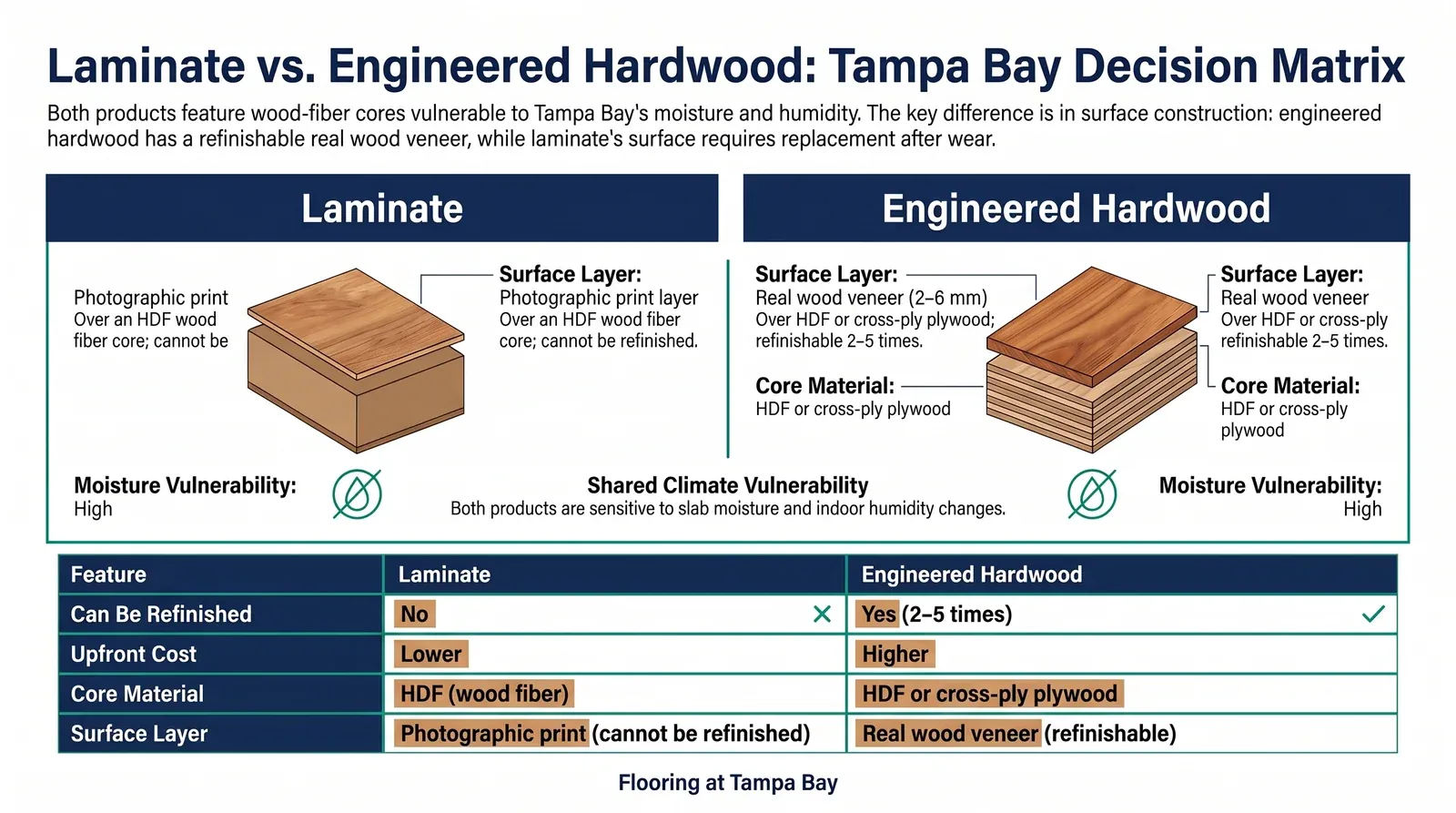
In Tampa Bay’s climate, laminate and engineered hardwood share one critical vulnerability — both have wood-fiber cores that react to moisture — but differ in one defining way: engineered hardwood can be refinished; laminate cannot. When the surface wears out on laminate, the entire floor is replaced. When the surface wears on engineered hardwood, a refinishing cycle extends life by another 10–15 years. That single difference, combined with the price gap (engineered hardwood costs noticeably more installed than laminate), defines the cost-value decision for Tampa Bay homeowners.
What is each product actually made of, and what does that mean in Florida?
Laminate flooring has four layers: a clear wear layer (melamine or aluminum oxide), a photographic print layer that mimics wood grain, an HDF core, and a backing. The image is a high-resolution photograph — it cannot be sanded, stained, or refinished.
Engineered hardwood also uses layered construction, but the top layer is a real wood veneer — actual sliced or sawn wood from the species the product represents. Below the veneer are cross-ply layers of HDF or plywood. Veneer thickness ranges from 2 mm on entry-level products to 6 mm on premium products — that veneer thickness determines how many times the floor can be sanded and refinished over its life.
In Florida’s humidity, both products expand and contract with moisture changes because both contain wood fiber. Neither is appropriate for wet rooms. The distinction between them is longevity, refinishability, and the authenticity of the surface material.
How does Florida’s climate affect both products?
Both laminate and engineered hardwood contain HDF in their core construction, making both vulnerable to the same Florida moisture risks:
- Slab-on-grade moisture affects both equally — a concrete slab transmitting vapor above 2.0% CM will damage either product.
- AC cycling stresses both products’ click-lock or tongue-and-groove joints through repeated expansion and contraction.
- The June–September rainy season drives indoor humidity above the tolerance range of both products without supplemental dehumidification.
The CM (calcium carbide) method is the European reference, standardized under DIN 18560-4. In the United States the governing standards are different instruments measuring different quantities: ASTM F2170 reads relative humidity inside the slab through in-situ probes set at 40% of slab depth, with a ceiling of 75% RH under ASTM F710, and ASTM F1869 measures surface moisture vapor emission with anhydrous calcium chloride, with a ceiling of 3 lb per 1,000 sq ft per 24 hours. The three readings are not convertible into one another.
The critical installation prerequisites — vapor barrier, slab moisture test, 48-hour acclimation, 8–10 mm perimeter gaps — are mandatory for both products in Tampa Bay.
| Feature | Laminate | Engineered Hardwood |
|---|---|---|
| Core material | HDF (wood fiber) | HDF or cross-ply plywood |
| Surface layer | Photographic print | Real wood veneer (2–6 mm) |
| Can be refinished | No | Yes — 2 to 5 times |
| Our installation labor | $2.25/sqft | $3/sqft (glue-down) |
| Relative installed cost | Lower | Higher |
| Lifespan dry room | 10–15 years | 20–30 years with refinishing |
| Moisture vulnerability | High | High (same core vulnerability) |
| Appropriate for bathrooms | No | No |
What does the refinishing advantage actually mean for Tampa Bay homeowners?
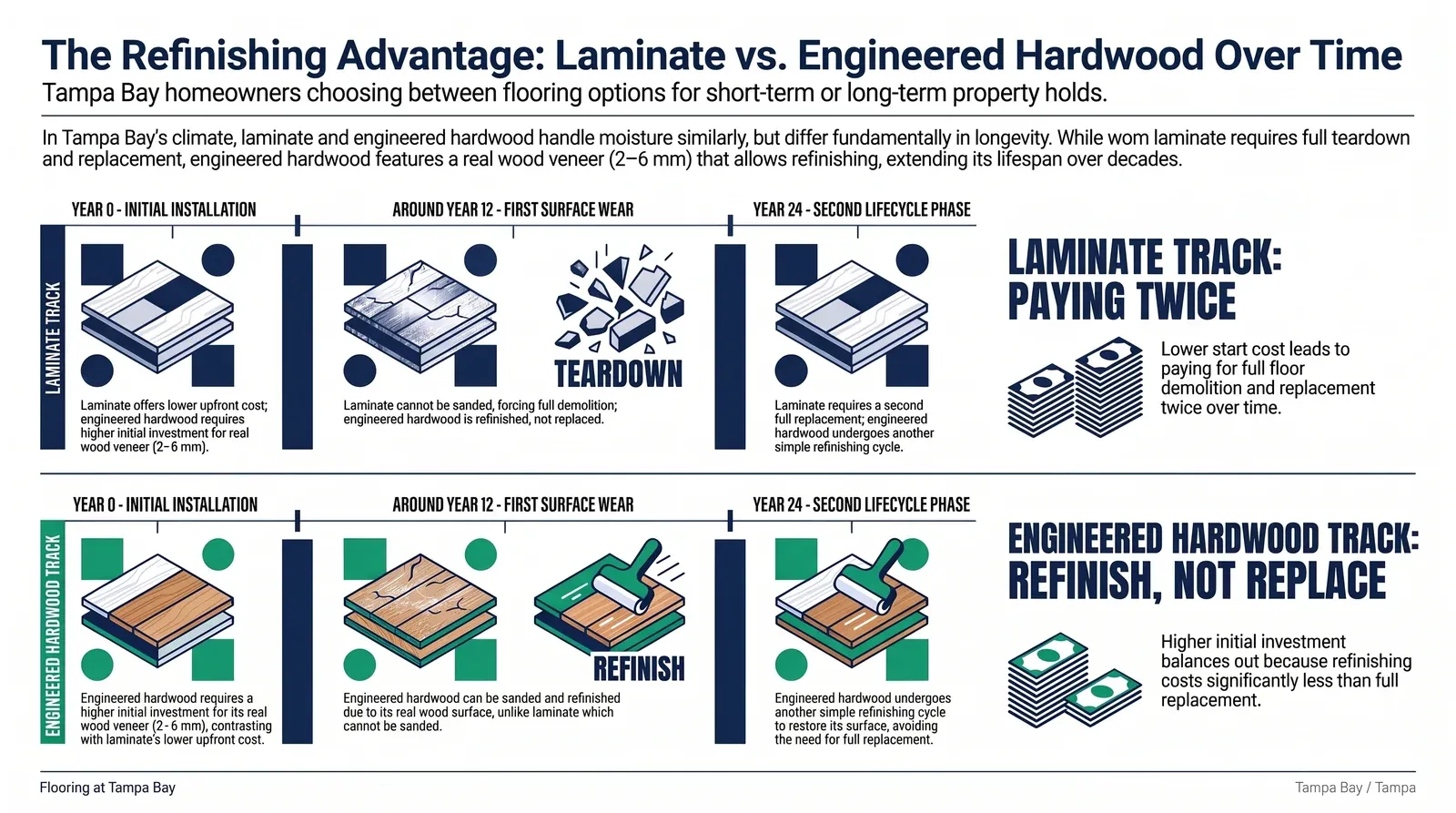
Refinishing is the operative difference for Tampa Bay homeowners with a 20+ year horizon. An engineered hardwood floor with a 4 mm veneer can be sanded and refinished 2–3 times during its life, and each refinishing cycle costs less than tearing out and reinstalling a floor. Each cycle extends the floor’s life by 10–15 years and restores the original surface appearance.
A laminate floor cannot be refinished at any price — when the surface wears, the only option is full replacement, including demolition, and you pay the full installed cost again on every cycle. Refinishing engineered hardwood over the same area costs less than that replacement — and the structural floor remains in place.
Where does each product make sense in a Tampa Bay home?
Engineered hardwood is appropriate in: living rooms and dining rooms in homes with consistent AC and tested slab moisture below 2.0% CM — particularly where the homeowner intends to refinish and hold the property for 15+ years; master bedrooms in premium renovations; and home offices in well-controlled environments.
Laminate is appropriate in: living areas and bedrooms where budget constraints make the cost difference material; rental properties where replacement cycles are expected and the lower upfront cost improves ROI; and any room where the floor is expected to last 10–12 years before the next renovation cycle.
Neither product is appropriate in bathrooms, laundry rooms, or any room with chronic moisture exposure in Florida.
Does Veneer Thickness Matter Beyond Just Refinishing Cycles?
Yes — a thicker veneer also tolerates more aggressive sanding per cycle, which matters when a floor has deeper scratches or an uneven wear pattern rather than uniform dulling. A 2 mm veneer allows only the lightest possible sanding pass each time, since removing even a fraction of a millimeter too much exposes the plywood or HDF layer underneath, ending the floor’s refinishing life permanently and immediately. A 4–6 mm veneer gives an installer real margin to level out uneven wear or deeper scratches in a single pass, which is why the thicker specification is worth the higher upfront cost for anyone planning to actually use the refinishing option rather than treating it as a theoretical feature.
Is the Installation Process Different Between the Two Products?
The subfloor prerequisites are identical — moisture test, vapor barrier, acclimation — but the installation method itself diverges. Laminate is almost always a floating installation, clicking together without touching the subfloor directly. Engineered hardwood can float, glue down, or nail down depending on the product and the subfloor; over a concrete slab in Tampa Bay, glue-down over a compliant vapor barrier is the most stable method because it eliminates the movement a floating system would otherwise need the expansion gap to absorb. Glue-down installation also takes noticeably longer and requires more surface preparation than a floating laminate job, which is reflected in engineered hardwood’s higher labor cost independent of the material price difference.
What does the 20-year cost calculation show for Tampa Bay homeowners?
For a 1,500 sqft living space in a Brandon or Riverview home, this is how the 20-year total cost compares (see our published prices for current labor rates):
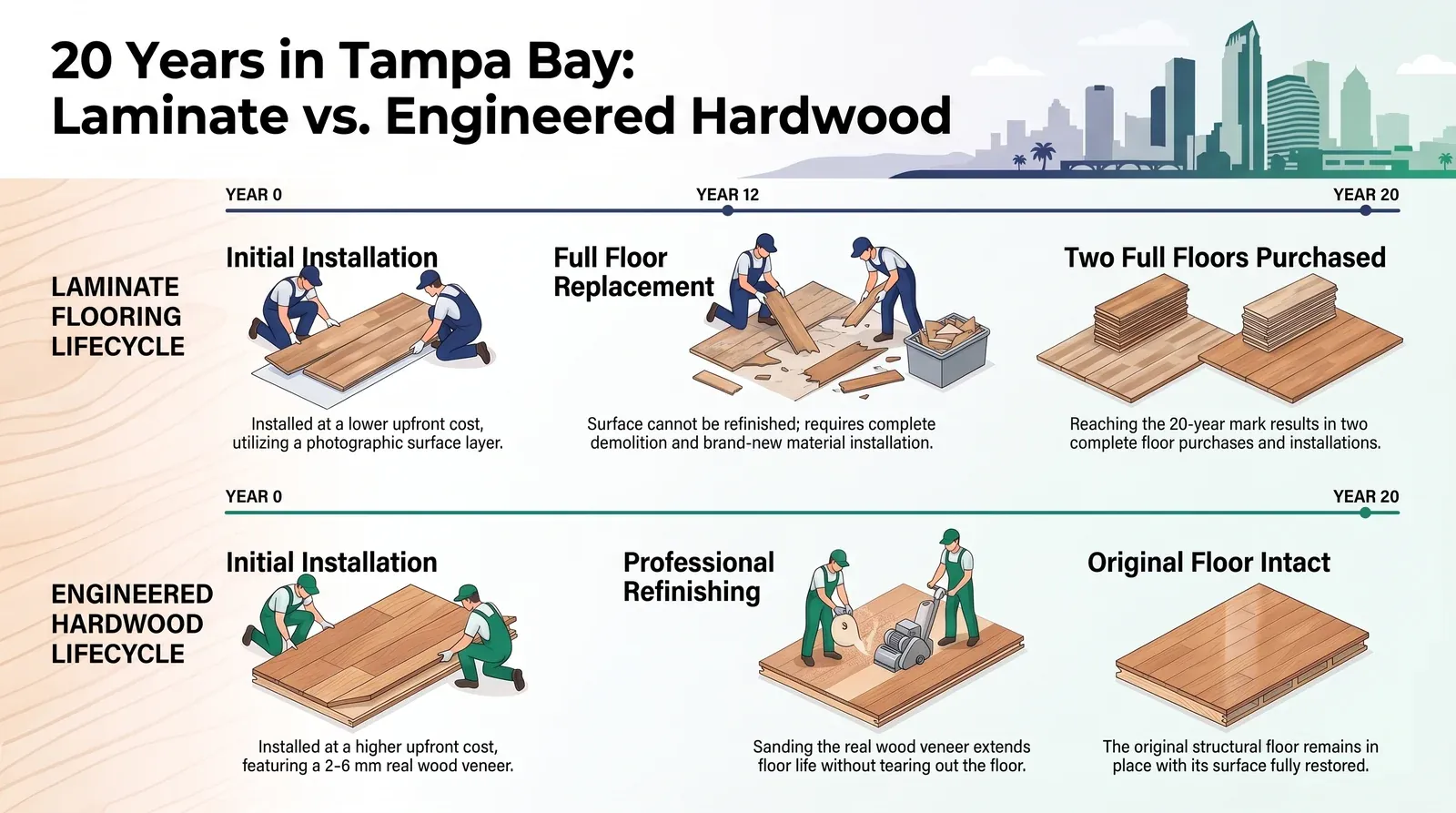
Laminate scenario: the lower installed cost at year 0. Full replacement at year 12–13 repeats that cost, plus demolition. By year 20 you have paid for two floors.
Engineered hardwood scenario: the higher installed cost at year 0. Refinishing at year 12–15 adds less than a full replacement would. The year-20 total is usually still higher than the laminate scenario — but the original structural floor is intact, the surface is restored, and no demolition cost was incurred.
The calculation favors laminate for homeowners with a 10-year horizon. The calculation shifts toward engineered hardwood for homeowners with a 20+ year horizon, particularly in homes where installation quality is high and moisture conditions are controlled.
Planning a flooring project in Tampa Bay? Every quote starts with a moisture reading of the slab, at no cost. Get your free photo estimate or call (813) 455-5756.
Frequently asked questions
Is laminate or engineered hardwood better for Florida?
For dry, climate-controlled rooms with a 10+ year horizon, engineered hardwood is the better long-term investment — it lasts 20–30 years with refinishing cycles, versus full laminate replacement every 10–15 years. For a 10-year horizon or budget-constrained renovation, laminate's lower upfront cost delivers comparable function.
Can engineered hardwood be installed over a concrete slab in Tampa Bay?
Engineered hardwood can be installed over a concrete slab when moisture reads below 2.0% CM and a vapor barrier is installed. Glue-down over a vapor barrier is the most stable method for Florida slabs. Floating engineered hardwood has the same moisture vulnerability as floating laminate on an untreated slab.
How many times can engineered hardwood be refinished in Florida?
Engineered hardwood can be refinished 2–5 times depending on veneer thickness. A 2 mm veneer allows 1–2 cycles. A 6 mm veneer allows 4–5 cycles. For homeowners planning to hold a property 20+ years, specifying a minimum 4 mm veneer at purchase is what makes multiple refinishing cycles possible later.
Does engineered hardwood feel different from laminate underfoot?
Engineered hardwood with a real wood veneer has a different surface texture and thermal conductivity than laminate's photographic print layer. The primary difference is that engineered hardwood can be refinished to a fresh surface — laminate cannot, and surface wear becomes permanent over time.
What is the installed cost difference between laminate and engineered hardwood in Tampa Bay?
Engineered hardwood costs noticeably more installed than laminate. Our installation labor is $2.25 per square foot for laminate and $3 per square foot for glue-down engineered hardwood, with material priced separately. The premium for engineered hardwood is offset over a 20-year horizon by avoiding full floor replacement — refinishing replaces the need for demolition and reinstallation.
Is glue-down or floating installation better for engineered hardwood over a slab?
Glue-down over a compliant vapor barrier is the more stable method for Tampa Bay concrete slabs. It eliminates the reliance on a floating expansion gap to absorb movement and takes more labor and surface prep than a floating installation, which is reflected in its higher labor cost.

US standard for measuring relative humidity inside a concrete slab using in-situ probes drilled to 40% of slab depth, read after 72 hours of equilibration.
US standard for measuring moisture vapor emission from a concrete slab using anhydrous calcium chloride, expressed in pounds per 1,000 sq ft per 24 hours.
US standard practice for preparing concrete floors to receive resilient flooring. Covers flatness, cleanliness, and moisture condition before installation.
The building code in force across Florida, including moisture and structural requirements that apply to slab-on-grade residential construction.
European deep-core moisture test that reacts a slab sample with calcium carbide and reads the resulting gas pressure. Supporting knowledge: the applicable US standards are ASTM F2170 and F1869.
Supporting knowledge — not the standard we work toGerman standard series for floor screeds, source of the widely cited 2.0% CM cement and 0.5% CM anhydrite thresholds. Supporting knowledge, not the applicable US standard.
Supporting knowledge — not the standard we work toHigh-Density Fiberboard: the compressed wood-fiber core of most laminate planks. It absorbs water vapor and swells irreversibly, which is why slab moisture matters.
Stone Plastic Composite: rigid vinyl core made of limestone powder and PVC. Dimensionally stable under humidity swings and unaffected by water.
Wood Plastic Composite: vinyl core with wood flour and foaming agents. Softer and warmer underfoot than SPC, and less dimensionally stable.
Luxury Vinyl Plank: multi-layer vinyl flooring in plank format. Fully waterproof as a material, though the subfloor beneath still governs installation.
Abrasion Class rating for laminate wear resistance, from AC1 to AC6. AC4 suits normal residential use; AC5 handles heavy traffic and light commercial.
A sheet layer placed between slab and flooring to block ground moisture vapor. Required over slab-on-grade construction regardless of surface dryness.
Foundation type where the concrete slab sits directly on the ground, dominant in Florida residential construction. Ground moisture migrates upward continuously.
The permitted deviation of a subfloor across a given span. The common benchmark is 3/16 inch over 10 feet; beyond that, deviation transfers into the locking joints.
A pourable cement-based compound that flows to a level surface, used to correct slab deviation. Needs 24 to 72 hours of cure before flooring goes down.
The 8 to 10 mm clearance left between a floating floor and every fixed vertical surface, absorbing seasonal expansion. Bridging it transfers stress to the joints.
Conditioning flooring material inside the room where it will be installed, 48 to 72 hours before installation, so it reaches interior temperature and humidity.
An angle-in locking profile that joins planks without adhesive. The insertion angle is specified by the manufacturer; forcing it deforms the profile permanently.
The raised ridge that forms along plank edges when a floating floor expands without room to move. In Florida the usual causes are slab moisture or a bridged expansion gap.