
AC4 vs. AC5 Flooring Ratings: What Tampa Bay Homes Actually Need
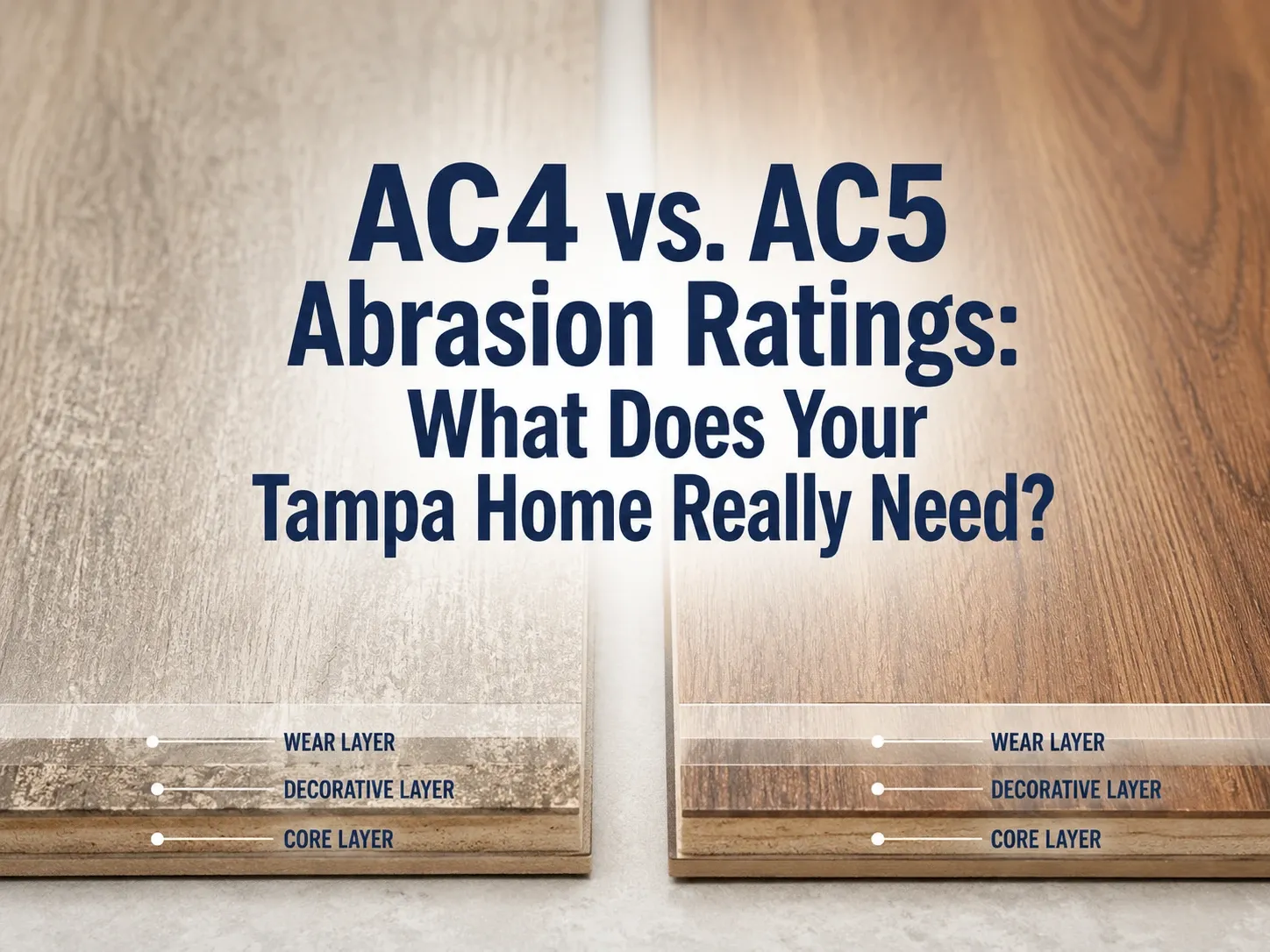
AC4-rated laminate flooring withstands 4,000+ abrasion cycles in the Taber test — the threshold specified by EN 13329 for heavy residential and general commercial use. AC5-rated flooring requires 6,000+ cycles, classifying it as heavy commercial, and the gap between the two ratings determines how long a wear layer survives Florida’s coastal conditions.
In Tampa Bay homes near the Gulf Coast, where quartz-heavy beach sand tracked through entryways acts as a continuous industrial abrasive, AC4 is the minimum practical specification for high-traffic zones. AC5 provides additional wear life but introduces a rougher surface texture engineered for commercial spaces — a trade-off that affects barefoot comfort in residential settings.
What Does the Taber Test Measure?
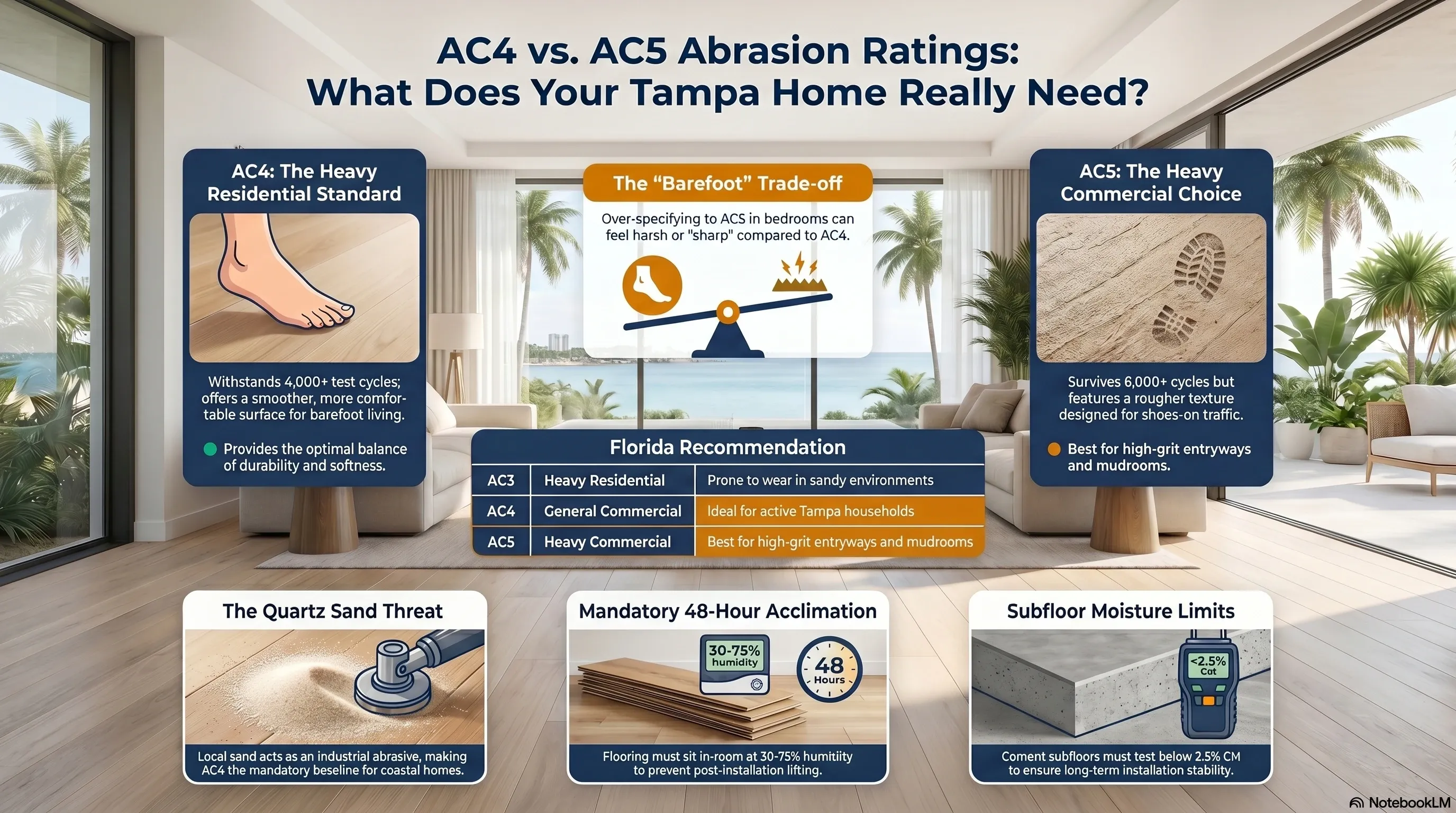
The Taber test measures wear layer resistance by applying abrasive wheels under constant pressure to the floor surface and counting the revolutions required to breach the transparent overlay and expose the decorative layer beneath. EN 13329 specifies 4,000 revolutions for AC4 and 6,000 for AC5.
In Tampa Bay homes within five miles of the Gulf Coast, residents track quartz sand — the primary component of Florida’s coastal topsoil — across flooring surfaces daily. Quartz ranks 7 on the Mohs hardness scale, making it significantly harder than most laminate wear layers. The Taber test’s abrasive wheels approximate the grinding action of quartz particles under foot traffic, making the cycle count a direct predictor of floor service life in coastal environments.
The Full AC Rating Scale
EN 13329 defines six AC tiers, and only two of them — AC4 and AC5 — apply to any realistic Tampa Bay residential scenario. The remaining tiers exist mainly to show how far below the coastal threshold AC1 through AC3 actually sit.
| Rating | Taber cycles | Classification | Tampa Bay application |
|---|---|---|---|
| AC1 | 900+ | Light residential | Not recommended for Florida |
| AC2 | 1,500+ | General residential | Bedrooms only, low sand exposure |
| AC3 | 2,000+ | Heavy residential | Not recommended within 10 miles of coast |
| AC4 | 4,000+ | General commercial | Standard for active Tampa Bay households |
| AC5 | 6,000+ | Heavy commercial | High-traffic entryways, mudrooms, Airbnb rentals |
| AC6 | 8,500+ | Extreme commercial | Airport terminals — not applicable to residential |
How Does Gulf Coast Quartz Sand Change the AC Rating Requirement?
Hillsborough County’s coastal topsoil contains 85–92 % quartz by composition (Florida Geological Survey data). Quartz particles at 200–500 micron grain size — the range tracked by shoe soles into homes — act as a distributed abrasive across the floor surface.
An AC3 floor rated for 2,000 Taber cycles fails at the wear layer within 3–5 years in a home with daily beach access, compared to a projected 15–20 year service life in a non-coastal low-traffic application. AC4’s 4,000-cycle rating extends wear life to 12–18 years under the same coastal sand exposure.
Why Is AC5 Not Always the Optimal Choice for Residential Installations?
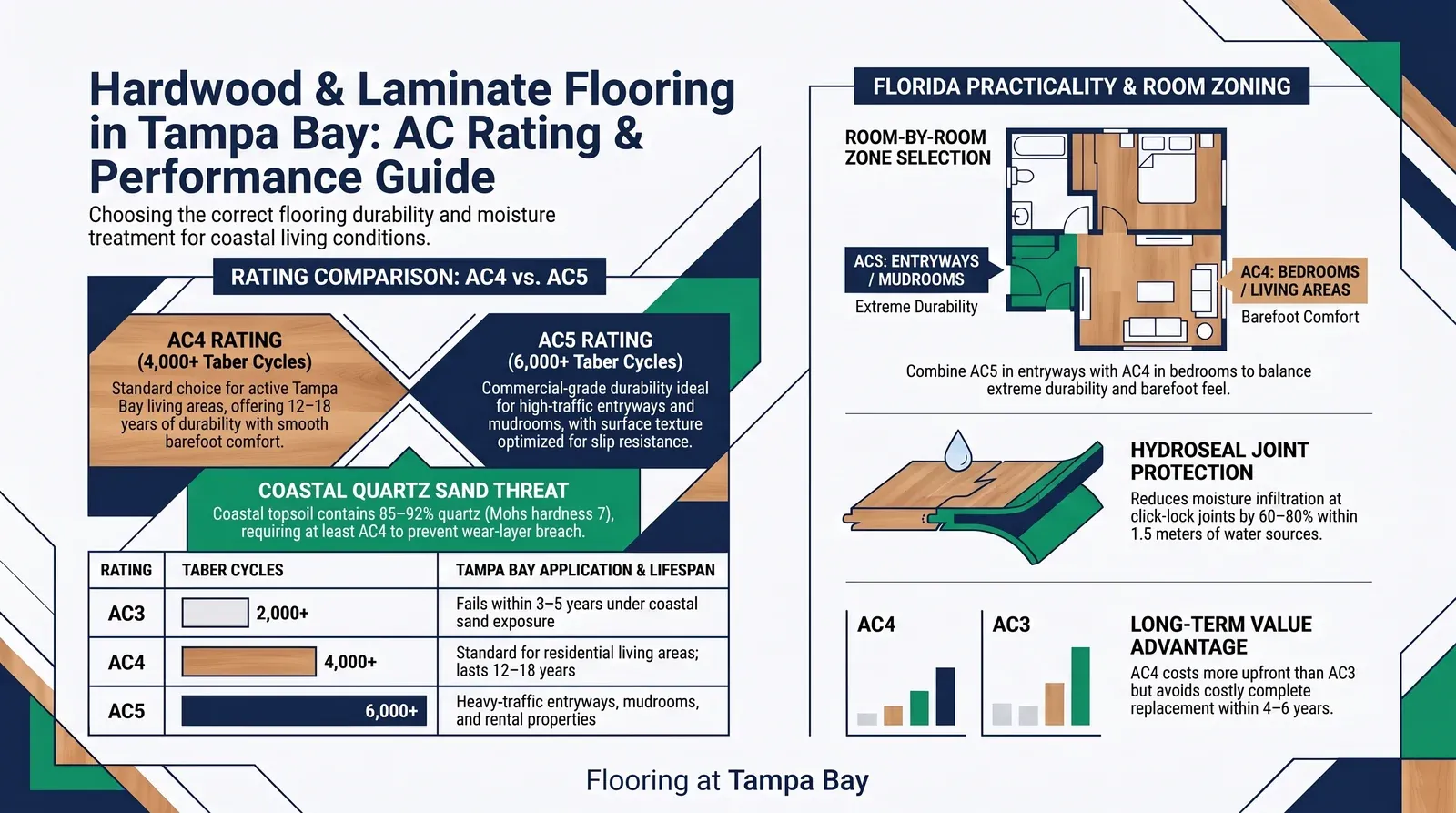
AC5 flooring is engineered for commercial environments where all users wear shoes and slip resistance is the priority. The commercial-grade surface texture — typically a deeper emboss pattern with higher coefficient of friction — provides traction on wet tile-adjacent floors in commercial spaces.
In residential settings, that same texture registers as rough or “sharp” on bare feet. A zone-based specification optimizes both durability and comfort: AC5 for entryways, mudrooms, and kitchen areas with direct outdoor access; AC4 for living, dining, and bedroom areas.
What Is Hydroseal Technology?
Hydroseal technology is a micro-bevel edge treatment that applies a water-resistant polymer seal to the laminate plank’s short and long edges, reducing moisture infiltration at the click-lock joint by 60–80 % compared to unsealed laminate.
Hydroseal does not change the AC abrasion rating — a Hydroseal AC4 floor remains AC4. It does expand the application range of both AC4 and AC5 into wet-adjacent zones: kitchen areas, laundry rooms, and half-baths where splash exposure is intermittent. Hydroseal-treated planks are specified for any zone within 1.5 meters of a water source, regardless of AC rating.
Total Cost of Ownership: AC3 vs. AC4 in Coastal Florida
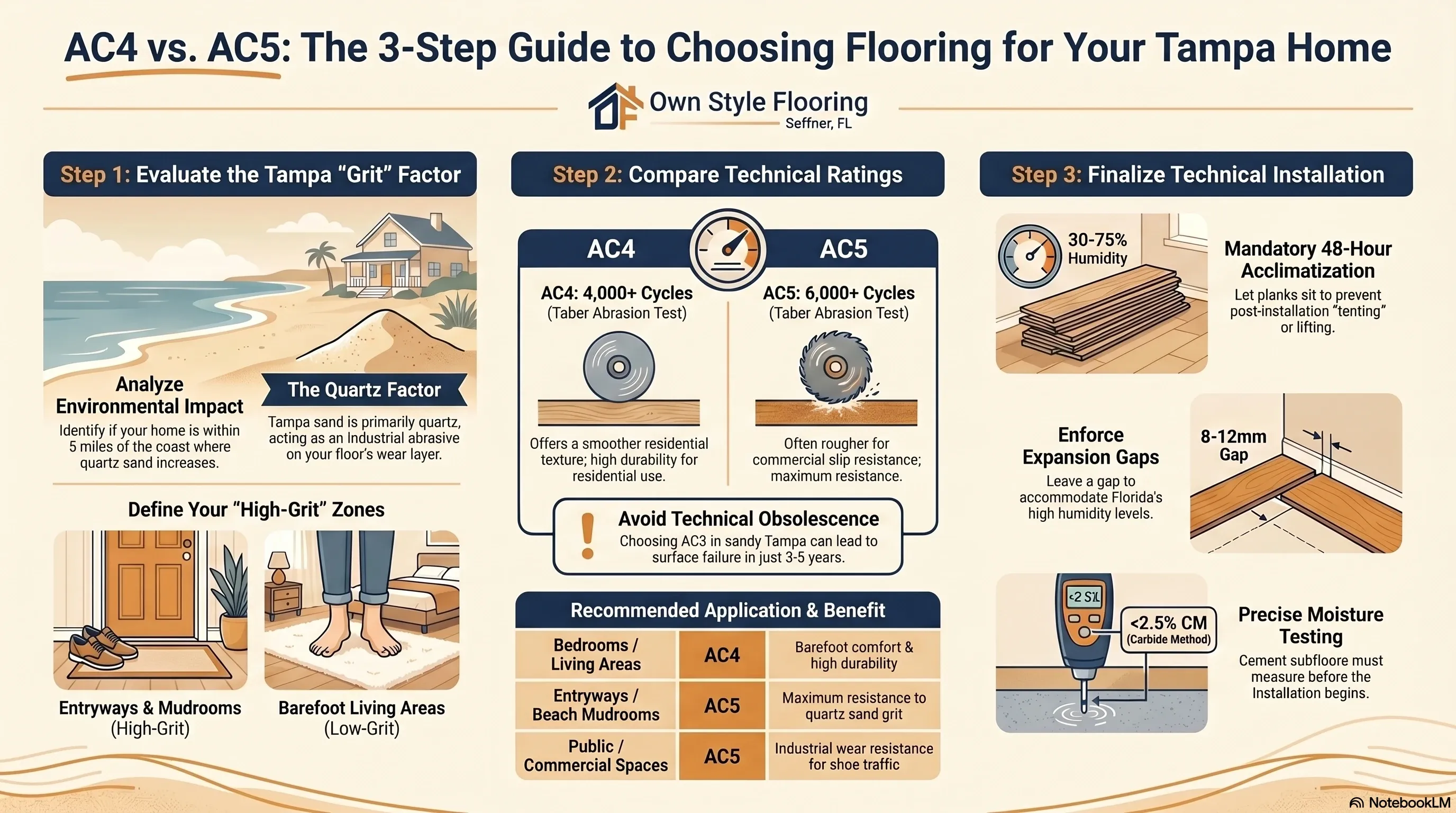
The Total Cost of Ownership for AC3 laminate in a coastal home includes the initial material and installation cost plus a full replacement within 4–6 years: removal and disposal of the worn floor, new material, and a second round of installation labor. Over a 6-year cycle, that means paying for the floor roughly twice.
AC4 laminate costs somewhat more upfront, but it maintains its wear layer for 12–18 years under the same coastal conditions, so the initial purchase covers that entire period. The modest premium for AC4 over AC3 is typically far smaller than the cost of the first replacement cycle it avoids. Our installation labor for laminate is $2.25 per square foot regardless of AC rating, so the difference comes down to the product itself — see our published prices for removal and installation labor.
How Can a Homeowner Verify an AC Rating Before Buying?
Retail displays and sample boards do not always carry an accurate AC number, and confirming the rating before installation day is far cheaper than discovering a mismatch after the wear layer starts showing traffic patterns.
- Request the manufacturer’s technical data sheet rather than the retail sales flyer — it lists the EN 13329 Taber cycle count directly, not a marketing summary.
- Look for the AC rating icon printed on the plank’s underside or edge; certified product carries this mark, generic product often does not.
- Ask for the test report number when a supplier claims AC4 or AC5 without documentation on hand — a legitimate laminate product has one on file.
- Compare the wear layer thickness listed alongside the AC number, since a thin overlay claiming AC5 performance is a mismatch worth questioning before purchase.
In a Tampa Bay showroom, cross-checking these details takes a few minutes and prevents installing an AC3 floor in a coastal entryway that needed AC4 from the start.
What Mistakes Push Tampa Bay Homeowners Toward the Wrong AC Rating?
Most AC rating mistakes in Hillsborough County homes trace back to treating the entire house as one zone instead of matching each area’s sand and moisture exposure to the right specification.
- Choosing AC3 for the whole house to save money — the entryway and kitchen wear out within 3–5 years while the bedrooms would have been fine at AC3 all along.
- Assuming AC5 everywhere solves durability — the commercial-grade texture feels rough underfoot in living rooms and bedrooms where AC4’s residential surface would have been the better fit.
- Ignoring wear layer thickness on the spec sheet — a laminate plank with HDF core can carry an AC5 label with a thin overlay that does not match true heavy-commercial performance.
- Skipping Hydroseal in kitchens and laundry rooms — an AC5 floor without edge sealing still lets moisture into the click-lock joint even though the abrasion rating looks correct on paper.
- Not budgeting for a 2026 replacement cycle on existing AC3 floors — a slab installed during Florida’s building boom years is often already past the point where refinishing helps.
As of 2026, the households seeing the longest service life from their laminate are the ones that specified AC4 or AC5 by room rather than picking one rating for the entire subfloor.
Planning a flooring project in Tampa Bay? Every quote starts with a moisture reading of the slab, at no cost. Get your free photo estimate or call (813) 455-5756.
Frequently asked questions
What AC rating is recommended for Tampa Bay homes near the Gulf Coast?
AC4 is the minimum recommended rating for active Tampa Bay households within 10 miles of the Gulf Coast. Quartz-heavy coastal sand tracked indoors acts as a continuous abrasive rated at 7 on the Mohs hardness scale. AC3 breaches its wear layer within 3–5 years under this condition. AC5 is recommended for high-traffic entryways and mudrooms with direct pool or beach access.
Does a higher AC rating mean a thicker plank?
AC rating and plank thickness are independent specifications. The AC rating measures abrasion resistance of the wear layer — the transparent overlay above the decorative layer. An 8 mm plank can carry AC5 while a 12 mm plank carries AC3. Both specifications must be evaluated separately.
Can I use AC5 flooring in a bathroom with a floor drain?
Abrasion rating does not confer waterproof status. AC5 resists surface abrasion but does not prevent moisture from penetrating click-lock joints. Bathrooms with floor drains require either Hydroseal-treated laminate with fully sealed perimeter gaps, or a waterproof alternative material.
How long does AC4 flooring last in a home with pets?
AC4 flooring maintains its wear layer for 12–18 years in a Tampa Bay home with one to two medium-sized dogs under normal indoor conditions. Large dog nails over 6 mm produce localized scratches independent of the Taber rating, as scratch resistance and abrasion resistance measure different failure modes.
Why does AC5 sometimes feel rough underfoot in residential spaces?
AC5 surface texture is calibrated for commercial environments where all users wear shoes, prioritizing slip resistance. The deeper emboss pattern registers as rough on bare feet. AC5 is appropriate for entryways and kitchens where shoes are worn; AC4's residential texture is appropriate for barefoot spaces.

US standard for measuring relative humidity inside a concrete slab using in-situ probes drilled to 40% of slab depth, read after 72 hours of equilibration.
US standard for measuring moisture vapor emission from a concrete slab using anhydrous calcium chloride, expressed in pounds per 1,000 sq ft per 24 hours.
US standard practice for preparing concrete floors to receive resilient flooring. Covers flatness, cleanliness, and moisture condition before installation.
The building code in force across Florida, including moisture and structural requirements that apply to slab-on-grade residential construction.
European deep-core moisture test that reacts a slab sample with calcium carbide and reads the resulting gas pressure. Supporting knowledge: the applicable US standards are ASTM F2170 and F1869.
Supporting knowledge — not the standard we work toGerman standard series for floor screeds, source of the widely cited 2.0% CM cement and 0.5% CM anhydrite thresholds. Supporting knowledge, not the applicable US standard.
Supporting knowledge — not the standard we work toHigh-Density Fiberboard: the compressed wood-fiber core of most laminate planks. It absorbs water vapor and swells irreversibly, which is why slab moisture matters.
Stone Plastic Composite: rigid vinyl core made of limestone powder and PVC. Dimensionally stable under humidity swings and unaffected by water.
Wood Plastic Composite: vinyl core with wood flour and foaming agents. Softer and warmer underfoot than SPC, and less dimensionally stable.
Luxury Vinyl Plank: multi-layer vinyl flooring in plank format. Fully waterproof as a material, though the subfloor beneath still governs installation.
Abrasion Class rating for laminate wear resistance, from AC1 to AC6. AC4 suits normal residential use; AC5 handles heavy traffic and light commercial.
A sheet layer placed between slab and flooring to block ground moisture vapor. Required over slab-on-grade construction regardless of surface dryness.
Foundation type where the concrete slab sits directly on the ground, dominant in Florida residential construction. Ground moisture migrates upward continuously.
The permitted deviation of a subfloor across a given span. The common benchmark is 3/16 inch over 10 feet; beyond that, deviation transfers into the locking joints.
A pourable cement-based compound that flows to a level surface, used to correct slab deviation. Needs 24 to 72 hours of cure before flooring goes down.
The 8 to 10 mm clearance left between a floating floor and every fixed vertical surface, absorbing seasonal expansion. Bridging it transfers stress to the joints.
Conditioning flooring material inside the room where it will be installed, 48 to 72 hours before installation, so it reaches interior temperature and humidity.
An angle-in locking profile that joins planks without adhesive. The insertion angle is specified by the manufacturer; forcing it deforms the profile permanently.
The raised ridge that forms along plank edges when a floating floor expands without room to move. In Florida the usual causes are slab moisture or a bridged expansion gap.