How Long Does Laminate Flooring Last in Florida? What Shortens Its Life
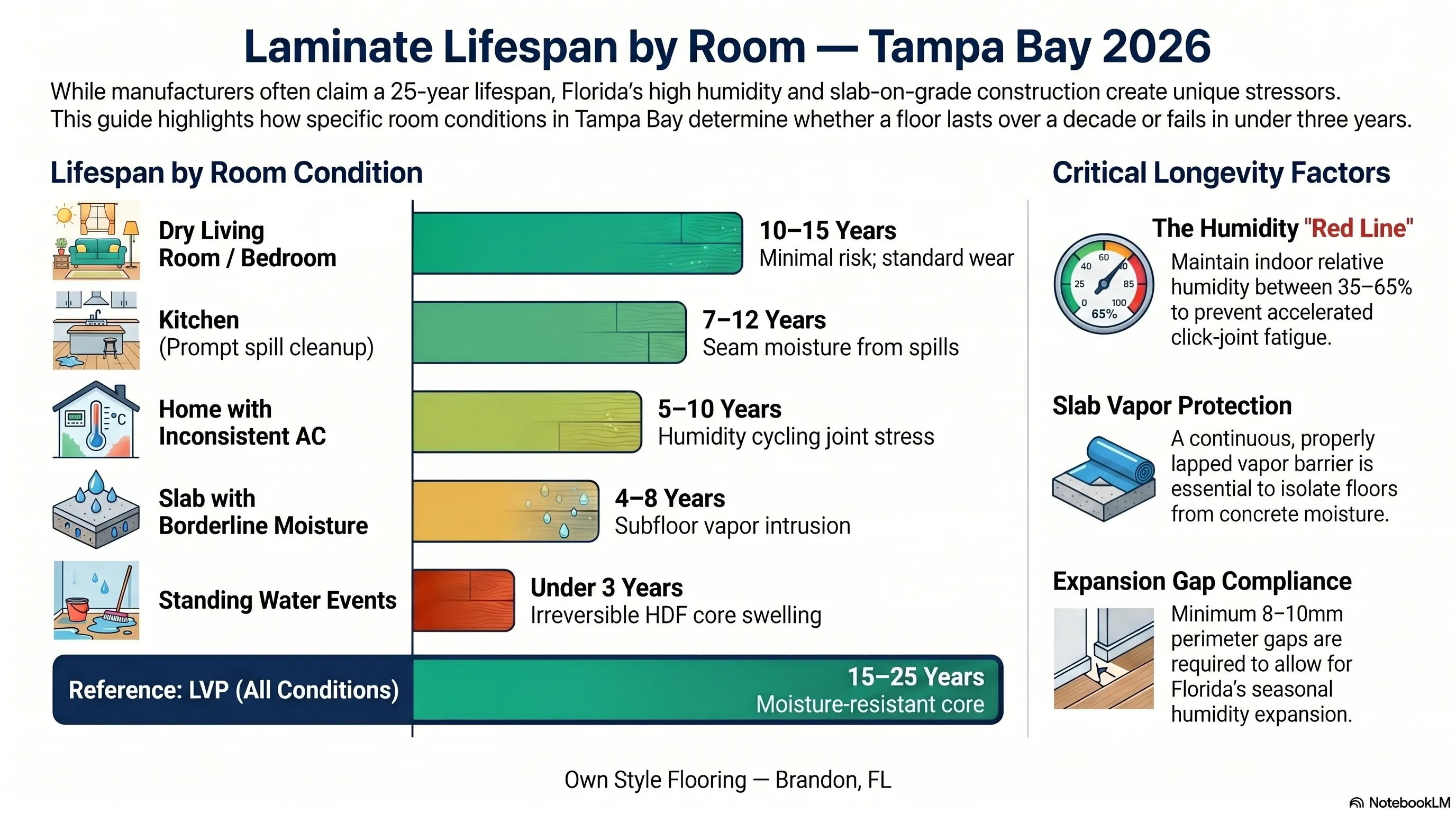
In a dry, climate-controlled Tampa Bay room, quality laminate flooring lasts 10 to 15 years. In a room with moisture exposure, the same product fails in 5 to 8. The gap is not about product quality or brand — it is about conditions: slab-on-grade construction, seasonal humidity above 80%, and daily AC cycling.
What lifespan should Tampa Bay homeowners actually expect from laminate?
Laminate manufacturer warranties quote 15–25 years, and those figures are accurate for ideal climate-controlled conditions. Florida is not one. Realistic lifespan in Tampa Bay depends on which room the floor sits in and how consistently that room stays dry, ranging from 5 to 15 years:
| Condition / Room Type | Expected Lifespan | Primary Risk Factor |
|---|---|---|
| Living room with consistent AC, dry slab | 10–15 years | Wear layer abrasion over time |
| Bedroom with stable climate control | 10–15 years | Minimal risk, low traffic |
| Kitchen with prompt spill cleanup | 7–12 years | Moisture at seams from spills |
| Home with inconsistent AC coverage | 5–10 years | Humidity cycling stresses joints |
| Slab with borderline moisture reading | 4–8 years | Subfloor vapor intrusion |
| Any room with standing water events | Under 3 years | HDF core swelling, irreversible |
| LVP in same Florida conditions (reference) | 15–25 years | Wear layer only, no moisture risk |
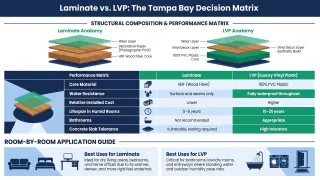
The LVP reference row is included because it is the honest comparison point. Tampa Bay homeowners choosing laminate should understand what the alternatives offer before making the decision.
What five factors determine laminate lifespan in Florida?
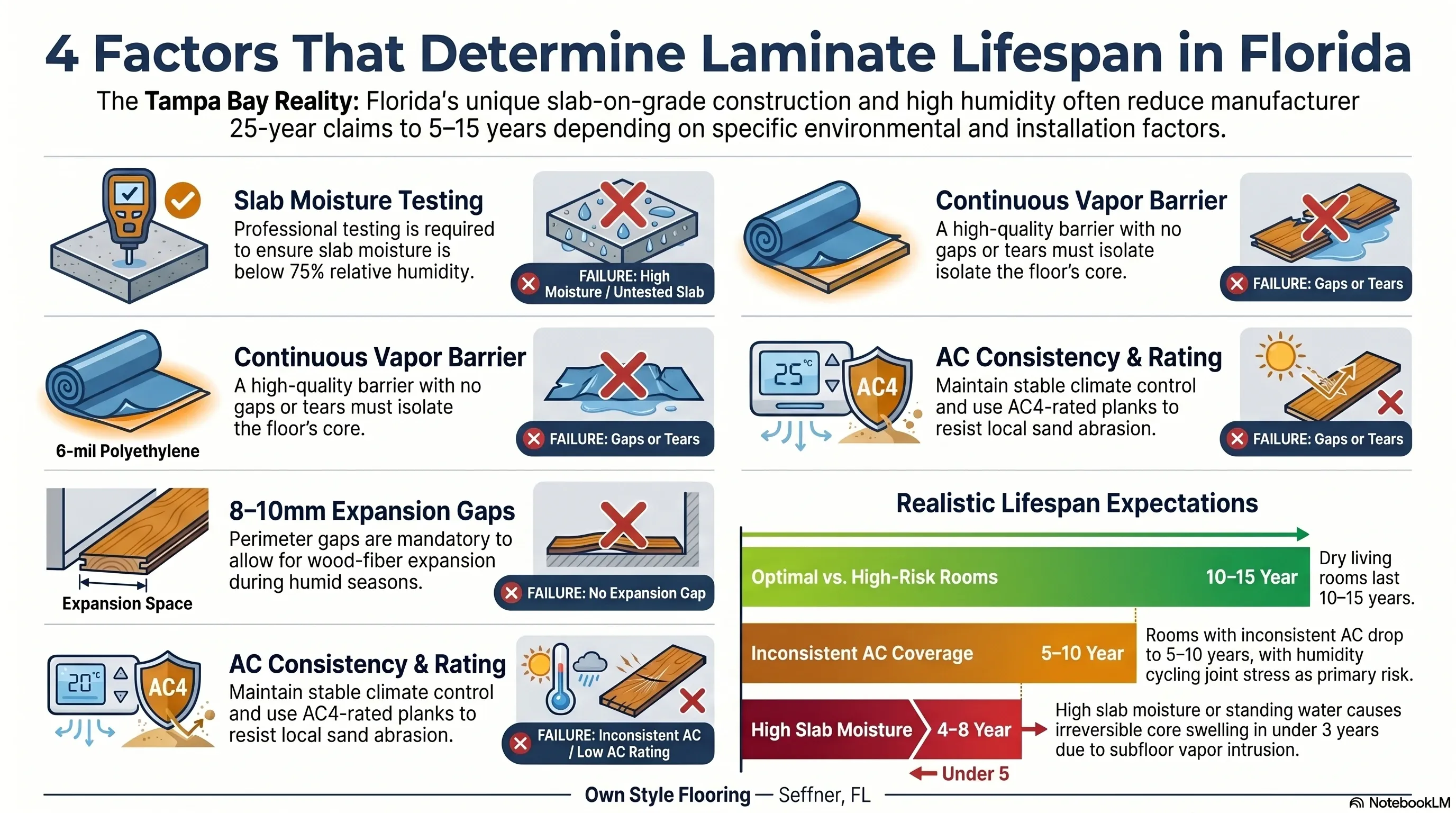
Five conditions determine whether a Tampa Bay laminate floor reaches its potential or fails prematurely:
-
Slab moisture: Concrete slabs in the Tampa Bay area transmit ground moisture upward continuously. A calcium chloride test reading above 3 lbs/1000 sqft/24 hrs, or a relative humidity reading above 75% at the slab surface, exceeds most laminate manufacturer limits.
-
Vapor barrier quality: A continuous, properly lapped vapor barrier isolates the HDF core from slab moisture. Gaps, tears, or missing sections allow moisture to migrate upward directly beneath the floor.
-
Expansion gap compliance: Laminate expands with Tampa Bay’s humidity cycles. Correct 8–10 mm perimeter gaps allow that movement without stress on the click-lock joints.
-
AC consistency: Homes where AC is turned off for extended periods — vacation properties, seasonal residents — experience rapid humidity spikes that accelerate joint fatigue.
-
AC rating: AC4-rated laminate withstands 4,000+ Taber abrasion cycles; AC3 degrades faster under Florida’s quartz sand abrasion.
What does correct installation add to laminate lifespan in Tampa Bay?
The installation decisions made before the first plank goes down determine years of floor life — not months. A Tampa Bay home where the slab tested below 2.0% CM, a quality vapor barrier was installed, all planks acclimated 48 hours at 60–80% RH, and expansion gaps were maintained at 8–10 mm throughout will realistically reach the 10–15 year lifespan range.
The CM (calcium carbide) method is the European reference, standardized under DIN 18560-4. In the United States the governing standards are different instruments measuring different quantities: ASTM F2170 reads relative humidity inside the slab through in-situ probes set at 40% of slab depth, with a ceiling of 75% RH under ASTM F710, and ASTM F1869 measures surface moisture vapor emission with anhydrous calcium chloride, with a ceiling of 3 lb per 1,000 sq ft per 24 hours. The three readings are not convertible into one another.
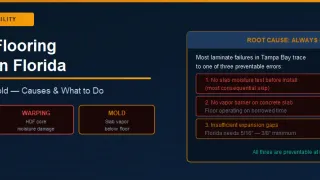
The same product installed over an untested slab, without a vapor barrier, with tight gaps at doorways, in a home where AC is turned off for two weeks at a time will fail in 4–6 years regardless of brand or price paid. The single largest factor in laminate longevity is what happened before the floor went down — a slab moisture reading taken before installation, not a warranty claim filed after the fact.
Does the AC Rating Change How Long the Floor Lasts, Separately From Moisture?
Yes — AC rating and moisture exposure are two independent failure clocks running at the same time. Moisture determines whether the HDF core swells and the joints separate; AC rating determines how fast the surface itself wears through from foot traffic and the fine quartz sand common in Tampa Bay soil.
A dry, climate-controlled living room with AC3 laminate can still show a dulled, scratched wear layer within 8–10 years from sand abrasion alone, even though the core stayed perfectly dry the whole time. AC4-rated product in the same room, under the same traffic, extends that surface life toward the upper end of the 10–15 year range because its wear layer is rated for roughly double the abrasion cycles.
What are the early signs that laminate is failing in a Tampa Bay home?
Florida laminate failure follows a predictable sequence, and catching it at stage one or two is the difference between a repair and a full replacement. The five stages below appear in order, usually months apart, and only the first two are reversible once the moisture source is corrected:
-
Joint movement — small gaps opening between planks at door thresholds or in the center of large rooms, typically appearing in the first rainy season after installation if moisture conditions are wrong.
-
Edge swelling — raised edges at seam lines where the HDF core has absorbed moisture and expanded beyond the plank’s surface profile.
-
Surface dullness — loss of finish sheen from abrasive cleaning products or accumulated silica sand damage.
-
Soft spots — areas where planks flex noticeably underfoot, indicating hollow tile effect from subfloor irregularities or moisture-softened HDF core.
-
Odor — a musty smell from beneath the floor indicating moisture-driven mold growth in the underlayment or slab surface.
At the joint movement and edge swelling stage, remediation may be possible. At the odor stage, the floor requires full replacement and the moisture source must be identified and corrected before any new floor is installed.
How can Tampa Bay homeowners extend existing laminate life?
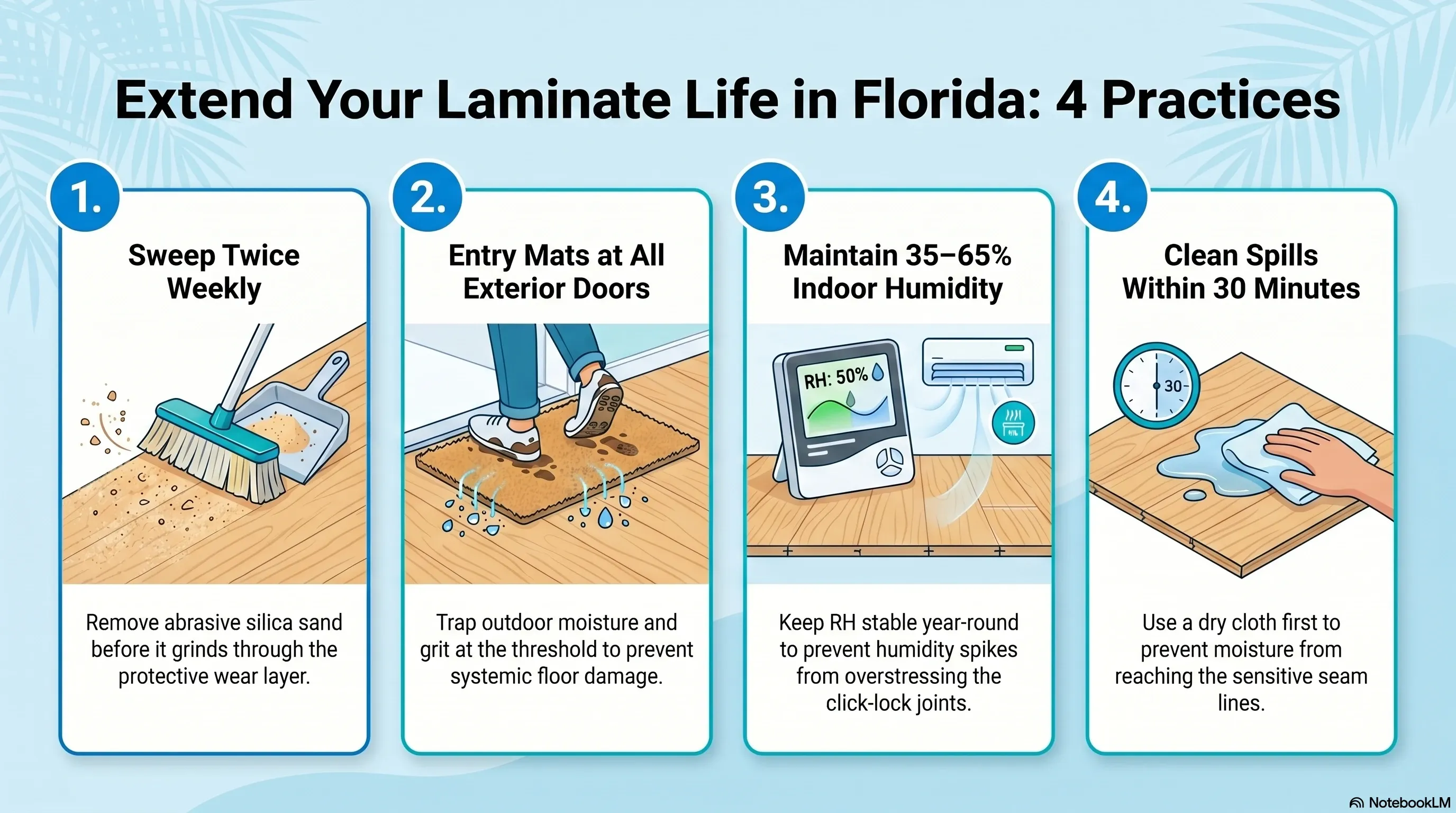
Four maintenance practices extend laminate life in Florida conditions, and all four target the two things that actually shorten it here: silica sand tracked in from the soil and indoor humidity swings. None requires a professional visit, and together they add years to a floor that is already installed:
-
Sand removal: Sweep or vacuum with a soft-bristle attachment at minimum twice per week to remove silica sand before it grinds through the wear layer under foot traffic.
-
Entry mat deployment: Mats at every exterior door trap sand and outdoor moisture at the threshold — the most cost-effective lifespan extension available.
-
Humidity management: Maintain indoor RH between 35–65% year-round using AC and dehumidifiers during the June–September rainy season. Homes in Brandon, Riverview, and Plant City that allow indoor humidity to exceed 70% repeatedly accelerate click-joint fatigue measurably.
-
Spill response: Clean liquid spills within 30 minutes before moisture reaches the seam line. Use a dry cloth first, then a barely damp microfiber — never a wet mop on laminate.
When does laminate replacement become inevitable in Florida?
Once moisture reaches the HDF core and causes swelling, the affected planks cannot be restored. Warped, buckled, or cupped planks require replacement. If the moisture source was slab vapor, the entire floor must come up — because the slab moisture will destroy any new laminate installed without correcting the vapor barrier first.
If the moisture source was an isolated leak that has been repaired, affected sections can sometimes be replaced without full floor removal. The diagnostic question is whether the failure is localized or systemic.
Systemic failure — multiple sections across the room, edge swelling throughout, or odor — indicates a moisture condition that affects the entire installation and requires full replacement with source correction.
Localized failure — one or two planks near a specific appliance — can sometimes be addressed with section replacement if the locking system is still intact in the surrounding area.
Planning a flooring project in Tampa Bay? Every quote starts with a moisture reading of the slab, at no cost. Get your free photo estimate or call (813) 455-5756.
Frequently asked questions
How long does laminate flooring last in Florida?
In a dry, climate-controlled Tampa Bay room, quality laminate (8 mm or thicker, AC3 rating) lasts 10 to 15 years. In rooms with moisture exposure or inconsistent AC, lifespan drops to 5 to 8 years. The primary determinants are slab moisture level, vapor barrier quality, and whether the home maintains 35–65% indoor relative humidity.
What shortens laminate flooring life most in Tampa Bay homes?
Slab moisture without a vapor barrier is the leading cause of premature laminate failure. Concrete slabs transmit ground moisture upward continuously. A calcium chloride test reading above 3 lbs/1000 sqft/24 hrs before installation is the single most predictive indicator of early failure.
Can laminate flooring be repaired if it warps in Florida?
Warped or buckled laminate planks caused by moisture absorption cannot be repaired — the HDF core swells permanently when wet. Affected planks must be replaced. If the moisture source was slab vapor, the entire floor must come up and the vapor barrier corrected before reinstallation.
Does laminate last longer with a better underlayment in Florida?
A quality underlayment with an integrated vapor barrier extends laminate life by reducing slab moisture transmission. However, underlayment quality does not substitute for a slab moisture test. If the slab tests above manufacturer limits, no underlayment makes laminate installation appropriate — LVP is the correct product.
What is the right indoor humidity level for laminate floors in Tampa Bay?
Indoor relative humidity should stay between 35–65% year-round for laminate installations. During the June–September rainy season, when outdoor humidity regularly exceeds 80%, consistent AC operation or supplemental dehumidification is necessary to keep laminate within its operating range.
Does the AC rating (AC3 vs AC4) actually change how long laminate lasts?
Yes, measurably. AC3 laminate is rated for 2,000+ Taber abrasion cycles, while AC4 withstands 4,000+. In Tampa Bay's quartz-sand environment, that difference translates to roughly 3–5 additional years of wear-layer life in high-traffic rooms before the surface dulls enough to require replacement.

US standard for measuring relative humidity inside a concrete slab using in-situ probes drilled to 40% of slab depth, read after 72 hours of equilibration.
US standard for measuring moisture vapor emission from a concrete slab using anhydrous calcium chloride, expressed in pounds per 1,000 sq ft per 24 hours.
US standard practice for preparing concrete floors to receive resilient flooring. Covers flatness, cleanliness, and moisture condition before installation.
The building code in force across Florida, including moisture and structural requirements that apply to slab-on-grade residential construction.
European deep-core moisture test that reacts a slab sample with calcium carbide and reads the resulting gas pressure. Supporting knowledge: the applicable US standards are ASTM F2170 and F1869.
Supporting knowledge — not the standard we work toGerman standard series for floor screeds, source of the widely cited 2.0% CM cement and 0.5% CM anhydrite thresholds. Supporting knowledge, not the applicable US standard.
Supporting knowledge — not the standard we work toHigh-Density Fiberboard: the compressed wood-fiber core of most laminate planks. It absorbs water vapor and swells irreversibly, which is why slab moisture matters.
Stone Plastic Composite: rigid vinyl core made of limestone powder and PVC. Dimensionally stable under humidity swings and unaffected by water.
Wood Plastic Composite: vinyl core with wood flour and foaming agents. Softer and warmer underfoot than SPC, and less dimensionally stable.
Luxury Vinyl Plank: multi-layer vinyl flooring in plank format. Fully waterproof as a material, though the subfloor beneath still governs installation.
Abrasion Class rating for laminate wear resistance, from AC1 to AC6. AC4 suits normal residential use; AC5 handles heavy traffic and light commercial.
A sheet layer placed between slab and flooring to block ground moisture vapor. Required over slab-on-grade construction regardless of surface dryness.
Foundation type where the concrete slab sits directly on the ground, dominant in Florida residential construction. Ground moisture migrates upward continuously.
The permitted deviation of a subfloor across a given span. The common benchmark is 3/16 inch over 10 feet; beyond that, deviation transfers into the locking joints.
A pourable cement-based compound that flows to a level surface, used to correct slab deviation. Needs 24 to 72 hours of cure before flooring goes down.
The 8 to 10 mm clearance left between a floating floor and every fixed vertical surface, absorbing seasonal expansion. Bridging it transfers stress to the joints.
Conditioning flooring material inside the room where it will be installed, 48 to 72 hours before installation, so it reaches interior temperature and humidity.
An angle-in locking profile that joins planks without adhesive. The insertion angle is specified by the manufacturer; forcing it deforms the profile permanently.
The raised ridge that forms along plank edges when a floating floor expands without room to move. In Florida the usual causes are slab moisture or a bridged expansion gap.