
How to Measure Concrete Moisture with the Calcium Carbide (CM) Method Before Flooring Installation
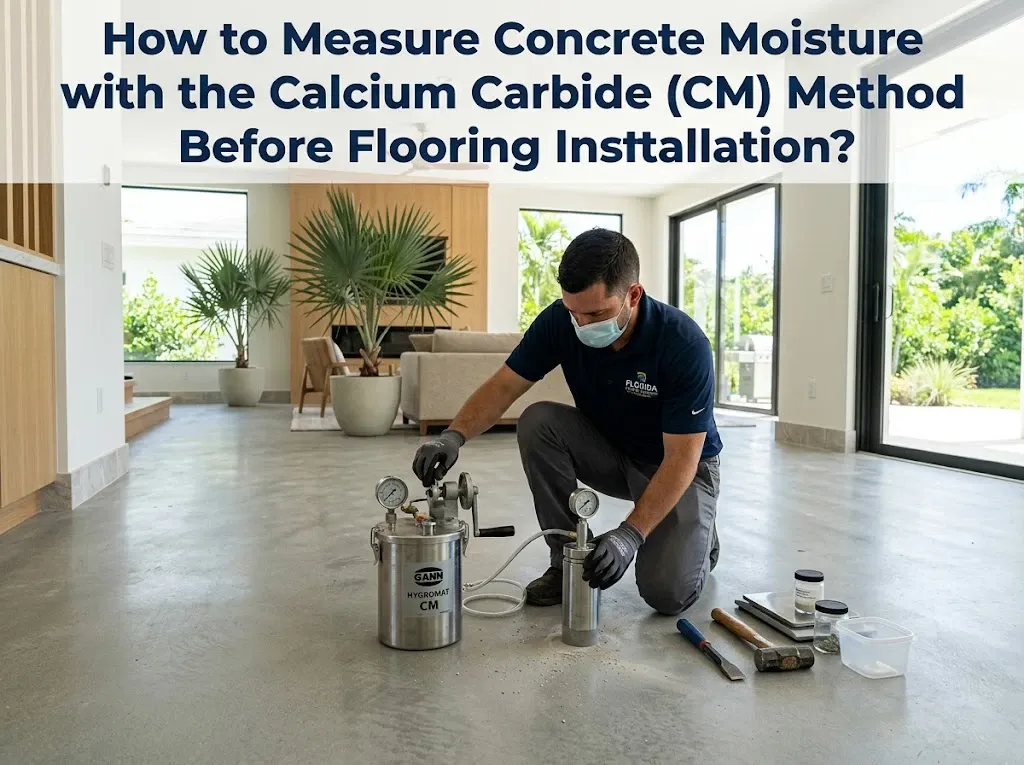
The CM (Calcium Carbide) method is the only scientifically accurate test for measuring deep-core moisture in concrete slabs before laminate flooring installation. A sample is extracted from the center of the slab, sealed with a calcium carbide reagent, and the resulting gas pressure is read on a calibrated manometer.
A reading above 2.0 % CM on a cement slab means the slab is not ready for flooring. Installing laminate over it will cause warping, joint failure, and voided manufacturer warranties — the reading is a pass/fail gate, not a general guideline.
The Invisible Risk in Florida Slab-on-Grade Homes
For homeowners in Brandon, Riverview, and Tampa, the ground beneath a slab-on-grade home is a constant source of water vapor. Concrete is naturally porous and pulls moisture from the soil through capillary action.
In the Tampa Bay area, where the water table sits 1–2.5 meters below grade, skipping a rigorous moisture check is the leading cause of post-installation failure. When moisture exceeds safe thresholds, the HDF core absorbs the vapor, causing “peaking” at joints and structural degradation that no manufacturer warranty will cover.
Why Electronic Meters Often Fail in Humid Climates
Many contractors rely on electronic impedance meters for speed. While fast, these tools are easily misled by Florida’s conditions. On a hot day in Hillsborough County, the slab surface may appear dry because of interior air conditioning while the core remains saturated.
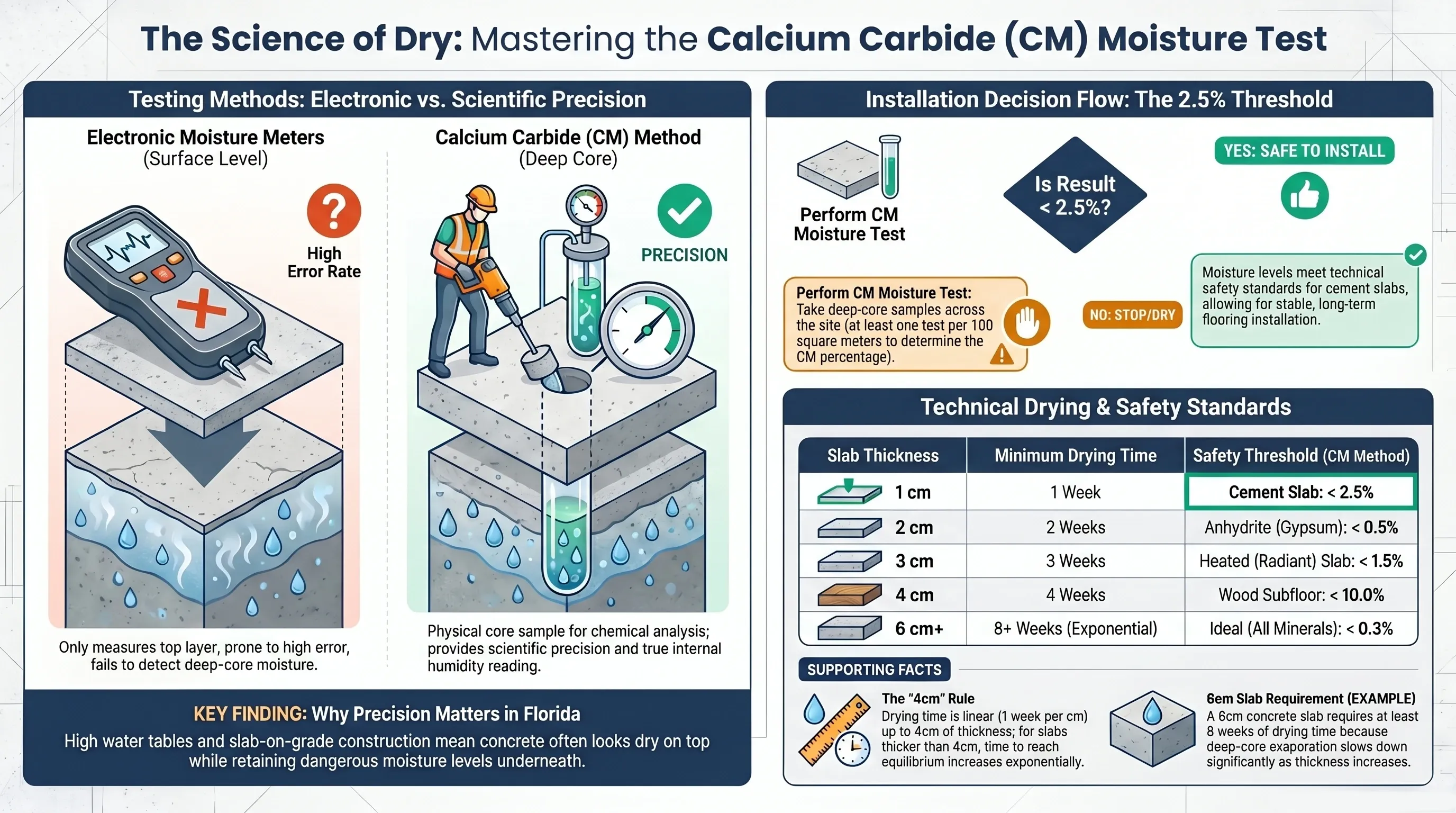
Electronic meters only measure the top 6–10 mm of concrete, a surface film reading, and their output is also skewed by surface salts and carbonation layers. The CM method bypasses these errors by using a chemical reaction on a physical sample extracted from the middle depth of the slab, providing a scientifically precise reading of the internal moisture state.
The Professional CM Testing Protocol
The procedure follows four fixed steps per DIN 18560-4 and EN 1803, each one dependent on the step before it:
- Deep-core sampling — A rotary hammer extracts material from the center depth of the slab, typically 7–8 cm on a 15 cm pour, where moisture concentrates most.
- Precision weighing — The sample is weighed to 0.1 g before being placed in the steel pressure cylinder.
- Chemical activation — A calcium carbide ampoule is crushed inside the sealed vessel. Moisture in the concrete reacts with the carbide to produce acetylene gas.
- Manometer reading — Pressure on the gauge correlates directly to percent moisture by weight. If the reading exceeds 2.0 % CM, installation is halted until the slab dries further.
Skipping any single step invalidates the reading. A rushed weighing or a contaminated sample produces a number that looks precise but does not reflect the slab’s actual internal moisture state.
Calculating Drying Times in Humid Climates
New concrete dries at approximately one week per centimeter of thickness under controlled conditions, roughly 20 °C and 65 % RH, as a practical industry guideline rather than a formal testing standard. A standard 15 cm residential slab therefore needs a minimum of 15 weeks under those ideal conditions.
In Tampa Bay’s high-humidity environment — where ambient RH regularly exceeds 75 % from June through September — the process runs longer than the guideline suggests. Rushing installation to save a few days often results in a full floor replacement within a year, at a cost far exceeding the price of professional testing.
| Slab thickness | Minimum drying time (controlled conditions) | Typical drying time in Tampa Bay summer |
|---|---|---|
| 10 cm | 10 weeks | 12–14 weeks |
| 15 cm | 15 weeks | 18–22 weeks |
| 20 cm | 20 weeks | 24–28 weeks |
The Moisture Barrier: Second Line of Defense
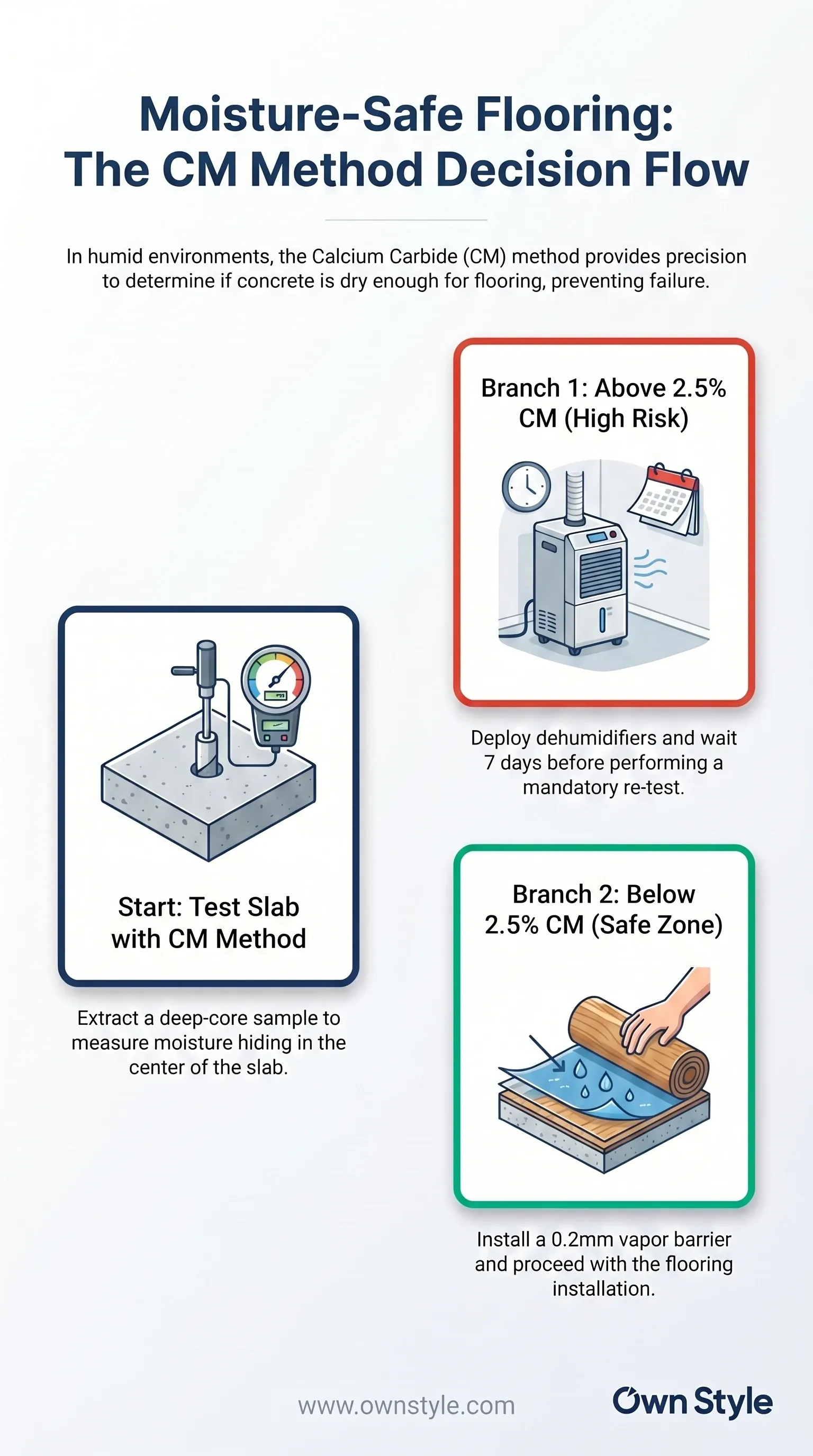
Even when a slab tests below the safe threshold, a professional installation always includes a high-quality moisture barrier. A 0.2 mm polyethylene film with an SD value greater than 75 m is the standard specification per DIN 18365 and EN 13329.
The barrier acts as a permanent shield against future water-table fluctuations or seasonal heavy rains. Without an SD-rated barrier, moisture from the ground will eventually reach the laminate’s locking system, causing click joints to become brittle and fracture — even on a slab that passed its CM test on installation day.
Professional Testing vs. DIY Risks
CM test equipment can be rented, but it requires precise calibration and a working understanding of concrete chemistry to use correctly. A miscalibrated gauge or a contaminated sample produces a false “pass” reading — a silent error that will not manifest until the floor begins to rise and crack six months later.
Professional installation includes the engineering-grade testing that protects the entire investment. A failed DIY reading that misses real moisture in the slab typically costs far more to correct after the fact than the professional test would have cost upfront.
Does Every Concrete Slab Need CM Testing — Even an Old One?
Yes, and age works against the assumption that an older slab is automatically dry. A 20-year-old slab in Wesley Chapel can still fail a CM test if the water table has risen, a nearby irrigation line leaks, or drainage around the foundation has degraded since the home was built.
New construction and renovation projects fail the test for different reasons, which is why both need the same protocol rather than a shortcut version.
- New pours fail because the concrete has not finished its initial cure, regardless of how long ago the forms came off
- Older slabs fail because of a change in site conditions — plumbing, grading, or water table — not because of the original pour
- Slabs with a prior flooring removed fail more often than untouched slabs, since old adhesive or underlayment can trap moisture against the surface for years
- Additions poured at a different time than the main slab often test differently from the original structure, even a few feet away
What Happens If the Slab Fails the CM Test?
A failed reading is not the end of the project — it changes the sequence, not the outcome. The slab needs additional drying time, active dehumidification, or a moisture mitigation system such as an epoxy sealer before flooring can proceed safely.
- Extend drying time and re-test in 2–4 weeks for a slab that is close to the 2.0 % CM threshold
- Run dehumidifiers and fans in the space to accelerate evaporation from the surface
- Apply a two-part epoxy moisture mitigation coating for slabs that remain elevated after extended drying
- Re-test with a fresh CM sample after any mitigation step, since visual dryness does not confirm a passing reading
Planning a flooring project in Tampa Bay? Every quote starts with a moisture reading of the slab, at no cost. Get your free photo estimate or call (813) 455-5756.
Frequently asked questions
What is the maximum moisture level for laminate flooring on a cement slab?
For standard cement slabs, moisture content must be below 2.0 % CM per DIN 18560-4, tested with the calcium carbide method. For anhydrite (gypsum) subfloors the limit is stricter at 0.5 % CM per DIN 18560-1, since anhydrite reacts differently to residual moisture than cement.
Can I use a pin meter from a hardware store instead of the CM method?
Pin meters only read the top 6 mm of the slab. In coastal Florida climates, the surface can appear dry from AC-driven evaporation while the core remains saturated, leading to floor failure months later. The CM method extracts a deep-core sample for a scientifically precise reading instead.
How long does it take for a new concrete slab to dry in Florida?
Concrete dries at approximately one week per centimeter of thickness under controlled conditions, as a practical guideline rather than a formal standard. In high-humidity areas like Tampa Bay, a standard 15 cm residential slab requires 10 to 16 weeks before reaching safe moisture levels for flooring.
What happens if laminate is installed on a wet slab?
The HDF core absorbs vapor through the underside of the planks, causing them to swell unevenly. Edges lift and create a washboard effect across the floor, the locking mechanism fractures under the added stress, and a full floor replacement becomes necessary within months.


US standard for measuring relative humidity inside a concrete slab using in-situ probes drilled to 40% of slab depth, read after 72 hours of equilibration.
US standard for measuring moisture vapor emission from a concrete slab using anhydrous calcium chloride, expressed in pounds per 1,000 sq ft per 24 hours.
US standard practice for preparing concrete floors to receive resilient flooring. Covers flatness, cleanliness, and moisture condition before installation.
The building code in force across Florida, including moisture and structural requirements that apply to slab-on-grade residential construction.
European deep-core moisture test that reacts a slab sample with calcium carbide and reads the resulting gas pressure. Supporting knowledge: the applicable US standards are ASTM F2170 and F1869.
Supporting knowledge — not the standard we work toGerman standard series for floor screeds, source of the widely cited 2.0% CM cement and 0.5% CM anhydrite thresholds. Supporting knowledge, not the applicable US standard.
Supporting knowledge — not the standard we work toHigh-Density Fiberboard: the compressed wood-fiber core of most laminate planks. It absorbs water vapor and swells irreversibly, which is why slab moisture matters.
Stone Plastic Composite: rigid vinyl core made of limestone powder and PVC. Dimensionally stable under humidity swings and unaffected by water.
Wood Plastic Composite: vinyl core with wood flour and foaming agents. Softer and warmer underfoot than SPC, and less dimensionally stable.
Luxury Vinyl Plank: multi-layer vinyl flooring in plank format. Fully waterproof as a material, though the subfloor beneath still governs installation.
Abrasion Class rating for laminate wear resistance, from AC1 to AC6. AC4 suits normal residential use; AC5 handles heavy traffic and light commercial.
A sheet layer placed between slab and flooring to block ground moisture vapor. Required over slab-on-grade construction regardless of surface dryness.
Foundation type where the concrete slab sits directly on the ground, dominant in Florida residential construction. Ground moisture migrates upward continuously.
The permitted deviation of a subfloor across a given span. The common benchmark is 3/16 inch over 10 feet; beyond that, deviation transfers into the locking joints.
A pourable cement-based compound that flows to a level surface, used to correct slab deviation. Needs 24 to 72 hours of cure before flooring goes down.
The 8 to 10 mm clearance left between a floating floor and every fixed vertical surface, absorbing seasonal expansion. Bridging it transfers stress to the joints.
Conditioning flooring material inside the room where it will be installed, 48 to 72 hours before installation, so it reaches interior temperature and humidity.
An angle-in locking profile that joins planks without adhesive. The insertion angle is specified by the manufacturer; forcing it deforms the profile permanently.
The raised ridge that forms along plank edges when a floating floor expands without room to move. In Florida the usual causes are slab moisture or a bridged expansion gap.