
Diagnosing Raised Laminate Edges (Peaking): Perimeter Gaps vs. Deep Moisture
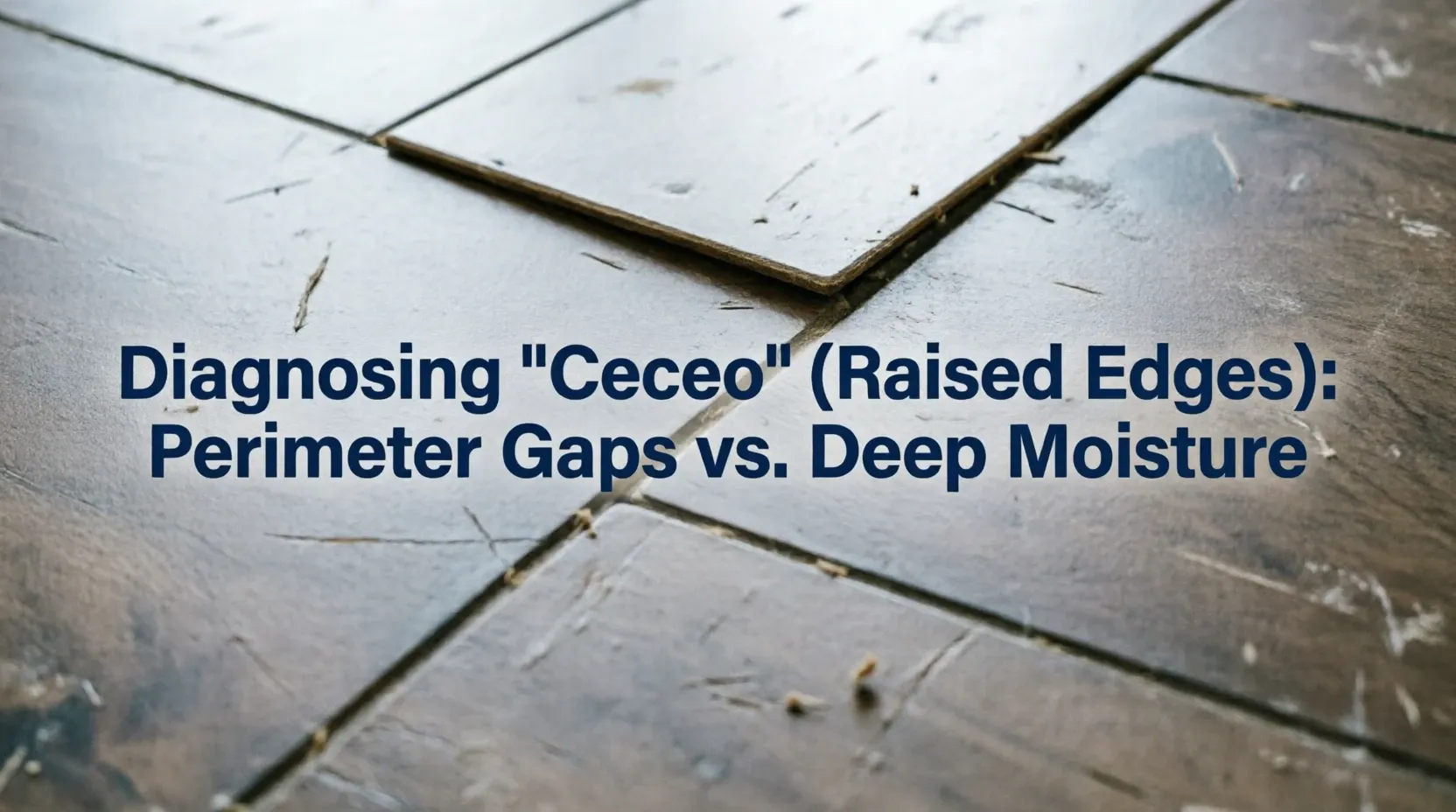
“Peaking” — raised laminate joints — occurs when expansion force has no perimeter relief and pushes upward at the weakest click-lock point. Two causes exist: perimeter tension (planks locked against walls without the 10 mm gap) and capillary moisture (HDF swollen by vapor through an inadequate barrier). Tension peaking is reversible; moisture peaking requires plank replacement.
What Is Peaking and Why Does It Happen in Florida?
Peaking occurs when laminate planks expand beyond the space available to them. Because laminate is made of High-Density Fiberboard (HDF), it is hygroscopic — it grows as humidity rises. In Tampa Bay, where indoor relative humidity can spike during summer, planks naturally want to expand. Without room to move, the expansion force pushes planks against each other, and since they cannot move horizontally, they deflect vertically at the weakest point: the click joint.
The Perimeter Trap — Missing Expansion Gaps
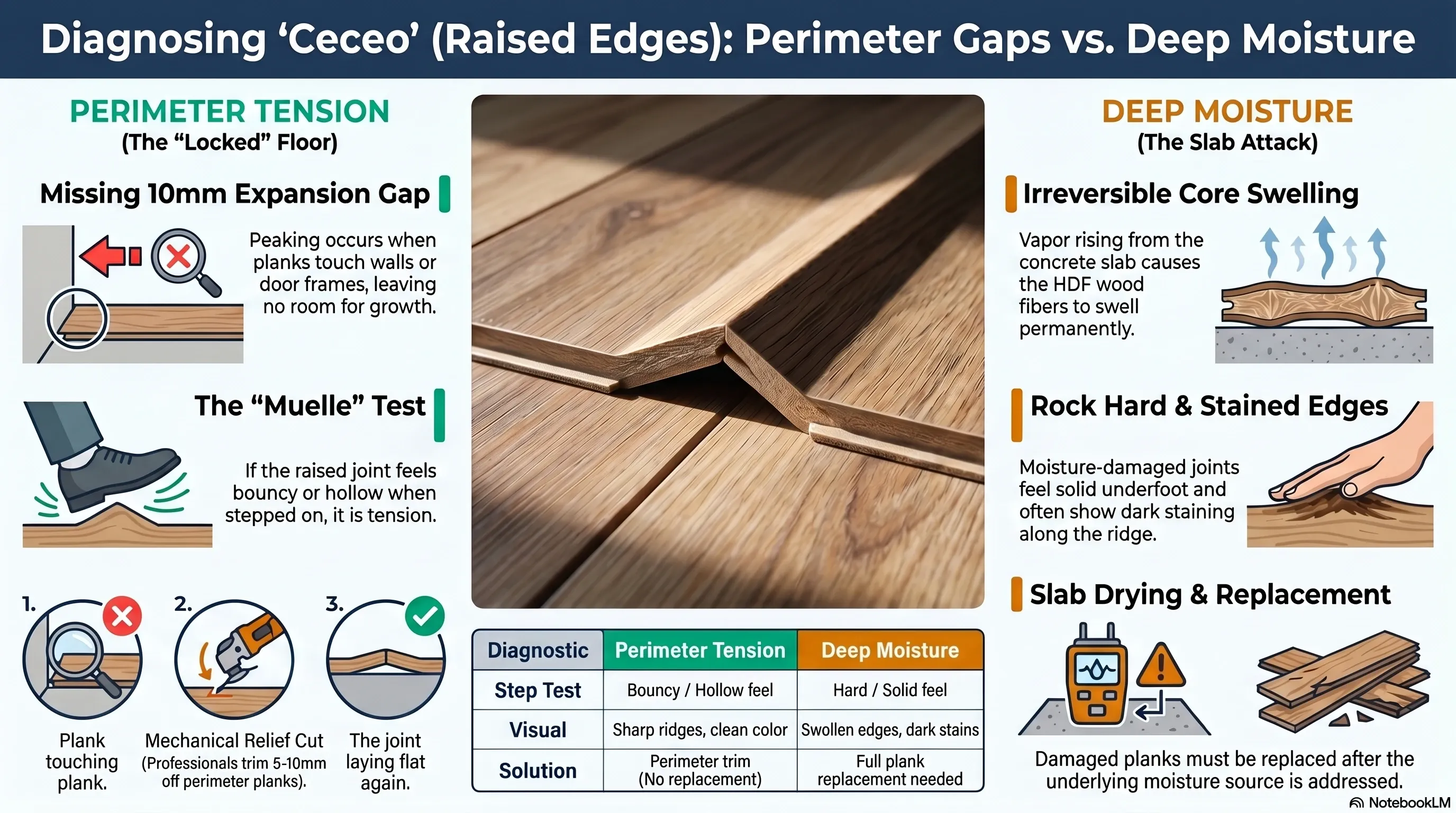
The most frequent cause of peaking in Tampa Bay homes is a “locked” floor. Professional standards require a minimum 10 mm (3/8 in) gap between the laminate and every vertical obstruction — walls, door frames, kitchen islands. If the floor was laid too tightly or baseboards were nailed into the flooring instead of the wall, the floor is pinned. When humidity rises, the floor tries to grow, hits the wall, and joints peak in the center of the room to relieve the accumulated pressure.
Deep Moisture — When the Slab Attacks the HDF
If perimeter gaps are correct but edges still rise, capillary moisture is the likely culprit. In Tampa Bay’s high water-table environment, vapor can rise through a concrete slab lacking a proper SD > 75 m vapor barrier. This moisture attacks the unsealed tongue-and-groove joints on the underside of planks. As wood fibers absorb water, they swell irreversibly. This type of peaking is often accompanied by “crowning” (plank curvature) or dark staining along joints.
Tension Peaking vs. Moisture Peaking — Side by Side
The two causes produce different symptoms and require entirely different fixes. Confusing one for the other leads to a relief cut that does nothing, or a full plank replacement that was never necessary.
| Signal | Tension peaking | Moisture peaking |
|---|---|---|
| Root cause | Missing 10 mm perimeter gap | Slab vapor through failed barrier |
| Feel underfoot | Bouncy, hollow at the joint | Rock hard, does not flex |
| Accompanying signs | None beyond the raised joint itself | Crowning, dark staining, musty odor |
| Correct fix | Perimeter relief cut | Plank replacement + source correction |
| Reversible? | Yes, within 48–72 hours | No — HDF swelling is permanent |
| Location pattern | Often room-wide, along walls | Often localized to one section or a specific slab area |
Is Peaking the Same Thing as Buckling or Crowning?
No, though the three terms get used interchangeably. Peaking is a raised joint at a single seam line, typically millimeters high. Crowning is a broader convex curve across the width of an individual plank, usually the first visible sign of moisture-driven swelling before a joint fully peaks. Buckling is the severe end state — entire sections of flooring lifting away from the subfloor, sometimes by an inch or more, which only happens after peaking or crowning has gone uncorrected for an extended period under continued moisture exposure.
Why Does Peaking Often Appear at the Start of a New Season?
Peaking tends to show up in the first weeks after Tampa Bay’s dry winter gives way to the humid rainy season. A floor installed during winter, when indoor RH often sits near 30–40%, has planks at their smallest dimension. Once June arrives and outdoor humidity regularly exceeds 80%, indoor RH climbs toward 60% even with AC running, and the planks expand toward their maximum size in the same window. If the perimeter gap was undersized to begin with, this first full seasonal swing is when the floor runs out of room and a joint peaks — which is why the failure often gets blamed on “the new AC system” or “the humid summer” rather than the installation gap that was always the real cause.
Performing a Forensic Audit at Home
Professional diagnostic protocol:
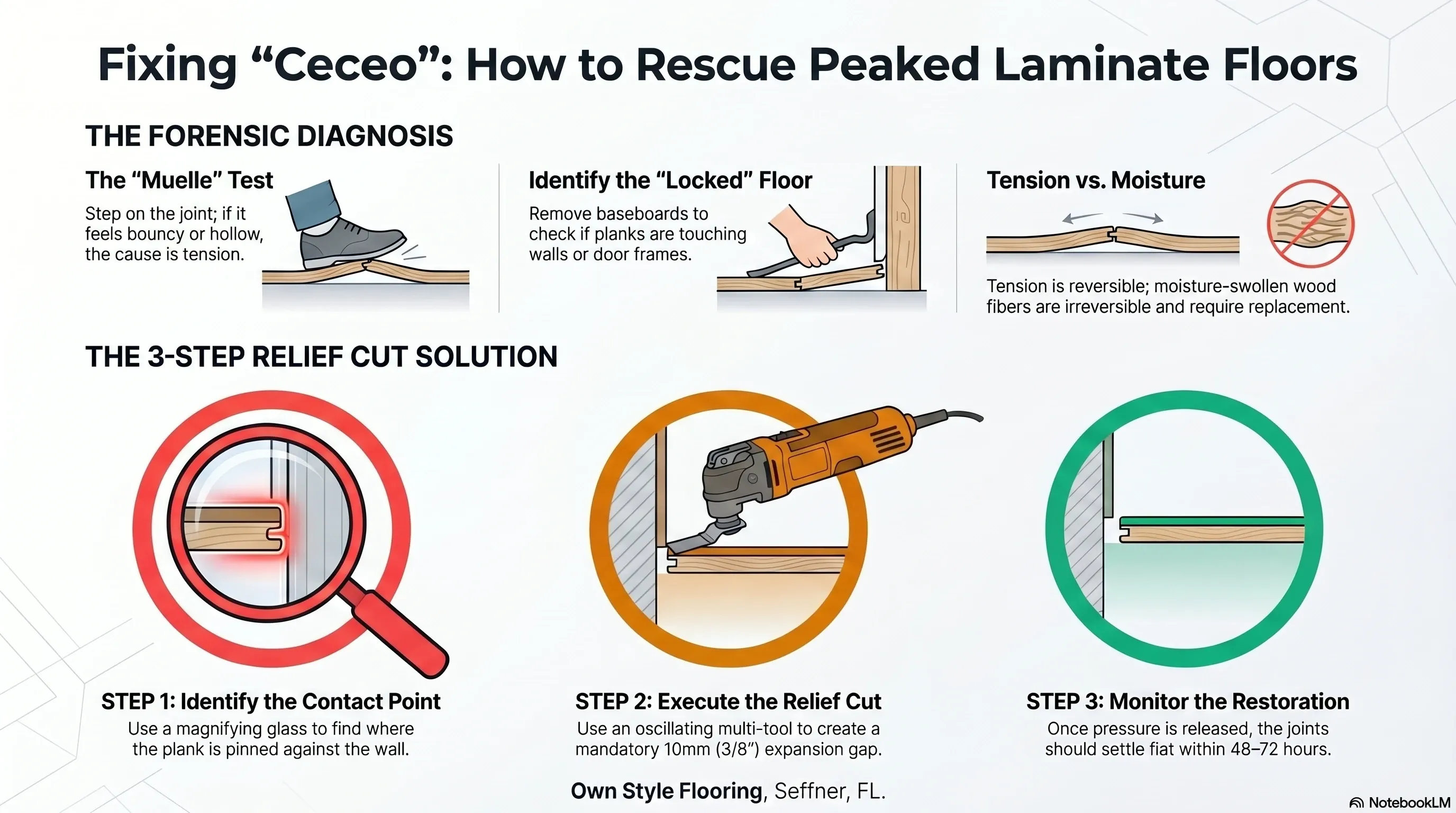
- Remove a piece of baseboard near the most severe peaking. Verify if planks touch the drywall. No gap = tension issue.
- The “spring” test — Step on the peaked joint. Bouncy or hollow = tension. Rock hard but still raised = HDF swelling from moisture.
- Check door frames — If laminate was not undercut and instead cut around the frame, it is likely “pinched” at that point, preventing the entire floor from floating.
Remediation for Perimeter Tension
If the diagnosis is insufficient expansion space, the floor can often be saved without dismantling. A professional oscillating saw performs a “perimeter relief cut” — carefully trimming 5–10 mm off planks while they remain on the floor, creating necessary breathing room. Once pressure is released, peaked joints typically settle back to a flat position within 48 to 72 hours.
A relief cut is a precision operation, not a job for a standard circular saw. The blade has to trim 5–10 mm off the edge of a plank that is already locked into a floating floor, without lifting adjoining rows or nicking the finished surface. An oscillating multi-tool with a fine flush-cut blade, guided along a straightedge, is the standard approach; a miscalculated cut that removes too little leaves the tension unresolved, and one that removes too much creates a visible gap at the wall line.
Does Peaking Show Up More in Older Tampa Bay Homes?
Slab age matters less than vapor barrier history. Homes built before vapor barriers became standard practice under concrete slabs — common across older neighborhoods in Tampa, Brandon, and Riverview — carry a higher baseline risk of moisture peaking regardless of when the laminate itself was installed. A newer home is not automatically protected either: a slab poured without a continuous, properly lapped vapor barrier transmits ground moisture the same way an older one does. The determining factor is always the vapor barrier’s condition and rating, not the age of the structure around it.
Dealing with Moisture Damage — When to Replace
If peaking is caused by deep slab moisture, a simple cut will not fix it. The swollen HDF core has undergone irreversible structural change. Affected planks must be replaced. Before installing new boards, the root cause must be addressed — industrial dehumidifiers to dry the slab or a technical moisture-blocking primer if the original vapor barrier failed. Installing new planks over a wet slab only delays the recurrence by months.
What Happens If Peaking Is Left Untreated?
The joint keeps working itself further open with every AC cycle. A tension-related peak that could have been solved with a relief cut in its first weeks tends to fracture the HDF tongue after months of repeated foot traffic flexing the raised joint, at which point the fix changes from a same-day cut to a plank replacement. A moisture-related peak left in place spreads as the slab continues emitting vapor, turning one raised joint into a section of crowned and stained planks that requires a wider repair than the original spot would have needed.
Prevention Through Correct Installation
Preventing peaking altogether comes down to two verifiable steps at installation: a confirmed 10 mm perimeter gap at every wall, door frame, and fixed obstruction, and a continuous vapor barrier rated above SD 75 m under the slab before the first plank goes down. Both are checks a homeowner can ask to see documented — a photo of the gap spacers in place and a note of the vapor barrier’s SD rating — before signing off on a finished installation.
Planning a flooring project in Tampa Bay? Every quote starts with a moisture reading of the slab, at no cost. Get your free photo estimate or call (813) 455-5756.
Frequently asked questions
Can raised edges be fixed by placing heavy furniture on them?
No. Heavy furniture can worsen the problem by pinning the floor and preventing it from expanding toward the walls. This increases joint tension and can cause the click system to snap.
Does waterproof laminate still get raised edges?
Yes. Even waterproof laminate has an HDF core that reacts to humidity and temperature. If the required 10 mm expansion gap is missing, even the highest-end waterproof product will peak in Tampa Bay's climate.
How long after installation does peaking usually appear?
It often appears during the first change of seasons. If the floor is installed during a dry winter without adequate gaps, it will peak as soon as humid Florida summer arrives and the planks expand.
Will the warranty cover raised edges?
Most manufacturer warranties specifically exclude damage caused by improper installation, including lack of expansion gaps or installation over a wet slab. Professional installation is a vital safeguard for this reason.
Is peaking the same as crowning or buckling?
No. Peaking is a raised joint at a single seam. Crowning is a convex curve across one plank, often the first sign of moisture swelling. Buckling is sections of flooring lifting away from the subfloor, the severe end state after peaking or crowning goes uncorrected.
Does peaking mean the whole floor needs to be replaced?
Not necessarily. Tension peaking caused by a missing perimeter gap is often reversible with a relief cut, restoring the affected joints within 48 to 72 hours. Only moisture-driven peaking, where the HDF core has swollen permanently, requires replacing the affected planks.



US standard for measuring relative humidity inside a concrete slab using in-situ probes drilled to 40% of slab depth, read after 72 hours of equilibration.
US standard for measuring moisture vapor emission from a concrete slab using anhydrous calcium chloride, expressed in pounds per 1,000 sq ft per 24 hours.
US standard practice for preparing concrete floors to receive resilient flooring. Covers flatness, cleanliness, and moisture condition before installation.
The building code in force across Florida, including moisture and structural requirements that apply to slab-on-grade residential construction.
European deep-core moisture test that reacts a slab sample with calcium carbide and reads the resulting gas pressure. Supporting knowledge: the applicable US standards are ASTM F2170 and F1869.
Supporting knowledge — not the standard we work toGerman standard series for floor screeds, source of the widely cited 2.0% CM cement and 0.5% CM anhydrite thresholds. Supporting knowledge, not the applicable US standard.
Supporting knowledge — not the standard we work toHigh-Density Fiberboard: the compressed wood-fiber core of most laminate planks. It absorbs water vapor and swells irreversibly, which is why slab moisture matters.
Stone Plastic Composite: rigid vinyl core made of limestone powder and PVC. Dimensionally stable under humidity swings and unaffected by water.
Wood Plastic Composite: vinyl core with wood flour and foaming agents. Softer and warmer underfoot than SPC, and less dimensionally stable.
Luxury Vinyl Plank: multi-layer vinyl flooring in plank format. Fully waterproof as a material, though the subfloor beneath still governs installation.
Abrasion Class rating for laminate wear resistance, from AC1 to AC6. AC4 suits normal residential use; AC5 handles heavy traffic and light commercial.
A sheet layer placed between slab and flooring to block ground moisture vapor. Required over slab-on-grade construction regardless of surface dryness.
Foundation type where the concrete slab sits directly on the ground, dominant in Florida residential construction. Ground moisture migrates upward continuously.
The permitted deviation of a subfloor across a given span. The common benchmark is 3/16 inch over 10 feet; beyond that, deviation transfers into the locking joints.
A pourable cement-based compound that flows to a level surface, used to correct slab deviation. Needs 24 to 72 hours of cure before flooring goes down.
The 8 to 10 mm clearance left between a floating floor and every fixed vertical surface, absorbing seasonal expansion. Bridging it transfers stress to the joints.
Conditioning flooring material inside the room where it will be installed, 48 to 72 hours before installation, so it reaches interior temperature and humidity.
An angle-in locking profile that joins planks without adhesive. The insertion angle is specified by the manufacturer; forcing it deforms the profile permanently.
The raised ridge that forms along plank edges when a floating floor expands without room to move. In Florida the usual causes are slab moisture or a bridged expansion gap.