How Florida Humidity Destroys the Wrong Flooring — and What Actually Survives in Tampa Bay
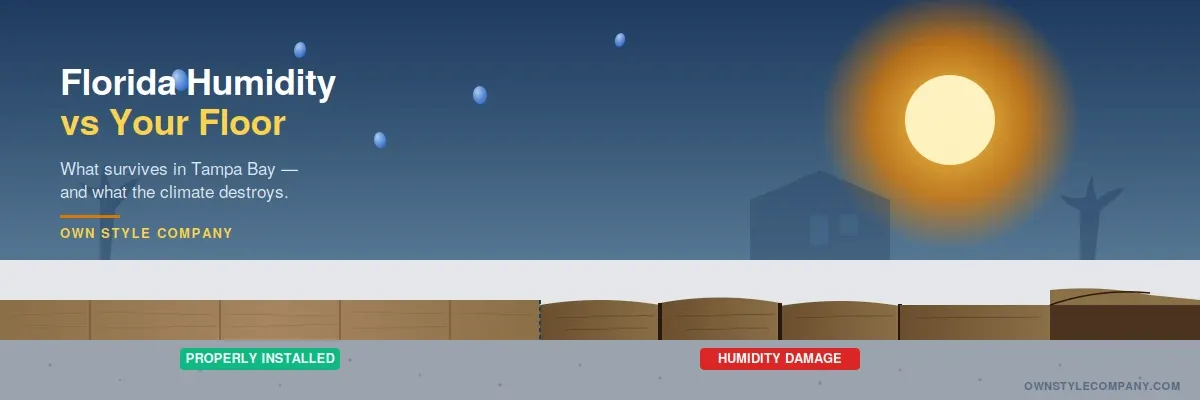
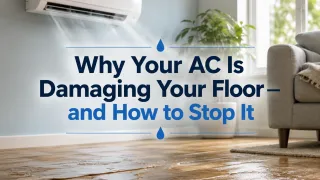
Florida humidity and A/C cycling destroy flooring faster than almost any other climate in the United States. In Tampa Bay, year-round humidity averaging 75 %, A/C running 9+ months a year, and concrete slab foundations create conditions most flooring products were never designed to handle.
Most laminate and engineered wood fall into that unprepared category. The floors that actually survive are waterproof luxury vinyl plank (LVP), properly sealed ceramic or porcelain tile, and a small category of laminate rated AC4 or higher installed with a proper moisture barrier.
Why does Florida humidity damage flooring so badly?
Wood and wood-based flooring (including laminate, which has a wood-fiber core) is hygroscopic — it absorbs and releases moisture from the air. In a dry climate, this cycle is small and predictable. In Florida, the air can hold 75 % relative humidity in the morning, drop to 50 % when the A/C has been running for four hours, and climb back to 70 % overnight. That constant swing expands and contracts the flooring every single day for years.
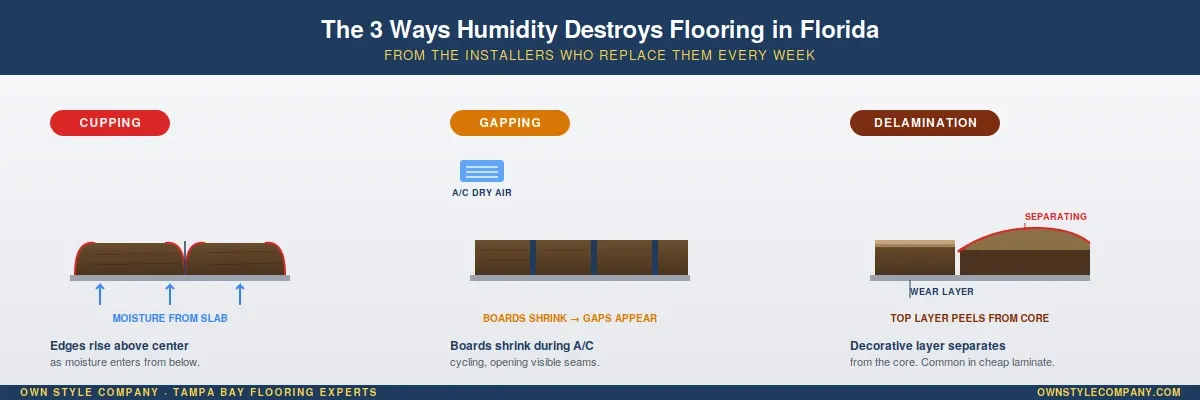
Three failure modes follow:
- Cupping — the edges of boards rise above the center as moisture enters from below.
- Gapping — boards shrink during prolonged A/C running, opening visible seams.
- Delamination — the decorative wear layer separates from the core. Most common in the cheapest budget laminate.
What flooring actually survives in Tampa Bay?
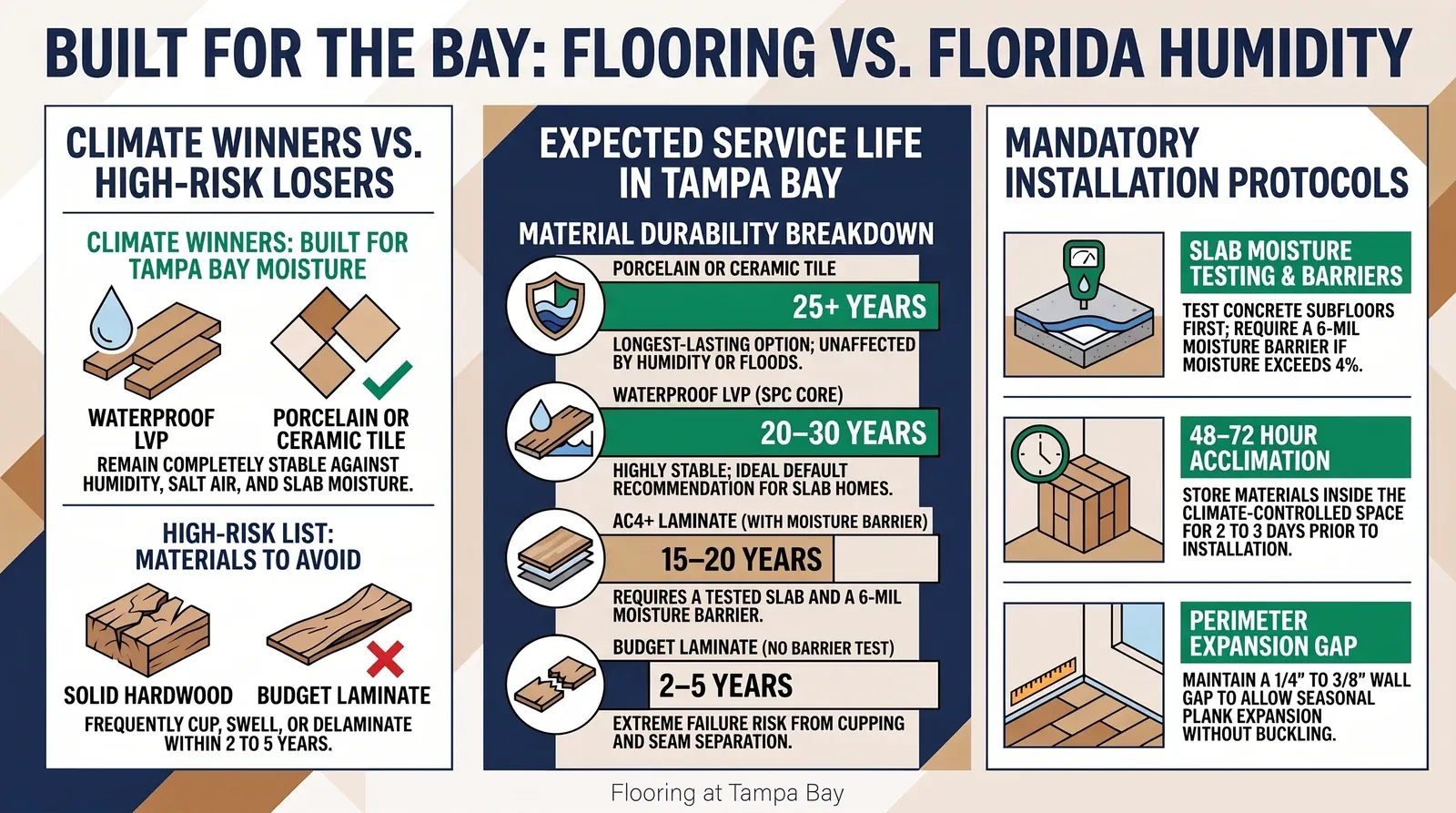
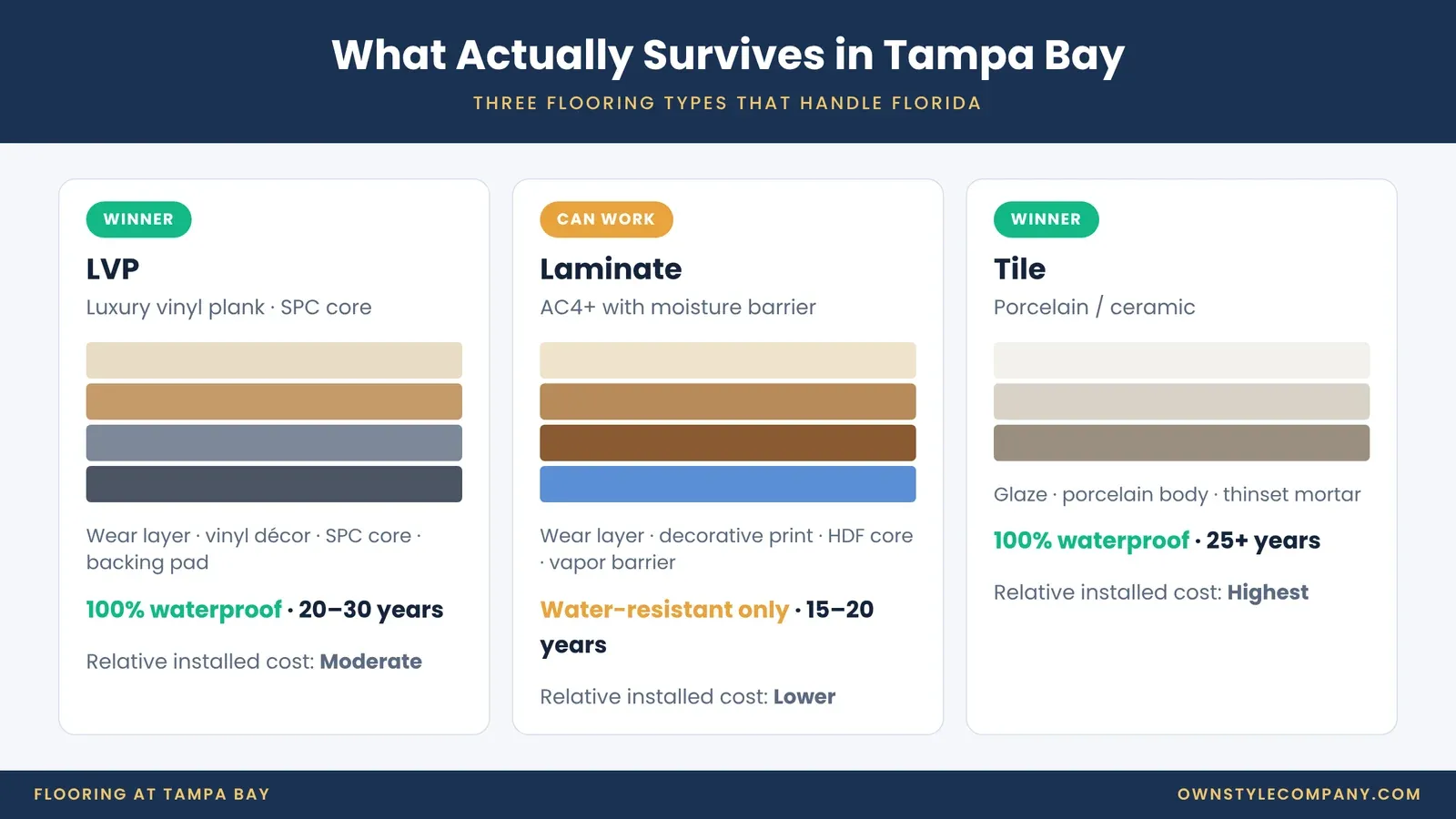
Three material categories consistently hold up to Tampa Bay’s humidity and slab conditions, while everything else requires exceptions and extra protection to avoid failing within a few years. The table below compares expected lifespan and relative installed cost before each material gets its own detail.
| Material | Typical Lifespan in Tampa Bay | Relative Installed Cost |
|---|---|---|
| Waterproof LVP (SPC core) | 20–30 years | Moderate |
| AC4+ laminate with moisture barrier | 15–20 years | Lower |
| Porcelain or ceramic tile | 25+ years | Highest |
| Budget laminate, no moisture testing | 2–5 years | Lowest upfront, highest replacement risk |
Luxury Vinyl Plank (LVP) — the workhorse
LVP is 100 % waterproof, dimensionally stable through humidity swings, and tolerant of the A/C cycling that ruins laminate. SPC-core LVP in particular (Stone Plastic Composite) barely moves at all. For most Tampa Bay homes, this is the default recommendation. Installed cost depends on thickness and brand; our installation labor for LVP is $2 per square foot, and the rest is listed in our published prices.
AC4+ laminate with a proper moisture barrier
Not all laminate fails in Florida. Laminate rated AC4 or AC5 with a 12 mm core, installed over a 6-mil polyethylene moisture barrier on a slab that tested below 4 % moisture content, can last 15+ years. The problem is that 80 % of laminate installed in Tampa Bay is AC3 or lower, installed without moisture testing. That is the laminate installers keep tearing out.
Porcelain or ceramic tile
The original Florida flooring for a reason. Completely unaffected by humidity, easy to clean after a flood, and ideal for coastal homes with salt air. The trade-offs are cost (the highest installed cost of the three), hardness underfoot, and the demolition cost if the homeowner ever wants to change it later.
What flooring should Tampa Bay homeowners avoid?
Three flooring categories are not recommended for most Tampa Bay homes unless the property has exceptional, consistent climate control. Each one performs well in drier states but runs into the same humidity and slab-moisture problems that define this market, usually within the first few years of ownership:
- Solid hardwood on slabs. Most Tampa Bay homes are built on concrete slabs. Solid hardwood is not designed for direct slab installation and will cup, crown, or buckle within 2–3 humid seasons.
- Bamboo. Marketed as durable, but strand-woven bamboo swells dramatically under Florida humidity. Replacement calls in multiple Riverview and Brandon homes trace back to this swelling within four years of the original install.
- Budget laminate (the cheapest tier). Thin wear layer, weak core, no realistic moisture protection. Cupping within two years is almost guaranteed.
What Are the Early Warning Signs a Floor Is Already Failing?
Catching moisture damage early keeps a repair limited to a few planks instead of a full tear-out, and the signs are usually visible well before the floor looks obviously wrong.
- Slight edge lift along baseboards — an early cupping signal, often noticed first near sliding doors or exterior walls where slab moisture concentrates.
- A musty smell that returns after the A/C has been off — points to moisture trapped beneath the flooring rather than surface humidity.
- Seams that feel slightly rough or raised underfoot — indicates the core has already absorbed enough moisture to swell at the joint.
- Visible gaps that open in winter and close in summer — normal to a small degree, but gaps wider than 3 mm point to an undersized expansion allowance.
A moisture meter reading at the affected spot, compared against a reading from an unaffected room, confirms whether the cause is slab moisture or a one-time spill.
The installation details that matter more than the product
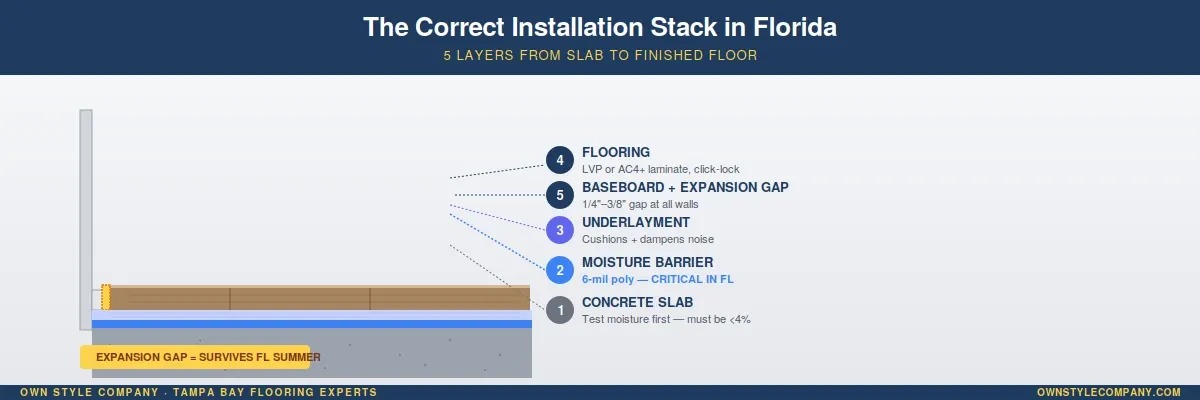
A premium LVP installed badly will fail faster than a budget laminate installed correctly. In Tampa Bay installs, these are the details that decide whether the floor survives 5 years or 20:
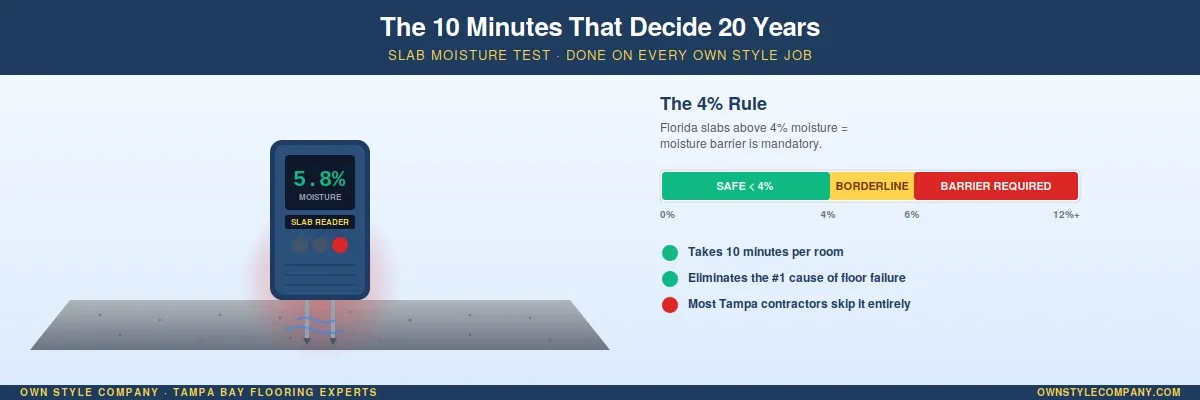
- Slab moisture test before install. Anything above 4 % moisture content means a moisture barrier is mandatory.
- Acclimation. The flooring sits in the home, in its final room, for 48–72 hours before installation so it matches the home’s humidity baseline.
- Expansion gap. Every plank floor needs a ¼″ to ⅜″ gap along walls and fixed objects. In Florida, skip this and the floor will buckle the first summer.
- Underlayment. Correct thickness, correct vapor properties, installed without seams overlapping the plank seams.
A slab moisture test takes 10 minutes and eliminates the single most common cause of premature floor failure.
Why Does Installation Timing Matter Across Florida’s Wet and Dry Seasons?
Installing during Tampa Bay’s June-through-September rainy season adds risk that has nothing to do with the flooring product itself, since ambient humidity during acclimation runs higher than at any other point in the year.
- Wet season (June–September): slab moisture readings run higher, acclimation should extend toward the full 72 hours, and the A/C should run continuously for at least 48 hours before testing the slab.
- Dry season (October–May): conditions sit closer to ideal for installation, though a home with the A/C off during a summer vacation still needs a fresh moisture reading before work starts.
- Year-round rule: as of 2026, no reputable installer skips a pre-install moisture test regardless of season — the season changes how cautious that test needs to be, not whether it happens.
What to do next
If you are planning a flooring project in Tampa Bay, start with two questions: (1) is your subfloor a concrete slab, and (2) what is the current moisture reading? Those two facts eliminate more than half the flooring options most manufacturers will try to sell you. A professional installer should test moisture before quoting, recommend a moisture barrier where needed, and size the expansion gap to Florida conditions — not to the minimum on the manufacturer’s instruction sheet.
Planning a flooring project in Tampa Bay? Every quote starts with a moisture reading of the slab, at no cost. Get your free photo estimate or call (813) 455-5756.
Frequently asked questions
How long does good flooring last in Tampa Bay?
Properly installed LVP or tile lasts 20–30 years in a Tampa Bay home. AC4+ laminate with a correctly sized moisture barrier lasts 15–20 years under the same humidity conditions. Budget laminate installed without moisture testing typically fails within 2–5 years, usually from cupping or delamination at the seams.
Does my A/C setting affect my floor?
Yes. Keep indoor relative humidity in the canonical 35–65 % RH range with the A/C running consistently. Aggressive cooling below 70 °F while outdoor humidity stays high creates condensation on the slab surface, driving moisture damage into the flooring from below rather than from the room air.
Can I install laminate over my existing tile?
Often yes, when the existing tile is level, intact, and structurally sound. A floating click-lock laminate or LVP installation over that tile eliminates demolition cost and shortens the project timeline. A subfloor check for cracks, loose tiles, or unevenness above 2 mm per meter should still happen first.
How do LVP, laminate, and tile compare in installed cost in Tampa Bay?
AC4+ laminate usually costs the least installed, LVP sits slightly above it, and porcelain tile costs noticeably more. Demolition of existing flooring and subfloor leveling are added when the job needs them. Our installation labor is $2.25 per square foot for laminate, $2 for LVP, and $8 for tile; material is quoted separately by product.
Is engineered hardwood a safe choice in Florida?
Sometimes. Thick engineered hardwood with a wear layer of 5 mm or more can perform well in a climate-controlled home with proper subfloor preparation and acclimatization. In coastal or uncontrolled environments, engineered hardwood still moves more than LVP or tile, making it a secondary choice rather than a default.
US standard for measuring relative humidity inside a concrete slab using in-situ probes drilled to 40% of slab depth, read after 72 hours of equilibration.
US standard for measuring moisture vapor emission from a concrete slab using anhydrous calcium chloride, expressed in pounds per 1,000 sq ft per 24 hours.
US standard practice for preparing concrete floors to receive resilient flooring. Covers flatness, cleanliness, and moisture condition before installation.
The building code in force across Florida, including moisture and structural requirements that apply to slab-on-grade residential construction.
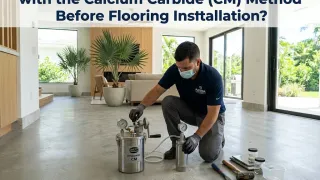
European deep-core moisture test that reacts a slab sample with calcium carbide and reads the resulting gas pressure. Supporting knowledge: the applicable US standards are ASTM F2170 and F1869.
Supporting knowledge — not the standard we work toGerman standard series for floor screeds, source of the widely cited 2.0% CM cement and 0.5% CM anhydrite thresholds. Supporting knowledge, not the applicable US standard.
Supporting knowledge — not the standard we work toHigh-Density Fiberboard: the compressed wood-fiber core of most laminate planks. It absorbs water vapor and swells irreversibly, which is why slab moisture matters.
Stone Plastic Composite: rigid vinyl core made of limestone powder and PVC. Dimensionally stable under humidity swings and unaffected by water.
Wood Plastic Composite: vinyl core with wood flour and foaming agents. Softer and warmer underfoot than SPC, and less dimensionally stable.
Luxury Vinyl Plank: multi-layer vinyl flooring in plank format. Fully waterproof as a material, though the subfloor beneath still governs installation.
Abrasion Class rating for laminate wear resistance, from AC1 to AC6. AC4 suits normal residential use; AC5 handles heavy traffic and light commercial.
A sheet layer placed between slab and flooring to block ground moisture vapor. Required over slab-on-grade construction regardless of surface dryness.
Foundation type where the concrete slab sits directly on the ground, dominant in Florida residential construction. Ground moisture migrates upward continuously.
The permitted deviation of a subfloor across a given span. The common benchmark is 3/16 inch over 10 feet; beyond that, deviation transfers into the locking joints.
A pourable cement-based compound that flows to a level surface, used to correct slab deviation. Needs 24 to 72 hours of cure before flooring goes down.
The 8 to 10 mm clearance left between a floating floor and every fixed vertical surface, absorbing seasonal expansion. Bridging it transfers stress to the joints.
Conditioning flooring material inside the room where it will be installed, 48 to 72 hours before installation, so it reaches interior temperature and humidity.
An angle-in locking profile that joins planks without adhesive. The insertion angle is specified by the manufacturer; forcing it deforms the profile permanently.
The raised ridge that forms along plank edges when a floating floor expands without room to move. In Florida the usual causes are slab moisture or a bridged expansion gap.