
The History of Flooring in the United States: From Dirt Floors to LVP
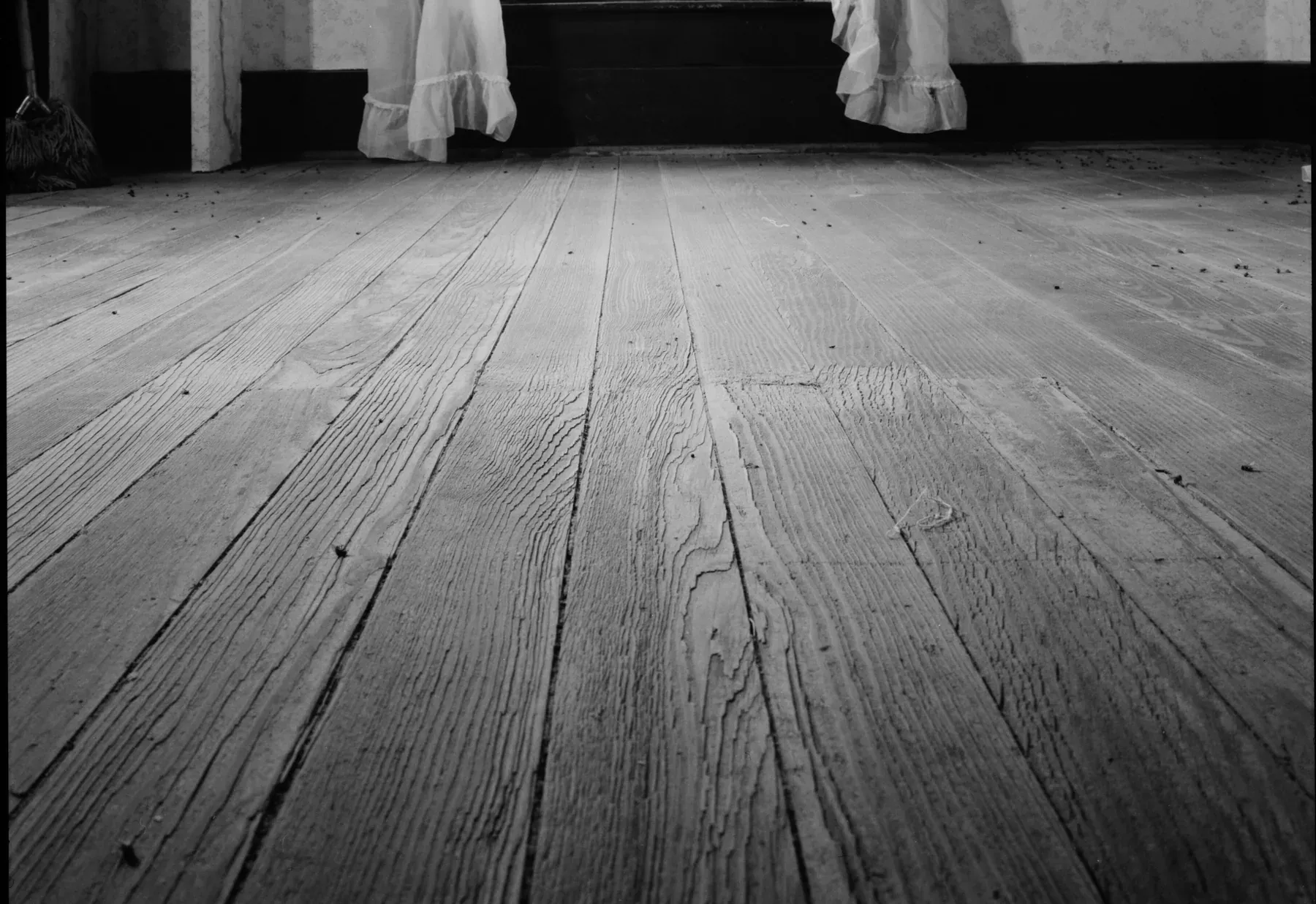
The history of flooring in the United States runs from packed-earth floors in the 1600s to hand-sawn pine planks, factory-milled oak strips, linoleum, wall-to-wall carpet, vinyl, laminate and, today, Luxury Vinyl Plank (LVP). Each change answered the same three needs: a floor that was cheaper to make, easier to clean, and better at handling moisture.
The moisture requirement explains why Florida homes look the way they do. Most houses in Tampa Bay sit on a concrete slab, and the floor that wins in this climate is the one that tolerates moisture rising through that slab. The story below follows four centuries of American floors and ends where most Florida renovations start in 2026: at the slab.
What were the first floors in colonial America?
The first floors in many colonial American homes were packed earth: dirt leveled, wetted and tamped until it was hard enough to sweep. Wood plank floors replaced earth as settlers turned the old-growth forests of the East Coast into lumber, first by hand with axes and pit saws, and later in water-powered sawmills.
Before machines, every board was cut and smoothed by hand. A pit saw needed two men, one standing on the log and one in a pit below it, and the rough boards came out about 1½ inches thick. Carpenters then flattened each board with hand planes and cut the joints with special grooving planes.
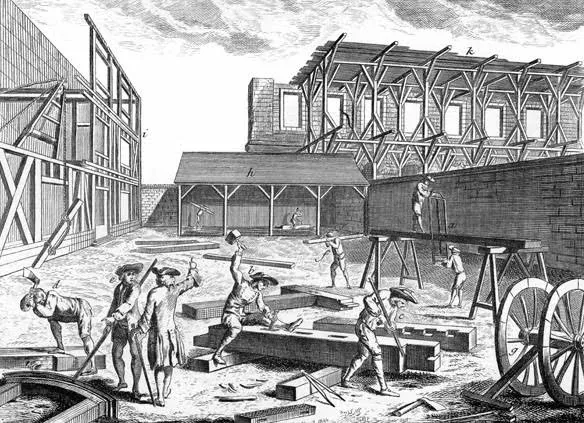
Carpenters squaring timber by hand, from Diderot’s Encyclopédie, 1760s. The scene is French, but the tools were the same in the colonies. Public domain.
The Fairbanks House in Dedham, Massachusetts, shows what survives from that era. Tree-ring dating places the cutting of its oldest timbers between 1637 and 1641, which makes it the oldest timber-frame house in North America verified by that method. Its rooms still have hand-hewn beams overhead and plank floors underfoot.
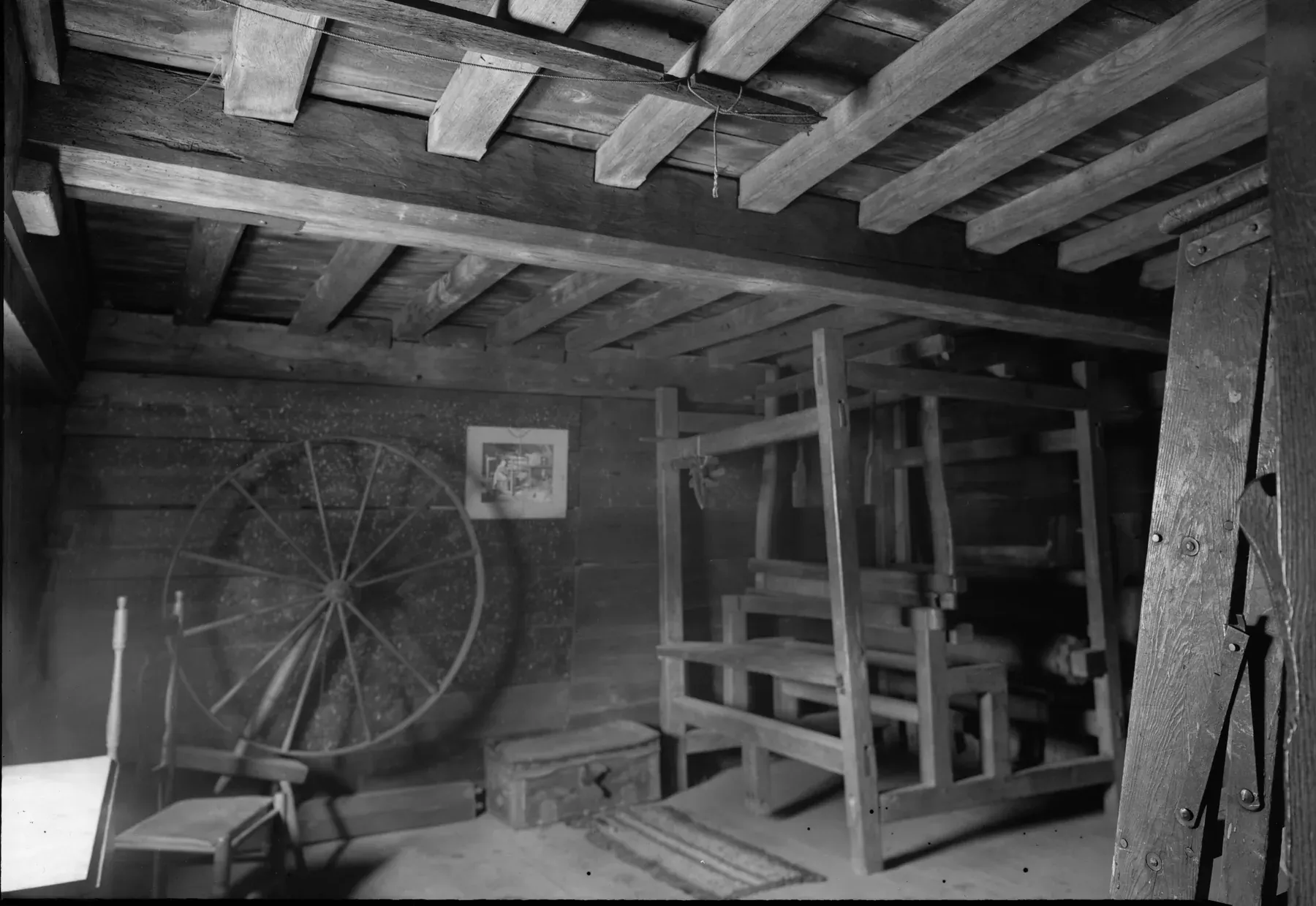
Workroom of the Fairbanks House in Dedham, Massachusetts, built around 1641. Historic American Buildings Survey, Library of Congress. Public domain.
Why do old American houses have such wide pine floorboards?
Old American houses have wide pine floorboards because the original forests were full of enormous trees, and a wide board meant fewer boards to cut, plane and nail. Eastern white pine was the common choice in New England: it grew straight, worked easily with hand tools and was available in widths that later generations would never see again.
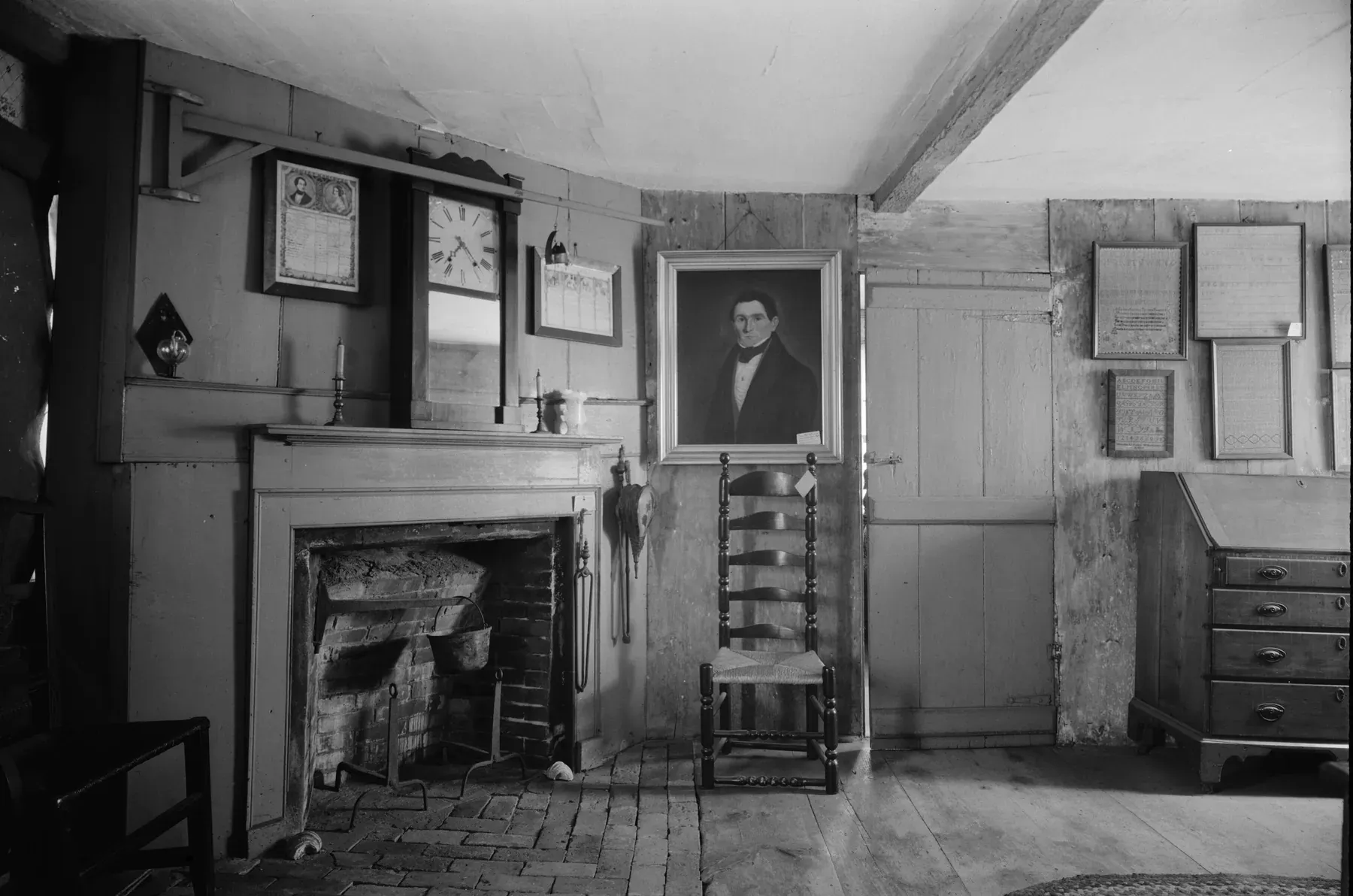
Parlor of the Fairbanks House, with its brick hearth and plank floor. Historic American Buildings Survey, Library of Congress. Public domain.
The biggest pines were not always available to builders. Under the Broad Arrow Policy, written into the Massachusetts charter of 1691, white pines 24 inches or more in diameter were reserved for the masts of the Royal Navy. The rule extended to New Hampshire in 1698 and to the rest of New England, New York and New Jersey in 1711. Old-house lore often links wide floorboards to this law. The law itself is documented. The floorboard connection is a story, not a record.
Frontier families farther west built the same way with whatever grew nearby. Log cabins often had split-log floors, called puncheon floors, with the flat face up, until a sawmill reached the area.
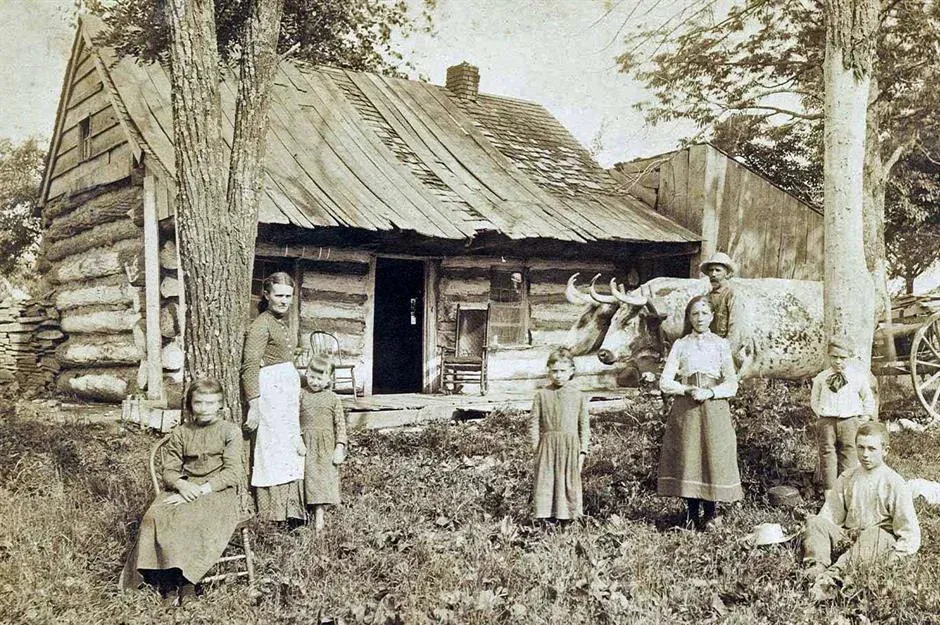
A family in front of their log cabin, late 1800s. Public domain.
How did homeowners cover wood floors before carpet and linoleum?
Before carpet and linoleum, homeowners covered wood floors with floorcloths: heavy linen or cotton canvas stretched, painted with several coats of oil paint and varnished. Floorcloths were common in 18th-century Virginia homes, according to The George Washington Foundation, which found fragments of one under the attic floorboards of Kenmore, a 1770s house in Fredericksburg.
Floorcloths solved real problems. A painted canvas imitated marble or tile for a fraction of the cost, wiped clean with a damp cloth, and moved to another room when fashions changed. Floors themselves were often painted too, especially once painted interiors became common in the mid-1800s.
Woven carpet took over the formal rooms of wealthier homes during the 1800s. In 1843, Fanny Longfellow described the new parlor of her house in Cambridge, Massachusetts, as “gay with flowers,” carpet included, according to the National Park Service, which runs the house today.
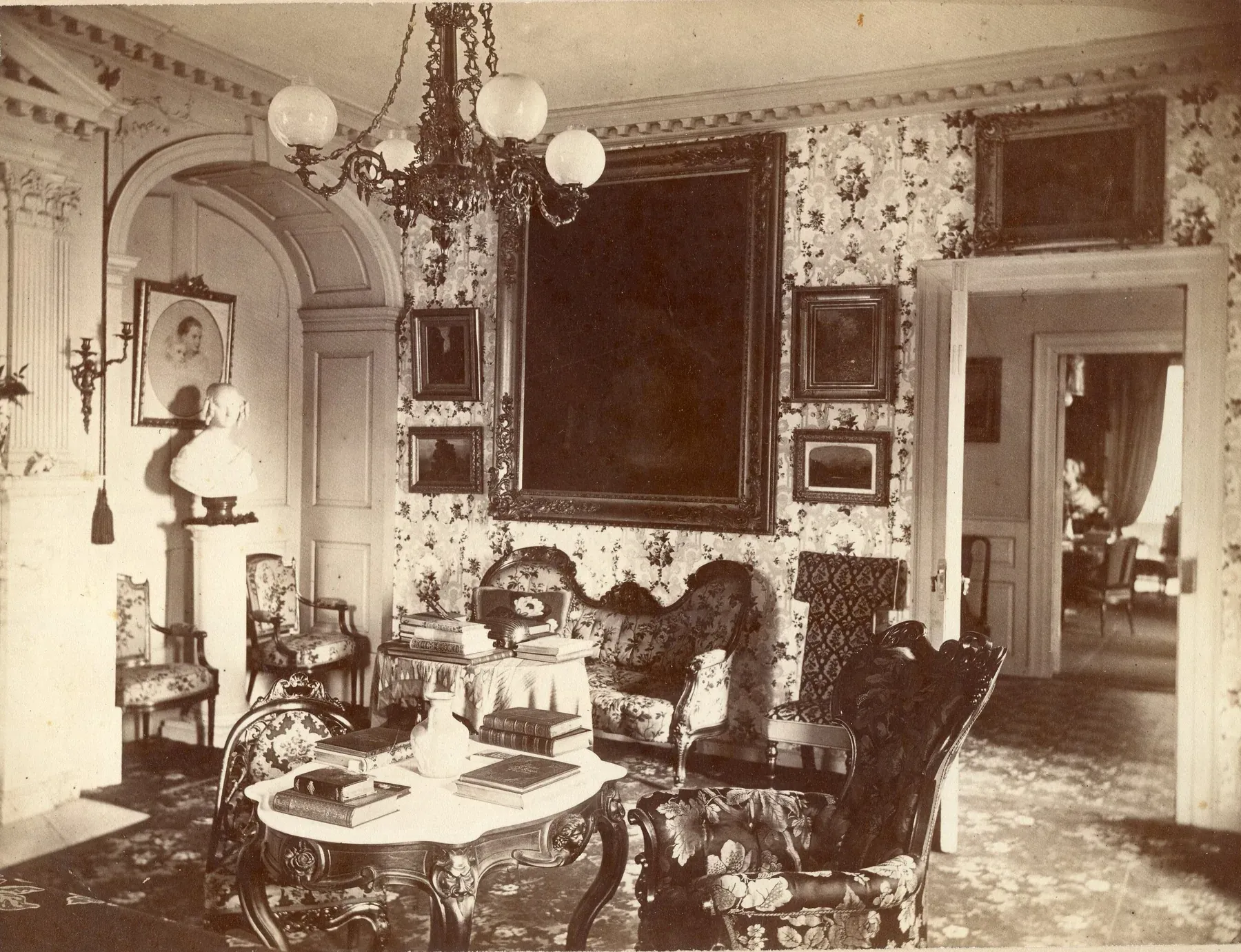
The parlor of the Longfellow House in Cambridge, Massachusetts, in 1871, with patterned carpet from wall to wall. National Park Service. Public domain.
When did floorboards start being made by machine?
Floorboards started being made by machine in the 1820s. In 1828, William Woodworth of Hudson, New York, began patenting planing machines that did the work of 25 laborers, and in 1850 the U.S. Congress praised the invention alongside Eli Whitney’s cotton gin. Steam power then turned flooring into a factory product with uniform thickness and machined tongue-and-groove edges.
The timber came from a logging industry that grew through the 1800s across Maine, Michigan, Wisconsin and the South. Logs moved on horse-drawn sleds over frozen roads in winter and floated downriver to the mills in spring.
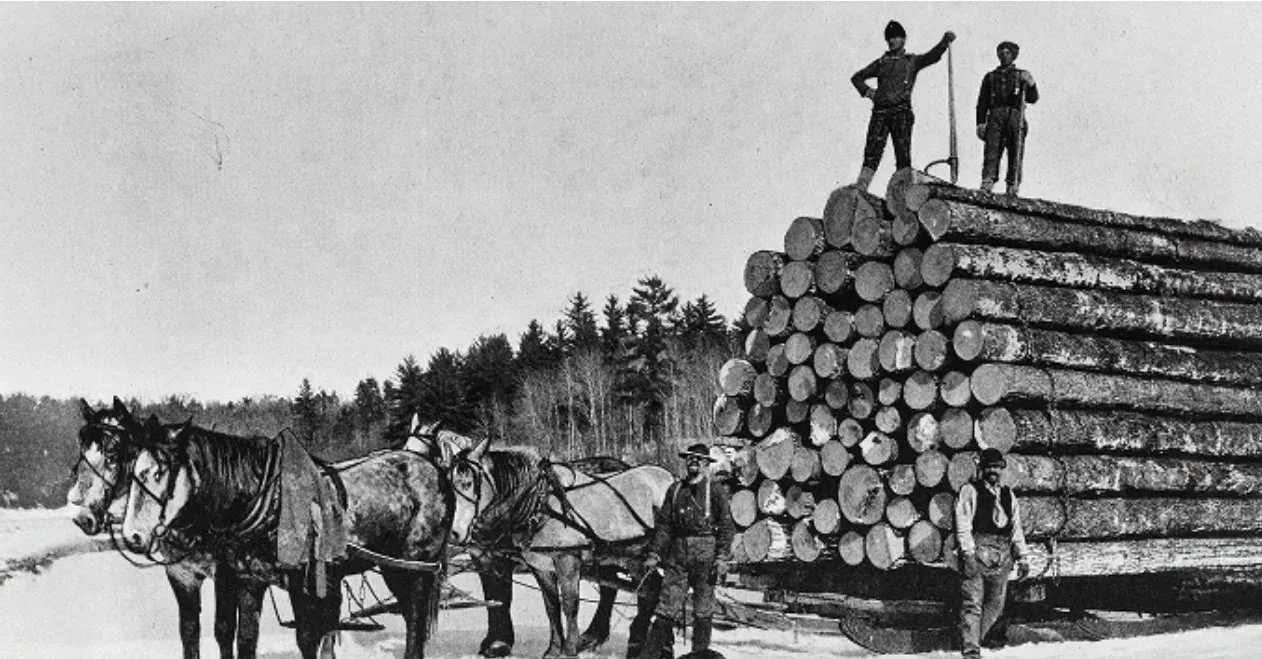
A winter log haul in the northern forests, late 1800s or early 1900s. Public domain.
By the early 1900s, the standard American floor was narrow oak strip flooring, 2¼ inches wide, with 1½-inch strips cut from smaller stock. These widths were not a design choice. They came from how mills cut the lumber, and they are the floors that still appear under old carpet in many 1920s homes.
What was “wood carpet”?
Wood carpet was a Victorian flooring product made of thin hardwood strips glued to a heavy cloth backing, sold in rolls and laid over existing floors like a carpet. In the 1880s, one Ohio maker offered more than 50 patterns at about $1.75 per linear yard. By the 1890s the strips were thicker and were nailed down through the backing.
Catalogs of the time sold wood carpet in quarter-sawed white oak, walnut or cherry, in strips about 1⅛ inches wide, and promised a floor “as cheap as good carpeting.” The product let a family put a parquet-style floor over plain softwood boards without tearing them out.
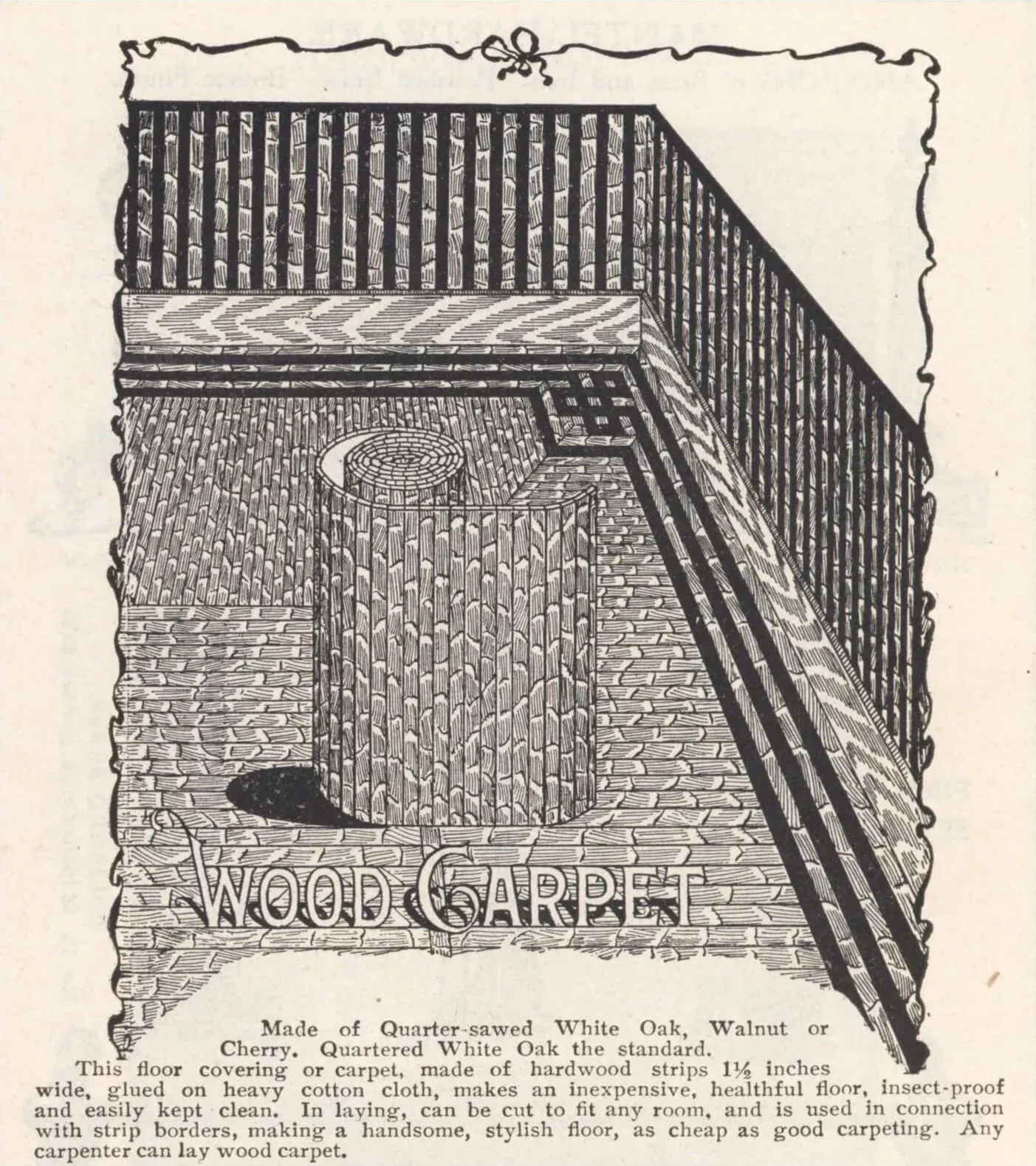
Catalog advertisement for wood carpet, about 1900. Public domain.
Many homes still have wood carpet today, and some owners only find out after a floor sander cuts through it. The strips are thin, often about ¼ to ⅜ inch, so a single aggressive sanding can expose the backing.
When did linoleum become the American kitchen floor?
Linoleum became the American kitchen floor between the 1870s and the 1950s. Frederick Walton, an English inventor, found a way to solidify linseed oil and patented linoleum in 1863, naming it after the Latin words for flax and oil. In the 1870s, the American Linoleum Company opened a factory on Staten Island, in a neighborhood that took the name Linoleumville.
Linoleum is made of oxidized linseed oil mixed with cork dust, wood flour and pigments, pressed onto a burlap or canvas backing. Walton patented a process for inlaid linoleum in 1882, which put the color through the full thickness of the sheet so the pattern did not wear off. A cork manufacturer in Lancaster, Pennsylvania, opened a linoleum plant in 1908 and made linoleum there until 1974.
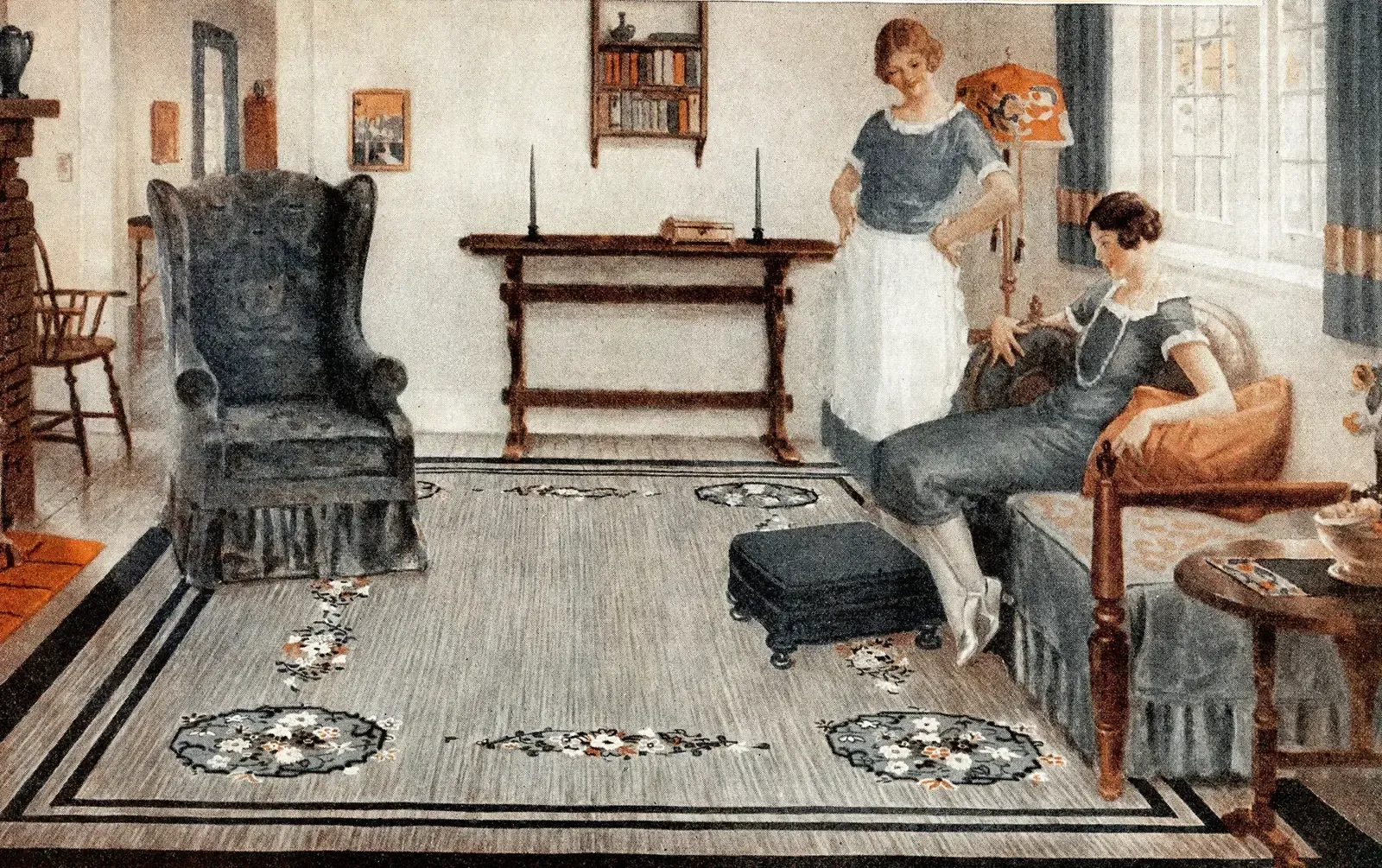
Linoleum laid as a patterned rug, from a 1927 magazine advertisement. Public domain.
By the early 1900s linoleum covered kitchens, bathrooms, hospitals and ships. It was easy to mop, it resisted grease, and it came in patterns that imitated tile, carpet and parquet for much less money.
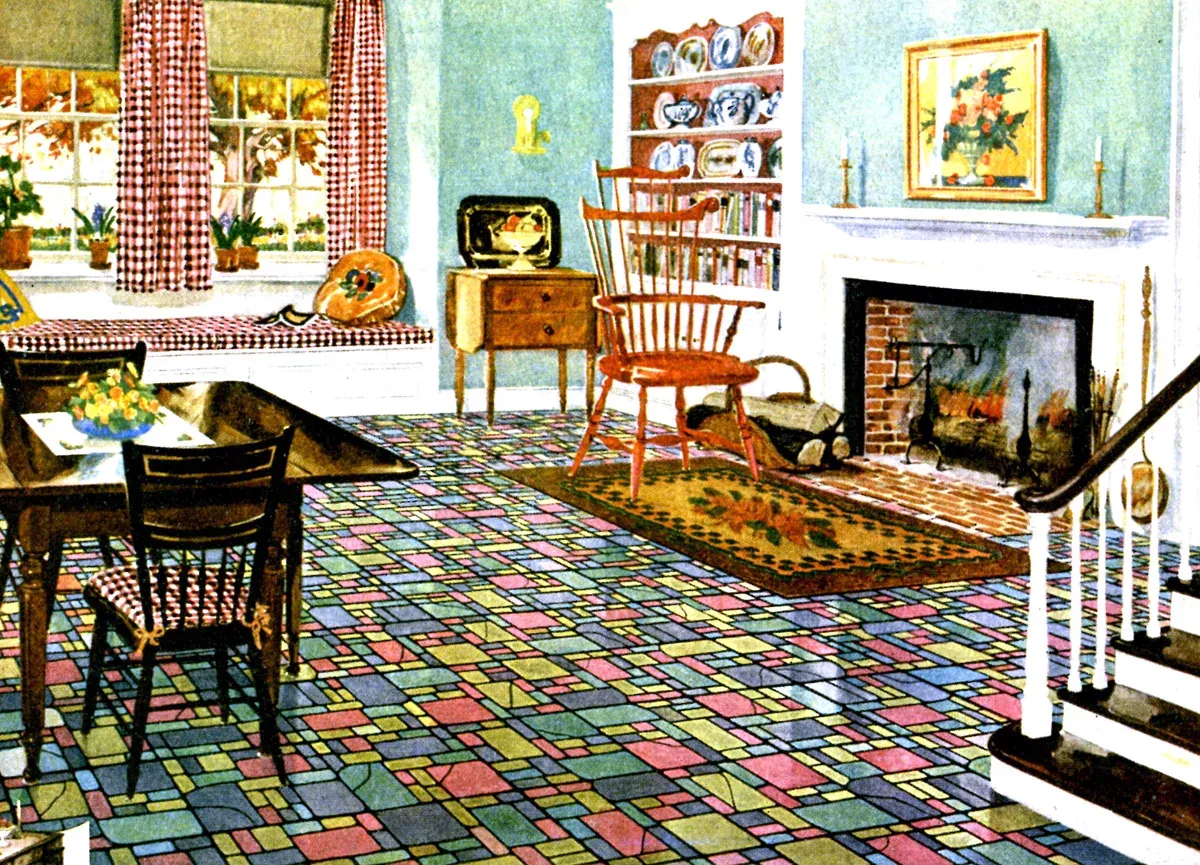
A patterned linoleum floor from wall to wall, from a 1928 magazine advertisement. Public domain.
How did vinyl, carpet and the post-war boom change American floors?
Vinyl, wall-to-wall carpet and the post-war housing boom replaced linoleum and wood in most new American homes between the late 1940s and the 1970s. Waldo Semon, a chemist at an Ohio rubber company, made polyvinyl chloride flexible in 1926. After World War II, vinyl overtook linoleum as the resilient floor of choice.
Carpet grew out of an unlikely place. In Dalton, Georgia, a hand-tufted bedspread craft became a factory industry in the 1930s, using adapted sewing machines to insert yarn tufts. By the 1950s, tufted carpet had passed bedspreads as Dalton’s main product, and by the early 1960s Dalton called itself the carpet capital of the world. Machine tufting made wall-to-wall carpet affordable, and it covered millions of wood floors.
Construction changed the floor too. After the war, builders in the South poured concrete slabs instead of building raised wood floors, and the flooring industry followed. Factory-finished parquet blocks, glued straight to concrete, spread in the 1940s and 1950s, and by the 1970s engineered wood products dominated the Sunbelt slab construction boom.
Do old floors in Florida homes contain asbestos?
Some old floors in Florida homes do contain asbestos, mostly in older vinyl and asphalt floor tiles, sheet vinyl backing and the black adhesive beneath them. The EPA states that the only way to be sure is to have the material tested by a qualified laboratory, and it recommends testing before any renovation that would disturb the floor.
The safe sequence in an older Tampa Bay home is simple. Test before removing anything, and leave intact tiles alone until the result comes back. Sanding, grinding or scraping suspect tiles is the step that releases fibers, and removal of asbestos-containing material in Florida is work for a licensed asbestos contractor.
How did laminate and LVP take over in the last 50 years?
Laminate and Luxury Vinyl Plank took over American floors in the last 50 years by printing a realistic photo of wood onto a tougher, cheaper core. Laminate was invented in Sweden in 1977, sold in Europe from 1984 and introduced in the United States in 1994. Glueless click-lock systems, launched in 1996 and 1997, let planks float over the subfloor without glue or nails.
Luxury vinyl followed a parallel path. Through the 2000s, better printing and embossing made vinyl planks look like real wood and stone. In 2013, rigid-core vinyl arrived in two forms, WPC and SPC, and paired a waterproof core with a click-lock edge. By 2015 luxury vinyl was the growth engine of the resilient category, and in 2026 an industry executive told Floor Covering News that luxury vinyl accounts for more than half of all hard surface flooring sales in the U.S.
The table below condenses four centuries into the floor that dominated each period and the problem each new floor solved:
| Period | Dominant floor | Problem it solved |
|---|---|---|
| 1600s–1700s | Packed earth, hand-sawn plank | A floor at all, from local materials |
| 1700s–1800s | Wide pine boards, painted floors, floorcloths | Cleanable surfaces and decoration at low cost |
| 1820s–1900s | Machine-planed tongue-and-groove, wood carpet | Uniform boards, made in factories |
| 1870s–1950s | Linoleum | Washable, grease-resistant kitchens and baths |
| 1900s–1940s | Narrow oak strip flooring | Durable, standard hardwood for every room |
| 1950s–1970s | Vinyl tile, sheet vinyl, wall-to-wall carpet | Cheap, fast floors for the post-war housing boom |
| 1977–2000s | Laminate | Wood look at a fraction of the price |
| 2013–today | Rigid-core LVP | Wood look with a waterproof core |
Why does Florida’s history end on the slab?
Florida’s flooring history ends on the slab because most Florida homes are built slab-on-grade, and moisture moves up through concrete from the ground below. A floor that cannot tolerate that moisture cups, swells or loses its adhesive. Mid-century Florida builders answered with terrazzo and tile. Today the most common answers are ceramic tile and LVP.
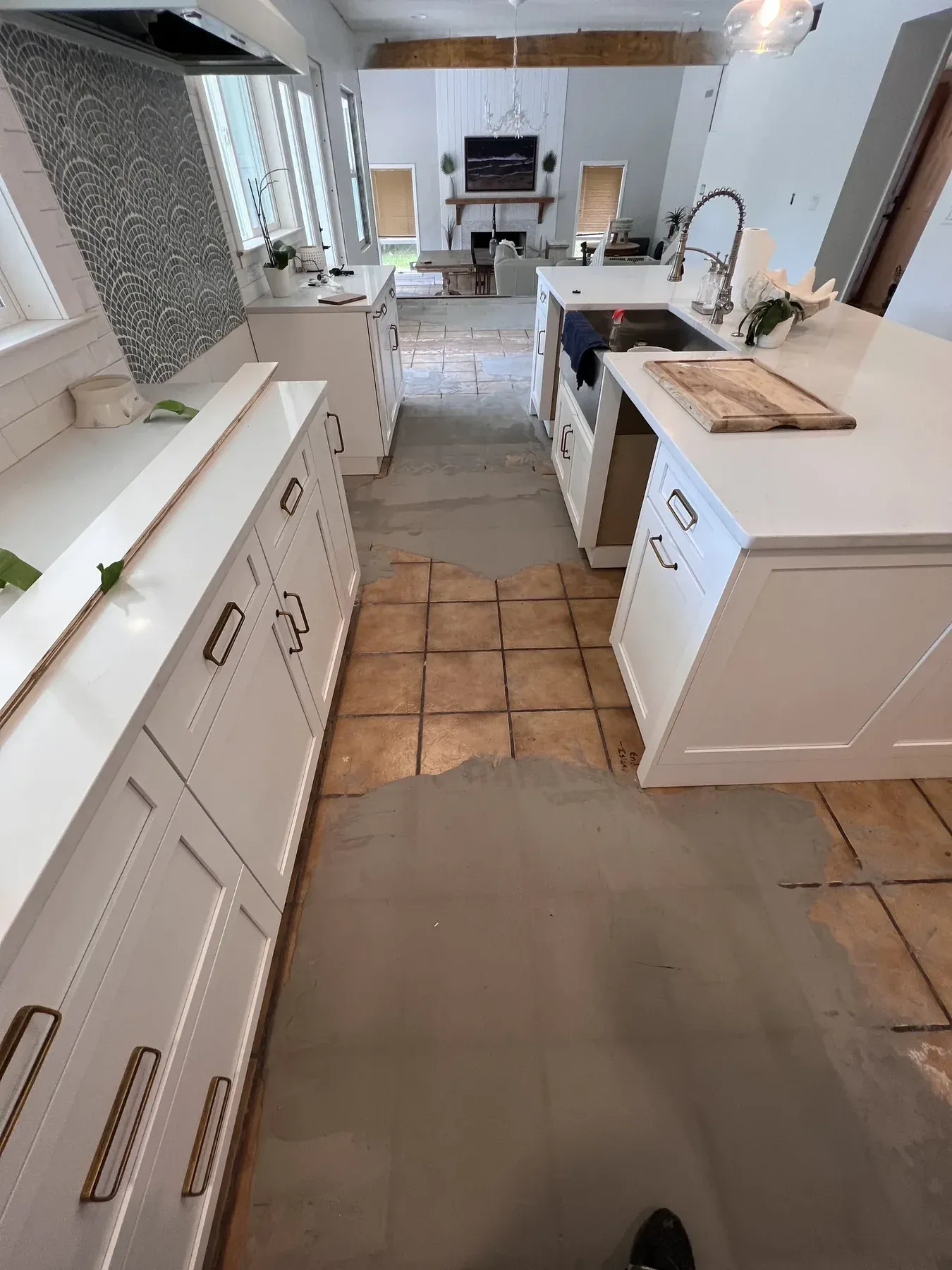
A kitchen in Ruskin during a renovation: old tile coming up, the concrete slab exposed and leveling compound applied. Flooring at Tampa Bay project.
The slab is the subfloor in most Tampa Bay houses, so its condition decides how the new floor performs. Before replacing an old floor in a Florida home built decades ago, a few checks prevent the most common surprises:
- Test suspect tiles for asbestos before anyone removes or sands them.
- Check the thickness of old wood floors before sanding, because wood carpet and worn strip flooring may not survive another pass.
- Measure slab moisture before installing any floor glued or floated over concrete.
- Check flatness, because click-lock laminate and LVP need a flat subfloor to keep the joints closed.
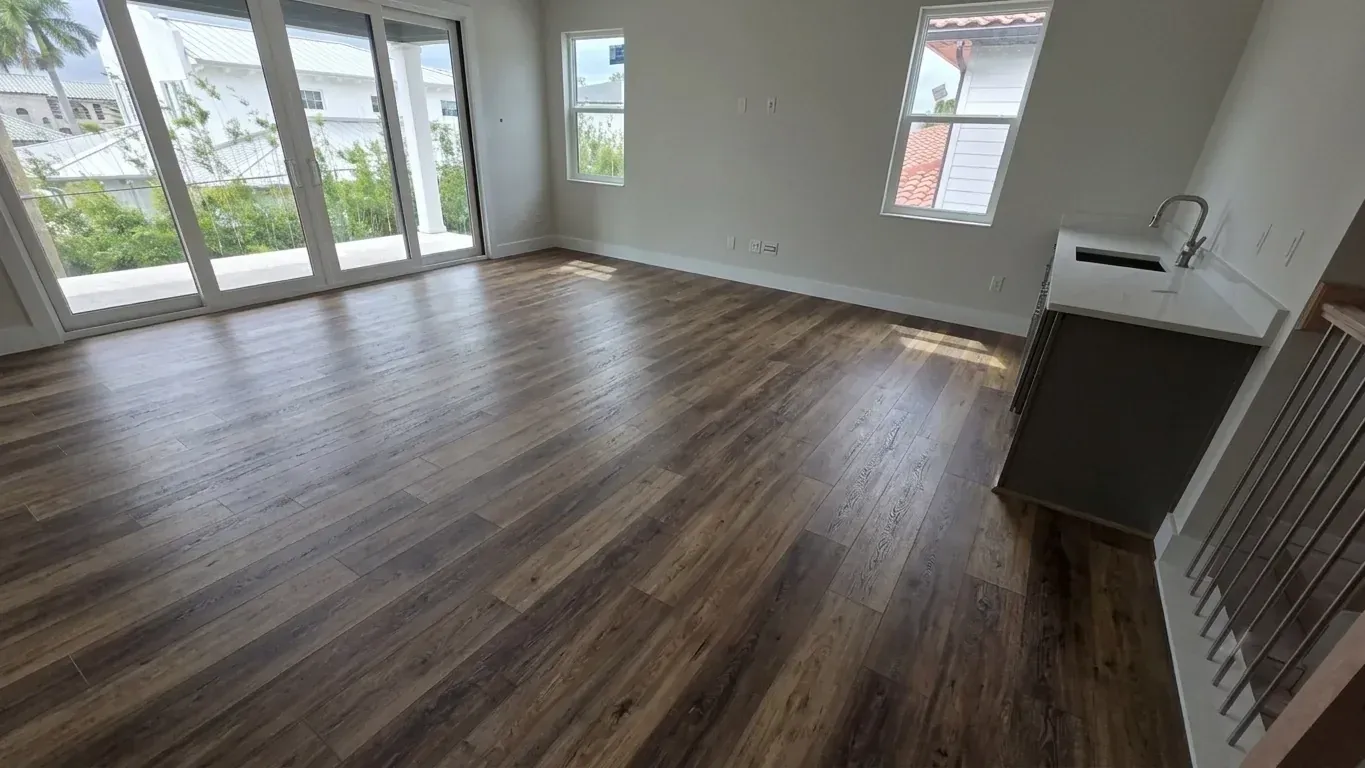
A living room in Seffner with wood-look LVP over the slab. Flooring at Tampa Bay project.
Four hundred years after packed-earth floors, the goal is the same: a floor that is affordable, easy to clean and right for the conditions underneath it. In Tampa Bay, those conditions start with concrete and humidity.
Planning a flooring project in Tampa Bay? Every quote starts with a moisture reading of the slab, at no cost. Get your free photo estimate or call (813) 455-5756.
Frequently asked questions
What was the first type of flooring in American homes?
Packed earth was the first floor in many early colonial homes. Wood plank floors spread as settlers cut boards from old-growth forests with pit saws and later with water-powered sawmills. In Florida, most homes built since the mid-1900s skipped wood framing at ground level and sit on a concrete slab instead.
When did linoleum come to the United States?
Linoleum reached American homes in the 1870s, when a factory opened on Staten Island, New York, about a decade after Frederick Walton patented the material in England in 1863. Linoleum stayed common until vinyl overtook it in the 1950s, and original sheets still turn up in older homes across Tampa Bay.
Can old vinyl floor tiles contain asbestos?
Yes, some older resilient floor tiles and sheet floors contain asbestos. The EPA states that the only way to know is to have the material tested by a qualified laboratory, and it recommends testing before any renovation that would disturb it. Homeowners in older Tampa Bay houses should test first and never sand or scrape suspect tiles.
When did laminate and LVP become popular in the U.S.?
Laminate flooring was invented in Sweden in 1977 and arrived in the United States in 1994. Glueless click-lock systems followed in 1996 and 1997. Rigid-core luxury vinyl launched in 2013, and by the mid-2010s luxury vinyl was the fastest-growing flooring category, including in slab-on-grade markets like Tampa Bay.
Why is LVP so common in Florida homes today?
LVP is common in Florida because most Florida homes sit on a concrete slab, and moisture rises through concrete. Luxury Vinyl Plank (LVP) has a core that does not absorb water, so it handles slab moisture and humidity better than solid wood or fiber-core laminate, which explains its spread across Tampa Bay since the 2010s.


US standard for measuring relative humidity inside a concrete slab using in-situ probes drilled to 40% of slab depth, read after 72 hours of equilibration.
US standard for measuring moisture vapor emission from a concrete slab using anhydrous calcium chloride, expressed in pounds per 1,000 sq ft per 24 hours.
US standard practice for preparing concrete floors to receive resilient flooring. Covers flatness, cleanliness, and moisture condition before installation.
The building code in force across Florida, including moisture and structural requirements that apply to slab-on-grade residential construction.
European deep-core moisture test that reacts a slab sample with calcium carbide and reads the resulting gas pressure. Supporting knowledge: the applicable US standards are ASTM F2170 and F1869.
Supporting knowledge — not the standard we work toGerman standard series for floor screeds, source of the widely cited 2.0% CM cement and 0.5% CM anhydrite thresholds. Supporting knowledge, not the applicable US standard.
Supporting knowledge — not the standard we work toHigh-Density Fiberboard: the compressed wood-fiber core of most laminate planks. It absorbs water vapor and swells irreversibly, which is why slab moisture matters.
Stone Plastic Composite: rigid vinyl core made of limestone powder and PVC. Dimensionally stable under humidity swings and unaffected by water.
Wood Plastic Composite: vinyl core with wood flour and foaming agents. Softer and warmer underfoot than SPC, and less dimensionally stable.
Luxury Vinyl Plank: multi-layer vinyl flooring in plank format. Fully waterproof as a material, though the subfloor beneath still governs installation.
Abrasion Class rating for laminate wear resistance, from AC1 to AC6. AC4 suits normal residential use; AC5 handles heavy traffic and light commercial.
A sheet layer placed between slab and flooring to block ground moisture vapor. Required over slab-on-grade construction regardless of surface dryness.
Foundation type where the concrete slab sits directly on the ground, dominant in Florida residential construction. Ground moisture migrates upward continuously.
The permitted deviation of a subfloor across a given span. The common benchmark is 3/16 inch over 10 feet; beyond that, deviation transfers into the locking joints.
A pourable cement-based compound that flows to a level surface, used to correct slab deviation. Needs 24 to 72 hours of cure before flooring goes down.
The 8 to 10 mm clearance left between a floating floor and every fixed vertical surface, absorbing seasonal expansion. Bridging it transfers stress to the joints.
Conditioning flooring material inside the room where it will be installed, 48 to 72 hours before installation, so it reaches interior temperature and humidity.
An angle-in locking profile that joins planks without adhesive. The insertion angle is specified by the manufacturer; forcing it deforms the profile permanently.
The raised ridge that forms along plank edges when a floating floor expands without room to move. In Florida the usual causes are slab moisture or a bridged expansion gap.