
Laminate vs Carpet in Florida Bedrooms: The Comparison No One Makes Honestly
Carpet remains one of the most-installed flooring types in Florida bedrooms. It is soft, familiar, and affordable upfront, but it is also one of the worst matches for Florida’s humid climate among common bedroom flooring choices available to homeowners today.
Tampa Bay’s ambient humidity creates conditions that accelerate everything carpet does wrong: dust mite populations, mold risk, odor retention, and wear. The total cost of ownership over 15 years, in a Florida bedroom, almost always favors laminate.
Why Is Carpet So Common in Florida Bedrooms — and Should It Be?
In Brandon, Riverview, and across Tampa Bay, carpet dominates bedrooms for historical and comfort reasons — it was the default in Florida home construction for decades. The problem is that carpet’s performance characteristics assume a moderate, dry climate. Florida is neither.
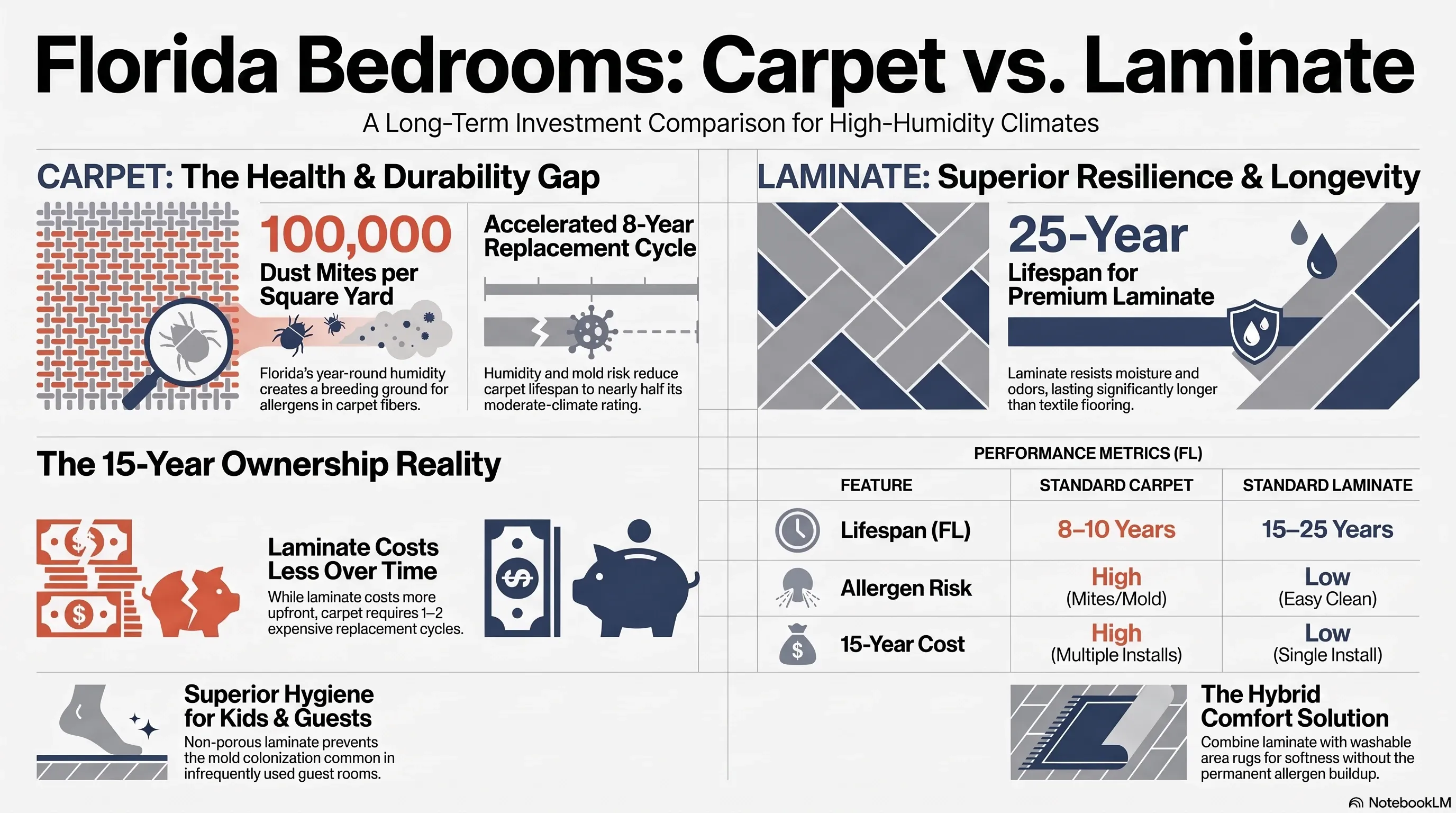
- Dust mite populations: a square yard of carpet in Florida can harbor up to 100,000 dust mites. Tampa Bay’s indoor humidity, cycling through the canonical 35–65 % RH range with AC, falls within the range where dust mite populations are active year-round.
- Mold risk: mold spores are present in Florida air at all times. Carpet fiber provides a surface for mold colonization when humidity spikes — during AC outages or vacations.
- Odor retention: carpet absorbs humidity and its associated odors more aggressively in Florida than in dry-climate states.
What Does Florida’s Humidity Do to Bedroom Carpet Over Time?
Carpet in a Florida bedroom follows a predictable decline that has little to do with how well it was maintained, since humidity itself is doing most of the damage from the inside out.
- Years 1–3: carpet looks and performs as expected. Dust mite population is building but not visible.
- Years 4–6: wear patterns become visible. Carpet fiber begins to flatten and lose resilience.
- Years 7–10: most Florida carpets in bedrooms show significant aging — matting, staining that does not clean fully, and odor that becomes apparent when the room is closed.
Carpet lifetime ratings of 10–15 years are based on moderate-climate performance. In Tampa Bay bedrooms, the practical replacement cycle is 8–10 years for standard carpet.
How Does Laminate Compare to Carpet on Comfort in a Florida Bedroom?
Comfort is the one category where carpet still has a real advantage, and it is worth being honest about rather than dismissing outright before covering how laminate closes most of that gap.
- Underfoot feel: carpet is softer. Laminate with foam underlayment is warmer than tile but cooler than carpet. In Tampa Bay’s 72–76 °F interiors, the difference is less significant than in cold-climate bedrooms.
- Sound absorption: carpet absorbs impact sound better. Laminate with a quality underlayment reduces but does not eliminate footfall noise.
- Practical solution: laminate throughout the bedroom + a washable area rug at the bedside delivers comfort equal to carpet with none of the allergen or moisture problems.
What Does Each Option Cost Installed in Tampa Bay in 2026?
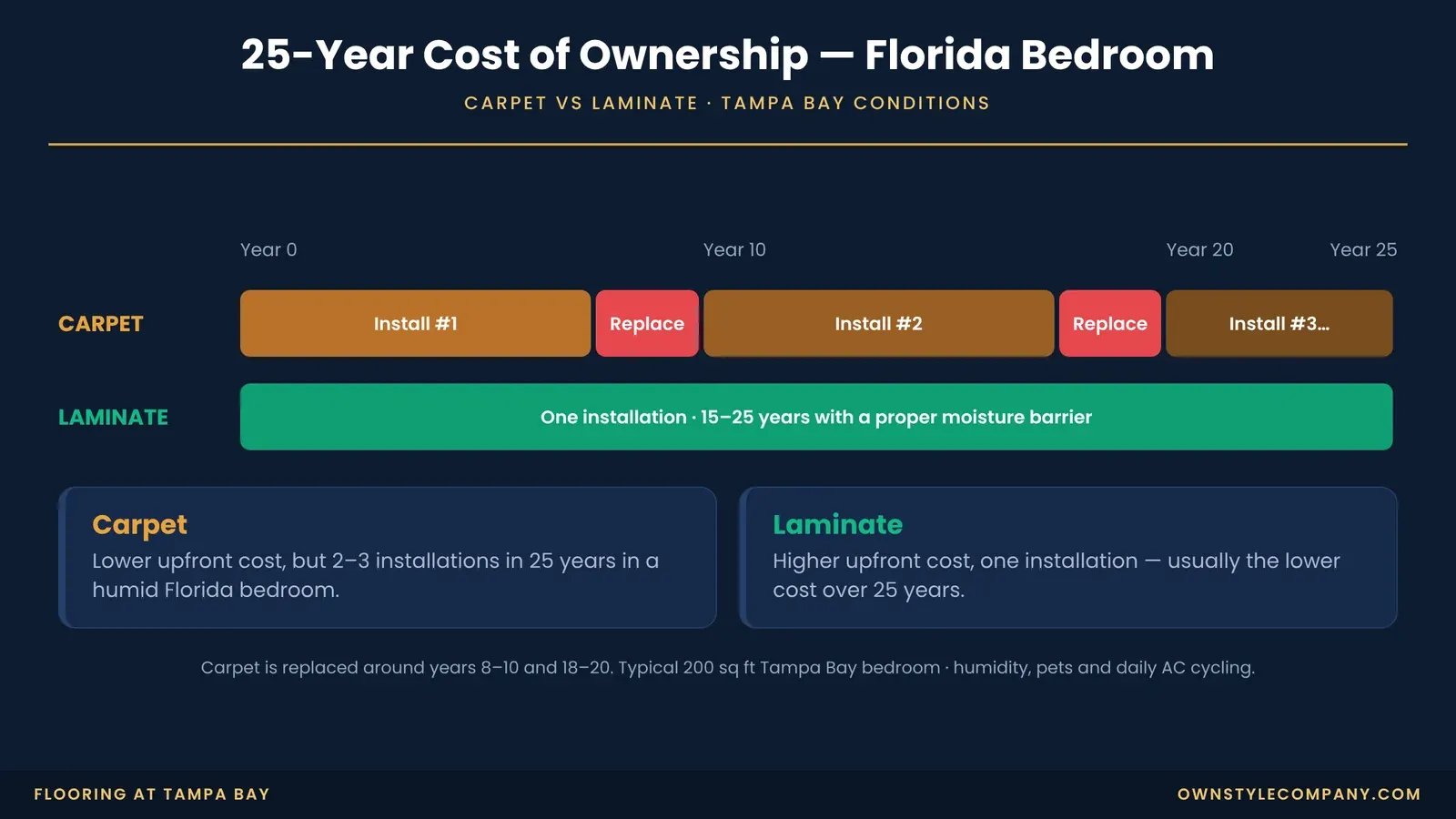
Upfront cost favors carpet, but that comparison only holds if the 15-year replacement cycle is ignored, and Florida’s climate makes that cycle shorter than in most other states.
| Option | Relative upfront cost | 15-year total cost |
|---|---|---|
| Standard carpet | Lower | Higher (1–2 replacements) |
| Standard laminate | Higher | Lower (no replacement needed) |
- Carpet (remove existing + install new): the lower upfront option for a bedroom, but the whole cost comes back with every replacement.
- Laminate (remove carpet + install laminate): our carpet removal labor is $0.80 per square foot and our laminate installation labor is $2.25 per square foot, plus the material you choose. See our published prices for the full list.
- 15-year total: carpet requires 1–2 additional replacement cycles, each one repeating the upfront cost. Laminate typically does not require replacement in 15 years.
What About Children’s Bedrooms and Guest Rooms — Does the Answer Change?
The general recommendation holds across most room types, but three specific situations shift the calculus enough to call out individually rather than treat every bedroom the same way.
Children’s bedrooms
The strongest case for switching to laminate in Florida. Children spend more time on the floor, are more sensitive to allergens, and create more spills and accidents. A washable area rug on laminate provides cushion while remaining fully cleanable.
Guest rooms
Guest rooms are often unoccupied for weeks or months. An unoccupied room with carpet — especially if AC is reduced — creates ideal conditions for mold and dust mite concentration. Laminate in guest rooms is more hygienic.
Primary bedrooms
For homeowners who strongly prefer carpet, mid-to-high grade carpet (40+ ounce weight, moisture-resistant backing) with a strict no-pets-in-bedroom policy extends practical life to 10–12 years. This is the only scenario where carpet is a reasonable long-term choice in a Tampa Bay bedroom.
How Long Does Each Option Last in a Florida Climate?
Lifespan is where the gap between carpet and laminate becomes hardest to ignore, and the difference roughly doubles once premium versions of each material are compared.
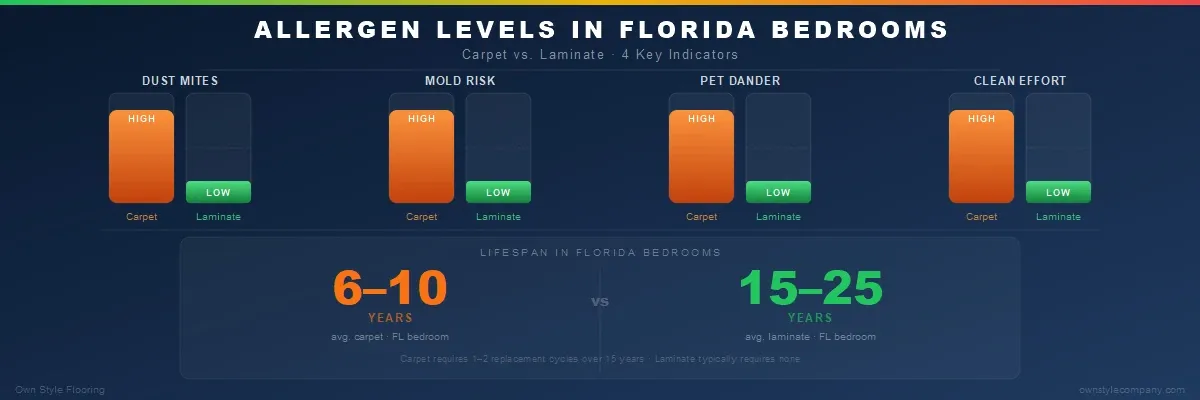
- Standard carpet in Tampa Bay bedroom: 6–10 years.
- Premium carpet with moisture-resistant backing: 10–12 years (best case).
- Standard laminate in Tampa Bay bedroom: 15–20 years with proper installation and moisture barrier.
- Premium laminate (AC5 rating, thicker core): 20–25 years.
What Does Flooring at Tampa Bay Recommend for Florida Bedrooms?
The recommendation: laminate over carpet, with a washable area rug at the bedside. Laminate handles Florida’s humidity better, costs less over time, and eliminates the allergen and mold conditions that carpet creates in this climate.
For homeowners committed to carpet: moisture-resistant backing, 40+ ounce face weight, no pets in the bedroom, and a replacement budget at year 8–10.
Is LVP a Better Bedroom Choice Than Laminate in Florida?
Both outperform carpet decisively, and the choice between LVP and laminate for a bedroom comes down to moisture risk rather than comfort, since the two feel and look similar underfoot with a quality underlayment.
SPC-core LVP is fully waterproof and handles a ground-floor bedroom near a bathroom or in a flood-prone area with less risk than laminate’s HDF core. Laminate remains the better choice in a stable, climate-controlled bedroom where the slightly warmer, more wood-like feel matters more than waterproofing that will likely never be tested. Neither material carries carpet’s dust mite and mold risk in Tampa Bay’s humidity.
Planning a flooring project in Tampa Bay? Every quote starts with a moisture reading of the slab, at no cost. Get your free photo estimate or call (813) 455-5756.
Frequently asked questions
Is laminate or carpet better for Florida bedrooms?
For most Florida bedrooms, laminate is the better long-term choice. Florida's humidity creates ideal conditions for dust mites and mold in carpet fibers. Laminate is significantly easier to clean, lasts 15 to 25 years compared to carpet's 8 to 10, and does not hold allergens. The comfort trade-off can be addressed with a washable area rug at the bedside.
Why is carpet a problem in Florida bedrooms specifically?
Florida's indoor humidity, cycling through the canonical 35–65 % RH range with AC, creates warm, moist conditions in carpet fiber ideal for dust mite reproduction. A square yard of carpet can harbor up to 100,000 dust mites. Tampa Bay carpet also absorbs humidity and retains odors more aggressively than in drier states, particularly with pets or when AC is off during vacations.
How much does it cost to replace bedroom carpet with laminate in Tampa Bay in 2026?
Our carpet removal labor is $0.80 per square foot and our laminate installation labor is $2.25 per square foot; the laminate material is priced separately depending on the product you choose. Upfront, converting a bedroom to laminate costs more than replacing the carpet, but over 15 years, the total cost of ownership heavily favors laminate — carpet requires 1–2 replacement cycles in Florida conditions.
Does laminate feel cold underfoot in a Florida bedroom?
Laminate with a foam or cork underlayment is warmer than tile but cooler than carpet. In Tampa Bay's 72–76 °F interior temperatures, the difference is minimal. A bedside area rug provides the warmth underfoot that most bedroom occupants want without the allergen and moisture problems of wall-to-wall carpet.
What about carpet in children's bedrooms in Tampa Bay?
Children's bedrooms are one of the strongest cases for replacing carpet with laminate in Florida. Children spend more time on the floor, are more susceptible to allergens, and create more spills and accidents. Laminate handles all of these better. For play areas, a washable area rug on laminate provides cushion while remaining fully cleanable.


US standard for measuring relative humidity inside a concrete slab using in-situ probes drilled to 40% of slab depth, read after 72 hours of equilibration.
US standard for measuring moisture vapor emission from a concrete slab using anhydrous calcium chloride, expressed in pounds per 1,000 sq ft per 24 hours.
US standard practice for preparing concrete floors to receive resilient flooring. Covers flatness, cleanliness, and moisture condition before installation.
The building code in force across Florida, including moisture and structural requirements that apply to slab-on-grade residential construction.
European deep-core moisture test that reacts a slab sample with calcium carbide and reads the resulting gas pressure. Supporting knowledge: the applicable US standards are ASTM F2170 and F1869.
Supporting knowledge — not the standard we work toGerman standard series for floor screeds, source of the widely cited 2.0% CM cement and 0.5% CM anhydrite thresholds. Supporting knowledge, not the applicable US standard.
Supporting knowledge — not the standard we work toHigh-Density Fiberboard: the compressed wood-fiber core of most laminate planks. It absorbs water vapor and swells irreversibly, which is why slab moisture matters.
Stone Plastic Composite: rigid vinyl core made of limestone powder and PVC. Dimensionally stable under humidity swings and unaffected by water.
Wood Plastic Composite: vinyl core with wood flour and foaming agents. Softer and warmer underfoot than SPC, and less dimensionally stable.
Luxury Vinyl Plank: multi-layer vinyl flooring in plank format. Fully waterproof as a material, though the subfloor beneath still governs installation.
Abrasion Class rating for laminate wear resistance, from AC1 to AC6. AC4 suits normal residential use; AC5 handles heavy traffic and light commercial.
A sheet layer placed between slab and flooring to block ground moisture vapor. Required over slab-on-grade construction regardless of surface dryness.
Foundation type where the concrete slab sits directly on the ground, dominant in Florida residential construction. Ground moisture migrates upward continuously.
The permitted deviation of a subfloor across a given span. The common benchmark is 3/16 inch over 10 feet; beyond that, deviation transfers into the locking joints.
A pourable cement-based compound that flows to a level surface, used to correct slab deviation. Needs 24 to 72 hours of cure before flooring goes down.
The 8 to 10 mm clearance left between a floating floor and every fixed vertical surface, absorbing seasonal expansion. Bridging it transfers stress to the joints.
Conditioning flooring material inside the room where it will be installed, 48 to 72 hours before installation, so it reaches interior temperature and humidity.
An angle-in locking profile that joins planks without adhesive. The insertion angle is specified by the manufacturer; forcing it deforms the profile permanently.
The raised ridge that forms along plank edges when a floating floor expands without room to move. In Florida the usual causes are slab moisture or a bridged expansion gap.