
Laminate Flooring Problems in Florida: Warping, Buckling, and What Causes Them
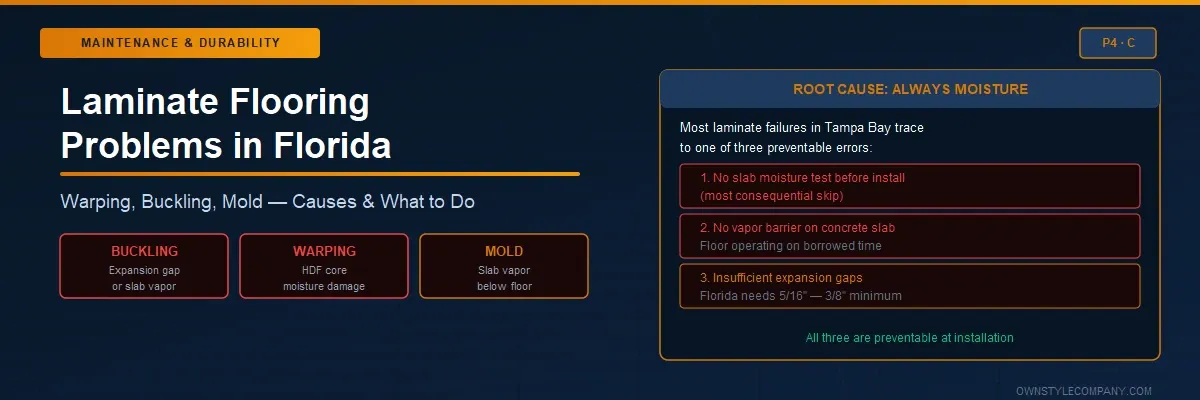
Laminate floors fail in Florida in predictable, repeatable patterns. The failures are almost always moisture-related and trace back to one of three sources: slab vapor without a vapor barrier, an installation error, or a household moisture event caught too late.
Identifying which source caused the failure determines whether the floor can be repaired or must be fully replaced in a Tampa Bay home — and whether a new floor will last if installed without correcting the source first.
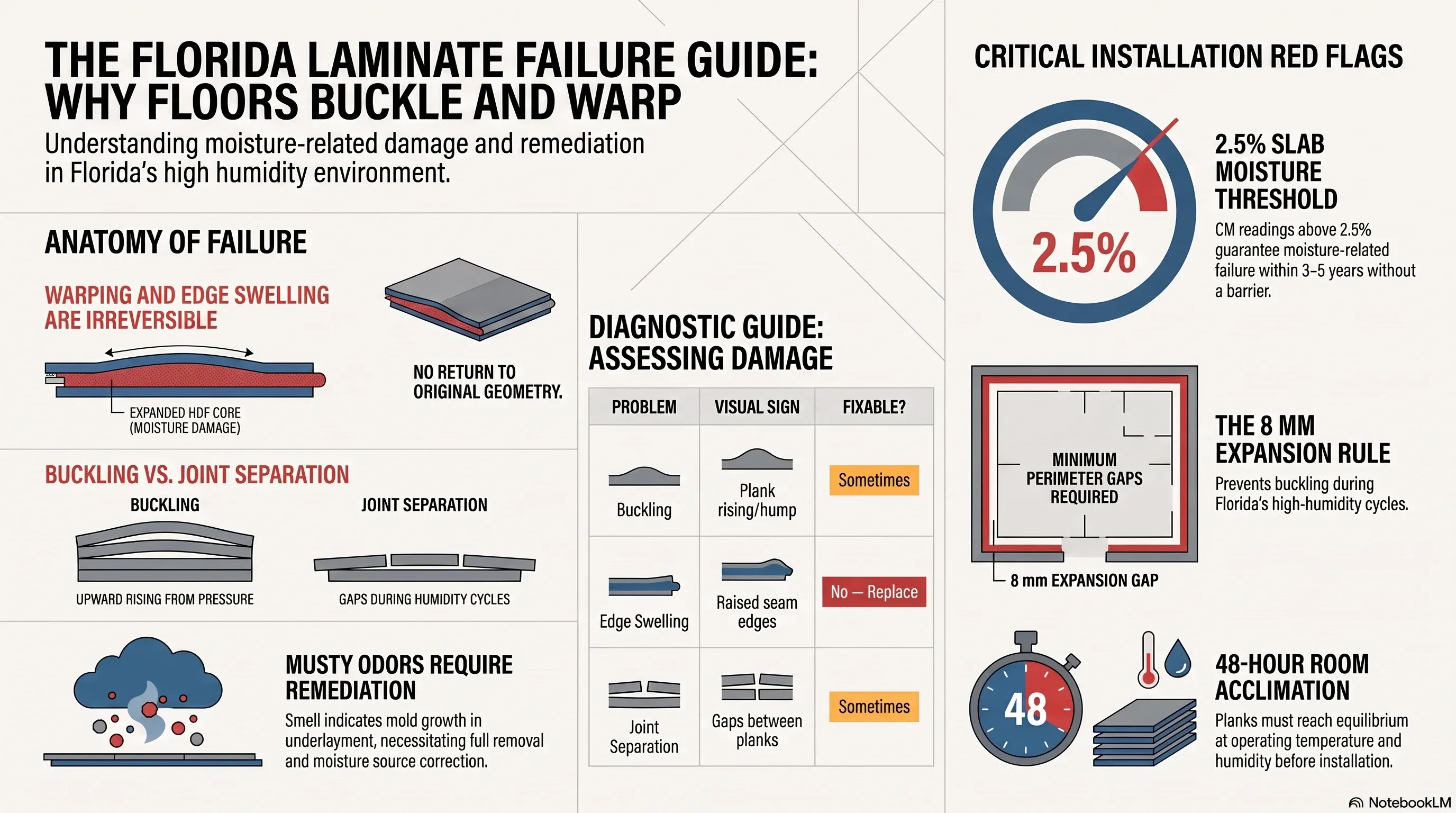
What are the seven most common laminate floor failures in Tampa Bay homes?
Seven distinct failure patterns account for nearly every laminate complaint seen in Tampa Bay homes, and each one has a specific visual signature that points back to a root cause. The table below maps symptom to cause and whether the damage is fixable.
| Problem | Visual Sign | Root Cause | Fixable? |
|---|---|---|---|
| Buckling / hump | Plank rises from subfloor | Expansion gap too small or slab moisture | Sometimes |
| Warping | Plank cups or twists | Moisture from below or above | No — replace |
| Edge swelling | Raised edges at seams | Moisture at seam penetration | No — replace |
| Joint separation | Gap opens between planks | Insufficient expansion gap or moisture | Sometimes |
| Squeaking | Noise with foot traffic | Subfloor contact point, plank movement | Sometimes |
| Cloudy / dull surface | Loss of finish sheen | Cleaning product residue or wear damage | Partial |
| Mold / musty odor | Dark seam staining, smell | Chronic moisture under floor | No — replace + correct source |
What causes buckling in Tampa Bay laminate floors, and when does it occur?
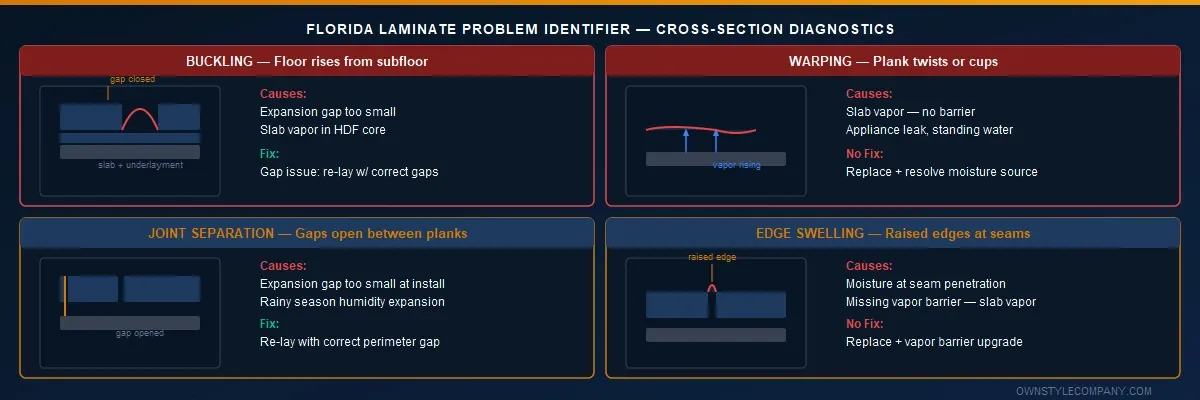
Buckling — a plank rising off the subfloor in a hump or arch — is the most visible Florida laminate failure and almost always has one of two causes, both of which trace back to moisture or a blocked expansion path:
Cause 1: Insufficient expansion gap. Laminate expands with Tampa Bay’s humidity cycles. When perimeter gaps are less than 8 mm, or when furniture legs or door stops contact the floor edge and block expansion, the floor has no room to move — cumulative expansion lifts a plank off the subfloor at the point of highest stress, typically at a doorway or in the center of a large room.
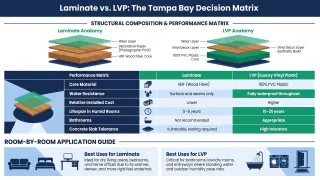
Cause 2: Slab moisture. Concrete slab vapor transmitting upward without a vapor barrier enters the HDF core from below. The HDF swells, and the plank buckles upward as the expansion exceeds the click-lock system’s accommodation capacity.
Buckling from inadequate expansion gaps is sometimes reversible by removing the obstruction and allowing the floor to contract. Buckling from slab moisture requires full floor removal, vapor barrier installation, and source correction before reinstallation.
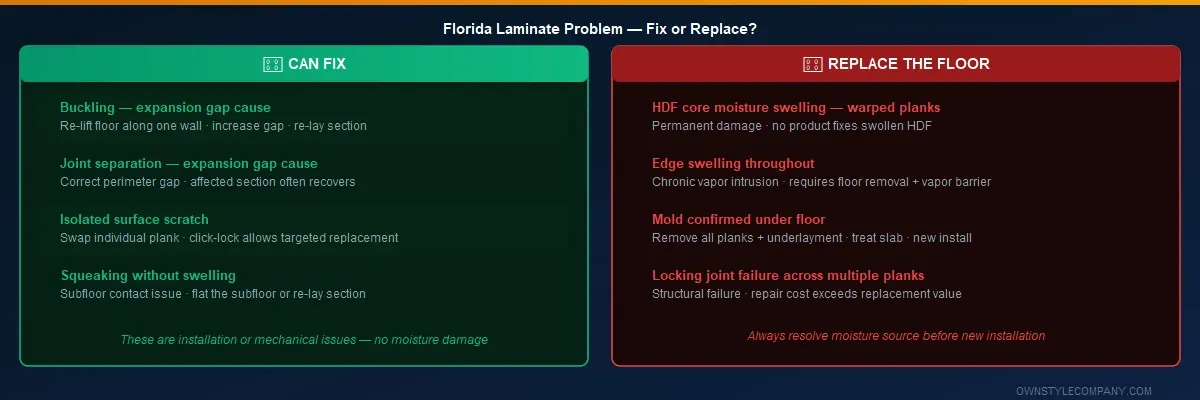
What causes warping and cupping in Florida laminate, and is it fixable?
Warping describes a plank that has curved across its width (cupping) or along its length (bowing). Both are caused by moisture reaching the HDF core unevenly — typically from below via slab vapor, or from a sustained leak above.
When moisture enters from below, the bottom of the HDF core expands while the top (sealed by the wear layer) does not — the differential expansion curves the plank. Warping is not reversible. HDF that has absorbed moisture and then dried does not return to its original flat geometry.
Affected planks must be replaced. Before replacement, the moisture source must be identified: a CM test on the exposed slab confirms whether slab vapor is ongoing. Replacement without source correction produces the same warping pattern within one rainy season.
How does edge swelling differ from buckling, and what causes it in Tampa Bay?
Edge swelling produces raised edges at the seam lines between planks — the plank surface is flat, but the edges are visibly lifted above the adjacent plank. The cause is moisture penetrating the click-lock joint and reaching the HDF core at the edge.
In Brandon, Riverview, and across Tampa Bay, edge swelling occurs from three sources: standing water at doorways from rain tracking, appliance leaks (refrigerators, dishwashers, washing machines), and slab vapor transmitting upward through the underlayment.
Edge swelling is not reversible and indicates the HDF core has permanently expanded at the edge. Edge swelling in multiple locations across the floor indicates systemic slab moisture, not isolated spill events.
What causes joint separation in Tampa Bay laminate, and is it repairable?
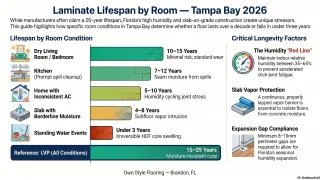
Joint separation — visible gaps opening between planks — occurs when the floor expands beyond the perimeter gap capacity. During Tampa Bay’s June–September wet season, outdoor humidity above 80% drives laminate expansion toward the perimeter. When cumulative expansion exceeds available gap space, the floor pushes planks apart at the weakest joint location.
Joint separation is sometimes reversible in early stages: if the expansion gap is adequate and the separation is not accompanied by HDF core damage, the planks can be tapped back together with a pull bar. Joint separation accompanied by edge swelling or warping indicates the HDF core is involved — replacement is required.
What installation errors cause most Florida laminate failures?
Five installation errors, all preventable at the time of installation, produce the large majority of laminate failures seen across Tampa Bay and Hillsborough County homes. Each one is checkable before the first plank goes down.
-
No slab moisture test — installing over a concrete slab without measuring vapor emission rate is the single most predictive failure risk. A CM reading above 2.0% at installation guarantees moisture-related failure within 3–5 years.
-
No vapor barrier, or barrier with unsealed laps — even a correctly specified barrier fails if installation creates gaps at seams or edges.
-
Insufficient expansion gaps — gaps under 8 mm at any perimeter point, or furniture placed against baseboards eliminating the gap, create buckling points during the first rainy season.
-
No acclimation — planks installed without 48 hours at the room’s operating temperature and humidity are cut at non-equilibrium dimensions; expansion after installation can close gaps and produce buckling within weeks.
-
Over-tile installation without hollow tile detection or grout line filling — the most common installation shortcut that creates immediate joint failure over hollow tiles.
How Can a Homeowner Tell Whether Damage Is Isolated or Systemic?
The distinction between isolated and systemic damage changes the entire scope of repair, and it is usually visible without any special equipment before calling a professional.
- Isolated damage appears near a single fixed source — under a refrigerator, along one exterior wall, or near a single window — and stops spreading once that source is addressed
- Systemic damage appears in multiple, unrelated locations across the room, with no single point source connecting the affected planks
- A single CM reading taken at one point on the slab cannot rule out systemic moisture, since ground moisture varies across a slab’s surface
- Multiple readings across the room, taken during a full moisture assessment, are what actually confirm whether a slab-wide vapor barrier failure exists
A floor with damage confined to one 3-foot radius near an appliance is a plumbing problem. A floor with edge swelling in four different rooms is a slab problem, and no amount of localized plank replacement will resolve it permanently.
Planning a flooring project in Tampa Bay? Every quote starts with a moisture reading of the slab, at no cost. Get your free photo estimate or call (813) 455-5756.
Frequently asked questions
Why is my laminate floor buckling in Florida?
Buckling in Florida laminate is almost always caused by moisture or insufficient expansion gaps. The most common source is slab vapor intrusion without a vapor barrier. The second cause is expansion gaps under 8 mm at the perimeter. A CM moisture test on the exposed slab identifies which source is responsible.
Can warped laminate flooring be fixed without replacing it?
Warped or cupped laminate planks cannot be restored — HDF that has absorbed moisture does not return to its original flat geometry after drying. Affected planks must be replaced. Replacing planks without correcting the moisture source produces the same warping within 6–12 months.
What causes a musty smell under laminate floors in Tampa Bay?
A musty odor indicates mold growth in the underlayment or on the slab surface from chronic moisture — most commonly slab vapor without a vapor barrier. The floor must be removed, mold remediated, moisture source corrected, and floor replaced. Surface cleaning does not resolve the underlying condition.
Why is my laminate floor squeaking in Florida?
Squeaking has three common causes: subfloor high spots creating contact friction, debris between plank and underlayment, or humidity-driven micro-movement in fatigued click-lock joints. Squeaking without other failure signs can sometimes be addressed with seam lubricant. Squeaking with moisture signs requires professional assessment.
What should I do if I see edge swelling on my Tampa Bay laminate floor?
Edge swelling indicates moisture has reached the HDF core at the plank edge. If isolated near one appliance, identify and repair the source and assess individual plank replacement. If swelling appears in multiple locations, the floor has a systemic slab moisture problem requiring full removal, vapor barrier installation, and reinstallation.

US standard for measuring relative humidity inside a concrete slab using in-situ probes drilled to 40% of slab depth, read after 72 hours of equilibration.
US standard for measuring moisture vapor emission from a concrete slab using anhydrous calcium chloride, expressed in pounds per 1,000 sq ft per 24 hours.
US standard practice for preparing concrete floors to receive resilient flooring. Covers flatness, cleanliness, and moisture condition before installation.
The building code in force across Florida, including moisture and structural requirements that apply to slab-on-grade residential construction.
European deep-core moisture test that reacts a slab sample with calcium carbide and reads the resulting gas pressure. Supporting knowledge: the applicable US standards are ASTM F2170 and F1869.
Supporting knowledge — not the standard we work toGerman standard series for floor screeds, source of the widely cited 2.0% CM cement and 0.5% CM anhydrite thresholds. Supporting knowledge, not the applicable US standard.
Supporting knowledge — not the standard we work toHigh-Density Fiberboard: the compressed wood-fiber core of most laminate planks. It absorbs water vapor and swells irreversibly, which is why slab moisture matters.
Stone Plastic Composite: rigid vinyl core made of limestone powder and PVC. Dimensionally stable under humidity swings and unaffected by water.
Wood Plastic Composite: vinyl core with wood flour and foaming agents. Softer and warmer underfoot than SPC, and less dimensionally stable.
Luxury Vinyl Plank: multi-layer vinyl flooring in plank format. Fully waterproof as a material, though the subfloor beneath still governs installation.
Abrasion Class rating for laminate wear resistance, from AC1 to AC6. AC4 suits normal residential use; AC5 handles heavy traffic and light commercial.
A sheet layer placed between slab and flooring to block ground moisture vapor. Required over slab-on-grade construction regardless of surface dryness.
Foundation type where the concrete slab sits directly on the ground, dominant in Florida residential construction. Ground moisture migrates upward continuously.
The permitted deviation of a subfloor across a given span. The common benchmark is 3/16 inch over 10 feet; beyond that, deviation transfers into the locking joints.
A pourable cement-based compound that flows to a level surface, used to correct slab deviation. Needs 24 to 72 hours of cure before flooring goes down.
The 8 to 10 mm clearance left between a floating floor and every fixed vertical surface, absorbing seasonal expansion. Bridging it transfers stress to the joints.
Conditioning flooring material inside the room where it will be installed, 48 to 72 hours before installation, so it reaches interior temperature and humidity.
An angle-in locking profile that joins planks without adhesive. The insertion angle is specified by the manufacturer; forcing it deforms the profile permanently.
The raised ridge that forms along plank edges when a floating floor expands without room to move. In Florida the usual causes are slab moisture or a bridged expansion gap.