Laminate on Concrete Slabs in Florida: The Moisture Barrier Mistakes That Cause Failure
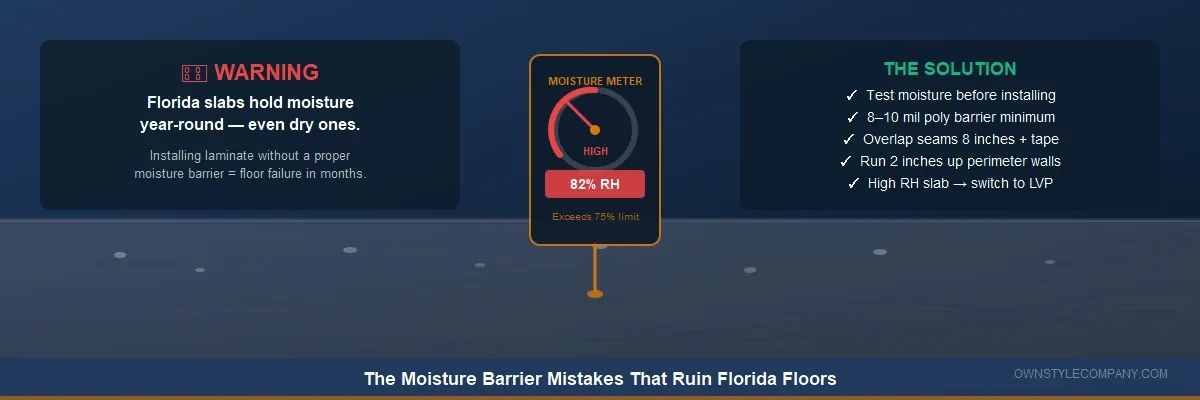
Installing laminate flooring on a concrete slab in Florida requires a proper moisture barrier — no exceptions. Concrete slabs in Hillsborough County and across the Tampa Bay area retain ground moisture year-round, driven by Florida’s high water table, sandy soil, and the constant humidity gradient between warm outdoor air and the cooler conditioned interior.
Without the right moisture barrier, laminate flooring swells, buckles, and develops mold within months — damage that typically costs far more to repair than the barrier would have cost to install correctly the first time.
Why Is Moisture Such a Big Issue with Slabs in Florida?
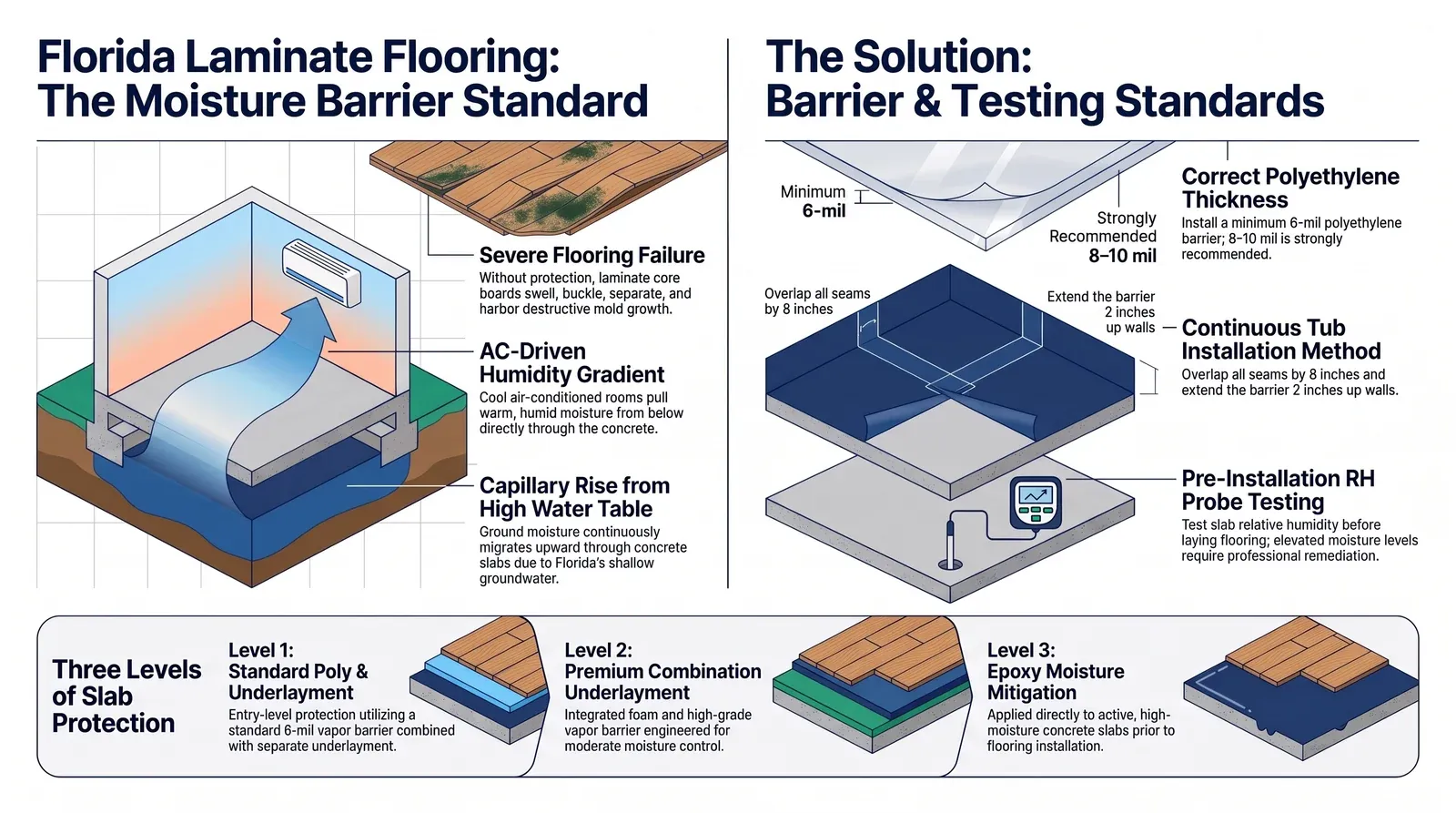
Four separate factors combine to keep Florida slabs wetter than concrete in almost any other region, and each one pushes moisture toward the flooring installed above it rather than away from it:
- High water table: in much of Hillsborough County, the water table is within 10–15 feet of the surface. Ground moisture migrates upward through concrete by capillary action.
- No basement buffer: slab-on-grade construction puts concrete directly in contact with the ground. The slab is the ground floor of the moisture gradient.
- Humidity differential: with AC running and outdoor humidity at 80–90 %+ in summer, moisture is drawn toward the cooler interior from multiple directions.
- Sandy soil: Florida’s sandy soil has lower water retention, meaning water moves more freely to and from the slab.
What Are the Most Common Moisture Barrier Mistakes?
Most laminate failures on Florida slabs trace back to one of five recurring mistakes, not a defective product. Each mistake below compounds the others, so a single shortcut is rarely the sole cause of a failed installation:
Mistake 1: Wrong barrier thickness
The minimum for Florida slab installations is 6 mil polyethylene. Installers regularly find 3 mil poly — a common hardware store product — installed by homeowners or inexperienced contractors. At 3 mil, the barrier punctures easily and is not rated for Florida vapor transmission levels.
Mistake 2: Skipping the moisture test
Many contractors skip the moisture test and assume the slab is dry enough. In Florida, this assumption is almost always wrong. A reading that looks borderline in December can spike during rainy season — after the floor is already installed.
Mistake 3: Improper seam lapping
Barrier sheets must overlap at least 8 inches and be secured with moisture barrier tape along the full seam length. Seams butted edge-to-edge without overlap leave an open moisture channel directly beneath the flooring.
Mistake 4: Not running the barrier up the walls
The barrier should extend 2 inches up the perimeter walls, creating a continuous tub. Moisture enters not just from below the slab but from the perimeter where the slab meets the stem wall.
Mistake 5: Installing over a wet slab without remediation
A slab with active moisture intrusion needs an epoxy or polyurethane sealer applied to the slab surface before any flooring system. A standard barrier alone cannot solve a slab with RH readings above 75 %.
How Do You Test Concrete Moisture Before Installing Laminate?
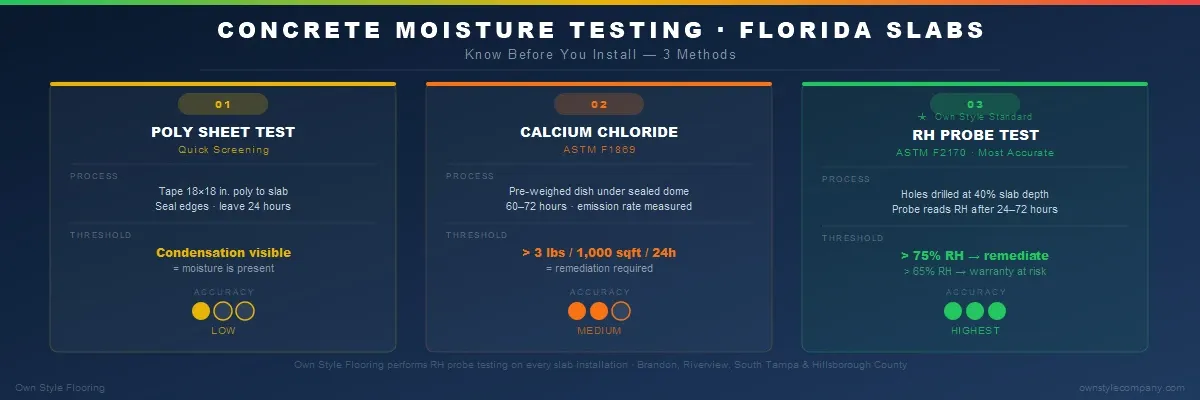
Three test methods measure slab moisture with different levels of accuracy and cost, and knowing which one a manufacturer’s warranty actually requires prevents wasting time and money on a test the paperwork will not accept.
Poly sheet test (quick screening)
Tape an 18×18 inch sheet of poly to the slab, seal all edges, and leave it for 24 hours. Condensation on the underside indicates moisture. This test tells whether a problem exists — not its severity.
Calcium chloride test (ASTM F1869)
A pre-weighed dish of calcium chloride is sealed under a dome on the slab surface for 60–72 hours. The moisture emission rate is calculated in pounds per 1,000 sqft per 24 hours. Emissions above 3 lbs require remediation for most laminate products.
RH probe test (ASTM F2170)
Holes are drilled into the slab and humidity sensors are inserted at 40 % depth. After equilibration (24–72 hours), relative humidity is read directly from within the slab. Readings above 65–75 % RH require remediation or a product switch to LVP. This method is the one most manufacturer warranties specify as acceptable proof of slab readiness.
How Much Does Proper Moisture Barrier Add to Installation Cost?
The added cost of doing moisture protection correctly is small compared to the cost of tearing out and replacing a failed laminate floor, and it scales with how much protection the specific slab actually needs:
| Moisture Protection Level | Relative Added Cost |
|---|---|
| Standard 6 mil poly + underlayment | Lowest |
| Premium combination underlayment | Moderate |
| Epoxy moisture mitigation | Highest, plus cure time |
These levels assume a straightforward slab with no active moisture intrusion. A slab requiring epoxy remediation typically also needs 24–48 hours of cure time before flooring installation can begin, extending the project timeline well beyond what the cost difference alone suggests.
What Happens When a Moisture Barrier Fails During Hurricane Season?
Hurricane season, June through November, is when a marginal moisture barrier gets exposed the fastest, since prolonged rain saturates the ground around a slab and pushes the water table even closer to the surface than it sits the rest of the year.
- Early sign: a musty smell near exterior walls. Often the first indication that moisture is bypassing the barrier at a seam or perimeter edge rather than through the barrier material itself.
- Boards peaking near the slab’s weakest drainage point. Laminate typically fails first near low spots in the yard grading, where water pools longest against the foundation.
- Mold growth invisible until the baseboard is removed. By the time discoloration reaches the visible plank surface, the moisture problem has usually been active for weeks underneath.
- A 2026 warranty claim requires the original moisture test documentation. Manufacturers increasingly deny claims without a dated RH probe or calcium chloride reading from before installation.
Homes in Brandon and Riverview built on lower-lying lots see this pattern most often, since their slabs sit closer to seasonal groundwater than homes on higher elevation nearby. A pre-installation moisture reading, dated and kept on file alongside the flooring warranty paperwork, is the single document that resolves most disputes over whether a hurricane-season failure was a product defect or a site condition the barrier was never rated to handle.
Planning a flooring project in Tampa Bay? Every quote starts with a moisture reading of the slab, at no cost. Get your free photo estimate or call (813) 455-5756.
Frequently asked questions
Can you install laminate on a concrete slab in Florida?
Yes, but only with a proper moisture barrier. Florida concrete slabs retain ground moisture year-round due to the high water table and sandy soil. Without a moisture barrier rated for Florida conditions, laminate on concrete will swell, buckle, and develop mold within 6 to 18 months.
How do I test concrete moisture before installing laminate in Tampa Bay?
Three tests are used: the poly sheet test (tape an 18×18 inch sheet to the slab for 24 hours — condensation indicates moisture), the calcium chloride test (ASTM F1869, measures emission rate over 60-72 hours), and the RH probe test (ASTM F2170, most accurate — drills into the slab to measure relative humidity at depth). Most manufacturer warranties require the RH probe method.
What type of moisture barrier is required for laminate on concrete in Florida?
A minimum of 6 mil polyethylene sheeting, overlapped at seams by at least 8 inches, taped with moisture barrier tape, and extended 2 inches up the perimeter walls. In Florida, 8–10 mil is recommended. Some combination underlayment products integrate foam and vapor barrier in one product.
What moisture reading is too high for laminate on a Florida slab?
Using the RH probe method, readings above 75 % relative humidity require remediation. Most laminate manufacturers require RH below 65 % for warranty compliance. Using the calcium chloride method, emissions above 3 lbs per 1,000 sqft per 24 hours typically require remediation.
What happens if laminate is installed over a high-moisture slab without a barrier?
Ground moisture migrates into the laminate core through the slab. The HDF core swells, causing boards to buckle and separate. Mold develops between the slab and the flooring and can spread to adjacent walls. In Tampa Bay's humid climate, this failure can occur within 3 to 6 months of installation.

US standard for measuring relative humidity inside a concrete slab using in-situ probes drilled to 40% of slab depth, read after 72 hours of equilibration.
US standard for measuring moisture vapor emission from a concrete slab using anhydrous calcium chloride, expressed in pounds per 1,000 sq ft per 24 hours.
US standard practice for preparing concrete floors to receive resilient flooring. Covers flatness, cleanliness, and moisture condition before installation.
The building code in force across Florida, including moisture and structural requirements that apply to slab-on-grade residential construction.
European deep-core moisture test that reacts a slab sample with calcium carbide and reads the resulting gas pressure. Supporting knowledge: the applicable US standards are ASTM F2170 and F1869.
Supporting knowledge — not the standard we work toGerman standard series for floor screeds, source of the widely cited 2.0% CM cement and 0.5% CM anhydrite thresholds. Supporting knowledge, not the applicable US standard.
Supporting knowledge — not the standard we work toHigh-Density Fiberboard: the compressed wood-fiber core of most laminate planks. It absorbs water vapor and swells irreversibly, which is why slab moisture matters.
Stone Plastic Composite: rigid vinyl core made of limestone powder and PVC. Dimensionally stable under humidity swings and unaffected by water.
Wood Plastic Composite: vinyl core with wood flour and foaming agents. Softer and warmer underfoot than SPC, and less dimensionally stable.
Luxury Vinyl Plank: multi-layer vinyl flooring in plank format. Fully waterproof as a material, though the subfloor beneath still governs installation.
Abrasion Class rating for laminate wear resistance, from AC1 to AC6. AC4 suits normal residential use; AC5 handles heavy traffic and light commercial.
A sheet layer placed between slab and flooring to block ground moisture vapor. Required over slab-on-grade construction regardless of surface dryness.
Foundation type where the concrete slab sits directly on the ground, dominant in Florida residential construction. Ground moisture migrates upward continuously.
The permitted deviation of a subfloor across a given span. The common benchmark is 3/16 inch over 10 feet; beyond that, deviation transfers into the locking joints.
A pourable cement-based compound that flows to a level surface, used to correct slab deviation. Needs 24 to 72 hours of cure before flooring goes down.
The 8 to 10 mm clearance left between a floating floor and every fixed vertical surface, absorbing seasonal expansion. Bridging it transfers stress to the joints.
Conditioning flooring material inside the room where it will be installed, 48 to 72 hours before installation, so it reaches interior temperature and humidity.
An angle-in locking profile that joins planks without adhesive. The insertion angle is specified by the manufacturer; forcing it deforms the profile permanently.
The raised ridge that forms along plank edges when a floating floor expands without room to move. In Florida the usual causes are slab moisture or a bridged expansion gap.