Why Steam Mops and Wax Ruin Your Laminate Floor Warranty
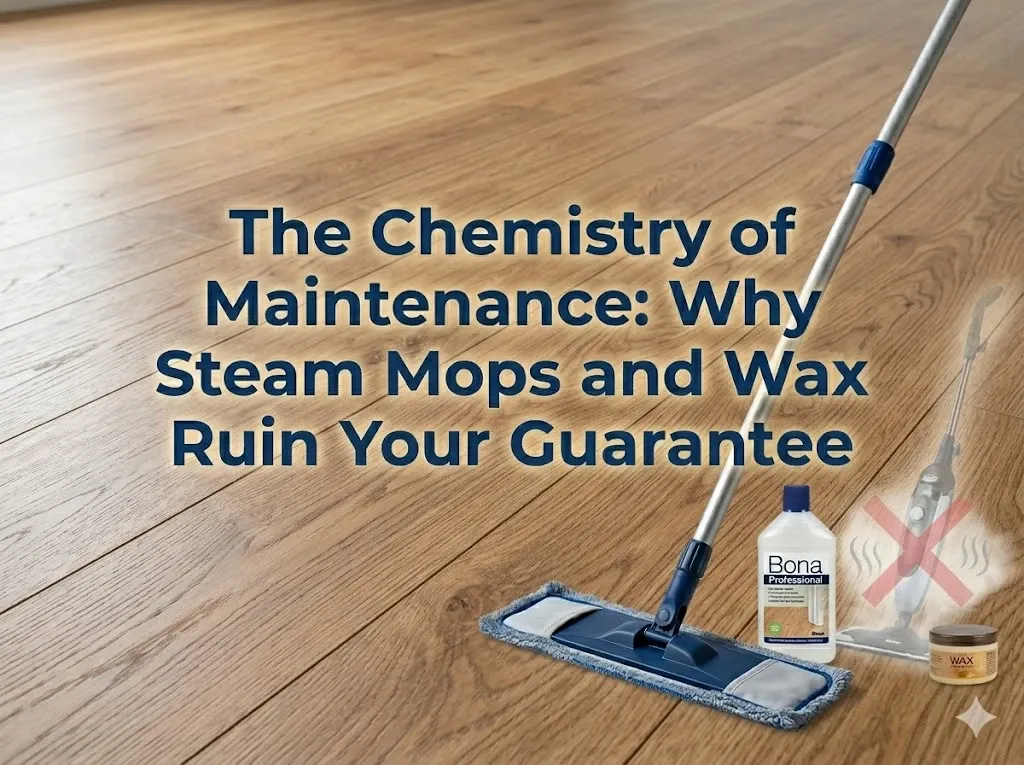
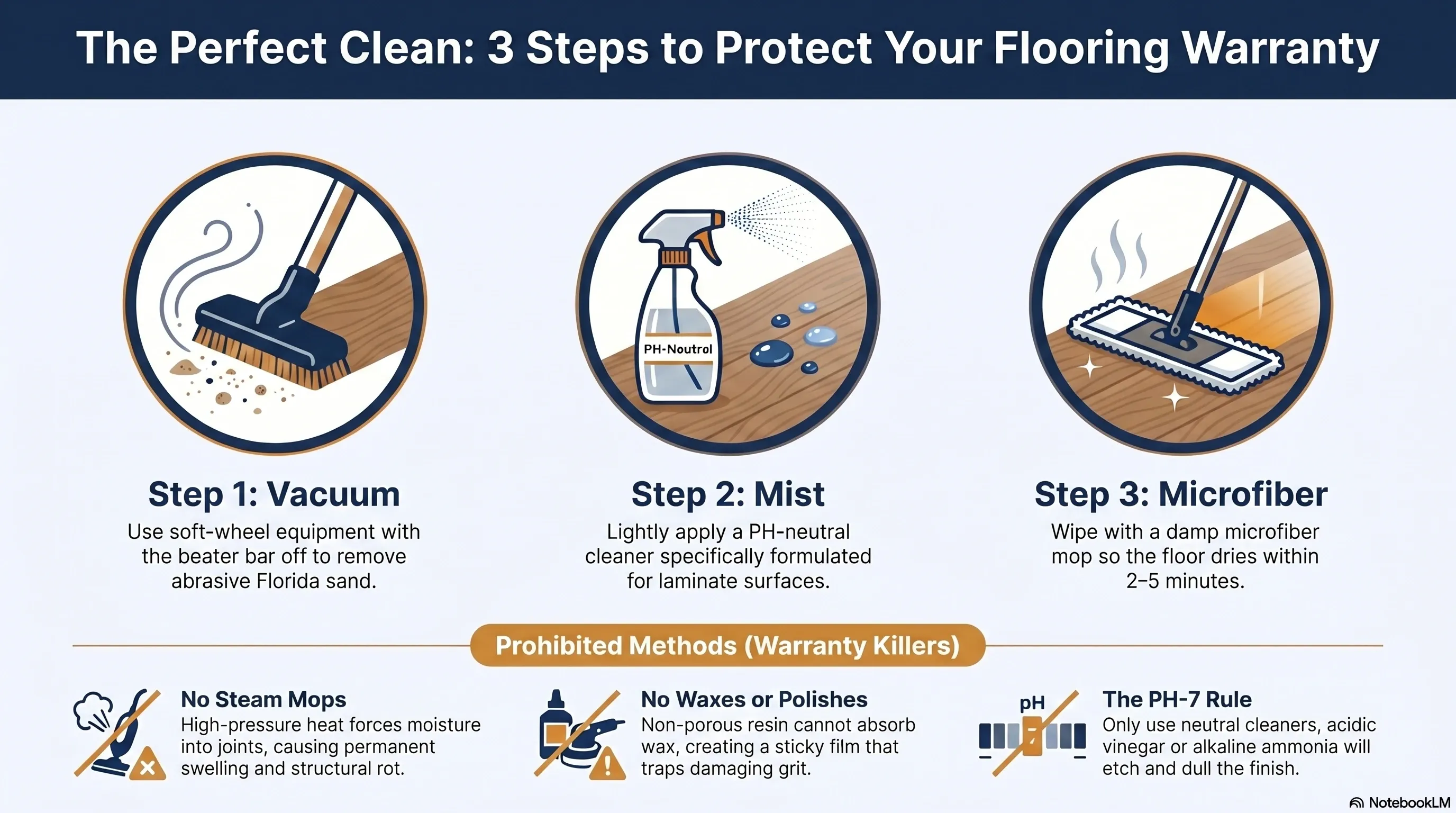
Steam mops are prohibited by every major laminate manufacturer because high-pressure moisture forced into unsealed click joints permanently swells the HDF core, voiding the warranty. Wax-based cleaners trap abrasive sand against the non-porous resin surface, accelerating wear. The correct protocol: daily dry vacuuming and weekly pH-neutral damp mopping only.
Tampa Bay’s climate makes the wrong maintenance products fail faster than in drier regions. Airborne salt near the coast, fine silica sand tracked in from yards and Gulf Coast beaches, and indoor humidity that regularly swings between 35 % and 65 % all interact with the wrong cleaner or tool in ways a dry-climate home never experiences. By 2026, this failure pattern is well documented across manufacturer warranty claims filed in Florida.
The Physics of Steam — A Floor’s Worst Enemy
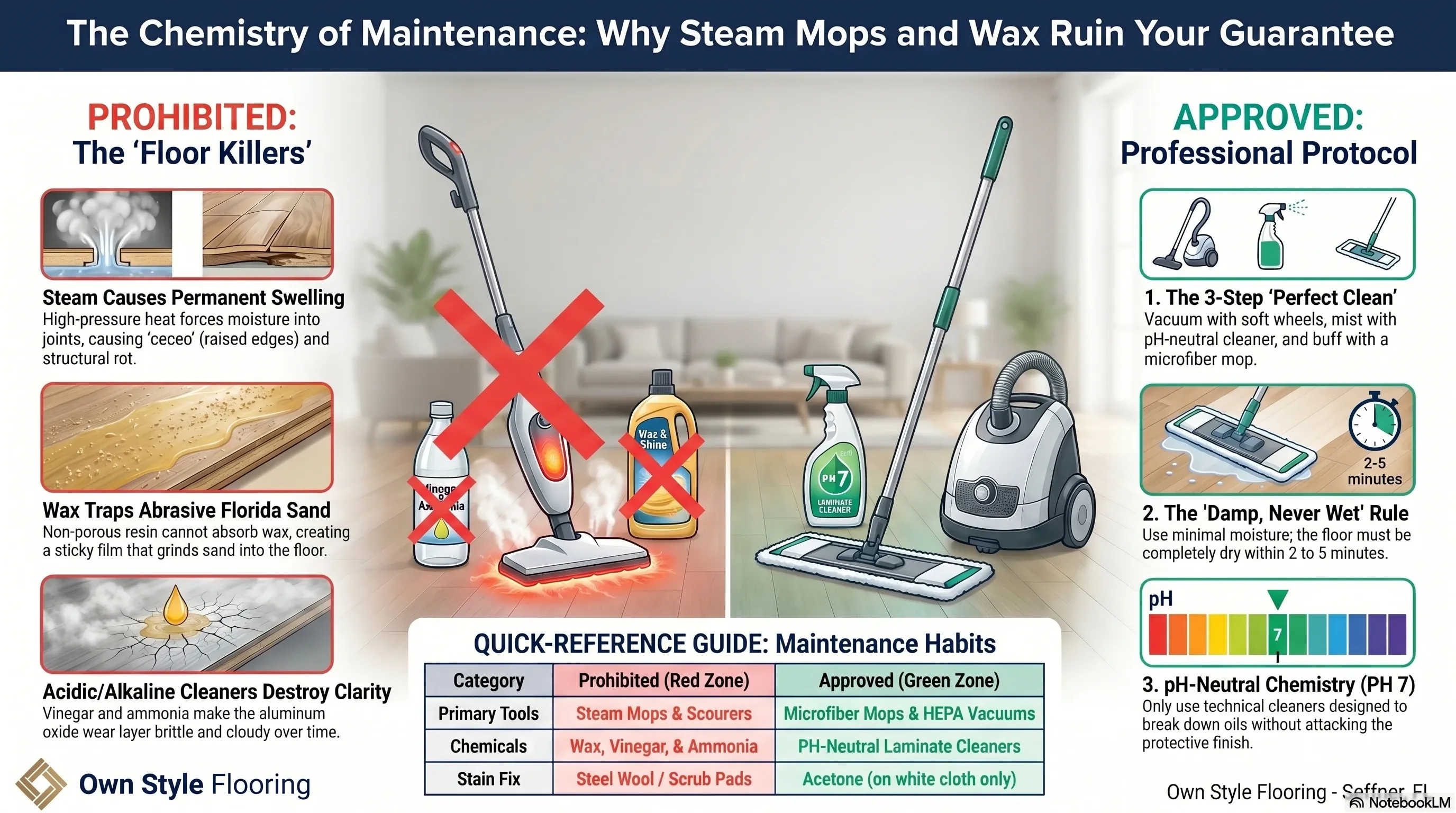
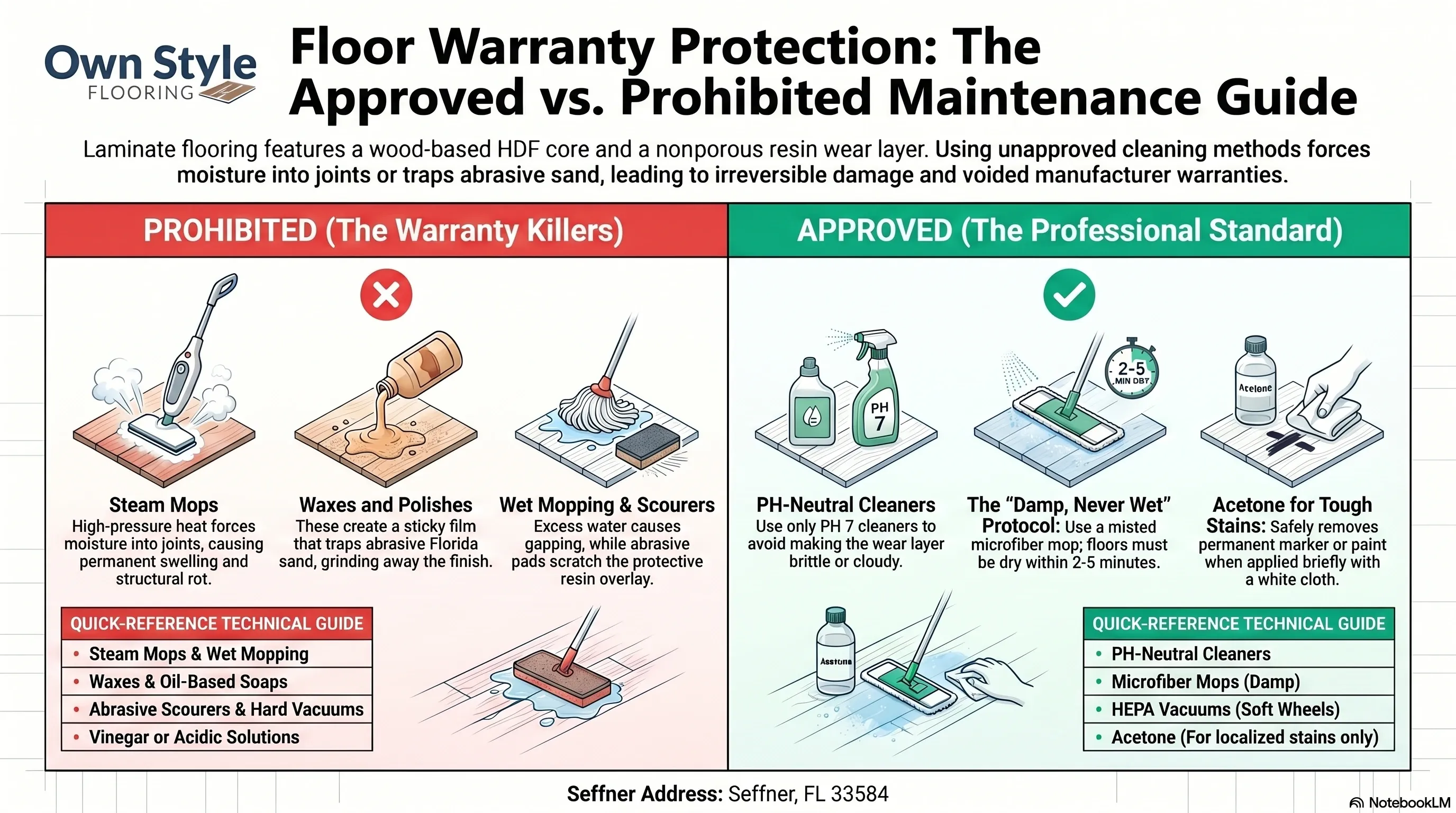
Many homeowners believe steam mops provide the “deepest” clean. However, laminate is a wood-based product. Steam mops force moisture into the floor at high pressure and extreme heat, bypassing the protective overlay and penetrating directly into unsealed click joints. Once moisture reaches the wood fibers of the core, they expand. Unlike a surface spill that can be wiped up, “steamed” moisture stays trapped, leading to permanent raised edges and structural rot that voids every major warranty.
The Resin Layer — Why Waxes and Soaps Fail
Laminate flooring comes with a factory-cured resin wear layer that is non-porous. Unlike old-fashioned hardwood, it does not need — and cannot absorb — wax or polish. Wax-based cleaners simply sit on top of the resin, creating a sticky film that traps fine silica sand from Florida’s environment. This trapped sand acts like sandpaper underfoot, grinding away the decorative image layer. A floor that looks “smudgy” or shows persistent footprints typically has a buildup of unapproved cleaning chemicals.
Most laminate rated AC4 or higher is engineered to survive 4000+ Taber abrasion cycles at the factory. That rating measures resistance to foot traffic, not to the wrong chemistry — no wear-layer spec protects against a wax film or steam-forced moisture in the seams.
pH Neutrality — The Safe Chemistry
The golden rule for flooring chemistry is pH 7 (neutral). Cleaners that are too acidic (vinegar) or too alkaline (ammonia) can react with the aluminum oxide in the wear layer, causing it to become brittle and lose transparency. Only technical cleaners specifically formulated for laminate should be used — products designed to break down oils and airborne salts without leaving residue or attacking the protective finish.
| Method or product | Safe for laminate? | Why |
|---|---|---|
| pH-neutral laminate cleaner | ✅ Yes | Formulated to break down oils without attacking the finish |
| Soft-bristle sweep / HEPA vacuum | ✅ Yes | Removes sand before it abrades the wear layer |
| Steam mop | ❌ Never | Forces heated moisture through seams into the HDF core |
| Wax or oil-based soap | ❌ Never | Leaves a residue film that traps abrasive grit |
| Vinegar or ammonia | ❌ Never | Etches the aluminum-oxide wear layer over repeated use |
| Bleach at full strength | ❌ No | Damages wear layer and print layer; only 1:10 dilution for spot mold |
| Acetone | ⚠️ Spot use only | Effective on tough stains but never on baseboards or transition profiles |
The “Damp, Never Wet” Protocol
The floor should never be flooded with a traditional mop and bucket. The professional maintenance protocol requires a slightly damp microfiber mop. After spraying the pH-neutral cleaner, the floor should be dry within 2 to 5 minutes. If water remains visible on the surface for longer than 15 minutes, the moisture is seeping into joints, setting the stage for future gapping or peaking.
Managing Sand and Grit — The First Line of Defense
In Tampa Bay, the biggest physical threat to a floor is abrasive sand tracked in from yards, pools, and Gulf Coast beaches. Maintenance starts at the door, and the fix is mechanical rather than chemical: keep grit off the resin surface before it ever gets ground into a scratch.
- High-quality walk-off mats at every exterior entrance, replacing the single “welcome mat” habit
- A second interior mat just inside doors used by pool or beach traffic, since wet feet track grit past a single exterior mat
- Soft rubber caster wheels on any vacuum, never hard plastic
- The vacuum’s beater bar switched off on hard-floor mode to avoid scuffing the resin
Hard plastic vacuum wheels leave microscopic scratches in the resin that eventually become visible dull spots in high-traffic areas of a Hillsborough County home. None of this is a one-time fix — it is a standing habit that has to outlast the novelty of a new floor.
Removing Tough Stains — The Acetone Exception
For tough stains like permanent marker, paint, or nail polish, standard cleaners are insufficient. A small amount of acetone or rubbing alcohol on a clean white cloth can be used on the affected area only. The area must be immediately wiped with a water-dampened cloth to remove chemical residue. Acetone should never be used on baseboards or transition profiles, as it can melt plastic or strip paint.
Does Tampa Bay’s Humidity Change the Cleaning Chemistry Itself?
Tampa Bay’s humidity changes how quickly the damp-never-wet window closes, not which products are safe to use. In a dry, well-conditioned room, a properly wrung microfiber mop dries within the standard 2 to 5 minutes after a pH-neutral pass.
During the June–September rainy season, when indoor humidity climbs above the canonical 35–65 % RH range even with AC running, that same damp mop pass can take noticeably longer to dry, extending the window during which moisture could work into a seam. The practical adjustment is a drier mop pass and a ceiling fan or the AC’s fan mode running during and after mopping in the humid months — not a different cleaner.
How Can Steam or Wax Damage Already Done Be Diagnosed?
The two failure modes leave distinct signatures. Steam damage shows up as raised, swollen joint edges concentrated along whichever path the mop traveled most, often a visible line tracing the cleaning route rather than uniform damage across the room.
Wax buildup instead shows as a hazy, smudgy film that becomes more visible under raking light — a lamp positioned low and to the side — and often collects visible footprints even on a freshly cleaned floor, since the residue itself stays tacky.
Steam damage to the HDF core cannot be reversed and requires plank replacement, which means paying for new material and installation labor again. Wax buildup can often be lifted with a manufacturer-approved stripping product and a microfiber cloth, restoring the original finish underneath at no replacement cost.
Do Robot Vacuums and Mops Work Safely on Laminate?
Robot vacuums are generally safe on laminate if the brush roll is soft-bristle and the unit runs in hard-floor mode without a beater bar — the same rule that applies to upright vacuums. Robot mops are the higher-risk category.
Many robot mop models use a saturated pad or a continuous-drip reservoir that leaves more standing moisture on the seams than a properly wrung microfiber mop would, and few give the operator direct control over how damp the pad actually is at any given pass.
A robot mop set to its lowest moisture setting, run on a schedule that avoids leaving a Brandon or Wesley Chapel home unattended long enough for standing water to sit unnoticed, is a reasonable use case. A robot mop left to run daily on a high-moisture setting is a slow-motion version of the same seam-penetration risk a wet string mop creates.
Investing in Longevity
Avoiding the convenience of a steam mop and the “shine” of wax products is the difference between a floor that looks new for 20 years and one that fails in five. The maintenance chemistry itself is simple — pH-neutral products, minimal moisture, and regular sand removal — but it only works as consistent habit, not a one-time deep clean after damage has already started.
Planning a flooring project in Tampa Bay? Every quote starts with a moisture reading of the slab, at no cost. Get your free photo estimate or call (813) 455-5756.
Frequently asked questions
Can a steam mop be used on waterproof laminate?
No. Manufacturers of waterproof laminate still prohibit steam mops. The surface itself handles spills, but high-pressure heat and moisture bypass that surface entirely, damaging the HDF core and specialized Hydroseal joint coatings underneath, which voids the warranty even on products marketed as waterproof.
Is vinegar and water safe for laminate floors?
It is not recommended. Vinegar is an acid that can etch the protective resin wear layer over repeated use, making the floor appear dull and cloudy over time. A pH-neutral cleaner formulated specifically for laminate is the safe choice for weekly damp mopping.
What should be done if wax was accidentally applied to laminate?
A smudgy, hazy buildup will become visible, especially under low-angled light. A specialized wax remover or stripper made for laminate flooring must be used with a microfiber cloth — never abrasive pads — applied in stages to lift the film gradually without scratching the resin.
How often should laminate floors be cleaned?
Vacuum or dry-mop daily to remove sand and grit before it grinds into the wear layer. Damp-mop with a pH-neutral cleaner once per week, or immediately after any spill, keeping the floor dry within the standard 2 to 5 minute window.
Are robot mops safe to use on laminate floors?
Only on their lowest moisture setting. Many robot mops use a saturated pad or continuous-drip reservoir that leaves more standing moisture on seams than a properly wrung microfiber mop, without the operator directly controlling how damp the pad is.
How can you tell if steam or wax damage has already happened?
Steam damage shows as raised, swollen joint edges tracing the mop's cleaning path. Wax buildup shows as a hazy film, more visible under low-angled light, that collects footprints even on a freshly cleaned floor. Steam damage requires plank replacement; wax buildup can often be stripped and restored.
US standard for measuring relative humidity inside a concrete slab using in-situ probes drilled to 40% of slab depth, read after 72 hours of equilibration.
US standard for measuring moisture vapor emission from a concrete slab using anhydrous calcium chloride, expressed in pounds per 1,000 sq ft per 24 hours.
US standard practice for preparing concrete floors to receive resilient flooring. Covers flatness, cleanliness, and moisture condition before installation.
The building code in force across Florida, including moisture and structural requirements that apply to slab-on-grade residential construction.
European deep-core moisture test that reacts a slab sample with calcium carbide and reads the resulting gas pressure. Supporting knowledge: the applicable US standards are ASTM F2170 and F1869.
Supporting knowledge — not the standard we work toGerman standard series for floor screeds, source of the widely cited 2.0% CM cement and 0.5% CM anhydrite thresholds. Supporting knowledge, not the applicable US standard.
Supporting knowledge — not the standard we work toHigh-Density Fiberboard: the compressed wood-fiber core of most laminate planks. It absorbs water vapor and swells irreversibly, which is why slab moisture matters.
Stone Plastic Composite: rigid vinyl core made of limestone powder and PVC. Dimensionally stable under humidity swings and unaffected by water.
Wood Plastic Composite: vinyl core with wood flour and foaming agents. Softer and warmer underfoot than SPC, and less dimensionally stable.
Luxury Vinyl Plank: multi-layer vinyl flooring in plank format. Fully waterproof as a material, though the subfloor beneath still governs installation.
Abrasion Class rating for laminate wear resistance, from AC1 to AC6. AC4 suits normal residential use; AC5 handles heavy traffic and light commercial.
A sheet layer placed between slab and flooring to block ground moisture vapor. Required over slab-on-grade construction regardless of surface dryness.
Foundation type where the concrete slab sits directly on the ground, dominant in Florida residential construction. Ground moisture migrates upward continuously.
The permitted deviation of a subfloor across a given span. The common benchmark is 3/16 inch over 10 feet; beyond that, deviation transfers into the locking joints.
A pourable cement-based compound that flows to a level surface, used to correct slab deviation. Needs 24 to 72 hours of cure before flooring goes down.
The 8 to 10 mm clearance left between a floating floor and every fixed vertical surface, absorbing seasonal expansion. Bridging it transfers stress to the joints.
Conditioning flooring material inside the room where it will be installed, 48 to 72 hours before installation, so it reaches interior temperature and humidity.
An angle-in locking profile that joins planks without adhesive. The insertion angle is specified by the manufacturer; forcing it deforms the profile permanently.
The raised ridge that forms along plank edges when a floating floor expands without room to move. In Florida the usual causes are slab moisture or a bridged expansion gap.