
Seasonal Floor Gapping in Tampa Bay: AC Cycling vs. Subfloor Movement
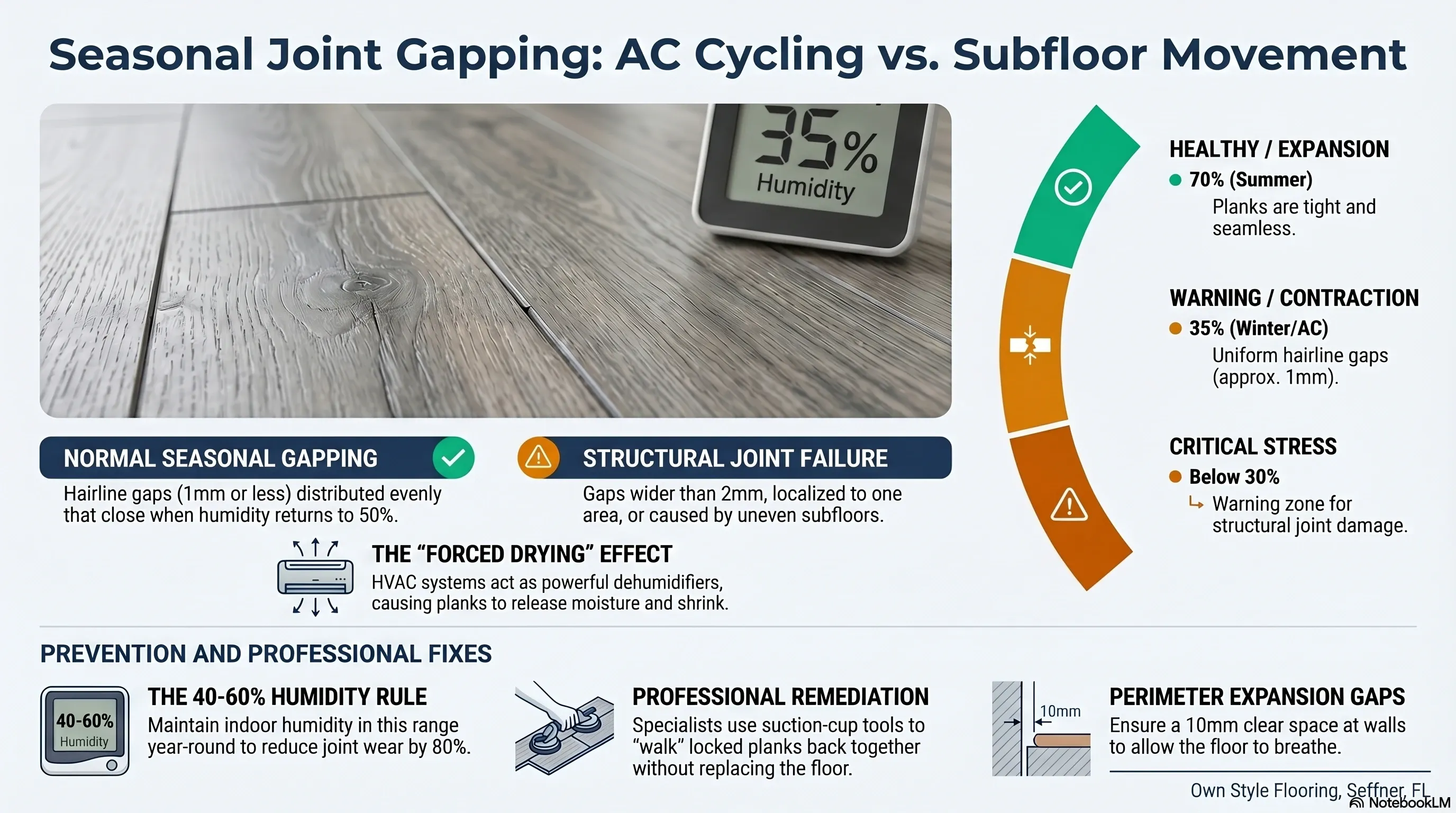
Hairline gaps appearing between laminate planks during Tampa Bay’s dry season (November–February) are a predictable response of the HDF core releasing moisture to equalize with low indoor humidity from AC. Gaps ≤ 1 mm that close in spring are normal. Gaps > 2 mm, localized, or persistent through summer indicate structural failure.
The Physics of the Shrinking Core
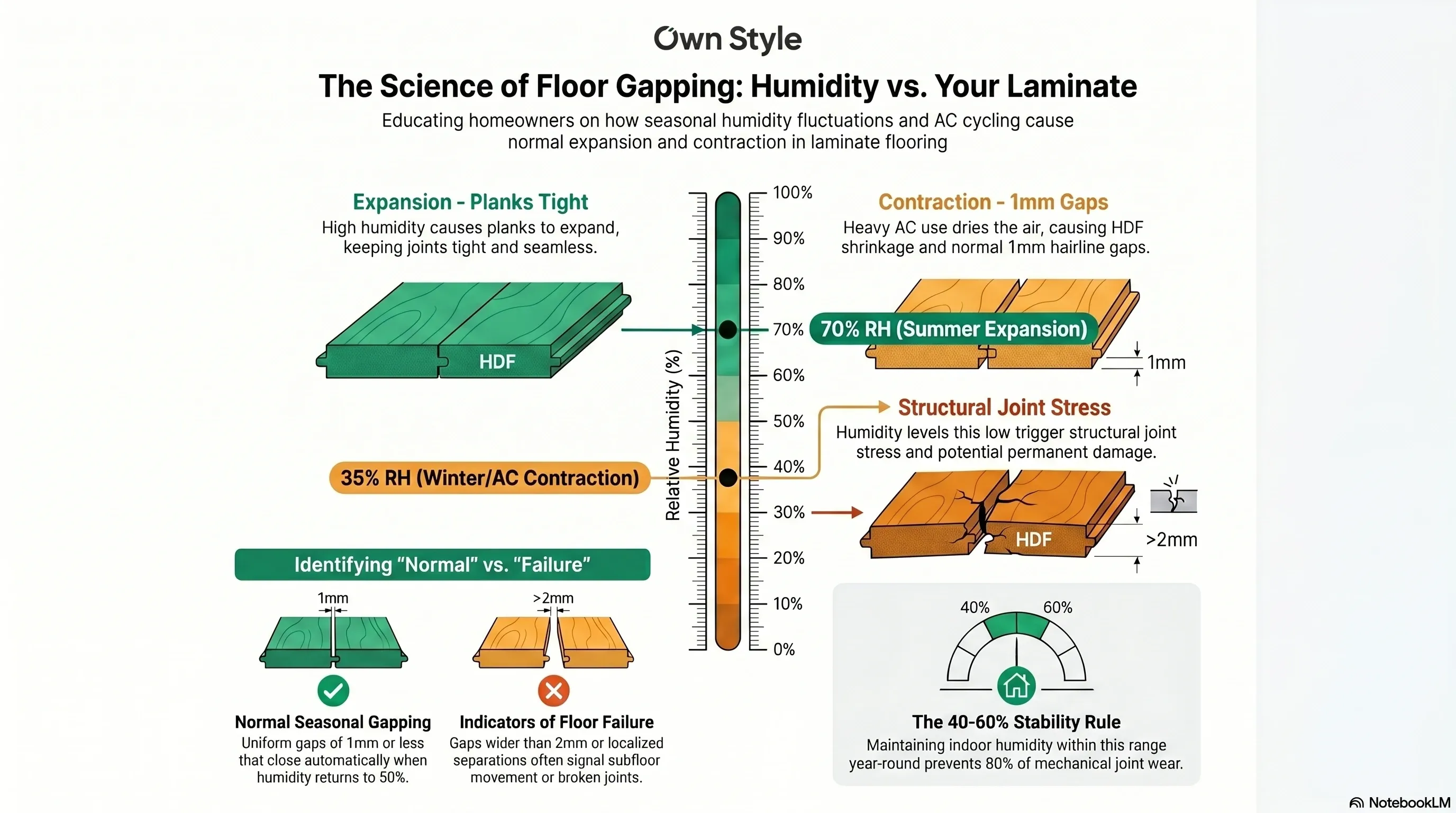
Laminate flooring is composed of compressed wood fibers that act like a sponge — they hold water when air is humid and release it when air is dry. In the Tampa Bay area, where outdoor humidity is high but indoor air is dried by air conditioning, planks are in constant flux. When a plank loses even 0.1 % of its moisture content, it shrinks by a fraction of a millimeter. Across a 20-foot room, those fractions add up, resulting in visible hairline gaps at the short-end joints.
The AC Cycling Effect — Florida’s Dehumidification Trap
The most significant driver of floor movement in Tampa Bay is not temperature — it is the dehumidification effect of HVAC systems. To maintain comfort, the AC removes gallons of water from indoor air daily. If relative humidity falls below 35 % for more than 15 consecutive days, laminate planks release their internal moisture to reach equilibrium with the room. This “forced drying” is the number-one cause of seasonal gapping in modern Florida homes.
An oversized AC system makes seasonal gapping in laminate worse, not better. A unit sized larger than the home’s actual cooling load satisfies the thermostat’s temperature setpoint quickly — often in short bursts — without running long enough in a single cycle to also manage humidity properly, a pattern known as short-cycling.
The result is a home that feels cold but stays more humid than it should between cycles, or in some configurations swings drier than expected as the oversized unit strips moisture faster than the space naturally re-equilibrates. Correct AC sizing for the home’s square footage and insulation, not just the biggest unit that fits the budget, is part of what keeps indoor humidity — and therefore plank dimensions — stable.
Subfloor Movement — When the Ground Shifts
While seasonal gapping is uniform across a room, subfloor movement causes localized, larger separations. In Brandon, Riverview, and other Tampa Bay areas with sandy soils, concrete slabs can experience minor settlement or heaving based on the water table. If a slab section sinks by just 3 mm, the floating floor above bridges that depression. Foot traffic then forces the planks apart at that point, causing Uniclic joints to slide open or, in extreme cases, snap the internal tongue.
Can a Digital Hygrometer Actually Predict When Gaps Will Appear?
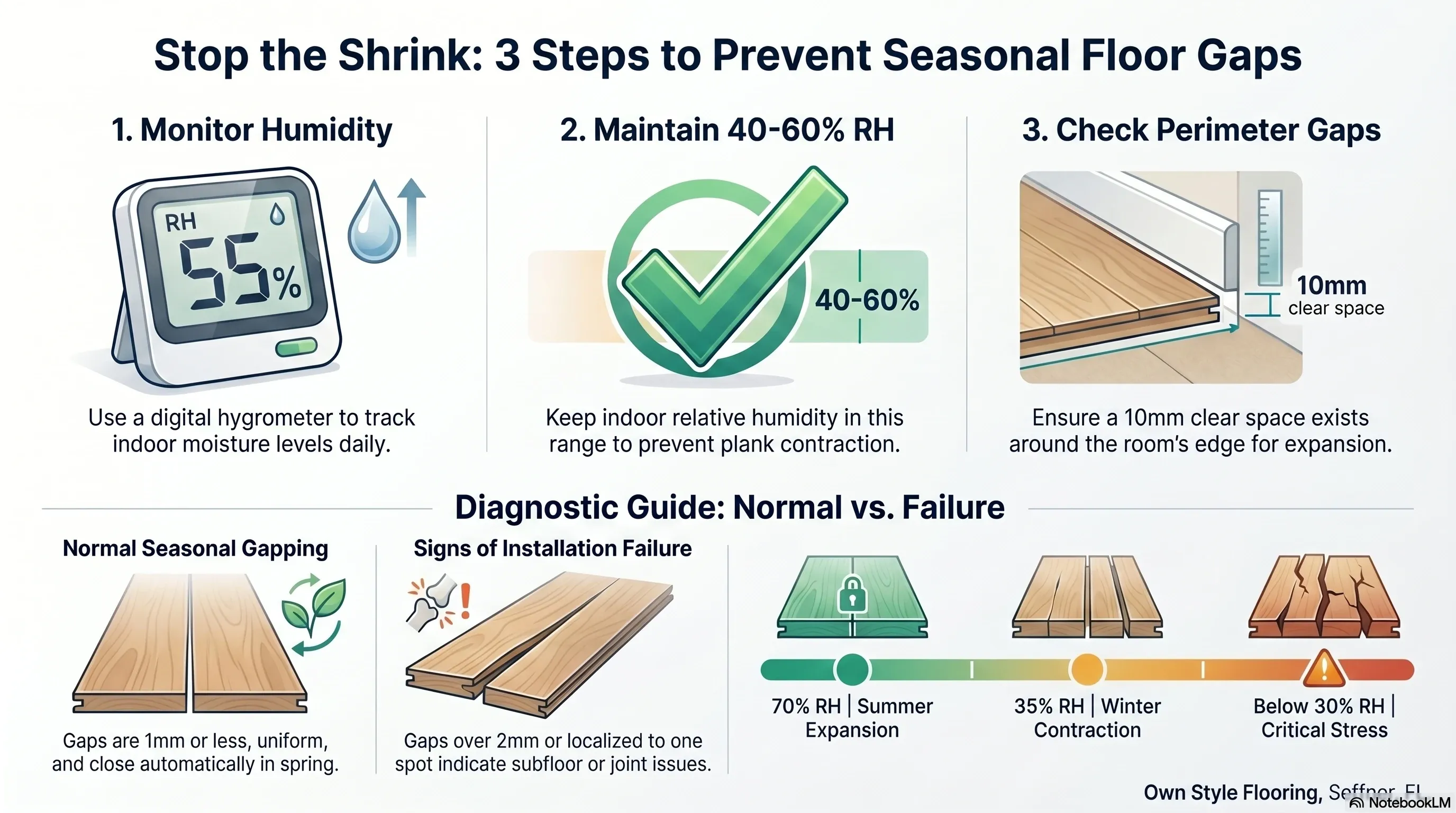
Yes, with reasonable reliability once a homeowner has a baseline for their own home. A basic digital hygrometer placed in the room that gaps most severely gives an early warning when indoor RH drops toward the 35% threshold that triggers forced drying of the HDF core — checking it during the first cold snap of the season, rather than waiting to notice visible gaps, allows a humidifier to be switched on before the floor has already released significant moisture. Tracking the reading over a full year also distinguishes a home with a genuine humidity control problem, where RH regularly swings outside the 40–60% range, from one experiencing entirely normal seasonal variation within that range.
Distinguishing “Normal” from “Failure”
A simple diagnostic rule helps determine if gaps require professional attention, comparing four characteristics against what normal seasonal movement looks like versus a genuine installation failure.
| Characteristic | Normal Gapping | Installation Failure |
|---|---|---|
| Width | ≤ 1 mm | > 2 mm |
| Distribution | Uniform across room | Concentrated in one area |
| Seasonality | Appears in winter, closes in summer | Persistent year-round |
| Accompanying symptoms | None | Uneven planks, clicking sounds |
A homeowner can run this check without any special tools:
- Measure the widest gap with a feeler gauge or a stack of business cards, not a visual guess
- Note whether the gap appears in one spot or spreads evenly across the room
- Check whether the gap closes at all during the most humid weeks of summer
- Listen for clicking or popping underfoot near the gap, which points to a joint issue rather than simple shrinkage
Preventing Gaps — The 40–60 % Humidity Rule
The key to a stable laminate floor is environmental consistency. Indoor relative humidity should be maintained between 40 % and 60 % year-round. During dry winter months, a whole-home humidifier prevents planks from shrinking. During the rainy season, a properly sized AC that avoids “short-cycling” prevents excess expansion. A floor in a stable climate experiences 80 % less mechanical wear on its joints over its lifespan.
Does Every Room in the Same House Gap the Same Amount?
No — rooms with different AC exposure or sun exposure often gap unevenly even in the same home. A room on a thermostat zone that runs colder and drier, or one with west-facing windows taking direct afternoon sun, sees more pronounced humidity swings than an interior, shaded room on the same floor.
Uneven gapping between rooms is not automatically a sign of a specific installation defect in the worse-affected room. It’s frequently just a signal that indoor climate conditions vary more between those rooms than a single whole-home humidity setting accounts for. A room-by-room hygrometer check during both the driest and most humid weeks of the year is the most reliable way to confirm whether uneven gapping traces back to climate variation or to an installation issue specific to one room, before assuming either explanation.
Professional Remediation for Persistent Gaps
If gaps will not close even when humidity is high, the laminate floor may have become “locked” — heavy furniture pinning it down or perimeter gaps that were omitted. Persistent gaps can often be corrected without full replacement using specialized floor suction-cup tools and tapping blocks to manually “walk” planks back together, followed by verifying the perimeter is actually clear for future movement rather than pinned again by trim or furniture.
How Long Does It Take for Gaps to Close Once Humidity Is Corrected?
Typically one to two weeks of sustained 40–60% RH, not an immediate response. The HDF core reabsorbs moisture at a similar gradual rate to how it released it — a whole-home humidifier turned on today does not close a winter gap tomorrow, and expecting an overnight fix leads some homeowners to conclude incorrectly that the gap is permanent when it simply hasn’t had time to respond yet.
Gaps that remain open after two full weeks of correctly maintained humidity point toward a mechanical cause — a locked perimeter or a broken joint — rather than a moisture issue still in progress.
Engineering Stability for Tampa Bay Homes
Calibrating an installation for the specific microclimate of a Tampa Bay neighborhood means treating expansion gaps and subfloor planimetry as engineering requirements, not finishing details. Flawless 10 mm expansion gaps combined with subfloor planimetry testing to prevent bridge-induced gapping are what keep a floor a stable, seamless surface across the full swing between a dry winter and a humid summer, decade after decade.
Planning a flooring project in Tampa Bay? Every quote starts with a moisture reading of the slab, at no cost. Get your free photo estimate or call (813) 455-5756.
Frequently asked questions
Will gaps in the floor close on their own?
If the gaps are seasonal (caused by dry winter air), they typically close once indoor humidity returns to the 50–60 % range. If they remain open by mid-summer, a mechanical issue or broken click joint is likely.
Can wood filler be used to fill laminate gaps?
No. Laminate is a floating floor that must move freely with the seasons, expanding and contracting as humidity changes. A rigid filler locked into a winter gap prevents that expansion when summer humidity rises, which causes planks to buckle or peak at the joints instead.
Does AC cycling really shrink laminate floors?
Yes. Air conditioning is a powerful dehumidifier by design, not just a temperature control device. Running the AC constantly at very low temperatures pulls moisture out of the HDF core over time, causing planks to contract as they dry and gaps to open at the joints.
Are gaps always a sign of bad installation?
Not always. Hairline gaps in a Florida winter are a natural physical reaction of wood-based products responding to lower indoor humidity, not a defect on their own. Gaps over 2 mm, or gaps concentrated in one specific area rather than spread evenly, more often indicate subfloor unevenness or missing expansion joints.
How long does it take for seasonal gaps to close once humidity is fixed?
Typically one to two weeks of sustained 40–60% RH, not an overnight fix. The HDF core reabsorbs moisture at a gradual pace similar to how it released it. Gaps still open after two full weeks of correct humidity point to a mechanical cause, not moisture.
Does an oversized AC unit make seasonal gapping worse?
Yes. An oversized unit satisfies the thermostat quickly in short bursts without running long enough per cycle to manage humidity properly — a pattern called short-cycling. Correct AC sizing for the home's actual cooling load helps keep indoor humidity, and plank dimensions, stable.


US standard for measuring relative humidity inside a concrete slab using in-situ probes drilled to 40% of slab depth, read after 72 hours of equilibration.
US standard for measuring moisture vapor emission from a concrete slab using anhydrous calcium chloride, expressed in pounds per 1,000 sq ft per 24 hours.
US standard practice for preparing concrete floors to receive resilient flooring. Covers flatness, cleanliness, and moisture condition before installation.
The building code in force across Florida, including moisture and structural requirements that apply to slab-on-grade residential construction.
European deep-core moisture test that reacts a slab sample with calcium carbide and reads the resulting gas pressure. Supporting knowledge: the applicable US standards are ASTM F2170 and F1869.
Supporting knowledge — not the standard we work toGerman standard series for floor screeds, source of the widely cited 2.0% CM cement and 0.5% CM anhydrite thresholds. Supporting knowledge, not the applicable US standard.
Supporting knowledge — not the standard we work toHigh-Density Fiberboard: the compressed wood-fiber core of most laminate planks. It absorbs water vapor and swells irreversibly, which is why slab moisture matters.
Stone Plastic Composite: rigid vinyl core made of limestone powder and PVC. Dimensionally stable under humidity swings and unaffected by water.
Wood Plastic Composite: vinyl core with wood flour and foaming agents. Softer and warmer underfoot than SPC, and less dimensionally stable.
Luxury Vinyl Plank: multi-layer vinyl flooring in plank format. Fully waterproof as a material, though the subfloor beneath still governs installation.
Abrasion Class rating for laminate wear resistance, from AC1 to AC6. AC4 suits normal residential use; AC5 handles heavy traffic and light commercial.
A sheet layer placed between slab and flooring to block ground moisture vapor. Required over slab-on-grade construction regardless of surface dryness.
Foundation type where the concrete slab sits directly on the ground, dominant in Florida residential construction. Ground moisture migrates upward continuously.
The permitted deviation of a subfloor across a given span. The common benchmark is 3/16 inch over 10 feet; beyond that, deviation transfers into the locking joints.
A pourable cement-based compound that flows to a level surface, used to correct slab deviation. Needs 24 to 72 hours of cure before flooring goes down.
The 8 to 10 mm clearance left between a floating floor and every fixed vertical surface, absorbing seasonal expansion. Bridging it transfers stress to the joints.
Conditioning flooring material inside the room where it will be installed, 48 to 72 hours before installation, so it reaches interior temperature and humidity.
An angle-in locking profile that joins planks without adhesive. The insertion angle is specified by the manufacturer; forcing it deforms the profile permanently.
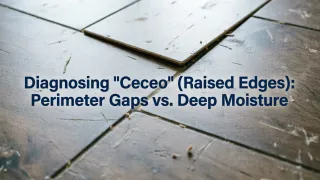
The raised ridge that forms along plank edges when a floating floor expands without room to move. In Florida the usual causes are slab moisture or a bridged expansion gap.