
Why Does My Laminate Floor Creak? Diagnosis Guide for Tampa Bay Homes

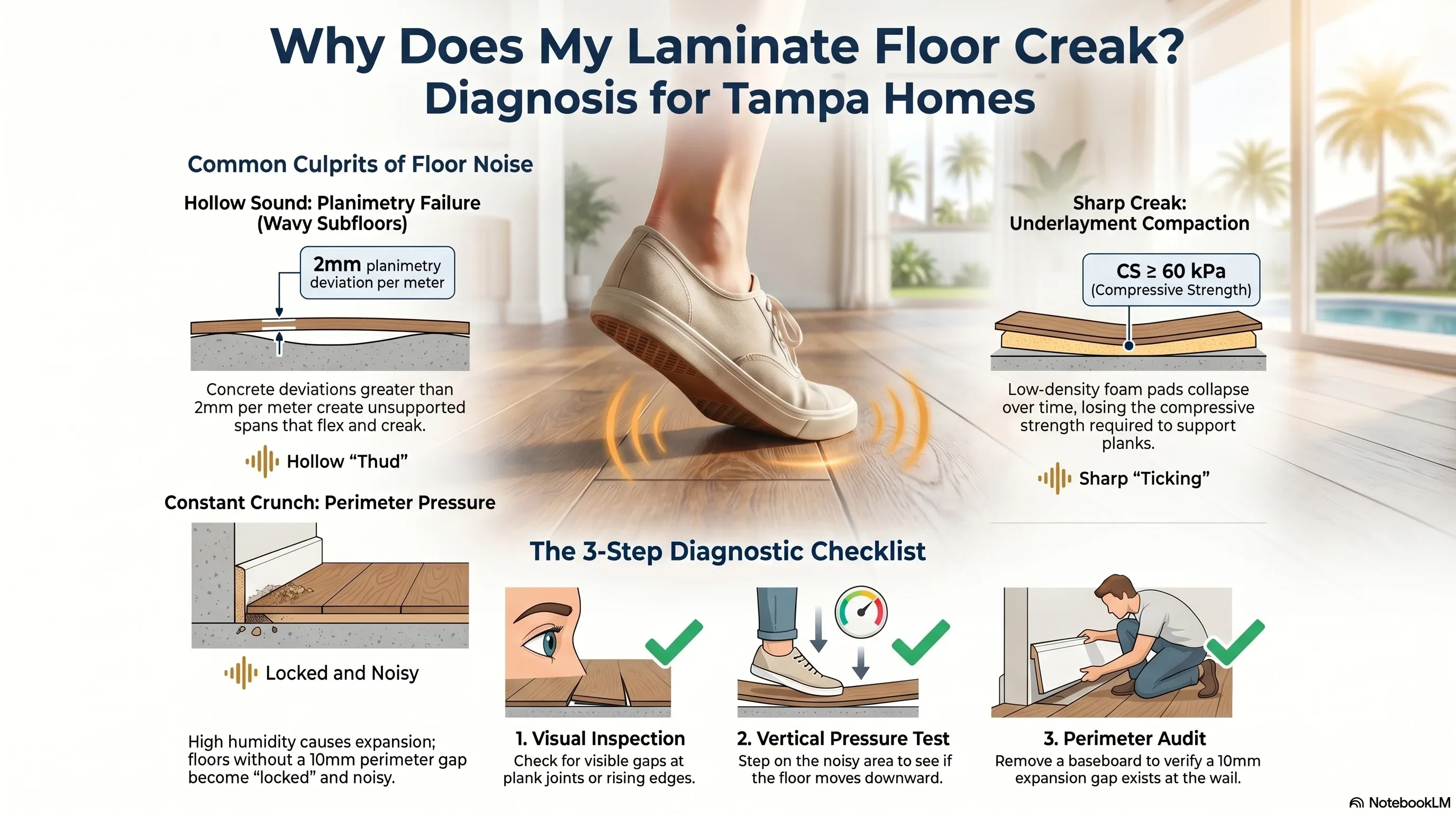
A laminate floor creaks when click-lock joints move vertically with each footfall — caused by the subfloor not providing continuous level support. The two primary causes are planimetry failure (slab deviation > 2 mm/m) and underlayment compaction (foam that lost compressive strength). Persistent creaking is a structural warning, not settling.
The Physics of Friction — Why Joints Make Noise
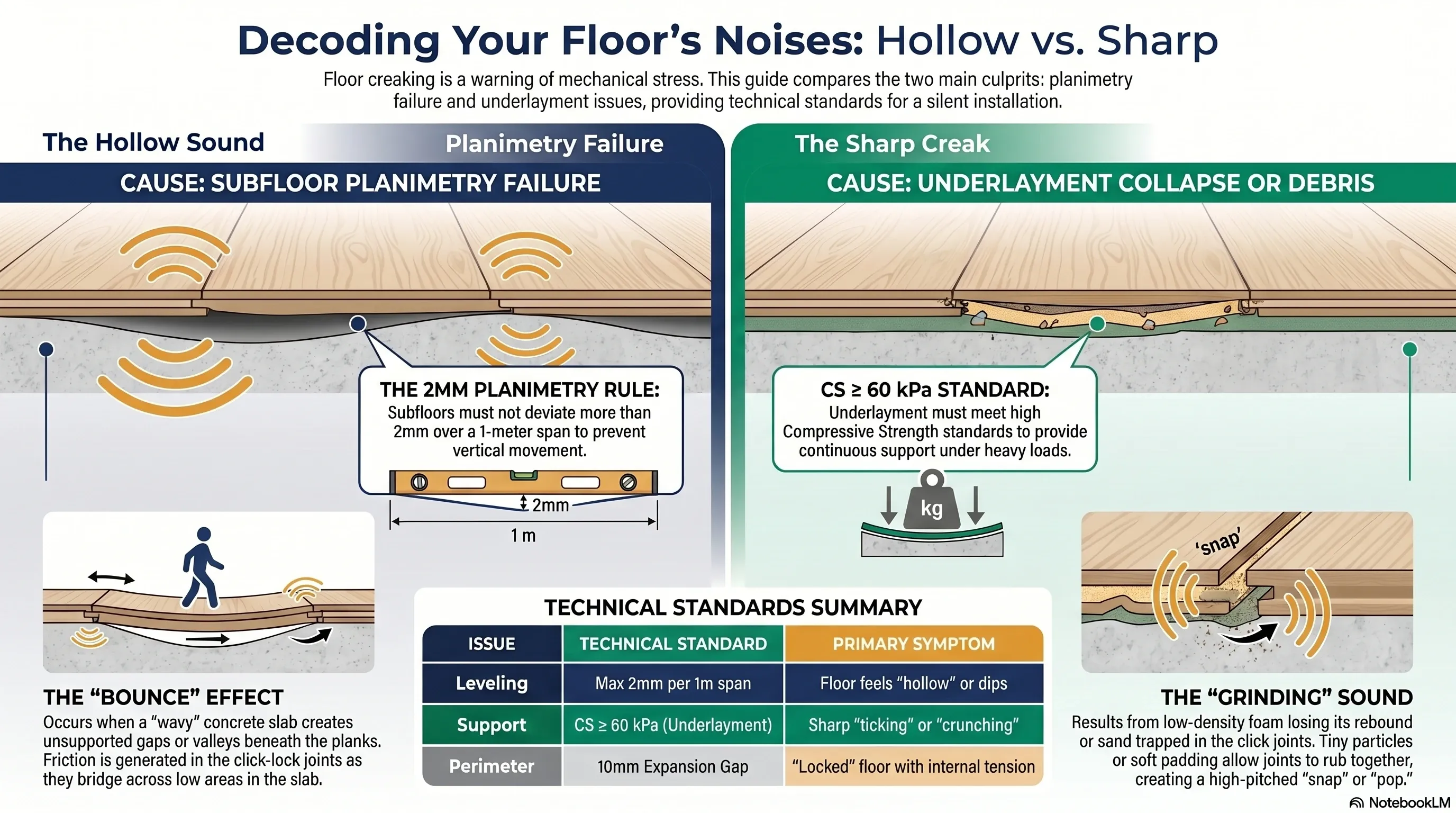
Laminate flooring is a mechanical system with click joints engineered to microscopic tolerances. In the Tampa Bay climate, humidity swinging through the canonical 35–65 % RH range can expand the HDF core slightly, tightening joints further. If the subfloor is perfectly flat, joints remain static; any “valley” in the concrete instead forces the joint to move vertically with every step.
The constant vertical movement causes tongue-and-groove profiles to grind, producing the annoying snap or pop sound. The click-lock system’s engineered tolerance is measured in fractions of a millimeter, which is why a subfloor deviation that looks trivial to the eye — well under the thickness of a coin — is enough to turn a silent joint into one that clicks audibly under every footstep.
Planimetry Failure — The Wavy Subfloor Culprit
The most common cause of floor noise in the Tampa Bay area is a subfloor that was never properly leveled. Engineering standards require that height differences not exceed 2 mm over a 1-meter span. In older homes, slabs settle or retain ridges from previous repairs. If these are not ground down or filled with self-leveler, the laminate “bounces.” The noise is the sound of the floor’s structural integrity being compromised one step at a time.
Underlayment Compaction — The “Soft Pad” Trap
Sometimes the concrete is flat but noise persists. This often points to underlayment compaction. If an installer used a low-density, soft foam padding, that foam can collapse under furniture weight or heavy foot traffic. Once the underlayment loses its rebound — measured as Compressive Strength (CS ≥ 60 kPa required) — it no longer supports the planks. The resulting vertical play allows joints to rub, creating cyclic creaking that typically worsens in drier months.
Debris and “Crunching” Sounds
If the sound is more “crunch” than “pop,” localized debris is the likely culprit. If the subfloor was not vacuumed with HEPA-grade equipment before installation, grains of sand or concrete dust become trapped between the underlayment and plank — or worse, inside the click joint. These particles act like sandpaper, grinding against wood fibers with every floor movement. This creates noise and can eventually wear down the locking system from the inside.
Can a Homeowner Diagnose the Cause Without Removing Any Planks?
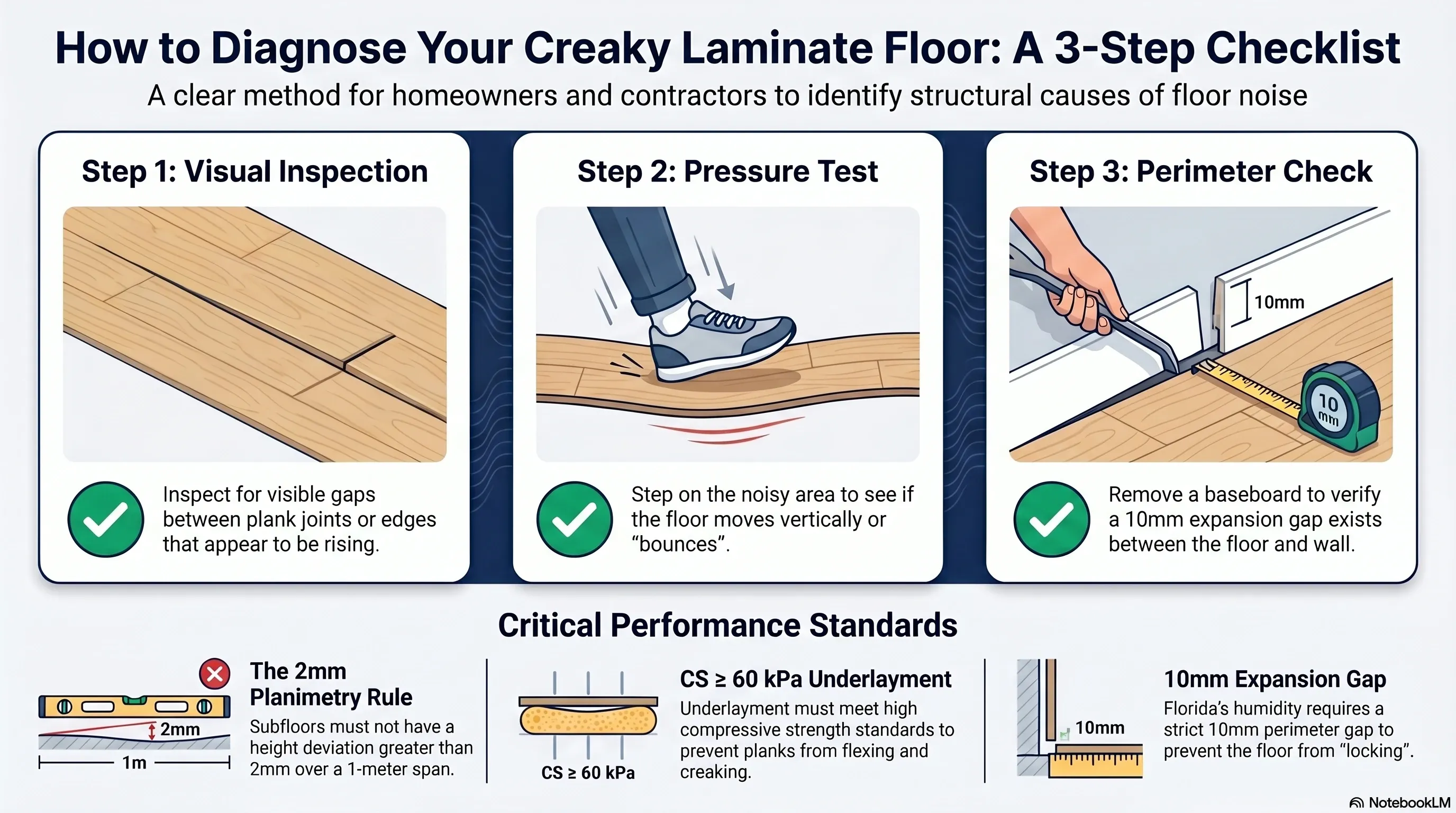
Yes, to a reasonable degree of confidence, using the same walk-and-listen protocol installers rely on. Walking the full floor slowly and marking every spot that creaks or feels different builds a diagnostic map of the room.
Noise concentrated near walls points to perimeter pressure, noise scattered evenly across the room center points to planimetry, and noise isolated to one or two specific joints with no pattern to their location points to trapped debris or a single underlayment defect. A flashlight held at a low, raking angle across the surface can also reveal subtle dips or ridges invisible under normal overhead lighting, corroborating what the footsteps are already suggesting.
A simple mapping list speeds up the process for a first-time homeowner audit:
- Walk a slow grid pattern across the entire room, not just a straight line
- Mark every creak location with painter’s tape before moving on
- Note whether each spot feels hollow, firm, or slightly springy underfoot
- Re-check marked spots a second time after 24 hours of normal humidity
Does the Type of Underlayment Affect How Likely Creaking Is?
Underlayment choice significantly changes the odds. Underlayment rated below the 60 kPa compressive strength minimum is the single most preventable cause of creaking, since it is a product specification problem rather than an installation error — the wrong material was correct on the day it was installed and only becomes a problem as it compresses under load over the following months.
Combination underlayments that pair adequate compressive strength with a built-in vapor barrier address two Tampa Bay-specific failure modes at once. A generic acoustic-only foam sold for impact noise reduction between floors may look similar on a shelf but carries no compressive strength guarantee at all.
Which Cause Fits Which Symptom?
Four distinct symptom patterns map to four different root causes, and matching them correctly before opening up the floor saves both time and unnecessary plank removal. The table below cross-references underfoot feel and sound signature against the most likely diagnosis.
| Symptom | Feel underfoot | Sound | Likely cause |
|---|---|---|---|
| Hollow bounce, worse near room center | Springy, dips slightly | Dull thud | Planimetry failure (uneven slab) |
| Sharp ticking at specific joints | Firm, no visible dip | High-pitched tick or snap | Underlayment compaction |
| Grinding or crunching | Firm | Gritty crunch | Trapped debris in underlayment or joint |
| Creaking concentrated near walls | Firm | Snap under light pressure | Perimeter pinned, missing expansion gap |
Perimeter Pressure — When the Floor Is Too Tight
In Tampa Bay’s humid climate, laminate floors require a 10 mm expansion gap at every wall. If the floor was installed too tightly against a wall or door frame, it becomes “locked.” When the floor tries to expand, internal tension builds and “pre-loads” the click joints, making them much more likely to creak at even the slightest footfall. Checking the perimeter is the first step in any professional diagnostic audit.
Professional Remediation vs. Temporary Fixes
DIY “hacks” such as injecting lubricants or waxes into joints to stop squeaking are counterproductive. Lubricants can swell the HDF core or attract dust, leading to permanent damage. The only engineering-grade solution is to identify the root cause. If the issue is planimetry, the floor must be carefully dismantled, the slab leveled, and the planks reinstalled.
Does Creaking Always Get Worse, or Can It Come and Go?
Creaking can genuinely come and go with humidity, which is part of why homeowners sometimes delay addressing it. A borderline case — a subfloor just outside tolerance, or underlayment just below the compressive strength threshold — may creak noticeably during the dry winter months when planks contract slightly and joints have more play.
The same borderline case then goes quiet during humid summer months when the HDF core swells enough to take up the play. This seasonal pattern does not mean the underlying problem resolved itself; the mechanical stress is intermittent rather than constant, and it typically returns every dry season until the root cause — the slab or the underlayment — is corrected.
Investing in a Silent Home
A quiet floor is a sign of a healthy installation, and silence is a premium feature in any Brandon, Riverview, or Wesley Chapel neighborhood. Whether noise is caused by a wavy slab, a failed underlayment, trapped debris, or a pinned perimeter, it is a warning of mechanical stress rather than a cosmetic annoyance to live with.
Calibrating every layer — subfloor planimetry, underlayment specification, and perimeter gap — to handle Florida’s environmental movement is what keeps a floor silent for the long term. Professional diagnosis and correction fixes the cause in the affected area, rather than temporarily masking a noise that will return. To find out what your floor needs, request a free photo estimate.
Planning a flooring project in Tampa Bay? Every quote starts with a moisture reading of the slab, at no cost. Get your free photo estimate or call (813) 455-5756.
Frequently asked questions
Will a laminate floor stop creaking once it settles?
Usually not. Minor settling sounds may occur in the first few days, but persistent creaking indicates a structural issue such as an uneven subfloor or collapsed underlayment. It typically worsens over time as the joints wear.
Can humidity in Tampa make a floor noisier?
Yes. High humidity causes the HDF core to expand, increasing pressure on click-lock joints throughout the room. Without adequate expansion space of at least 8–10 mm at the walls, this pressure has nowhere to release and instead forces the joints to rub and creak with every step.
How can the noise source be identified — subfloor or underlayment?
If the floor feels hollow or visibly dips underfoot, the cause is likely subfloor planimetry failure. If the surface is flat but makes a sharp ticking sound, underlayment collapse or debris in the joints is more probable.
Can a creak be fixed without removing the entire floor?
Sometimes. If the issue is at the perimeter, trimming planks to restore expansion space can resolve it. However, if noise originates in the center of the room due to an uneven slab, the affected area must be dismantled and the subfloor corrected.
Can creaking come and go with the seasons instead of staying constant?
Yes. A borderline subfloor or underlayment issue can creak during dry winter months when planks contract and joints have more play, then go quiet in humid summer months when the HDF core swells enough to take up that play. It typically returns each dry season until the root cause is corrected.
Can a homeowner diagnose the cause without removing planks?
To a reasonable degree, yes. Walking the floor slowly and mapping where it creaks helps: noise near walls suggests perimeter pressure, noise scattered across the room center suggests planimetry failure, and noise isolated to one or two joints suggests trapped debris or a single underlayment defect.


US standard for measuring relative humidity inside a concrete slab using in-situ probes drilled to 40% of slab depth, read after 72 hours of equilibration.
US standard for measuring moisture vapor emission from a concrete slab using anhydrous calcium chloride, expressed in pounds per 1,000 sq ft per 24 hours.
US standard practice for preparing concrete floors to receive resilient flooring. Covers flatness, cleanliness, and moisture condition before installation.
The building code in force across Florida, including moisture and structural requirements that apply to slab-on-grade residential construction.
European deep-core moisture test that reacts a slab sample with calcium carbide and reads the resulting gas pressure. Supporting knowledge: the applicable US standards are ASTM F2170 and F1869.
Supporting knowledge — not the standard we work toGerman standard series for floor screeds, source of the widely cited 2.0% CM cement and 0.5% CM anhydrite thresholds. Supporting knowledge, not the applicable US standard.
Supporting knowledge — not the standard we work toHigh-Density Fiberboard: the compressed wood-fiber core of most laminate planks. It absorbs water vapor and swells irreversibly, which is why slab moisture matters.
Stone Plastic Composite: rigid vinyl core made of limestone powder and PVC. Dimensionally stable under humidity swings and unaffected by water.
Wood Plastic Composite: vinyl core with wood flour and foaming agents. Softer and warmer underfoot than SPC, and less dimensionally stable.
Luxury Vinyl Plank: multi-layer vinyl flooring in plank format. Fully waterproof as a material, though the subfloor beneath still governs installation.
Abrasion Class rating for laminate wear resistance, from AC1 to AC6. AC4 suits normal residential use; AC5 handles heavy traffic and light commercial.
A sheet layer placed between slab and flooring to block ground moisture vapor. Required over slab-on-grade construction regardless of surface dryness.
Foundation type where the concrete slab sits directly on the ground, dominant in Florida residential construction. Ground moisture migrates upward continuously.
The permitted deviation of a subfloor across a given span. The common benchmark is 3/16 inch over 10 feet; beyond that, deviation transfers into the locking joints.
A pourable cement-based compound that flows to a level surface, used to correct slab deviation. Needs 24 to 72 hours of cure before flooring goes down.
The 8 to 10 mm clearance left between a floating floor and every fixed vertical surface, absorbing seasonal expansion. Bridging it transfers stress to the joints.
Conditioning flooring material inside the room where it will be installed, 48 to 72 hours before installation, so it reaches interior temperature and humidity.
An angle-in locking profile that joins planks without adhesive. The insertion angle is specified by the manufacturer; forcing it deforms the profile permanently.
The raised ridge that forms along plank edges when a floating floor expands without room to move. In Florida the usual causes are slab moisture or a bridged expansion gap.