Engineered Hardwood vs Solid Hardwood in Florida: Which One Actually Makes Sense?
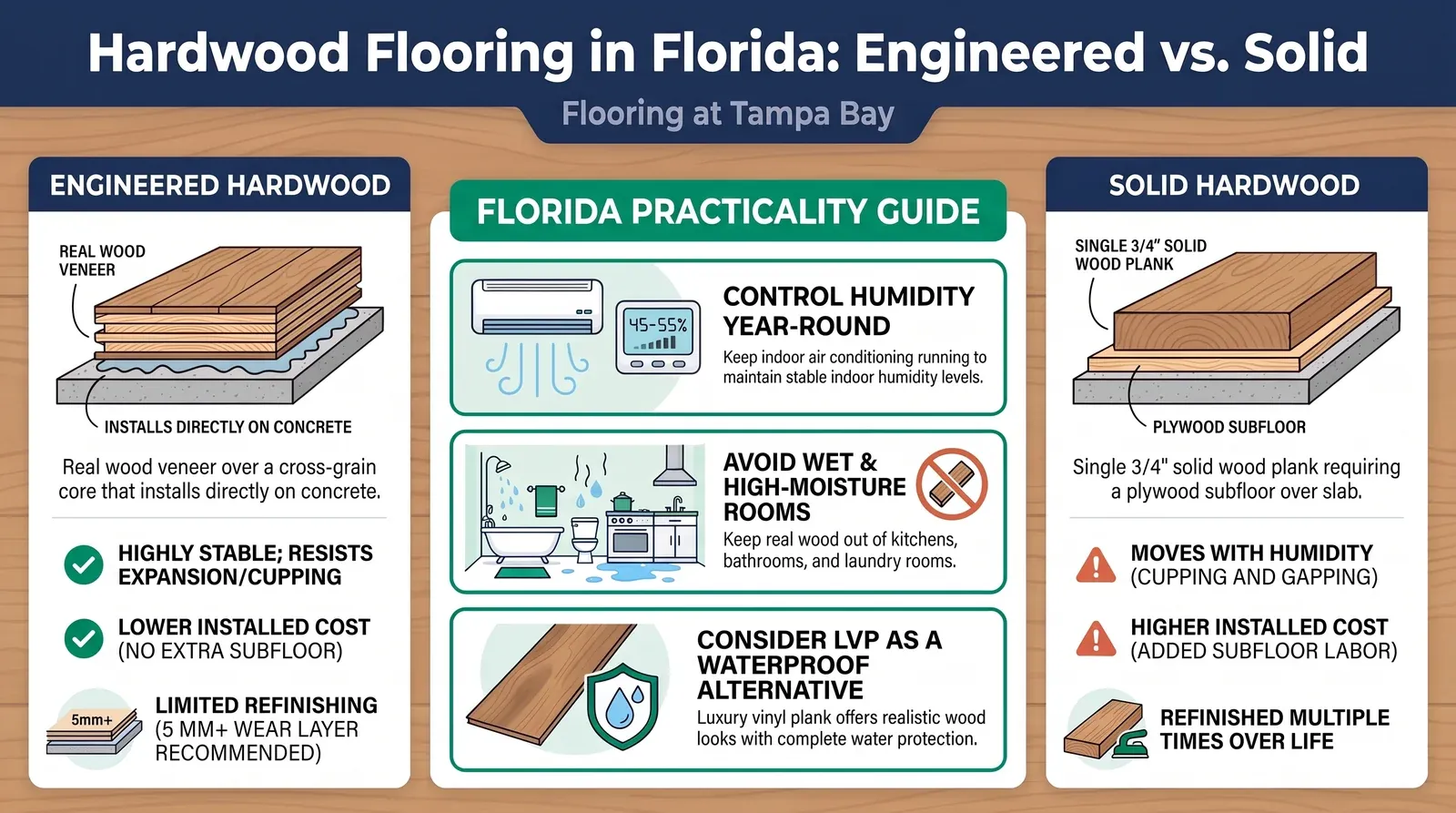
In Florida, engineered hardwood is the safer choice over solid hardwood for most homes. Its plywood core resists humidity swings better than solid wood, it installs directly on concrete slabs, and it typically costs 20–40 % less installed than solid hardwood in Tampa Bay.
Solid hardwood has a longer refinishing life and a premium feel underfoot, but it cannot be installed directly on a slab, it moves aggressively with Florida humidity, and it costs more installed because it needs a plywood subfloor over the slab. For many Hillsborough County homeowners, the honest answer is that neither hardwood type is the optimal choice — LVP often outperforms both in this climate.
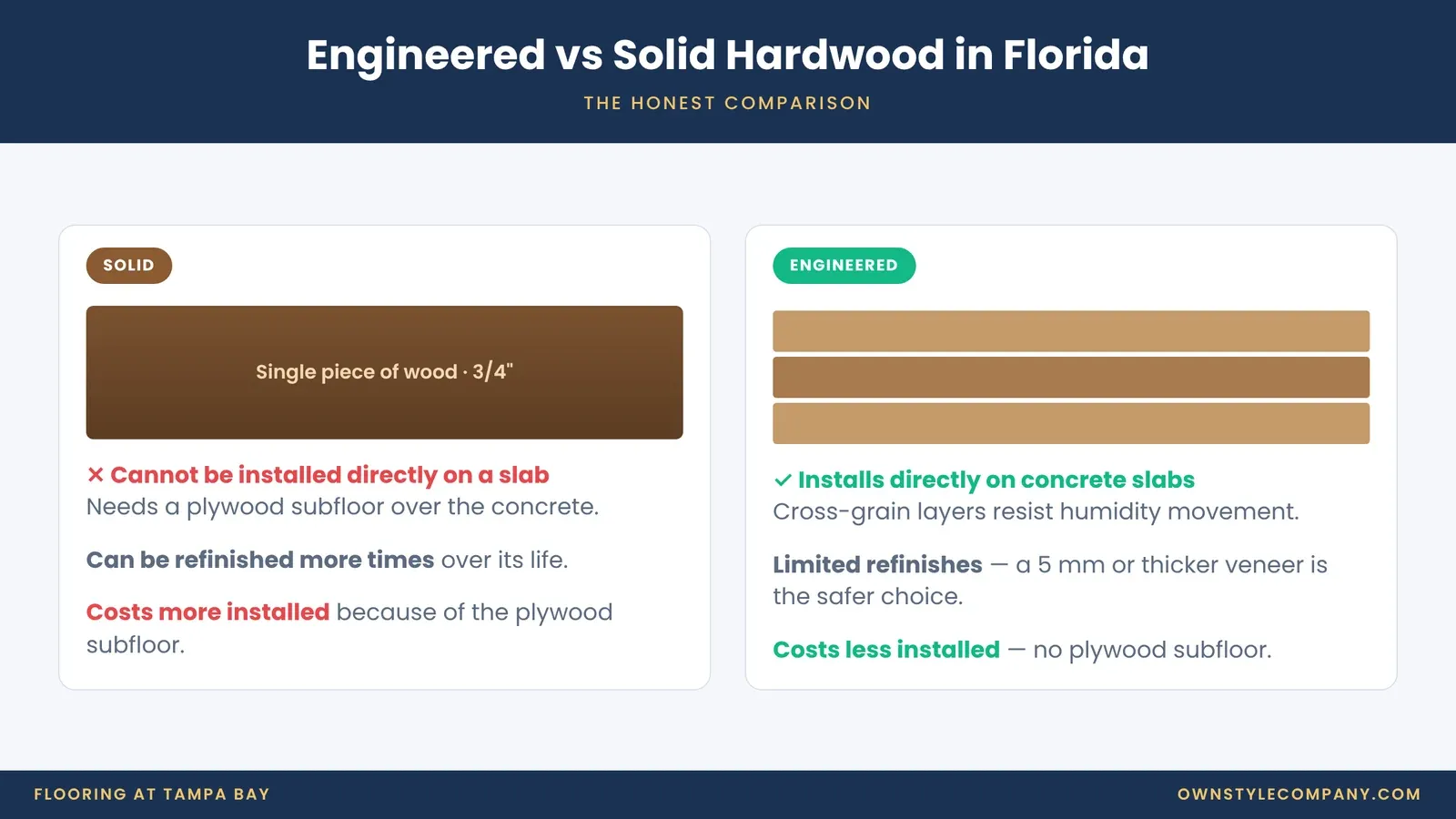
The guide below explains when each one makes sense, when neither does, and what the honest trade-offs are in the Florida context.
What is solid hardwood?
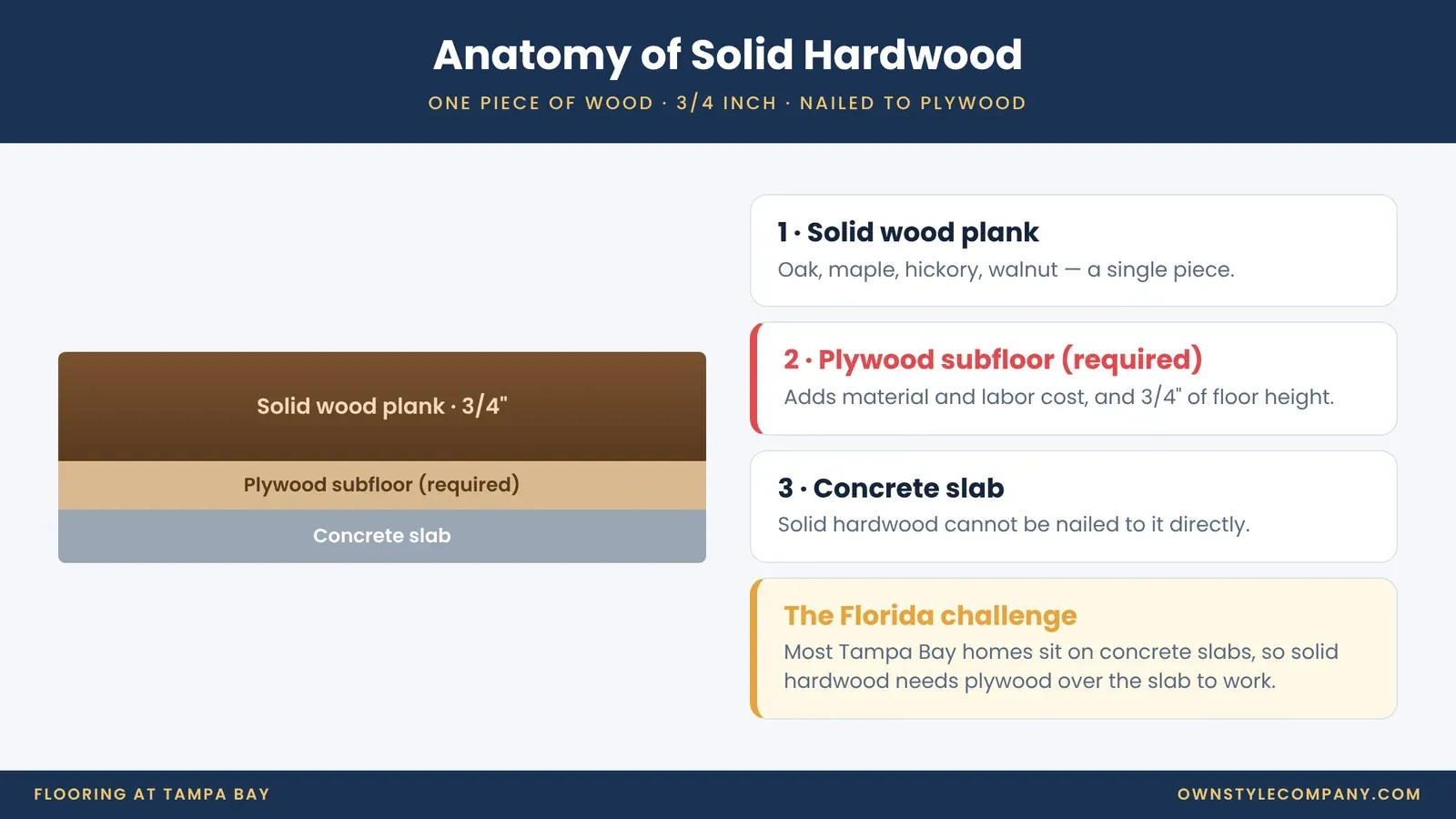
Solid hardwood is exactly what it sounds like: a single piece of wood, typically ¾ inch thick, milled from species like oak, maple, hickory, or walnut. It is nailed or stapled to a plywood subfloor. It cannot be glued or floated directly on concrete.
The great advantage of solid hardwood is refinishing. A ¾-inch solid plank can be sanded and refinished 3–5 times over its lifetime, giving it a potential 50–80 year useful life in a climate-controlled home. The great disadvantage in Florida is that it is a solid piece of wood, and wood moves with moisture — a lot.
What is engineered hardwood?
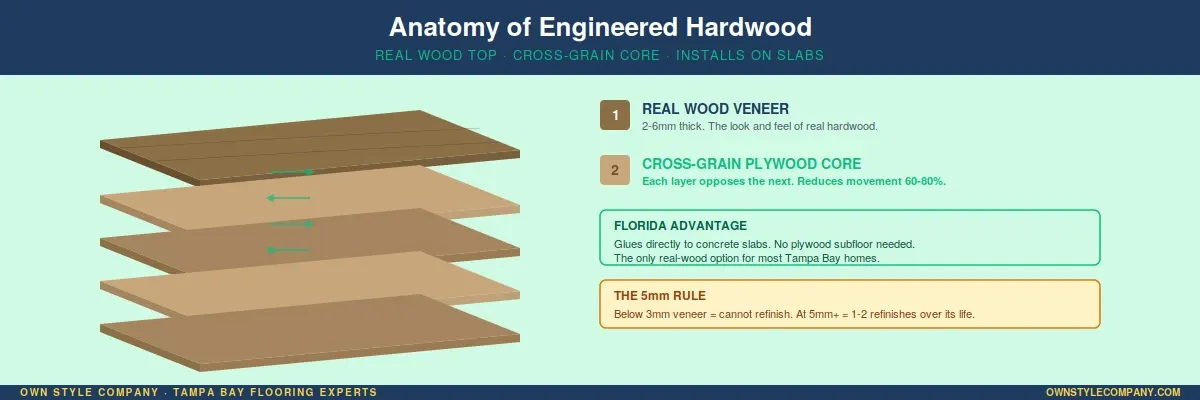
Engineered hardwood is a sandwich: a real wood veneer on top (the wear layer, typically 2–6 mm thick) bonded to a plywood or HDF core made of multiple cross-grain layers. The cross-grain construction is the engineering — each layer’s grain runs perpendicular to the one below it, which dramatically reduces expansion and contraction from humidity changes.
Engineered hardwood can be installed on concrete slabs (glued down or floated), on plywood subfloors (nailed, glued, or floated), and even over radiant heat. This makes it the only real-wood option for most Tampa Bay homes, where the slab is the subfloor.
The direct comparison for Florida homes
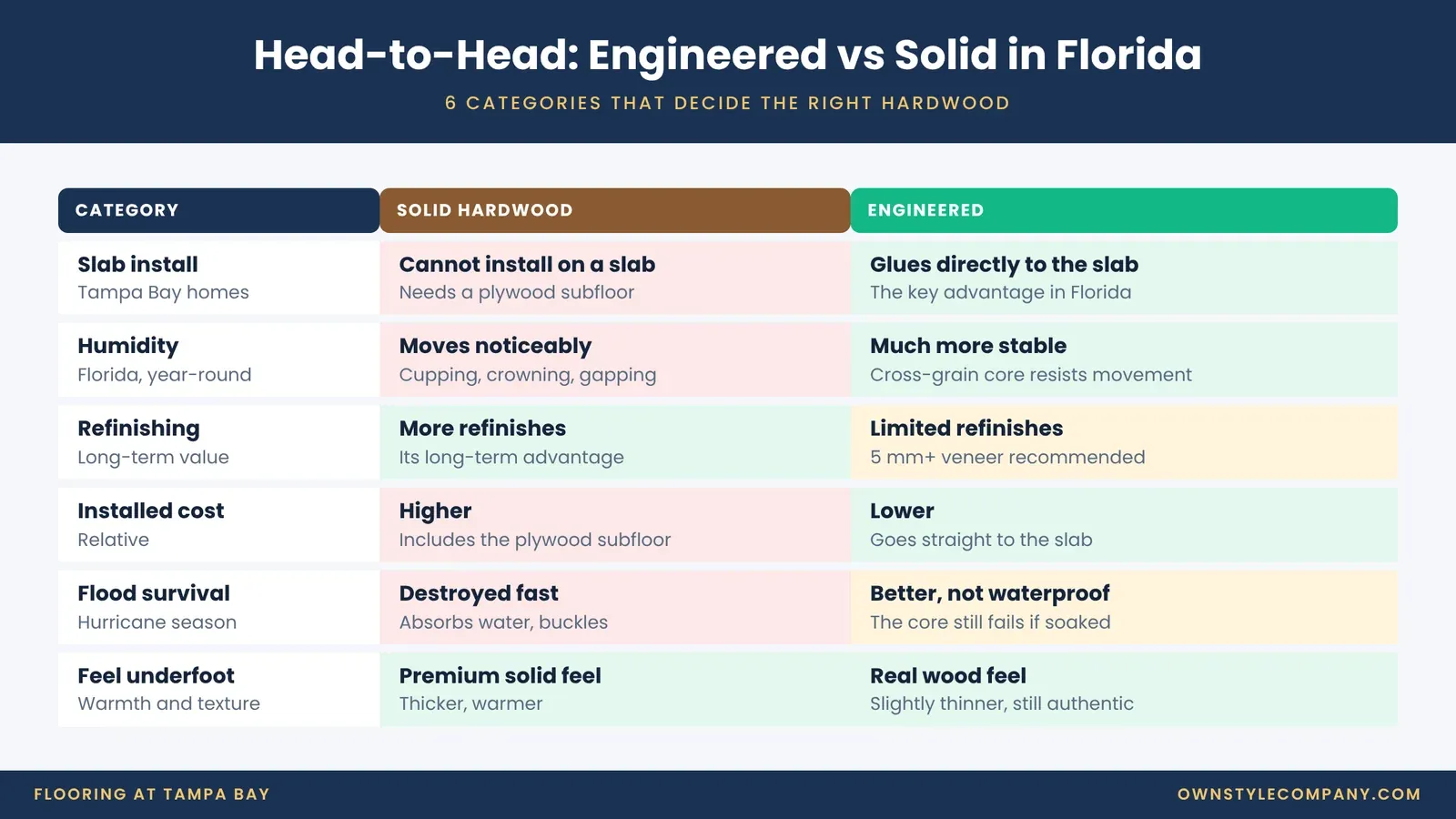
Six categories separate solid and engineered hardwood in a Florida installation, and the slab-compatibility row usually decides the choice by itself for a Tampa Bay home. The table below lines up construction, humidity stability, cost, and room suitability side by side.
| Category | Solid Hardwood | Engineered Hardwood |
|---|---|---|
| Construction | Single piece of solid wood, ¾ inch thick. | Real wood veneer over cross-grain plywood core. |
| Humidity stability | Moves significantly. Cupping, crowning, gapping common in FL. | Cross-grain core reduces movement 60–80 %. Much more stable. |
| Slab installation | CANNOT be installed on concrete slabs. Requires plywood subfloor. | CAN be installed on slabs (glue-down or floating). Key advantage in Tampa Bay. |
| Refinishing | 3–5 times over 50–80 year lifetime. The long-term advantage. | 1–2 times (depends on veneer thickness). 5 mm+ veneer recommended for FL. |
| Relative installed cost | Higher (including plywood subfloor). | Lower (direct to slab). |
| Flood survival | Destroyed. Absorbs water fast, buckles, mold risk. | Better than solid but NOT waterproof. Plywood core eventually delaminates. |
| Best rooms in FL | Second-floor bedrooms, climate-controlled year-round. | Ground floor in controlled homes. Never in kitchens/baths. |
| Worst rooms in FL | Any room on a concrete slab. Any room that might flood. | Kitchens, bathrooms, laundry. Use LVP or tile there instead. |
Our installation labor for glue-down engineered hardwood is $3 per square foot; material is priced separately depending on the product. See our published prices for current labor rates.
The honest question — should you get hardwood at all in Florida?
Most flooring websites skip this question entirely. Here is the honest answer from installers who work in Tampa Bay every day: hardwood, engineered or solid, is a premium aesthetic choice in this climate, not the practical one.
LVP with a realistic wood print gives 90 % of the look with zero water risk, better humidity stability, lower cost, and 20–30 year durability. The only reason to choose real hardwood over LVP in Tampa Bay is if the feel of real wood underfoot matters more than the practical advantages of vinyl — a valid reason, but one that should be a conscious decision, not a default.
If you do choose hardwood in Florida:
- Engineered over solid, unless the home has a plywood subfloor AND the rooms are climate-controlled year-round.
- 5 mm+ wear layer minimum on engineered, so it can be refinished at least once.
- Never in kitchens, bathrooms, laundry rooms, or entryways. Use LVP or tile in those rooms, with a clean transition strip between rooms.
- Keep indoor humidity within the 35–65 % RH range year-round. In Florida, this means the A/C runs constantly.
- Consider the resale angle: buyers in Tampa Bay increasingly prefer LVP over hardwood because they understand the maintenance burden.
How Long Should Hardwood Acclimate Before Installation in Florida?
Both hardwood types need to sit inside the actual installation room, boxes opened or bundles broken, before the crew starts nailing or gluing. Solid hardwood needs a longer window than engineered because a full ¾-inch plank has more mass to equalize with the room’s moisture content.
- Solid hardwood: minimum 5 to 7 days at normal occupied-home conditions, AC running
- Engineered hardwood: minimum 3 to 5 days under the same conditions
- Both types: the room’s indoor RH must already be inside the 35–65 % range before acclimation starts, not just by the time installation begins
- Skipping acclimation is one of the most common causes of early gapping in a first Florida summer, regardless of product quality
What Does Refinishing Actually Involve, and How Often Is It Needed?
Refinishing sands away the top layer of finish and a thin layer of wood, then reapplies stain and sealer to restore the surface. Solid hardwood’s full ¾-inch thickness supports 3 to 5 refinishing cycles over a 50 to 80 year lifespan, spaced roughly every 10 to 15 years depending on traffic.
Engineered hardwood’s veneer limits this significantly. A 5 mm or thicker veneer supports 1 to 2 refinishing cycles; anything thinner cannot be sanded at all without exposing the plywood core. Each refinishing job on either type is a significant added cost for sanding, staining, and sealing, and the floor is unusable for 2 to 3 days during the process.
How to decide for your Tampa Bay home
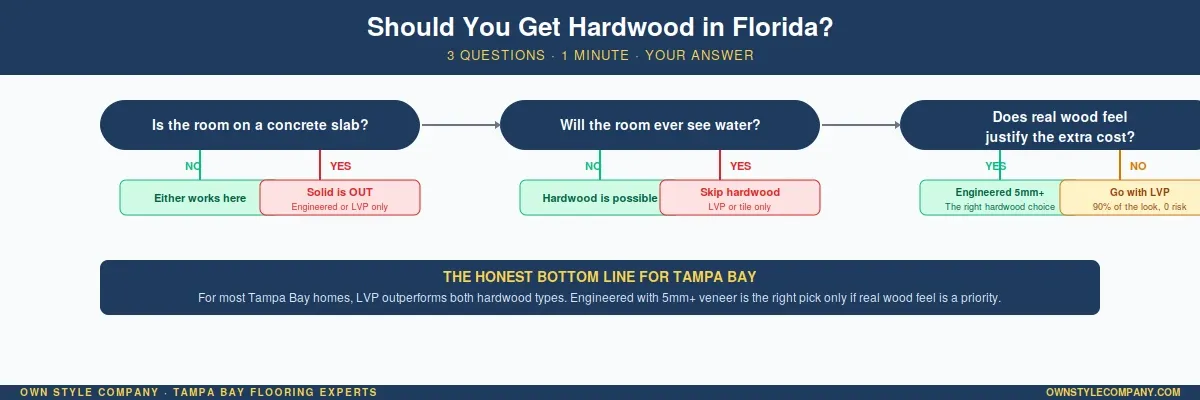
Start with three questions for a Brandon, Riverview, or Wesley Chapel home. First: is the room on a concrete slab? If yes, solid hardwood is off the table — engineered or LVP only. Second: will the room ever see water? If yes, LVP or tile. Third: does the feel of real wood matter enough to justify higher cost and higher maintenance? If yes, engineered hardwood with a 5 mm+ veneer is the right pick.
Planning a flooring project in Tampa Bay? Every quote starts with a moisture reading of the slab, at no cost. Get your free photo estimate or call (813) 455-5756.
Frequently asked questions
Can I install solid hardwood on a concrete slab in Tampa Bay?
Not directly. Solid hardwood must be nailed to a plywood subfloor built over the slab, which adds material and labor cost to the project. Engineered hardwood skips this step entirely and can be glued directly to the slab, which is the main reason it dominates ground-floor installations in Tampa Bay.
How thick should the wear layer be on engineered hardwood in Florida?
A minimum of 3 mm works for light-use rooms with no refinishing plans. For rooms with regular traffic or any expectation of future refinishing, 5 mm or thicker is the safer specification. Below 3 mm, the veneer is too thin to sand without exposing the plywood core underneath.
Does engineered hardwood hold up to dogs?
Better than solid hardwood, but not as well as LVP. Dog claws scratch both hardwood types at roughly the same rate, and engineered hardwood has fewer refinishing opportunities over its lifetime due to its thinner wear layer compared to a full ¾-inch solid plank.
How long does hardwood last in Tampa Bay?
Engineered hardwood in a climate-controlled home typically lasts 20 to 40 years before the core needs replacement. Solid hardwood on a plywood subfloor can last 50 to 80 years with periodic refinishing. Both figures assume consistent indoor climate control year-round, which is not optional in Florida's humidity.
Is hardwood a good investment for resale in Tampa Bay?
For higher-priced homes, real hardwood still commands a premium. In the mid-range price bands covering most of Tampa Bay, buyers increasingly prefer low-maintenance LVP. The hardwood premium has shrunk from 3–5 % to 1–2 % in recent years.
US standard for measuring relative humidity inside a concrete slab using in-situ probes drilled to 40% of slab depth, read after 72 hours of equilibration.
US standard for measuring moisture vapor emission from a concrete slab using anhydrous calcium chloride, expressed in pounds per 1,000 sq ft per 24 hours.
US standard practice for preparing concrete floors to receive resilient flooring. Covers flatness, cleanliness, and moisture condition before installation.
The building code in force across Florida, including moisture and structural requirements that apply to slab-on-grade residential construction.
European deep-core moisture test that reacts a slab sample with calcium carbide and reads the resulting gas pressure. Supporting knowledge: the applicable US standards are ASTM F2170 and F1869.
Supporting knowledge — not the standard we work toGerman standard series for floor screeds, source of the widely cited 2.0% CM cement and 0.5% CM anhydrite thresholds. Supporting knowledge, not the applicable US standard.
Supporting knowledge — not the standard we work toHigh-Density Fiberboard: the compressed wood-fiber core of most laminate planks. It absorbs water vapor and swells irreversibly, which is why slab moisture matters.
Stone Plastic Composite: rigid vinyl core made of limestone powder and PVC. Dimensionally stable under humidity swings and unaffected by water.
Wood Plastic Composite: vinyl core with wood flour and foaming agents. Softer and warmer underfoot than SPC, and less dimensionally stable.
Luxury Vinyl Plank: multi-layer vinyl flooring in plank format. Fully waterproof as a material, though the subfloor beneath still governs installation.
Abrasion Class rating for laminate wear resistance, from AC1 to AC6. AC4 suits normal residential use; AC5 handles heavy traffic and light commercial.
A sheet layer placed between slab and flooring to block ground moisture vapor. Required over slab-on-grade construction regardless of surface dryness.
Foundation type where the concrete slab sits directly on the ground, dominant in Florida residential construction. Ground moisture migrates upward continuously.
The permitted deviation of a subfloor across a given span. The common benchmark is 3/16 inch over 10 feet; beyond that, deviation transfers into the locking joints.
A pourable cement-based compound that flows to a level surface, used to correct slab deviation. Needs 24 to 72 hours of cure before flooring goes down.
The 8 to 10 mm clearance left between a floating floor and every fixed vertical surface, absorbing seasonal expansion. Bridging it transfers stress to the joints.
Conditioning flooring material inside the room where it will be installed, 48 to 72 hours before installation, so it reaches interior temperature and humidity.
An angle-in locking profile that joins planks without adhesive. The insertion angle is specified by the manufacturer; forcing it deforms the profile permanently.
The raised ridge that forms along plank edges when a floating floor expands without room to move. In Florida the usual causes are slab moisture or a bridged expansion gap.