After the Flood: What to Do with Your Floors in the First 72 Hours
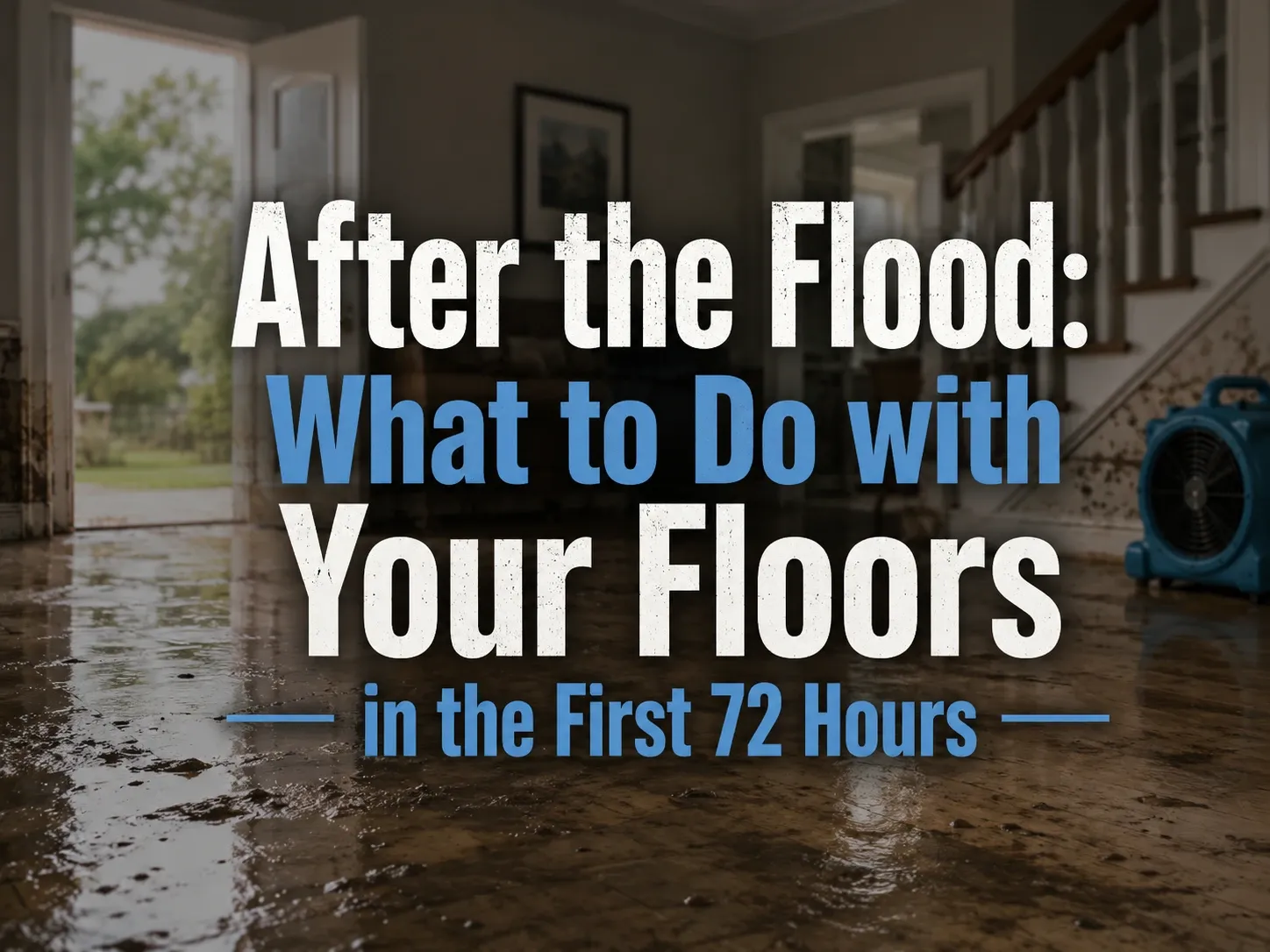
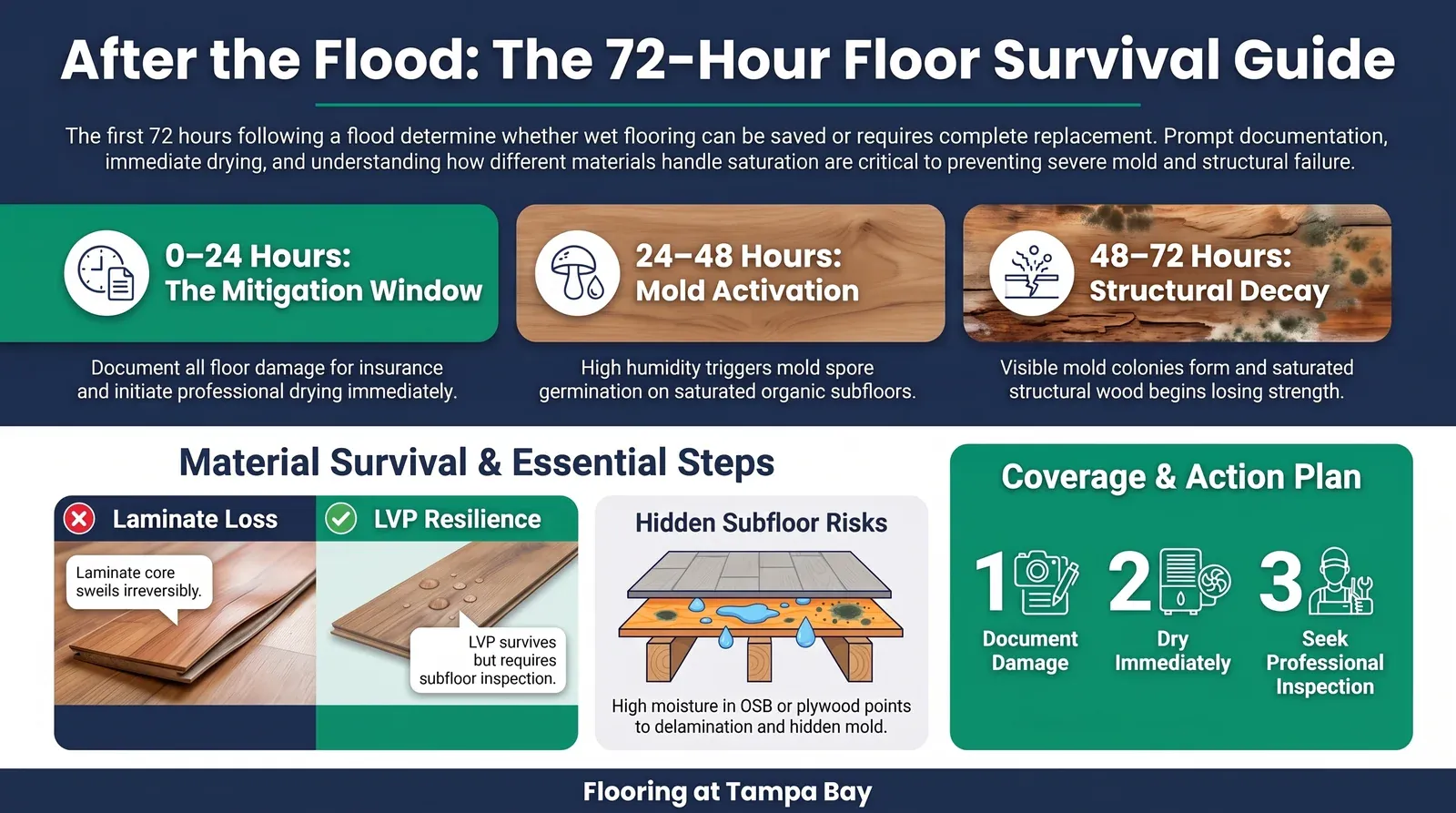
If floors were flooded, the first 72 hours determine whether they can be saved or need complete replacement. The key factors are water type, how long the floor was submerged, and which flooring material was under water when it happened.
Laminate almost never survives flooding, since the HDF core swells irreversibly. LVP is waterproof at the surface, but the subfloor beneath it may be compromised. In Tampa Bay, where hurricane flooding can combine storm surge with sewage backflow, professional assessment before any decisions is critical.
What Are the First Steps After Flood Water Enters Your Home?
The first hour after flood water recedes sets the tone for the entire recovery, and the actions taken here — or skipped — directly affect whether an insurance claim gets paid in full. Four steps come before any flooring decision is made:
- Confirm the home is structurally safe. Do not enter if the ceiling shows signs of collapse or if electrical fixtures are submerged.
- Stop the water source if possible. For plumbing failures, locate the main shutoff. For storm flooding, wait for water to recede naturally.
- Document everything. Photograph every room, every floor, every waterline — before removing a single piece of flooring. Insurance claims require before-cleanup documentation.
- Contact an IICRC-certified water mitigation company within the first 24 hours. They have industrial dehumidifiers and moisture meters that consumer equipment cannot replicate.
Which Floor Materials Survive Flooding — and Which Do Not?
Every flooring material responds to standing water differently, and the difference determines the scope of a post-flood project more than any other single factor. The breakdown below covers the four materials most common in Tampa Bay homes.
Laminate — almost always a total loss
Laminate has an HDF core that swells within hours of water contact. Once swollen, it cannot be restored. If laminate was submerged or in contact with standing water for more than a few hours, plan for replacement.
LVP — the surface survives, check the subfloor
LVP is 100 % waterproof at the product level. However, water migrates under LVP through seams and around the perimeter. The subfloor beneath can saturate and develop mold even when the LVP surface looks perfect. Always remove LVP after a flood and inspect the subfloor with a moisture meter before reinstalling.
Hardwood — possible to save within 24 hours
Solid and engineered hardwood can sometimes be saved, but the window is narrow. Professional drying equipment must be placed within 24 hours of the flood. Tampa Bay’s ambient humidity (often 85 %+) makes air-drying impossible at scale. Even with equipment, warping, cupping, and staining are common outcomes.
Tile — almost always survives the surface
Tile itself is unaffected by water. However, the grout can crack, the setting mortar can be weakened, and the subfloor beneath can be damaged. After flooding, tap tiles with a coin to check for loose or hollow-sounding areas.
Does the Type of Water Matter for Flooring Decisions?
Yes — the water’s contamination level, not just how long it sat, determines whether flooring can be cleaned or must be discarded. The IICRC S500 standard classifies flood water into three categories. Category 1 is clean water from a sanitary source, such as a supply line break. Category 2 (“gray water”) carries significant contamination — washing machine overflow, dishwasher discharge, or any Category 1 water left standing 24–48 hours.
Category 3 (“black water”) is grossly contaminated — sewage backflow, storm surge, or river flooding that carries soil and chemicals, or any Category 2 water left untreated past 72 hours. Hurricane storm surge in Tampa Bay is almost always Category 3, which means porous flooring materials in contact with it are discarded regardless of how long they were submerged, not just evaluated on a drying timeline.
What Does the 72-Hour Rule Mean for Tampa Bay Flooding?
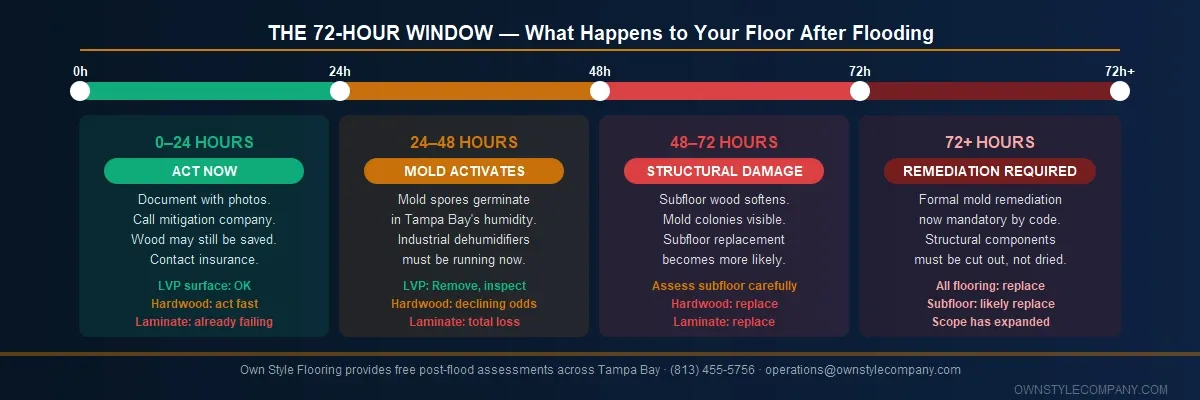
The 72-hour window is not a soft guideline — it maps to real, measurable changes inside wet structural material, and each 24-hour block crosses a threshold that changes what remediation is required next.
- 0–24 hours: structural wood is wet but not yet beginning permanent degradation. Mold spores are present but not yet activated.
- 24–48 hours: in Tampa Bay’s 80 %+ outdoor humidity, mold spore germination begins on wet organic surfaces.
- 48–72 hours: mold colonies become visible in saturated areas. Structural wood begins to soften and lose bearing capacity.
- 72+ hours: mold remediation becomes a formal requirement. Damaged structural components must be cut out, not dried.
What About the Subfloor — Is That the Real Problem?
In post-flood assessments across Brandon, Riverview, and the wider Tampa Bay area, the subfloor is damaged more often than the surface flooring. Homeowners focus on what they can see — but the structural platform the flooring sits on determines whether any new flooring will last.
- Soft spots or bounce when walking on a dried floor — indicates OSB or plywood that has delaminated.
- Visible mold on the underside of removed flooring panels.
- Moisture meter readings above 15 % in the subfloor after apparent drying.
What Mistakes Make Flood Damage Worse in the First 72 Hours?
The most common mistake is running only fans without a dehumidifier. Tampa Bay’s ambient humidity, often above 80% after a storm, keeps air-drying from ever catching up with the moisture already in the structure.
A second frequent error is walking flooded areas in regular shoes and tracking Category 2 or 3 contamination into unaffected rooms before containment is set up. A third is closing up the house and running central AC in recirculation mode, which distributes airborne mold spores through the duct system before remediation begins rather than containing them to the affected area.
What Equipment Does Professional Water Mitigation Use That a Homeowner Doesn’t Have?
Industrial dehumidifiers move far more water out of the air per hour than consumer units, which matters directly in Tampa Bay’s post-storm humidity where a household dehumidifier cannot keep pace with both the flood moisture and the 80%+ ambient air. Penetrating moisture meters read the actual water content inside subfloor material rather than just the surface, which is the only way to confirm an OSB or plywood subfloor is dry enough to install new flooring over.
For Category 3 water, mitigation companies also deploy negative air machines with HEPA filtration to contain airborne contaminants to the affected zone. This equipment is not part of a standard homeowner cleanup kit, and it is the reason a certified mitigation company, not a wet-vac and box fans, is the correct first call.
Does Homeowner’s Insurance Cover Flood Damage to Floors in Florida?
Standard homeowner’s insurance in Florida typically does not cover damage from rising water. That requires a separate flood insurance policy, usually through the NFIP. What homeowner’s insurance typically covers instead: damage from a burst pipe, appliance leak, or roof failure that allows rain in.
Before removing any flooring, contact your insurance company and document all damage. Photograph waterlines on walls, standing water depth if it can be measured safely, and every affected room before any material is removed — adjusters price claims from documentation, and flooring pulled up before photos are taken is difficult to substantiate later.
How Much Does Post-Flood Floor Replacement Cost in Tampa Bay?
Four cost categories cover nearly every post-flood project, and the total almost always exceeds what the flooring replacement alone would suggest once subfloor and remediation work are added in.
| Scope | What drives the cost |
|---|---|
| LVP replacement, material and installation | Square footage and the product chosen; our installation labor for LVP is $2 per square foot (our published prices) — the most common post-flood choice given its waterproof core |
| Laminate replacement | Not recommended for homes with recurring flood risk; the HDF core cannot survive the next event |
| Subfloor repair or replacement | Varies with the extent of OSB or plywood delamination found once flooring is pulled up |
| Moisture remediation, if mold is present | Varies with square footage affected and remediation scope; must precede any new flooring |
Subfloor repair and moisture remediation costs depend entirely on what the moisture meter and visual inspection find once the damaged flooring is removed — a home with mold confined to one room scopes very differently than one with saturated subfloor throughout. A photo estimate after the water mitigation company’s assessment gives an exact number for the specific damage, rather than a range that may not match the actual scope.
Planning a flooring project in Tampa Bay? Every quote starts with a moisture reading of the slab, at no cost. Get your free photo estimate or call (813) 455-5756.
Frequently asked questions
What should I do first after my floors are flooded in Tampa Bay?
Ensure the home is structurally safe and document all damage with photos and video before touching anything — insurance claims require before-cleanup documentation. Contact a water mitigation company within the first 24 hours. In Tampa Bay, mold begins growing within 48 hours in standing water conditions.
Will my laminate flooring survive a flood?
In almost all cases, no. Laminate has an HDF core that absorbs water rapidly and swells irreversibly. Once swollen, the core cannot be dried back to its original state. Laminate submerged for more than a few hours must be replaced entirely.
Does LVP flooring survive flooding?
LVP is 100 % waterproof at the product level and can survive flooding if the subfloor beneath it is also intact and properly dried. However, always remove LVP after a flood and inspect the subfloor before reinstalling, as OSB and plywood subfloors can be damaged even when the LVP above looks fine.
How long can floors stay wet before they are beyond saving?
After 24 hours of saturation, mold spores begin activating in Florida's humidity. After 72 hours, structural wood components in the subfloor begin permanent damage. Laminate is gone within hours of saturation. Hardwood may survive if professional drying equipment is on-site within 24 hours.
Does homeowner's insurance cover flood damage to floors in Florida?
Standard homeowner's insurance in Florida typically does not cover rising water flooding. That requires a separate flood insurance policy through the NFIP or a private carrier. Damage from a burst pipe or appliance leak is typically covered. Always document damage before any cleanup.
What is Category 3 black water and why does it matter for flooring?
Category 3 ("black water") under the IICRC S500 standard is grossly contaminated water — sewage backflow or storm surge carrying soil and chemicals. Porous flooring materials in contact with it are discarded regardless of drying time, since contamination, not just moisture, determines whether the material is salvageable.
Should the AC run after a flood while the home dries?
Not in recirculation mode before containment is set up. Running central AC too early distributes airborne mold spores through the duct system into unaffected rooms. Dedicated dehumidifiers and air scrubbers placed by a water mitigation company are the correct approach during the first 72 hours.


US standard for measuring relative humidity inside a concrete slab using in-situ probes drilled to 40% of slab depth, read after 72 hours of equilibration.
US standard for measuring moisture vapor emission from a concrete slab using anhydrous calcium chloride, expressed in pounds per 1,000 sq ft per 24 hours.
US standard practice for preparing concrete floors to receive resilient flooring. Covers flatness, cleanliness, and moisture condition before installation.
The building code in force across Florida, including moisture and structural requirements that apply to slab-on-grade residential construction.
European deep-core moisture test that reacts a slab sample with calcium carbide and reads the resulting gas pressure. Supporting knowledge: the applicable US standards are ASTM F2170 and F1869.
Supporting knowledge — not the standard we work toGerman standard series for floor screeds, source of the widely cited 2.0% CM cement and 0.5% CM anhydrite thresholds. Supporting knowledge, not the applicable US standard.
Supporting knowledge — not the standard we work toHigh-Density Fiberboard: the compressed wood-fiber core of most laminate planks. It absorbs water vapor and swells irreversibly, which is why slab moisture matters.
Stone Plastic Composite: rigid vinyl core made of limestone powder and PVC. Dimensionally stable under humidity swings and unaffected by water.
Wood Plastic Composite: vinyl core with wood flour and foaming agents. Softer and warmer underfoot than SPC, and less dimensionally stable.
Luxury Vinyl Plank: multi-layer vinyl flooring in plank format. Fully waterproof as a material, though the subfloor beneath still governs installation.
Abrasion Class rating for laminate wear resistance, from AC1 to AC6. AC4 suits normal residential use; AC5 handles heavy traffic and light commercial.
A sheet layer placed between slab and flooring to block ground moisture vapor. Required over slab-on-grade construction regardless of surface dryness.
Foundation type where the concrete slab sits directly on the ground, dominant in Florida residential construction. Ground moisture migrates upward continuously.
The permitted deviation of a subfloor across a given span. The common benchmark is 3/16 inch over 10 feet; beyond that, deviation transfers into the locking joints.
A pourable cement-based compound that flows to a level surface, used to correct slab deviation. Needs 24 to 72 hours of cure before flooring goes down.
The 8 to 10 mm clearance left between a floating floor and every fixed vertical surface, absorbing seasonal expansion. Bridging it transfers stress to the joints.
Conditioning flooring material inside the room where it will be installed, 48 to 72 hours before installation, so it reaches interior temperature and humidity.
An angle-in locking profile that joins planks without adhesive. The insertion angle is specified by the manufacturer; forcing it deforms the profile permanently.
The raised ridge that forms along plank edges when a floating floor expands without room to move. In Florida the usual causes are slab moisture or a bridged expansion gap.