Why Your AC Is Damaging Your Floor — and How to Stop It
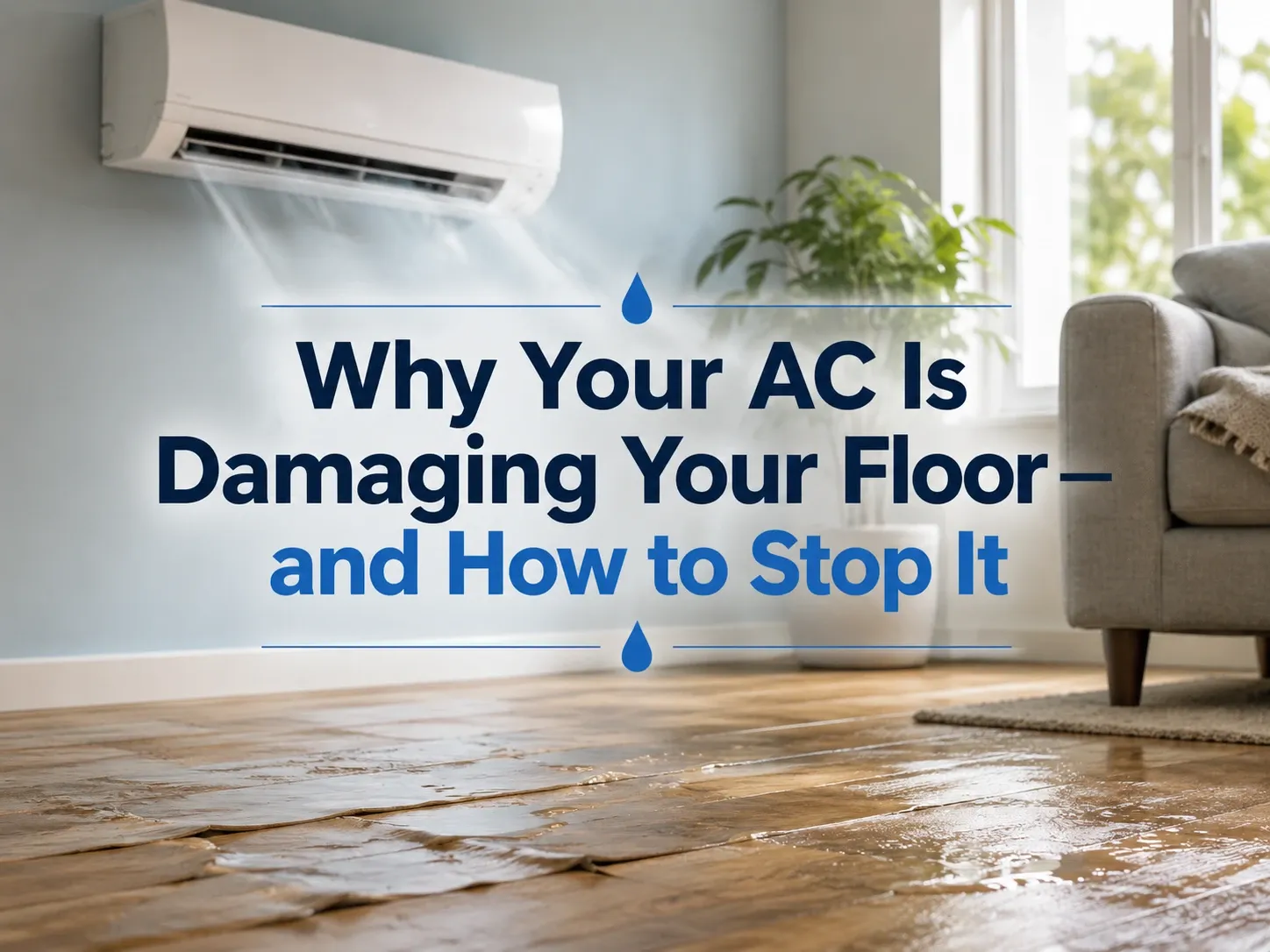
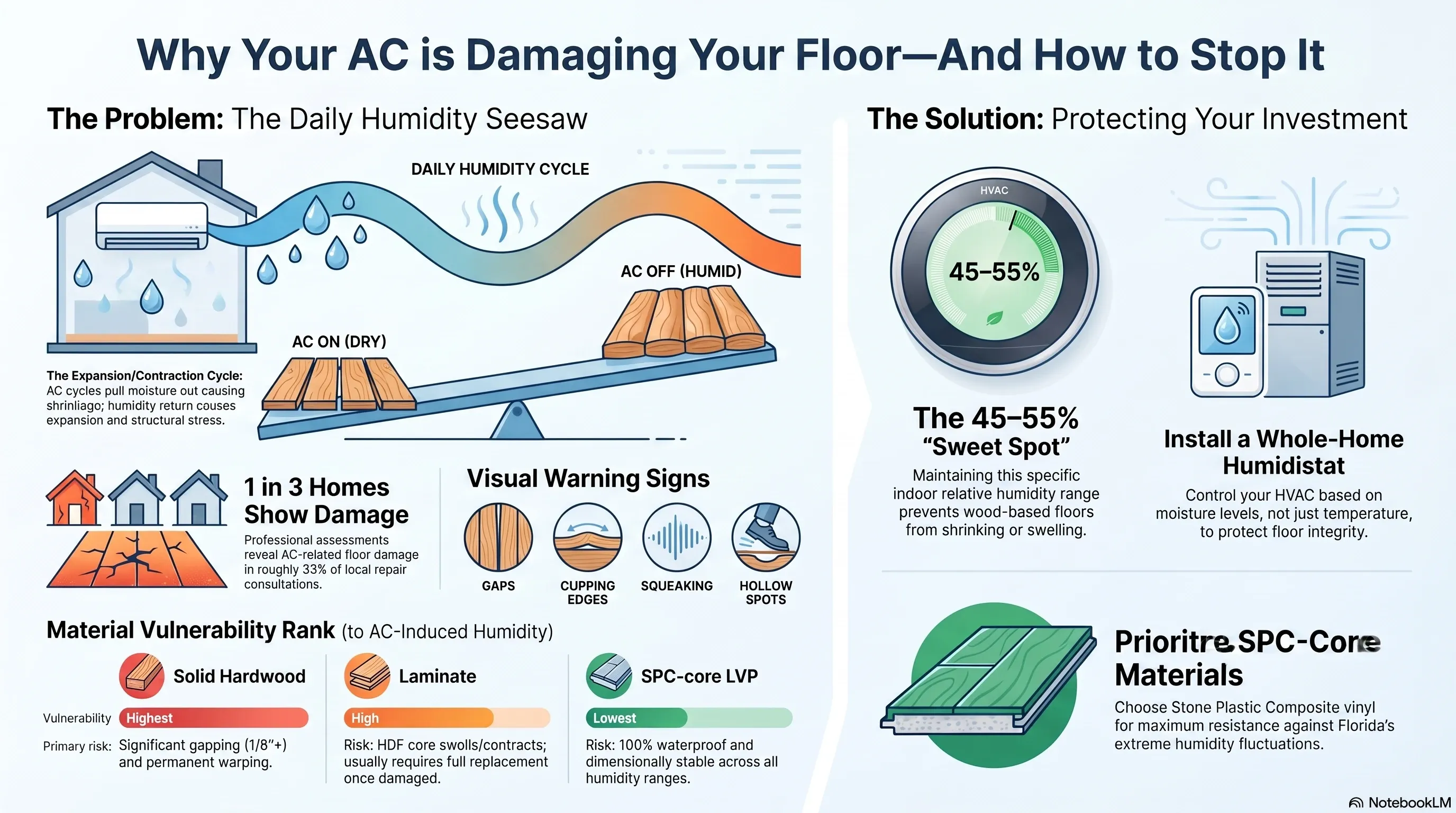
Air conditioning does not just cool the air — it dehumidifies it. In Tampa Bay, where AC runs nine months a year, that dehumidification is a leading cause of floor damage across Hillsborough County. Wood-based flooring contracts when AC pulls moisture out, then expands when humidity returns — daily, not seasonally.
The daily cycle of expansion and contraction causes gaps between planks, cupping, squeaking, and eventually structural failure. The fix is not running the AC less; it is controlling the humidity range the AC creates. AC-related floor damage is a common finding in repair consultations across Tampa Bay, and the damage rarely looks the way homeowners expect.
What Does AC Do to Your Floors, Exactly?
Air conditioners work by circulating air over cold coils, which causes moisture to condense and drain away. This process lowers indoor relative humidity — often significantly. In a Tampa Bay home running AC continuously during summer, indoor RH can drop to 35–40 % or lower, at the edge of the 35–65 % range that most flooring manufacturers require to maintain their warranties.
Wood-based flooring responds directly to the moisture content in the surrounding air. When the air dries out, the floor loses moisture and shrinks slightly. When humidity rises — when the AC cycles off overnight, or on a rainy day when doors are opened — the floor absorbs moisture and expands. Most flooring is engineered to handle a limited range of this movement. Florida’s extremes push past that range.
The result is what installers call “seasonal movement” — except in Tampa Bay, it is not seasonal. It is daily.
Which Flooring Types Are Most at Risk?
Not all flooring responds the same way to AC cycling, and the difference comes down to how much wood fiber each product contains. The ranking below runs from most vulnerable to most resistant for a typical Tampa Bay home:
- Solid hardwood — most vulnerable. Solid wood moves the most with humidity changes. Gaps of 1/8 inch or more between boards are common in dry conditions.
- Laminate — highly vulnerable. The HDF core swells and contracts significantly. Once the core is compromised, the floor cannot be restored — it must be replaced.
- Engineered hardwood — moderately vulnerable. The cross-ply construction reduces movement, but it is not immune. High humidity cycles still cause cupping over time.
- LVP / SPC vinyl — most resistant. Stone Plastic Composite vinyl contains no wood fiber and maintains dimensional stability across a wide temperature and humidity range.
What Are the Warning Signs That AC Is Damaging My Floor?
AC-driven humidity swings leave a recognizable pattern of symptoms, and catching them early prevents a bigger repair. These five signs, listed roughly in the order they typically appear, distinguish AC-related movement from other causes of floor damage.
- Gaps between planks — especially near exterior walls or under windows, where temperature differences are more extreme.
- Cupping — the edges of boards rise higher than the center, creating a concave surface. A classic sign of moisture imbalance.
- Squeaking — as boards shift microscopically with each step, friction develops at joints and subfloor contact points.
- End-joint separation — gaps form at the short ends of planks, not just the long sides.
- Hollow spots underfoot — the floor separates slightly from the subfloor due to repeated expansion and contraction cycles.
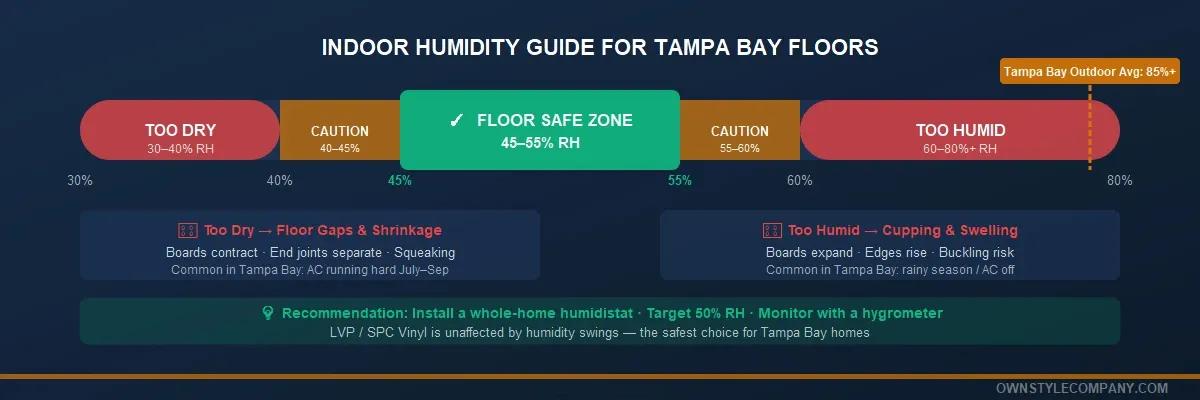
What’s the Right Indoor Humidity Level for Floors in Tampa Bay?
Most flooring manufacturers specify a range of 35–65 % relative humidity for wood-based floors in Tampa Bay. Below that range, floors dry out and shrink. Above it, floors absorb moisture, swell, and cup. Florida’s outdoor humidity routinely exceeds 85 % in summer months — which is why passive ventilation alone cannot protect a floor.
| Indoor humidity | Effect on wood-based flooring |
|---|---|
| Below 35 % RH | Boards shrink, gaps open between planks |
| 35–65 % RH | Stable range required by most manufacturer warranties |
| Above 65 % RH | Boards swell, cupping and buckling begin |
| Above 80 % RH (outdoor, Tampa Bay summer) | Passive ventilation cannot keep pace without active AC humidity control |
How Can You Protect Your Floors from AC Damage?
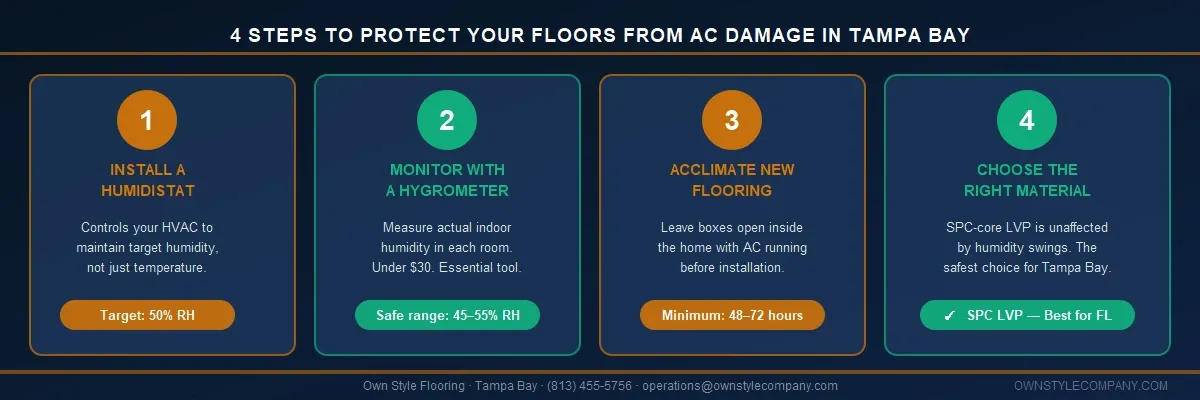
Four interventions address AC-driven humidity damage, and they work best combined rather than chosen individually. Each targets a different point in the moisture cycle, from the mechanical system itself to the material specification of the floor.
1. Install a whole-home humidistat
A humidistat controls the AC and HVAC system to maintain a target humidity range, not just a target temperature. Setting the target to the midpoint of the 35–65 % range and letting the system manage it is the single most effective intervention for floor protection in Tampa Bay homes.
2. Monitor humidity before and after installation
Before any flooring is installed, indoor RH should be stable within the 35–65 % range. A room-specific hygrometer reading, not a whole-house average, confirms this before the first plank goes down. Floors installed in unstable humidity conditions begin failing within months.
3. Acclimate new flooring
All wood-based flooring — including laminate — must acclimate inside the home for a minimum of 48–72 hours before installation. The boxes should be open, and the AC should be running normally.
4. Choose the right material for your conditions
If your Brandon, Riverview, or Wesley Chapel home’s humidity fluctuates widely and you don’t want to invest in humidity control, choose LVP with an SPC core. It is waterproof, dimensionally stable, and unaffected by the humidity swings that damage laminate and hardwood.
Is My Floor Already Damaged — or Can It Be Saved?
Existing AC-related damage falls into two categories: reversible movement that stabilizes once humidity is controlled, and permanent structural failure that requires replacement. The distinction depends on both the material and how far the damage has already progressed.
- Laminate with swollen or buckled boards — replacement is the only option. Laminate cannot be sanded or refinished, and a compromised core does not recover when dried.
- Engineered hardwood with minor cupping — if caught early and humidity is stabilized, the cupping may self-correct. Severe cupping requires board replacement or sanding and refinishing.
- Solid hardwood with gaps — proper humidity management may close most gaps in the next humidity cycle. Structural damage requires professional assessment.
- LVP that has separated — check the subfloor. LVP itself rarely fails from humidity, but the subfloor beneath it may have moved.
What Flooring Handles AC Cycling Best in Tampa Bay?
Material choice determines how much humidity control a Tampa Bay home actually needs to protect its floors. The ranking below reflects real-world performance under daily AC cycling, not laboratory conditions alone.
- SPC-core LVP — top choice. Rigid, waterproof, stable from 32 °F to 140 °F, no acclimation required.
- WPC-core LVP — good choice for living areas and bedrooms with stable climate control.
- Engineered hardwood — works well if humidity is actively managed.
- Laminate — use with caution in Florida. Best suited for low-moisture interior rooms with stable humidity.
- Solid hardwood — not recommended for most Tampa Bay homes. Requires strict humidity control year-round.
Planning a flooring project in Tampa Bay? Every quote starts with a moisture reading of the slab, at no cost. Get your free photo estimate or call (813) 455-5756.
Frequently asked questions
Can air conditioning damage my floors in Tampa Bay?
Yes. AC units dehumidify the air as they cool, causing wood-based flooring to contract. When the system cycles off and humidity rises, the floor expands. This daily cycle creates gaps, cupping, squeaking, and structural damage over time. SPC-core LVP is the most resistant option in Tampa Bay's AC-heavy environment.
What is the right humidity level for floors in Tampa Bay?
Indoor relative humidity should stay between 35–65 % RH. Below that range, wood-based floors shrink and gap. Above it, they swell and cup. Florida's outdoor humidity regularly exceeds 80 %, making a whole-home humidistat critical for floor protection.
What are the warning signs that AC is damaging my floor?
Visible gaps between planks (especially near exterior walls), cupping or bowing in the center of boards, squeaking when walking, separation at end joints, and boards that feel hollow underfoot. These symptoms typically appear 6 to 18 months after installation when humidity is not controlled.
Which flooring type is most resistant to AC cycling in Tampa Bay?
SPC-core LVP. It is 100 % waterproof, dimensionally stable across a wide temperature and humidity range, and contains no wood fiber that swells and shrinks. Solid hardwood is the most vulnerable, followed by laminate and engineered hardwood.
How can I protect my laminate or hardwood floors from AC damage?
Install a whole-home humidistat targeting the midpoint of the 35–65 % RH range, and use a room-specific hygrometer to confirm actual levels rather than relying on the thermostat's reading. Allow new flooring to acclimate 48–72 hours before installation, and keep furniture legs padded to reduce floor stress from movement.



US standard for measuring relative humidity inside a concrete slab using in-situ probes drilled to 40% of slab depth, read after 72 hours of equilibration.
US standard for measuring moisture vapor emission from a concrete slab using anhydrous calcium chloride, expressed in pounds per 1,000 sq ft per 24 hours.
US standard practice for preparing concrete floors to receive resilient flooring. Covers flatness, cleanliness, and moisture condition before installation.
The building code in force across Florida, including moisture and structural requirements that apply to slab-on-grade residential construction.
European deep-core moisture test that reacts a slab sample with calcium carbide and reads the resulting gas pressure. Supporting knowledge: the applicable US standards are ASTM F2170 and F1869.
Supporting knowledge — not the standard we work toGerman standard series for floor screeds, source of the widely cited 2.0% CM cement and 0.5% CM anhydrite thresholds. Supporting knowledge, not the applicable US standard.
Supporting knowledge — not the standard we work toHigh-Density Fiberboard: the compressed wood-fiber core of most laminate planks. It absorbs water vapor and swells irreversibly, which is why slab moisture matters.
Stone Plastic Composite: rigid vinyl core made of limestone powder and PVC. Dimensionally stable under humidity swings and unaffected by water.
Wood Plastic Composite: vinyl core with wood flour and foaming agents. Softer and warmer underfoot than SPC, and less dimensionally stable.
Luxury Vinyl Plank: multi-layer vinyl flooring in plank format. Fully waterproof as a material, though the subfloor beneath still governs installation.
Abrasion Class rating for laminate wear resistance, from AC1 to AC6. AC4 suits normal residential use; AC5 handles heavy traffic and light commercial.
A sheet layer placed between slab and flooring to block ground moisture vapor. Required over slab-on-grade construction regardless of surface dryness.
Foundation type where the concrete slab sits directly on the ground, dominant in Florida residential construction. Ground moisture migrates upward continuously.
The permitted deviation of a subfloor across a given span. The common benchmark is 3/16 inch over 10 feet; beyond that, deviation transfers into the locking joints.
A pourable cement-based compound that flows to a level surface, used to correct slab deviation. Needs 24 to 72 hours of cure before flooring goes down.
The 8 to 10 mm clearance left between a floating floor and every fixed vertical surface, absorbing seasonal expansion. Bridging it transfers stress to the joints.
Conditioning flooring material inside the room where it will be installed, 48 to 72 hours before installation, so it reaches interior temperature and humidity.
An angle-in locking profile that joins planks without adhesive. The insertion angle is specified by the manufacturer; forcing it deforms the profile permanently.
The raised ridge that forms along plank edges when a floating floor expands without room to move. In Florida the usual causes are slab moisture or a bridged expansion gap.