How to Clean Laminate Floors in Tampa Bay: What Works in Florida Humidity
Laminate floors in Tampa Bay need a different cleaning approach than laminate in lower-humidity markets. Florida’s fine silica sand acts as a natural abrasive on the wear layer, and daily humidity swings from AC cycling add a second stress the routine has to account for.
Both what is used to clean and how often it happens determine whether a laminate floor lasts 10 years or 15 in this climate. The routine itself is straightforward; the most common mistakes are using too much water and not sweeping frequently enough.
What is the correct dry cleaning routine for laminate in Tampa Bay?
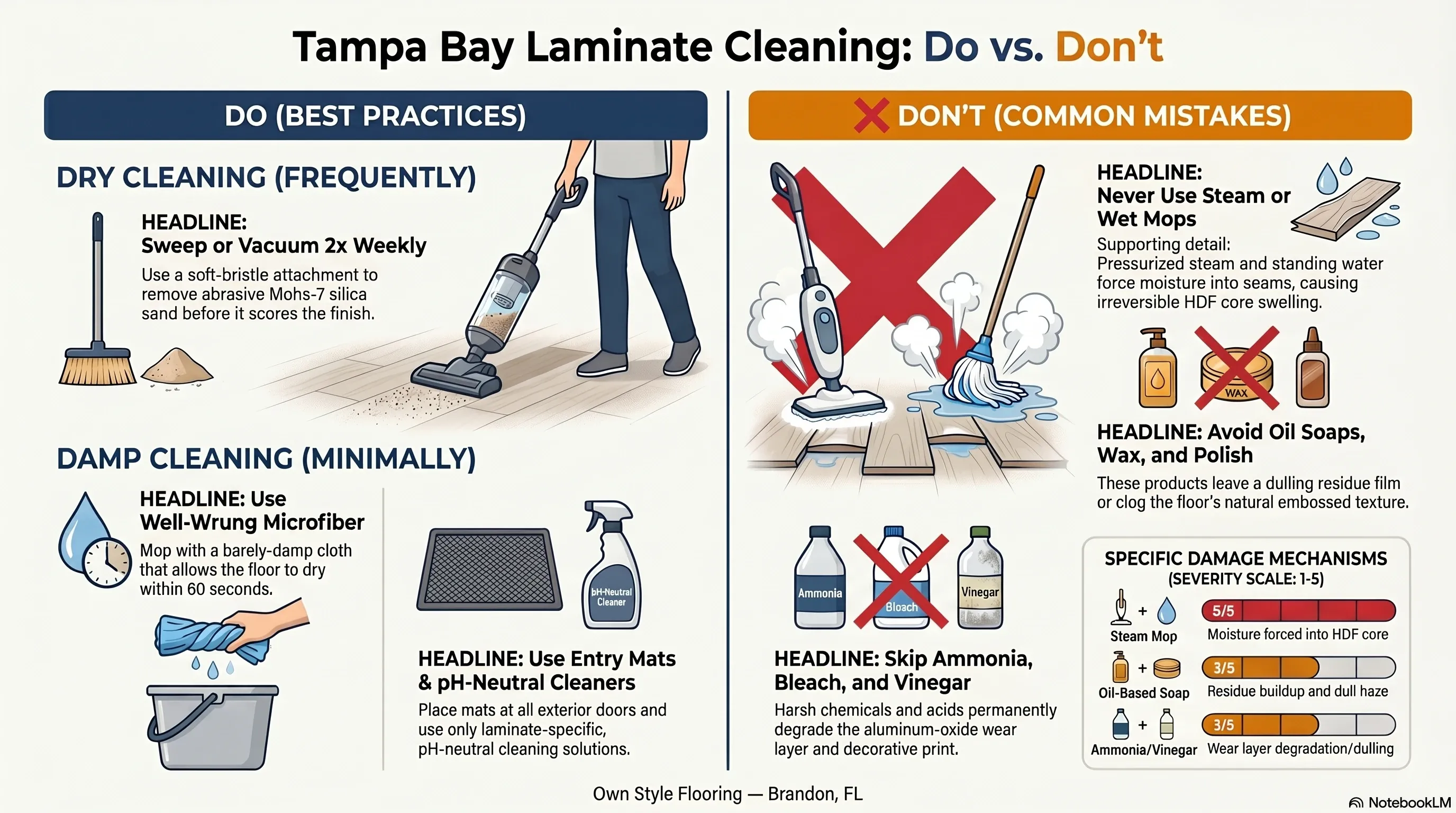
Dry cleaning is the most important maintenance step for laminate floors in Brandon, Riverview, and across Tampa Bay — more important than the choice of cleaning product. Florida’s silica sand, tracked in from yards, driveways, and outdoor areas, ranks 7 on the Mohs hardness scale. Under foot traffic, sand particles score the protective wear layer, dull the finish, and over years grind through to the decorative print layer.
Sweeping or vacuuming with a soft-bristle attachment removes these particles before they cause damage. The minimum frequency for Tampa Bay homes is twice per week — homes with pets, children, or direct outdoor access to pool or beach should sweep daily. Beater-bar vacuums scratch laminate surfaces regardless of AC rating and must not be used.
Entry mats at every exterior door — front door, garage entry, patio door — are the highest-ROI investment in laminate floor longevity available to a Tampa Bay homeowner.
What is the correct damp cleaning technique for Florida laminate?
The correct damp cleaning method uses a microfiber mop wrung to barely damp — the mop face should leave no visible moisture film on the surface and dry within 30–60 seconds. Standing water on laminate, even briefly, risks penetrating seam lines and reaching the HDF core.
Use plain water or a laminate-specific pH-neutral cleaner — one capful per gallon of water is the correct concentration for most products. Damp mop once per week at maximum under normal conditions; twice per week in high-traffic areas during the rainy season.
Never use a steam mop: steam forces pressurized hot moisture directly through the seam lines and into the HDF core, producing swelling and joint damage within 3–6 months of regular use.
| Method | Appropriate? | Notes |
|---|---|---|
| Soft-bristle sweep | ✅ Yes | Primary method — 2x/week minimum |
| Vacuum hard-floor setting | ✅ Yes | Soft suction head only, no beater bar |
| Well-wrung microfiber mop | ✅ Yes | Barely damp, dries in <60 seconds |
| Steam mop | ❌ Never | Forces moisture through seams into HDF core |
| Wet mop (wrung once) | ❌ No | Leaves standing water — seam penetration risk |
| String mop | ❌ No | Retains too much water for laminate surfaces |
Which cleaning products damage laminate floors in Florida?
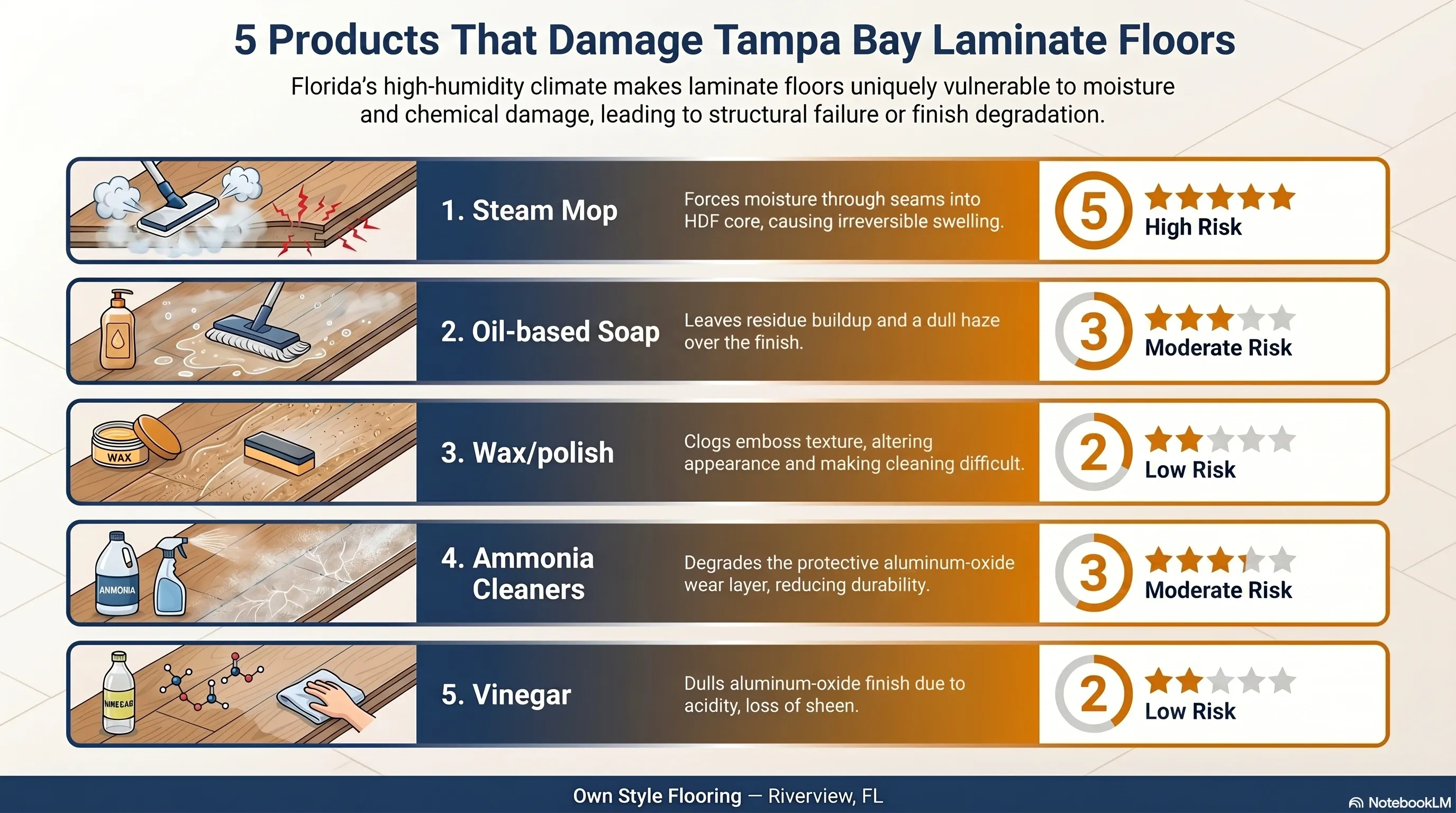
Five product categories destroy laminate finish or structural integrity in Tampa Bay’s climate, and most of them show up in a typical kitchen cabinet already, marketed for other flooring types entirely.
- Oil-based soaps and Murphy’s Oil Soap leave a residue film that builds up over months, creating a dull haze that cannot be removed without stripping.
- Wax and polish products fill the textured emboss pattern of the wear layer, producing an artificial shine that attracts more dirt.
- Ammonia-based cleaners degrade the aluminum-oxide wear layer over repeated use.
- Bleach damages both the wear layer and the decorative print layer at full strength — use only in diluted form (1:10 water-to-bleach) for targeted mold spot treatment.
- Vinegar is acidic enough to dull aluminum-oxide finishes over repeated applications — it is not appropriate as a routine laminate cleaner despite appearing in many DIY guides.
How does Tampa Bay humidity affect laminate floor maintenance?
Maintaining indoor relative humidity between 35–65% is the single most impactful maintenance practice for laminate floors — more effective than any cleaning product. Tampa Bay’s June–September rainy season regularly pushes outdoor humidity above 80%, elevating indoor humidity in all but the best-sealed homes.
Laminate planks absorb ambient moisture from the air and expand across the floor surface. When indoor humidity exceeds 65% consistently, expansion approaches the perimeter gap limit and click-lock joints experience cumulative fatigue.
A whole-home dehumidifier or consistent AC operation keeps indoor RH within the 35–65% range throughout the rainy season. Spot dehumidifiers in high-humidity rooms provide targeted protection for laminate in those zones.
How are common Florida stains removed from laminate?
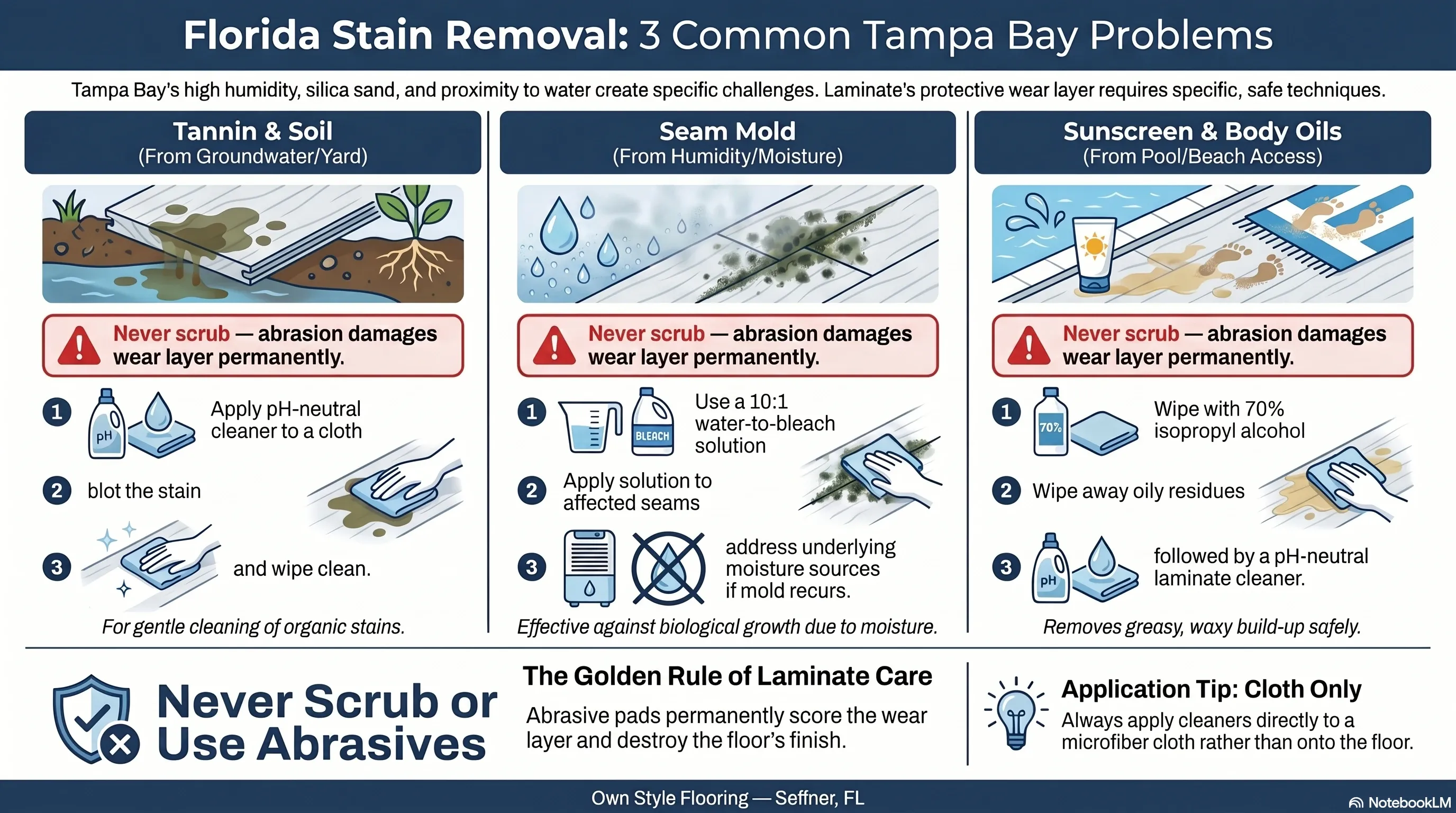
Three stain types are particularly common on laminate in Tampa Bay homes, each requiring a different technique since the wrong approach can set a stain permanently or damage the wear layer trying to remove it.
Tannin stains from Florida tea-colored groundwater or outdoor tracked soil: apply a laminate-specific pH-neutral cleaner directly to a cloth (not to the floor), blot the stain without scrubbing, wipe clean with a barely damp microfiber.
Mold or mildew spots at seam lines — indicating moisture penetrating the seam: clean the surface with a 10:1 water-to-bleach solution applied with a cloth, dry completely. If the seam mold is recurring, the moisture source must be addressed.
Sunscreen and body oil residue, common in homes with pool access: wipe with a cloth dampened with isopropyl alcohol (70% concentration), then clean with pH-neutral cleaner. Never scrub abrasively — any abrasive pad scores the wear layer permanently.
Hard water mineral spots, common in homes on well water or with high-mineral municipal supply, appear as a cloudy white residue where water sat and evaporated rather than being wiped dry. A 50/50 solution of water and white vinegar, applied briefly and wiped immediately rather than left to sit, dissolves the mineral deposit without the prolonged acid exposure that would dull the finish over repeated use.
When does cleaning stop being the solution for Tampa Bay laminate?
Cleaning solves surface problems, not structural ones, and confusing the two wastes time on a floor that already needs replacement. Four conditions signal that replacement, not another cleaning attempt, is the correct response:
-
Cloudy surface that does not clear with proper cleaning — indicates the wear layer is permanently abraded or contaminated with cleaning product buildup that cannot be removed.
-
Raised seam edges — the HDF core has absorbed moisture and swollen beyond the surface plane; no cleaning product reverses permanent core expansion.
-
Recurring mold at multiple seam lines — indicates systemic slab moisture or chronic high humidity that will continue regardless of surface treatment.
-
Soft spots under foot traffic — the HDF core has softened from moisture damage and the structural integrity of the plank is compromised.
At this point, a professional assessment identifies whether the failure is localized — a section repairable without disturbing the rest of the floor — or systemic, requiring full replacement with the moisture source corrected first. Cleaning products cannot distinguish between the two, which is why continuing to try different cleaners on a soft spot or recurring mold patch usually just delays a diagnosis that was needed from the start.
Does Cleaning Frequency Need to Change With the Seasons?
Yes — Tampa Bay’s rainy season changes both what tracks onto the floor and how fast the floor dries after mopping. From June through September, twice-weekly sweeping and damp mopping in high-traffic areas replaces the once-weekly routine that is sufficient in drier months, since foot traffic tracks in more sand and moisture during storms.
Ambient humidity during the rainy season also slows how quickly any residual dampness evaporates off the surface. Homes running AC consistently through the summer see less of this shift than homes that rely on open windows or intermittent AC use, since stable indoor humidity limits how much moisture ever reaches the floor in the first place.
Planning a flooring project in Tampa Bay? Every quote starts with a moisture reading of the slab, at no cost. Get your free photo estimate or call (813) 455-5756.
Frequently asked questions
How do you clean laminate floors in Tampa Bay?
Sweep or vacuum with a soft-bristle attachment at least twice per week to remove silica sand before it abrades the wear layer. Mop with a well-wrung microfiber mop using plain water or a laminate-specific pH-neutral cleaner — the mop should dry within 60 seconds. Never use a steam mop, wet mop, oil-based soap, or ammonia-based cleaner.
Can you use a steam mop on laminate floors in Florida?
Steam mops are not appropriate for laminate floors. Steam forces pressurized hot moisture directly through the seam lines and into the HDF core, producing irreversible swelling and joint separation within 3–6 months of regular use. Steam-mop damaged planks must be replaced.
Why do laminate floors get cloudy in Florida homes?
Cloudy laminate surfaces result from cleaning product residue buildup (oil-based soaps or wax products) or permanent wear layer degradation from silica sand abrasion or steam mop use. Residue buildup can sometimes be improved with a laminate floor cleaner. Permanent wear layer degradation cannot be reversed.
How often should laminate floors be mopped in a Tampa Bay home?
Damp mopping once per week is correct for most Tampa Bay laminate floors. During the June–September rainy season, twice-weekly damp mopping is appropriate for high-traffic areas. Always sweep before mopping to remove abrasive sand particles.
What indoor humidity level protects laminate floors in Florida?
Indoor relative humidity should stay within the 35–65% range year-round for laminate to perform as designed. During the June–September rainy season, consistent AC operation or supplemental dehumidification becomes necessary to hold that range. Humidity that stays above 65% consistently accelerates click-lock joint fatigue over time.
Does laminate cleaning frequency need to change between seasons in Tampa Bay?
Yes. During the June–September rainy season, twice-weekly sweeping and damp mopping in high-traffic areas is appropriate versus once weekly in the drier winter months. Rainy-season foot traffic tracks in more sand and moisture, and the higher ambient humidity means any residual dampness on the floor takes longer to evaporate.

US standard for measuring relative humidity inside a concrete slab using in-situ probes drilled to 40% of slab depth, read after 72 hours of equilibration.
US standard for measuring moisture vapor emission from a concrete slab using anhydrous calcium chloride, expressed in pounds per 1,000 sq ft per 24 hours.
US standard practice for preparing concrete floors to receive resilient flooring. Covers flatness, cleanliness, and moisture condition before installation.
The building code in force across Florida, including moisture and structural requirements that apply to slab-on-grade residential construction.
European deep-core moisture test that reacts a slab sample with calcium carbide and reads the resulting gas pressure. Supporting knowledge: the applicable US standards are ASTM F2170 and F1869.
Supporting knowledge — not the standard we work toGerman standard series for floor screeds, source of the widely cited 2.0% CM cement and 0.5% CM anhydrite thresholds. Supporting knowledge, not the applicable US standard.
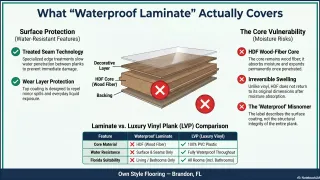
Supporting knowledge — not the standard we work toHigh-Density Fiberboard: the compressed wood-fiber core of most laminate planks. It absorbs water vapor and swells irreversibly, which is why slab moisture matters.
Stone Plastic Composite: rigid vinyl core made of limestone powder and PVC. Dimensionally stable under humidity swings and unaffected by water.
Wood Plastic Composite: vinyl core with wood flour and foaming agents. Softer and warmer underfoot than SPC, and less dimensionally stable.
Luxury Vinyl Plank: multi-layer vinyl flooring in plank format. Fully waterproof as a material, though the subfloor beneath still governs installation.
Abrasion Class rating for laminate wear resistance, from AC1 to AC6. AC4 suits normal residential use; AC5 handles heavy traffic and light commercial.
A sheet layer placed between slab and flooring to block ground moisture vapor. Required over slab-on-grade construction regardless of surface dryness.
Foundation type where the concrete slab sits directly on the ground, dominant in Florida residential construction. Ground moisture migrates upward continuously.
The permitted deviation of a subfloor across a given span. The common benchmark is 3/16 inch over 10 feet; beyond that, deviation transfers into the locking joints.
A pourable cement-based compound that flows to a level surface, used to correct slab deviation. Needs 24 to 72 hours of cure before flooring goes down.
The 8 to 10 mm clearance left between a floating floor and every fixed vertical surface, absorbing seasonal expansion. Bridging it transfers stress to the joints.
Conditioning flooring material inside the room where it will be installed, 48 to 72 hours before installation, so it reaches interior temperature and humidity.
An angle-in locking profile that joins planks without adhesive. The insertion angle is specified by the manufacturer; forcing it deforms the profile permanently.
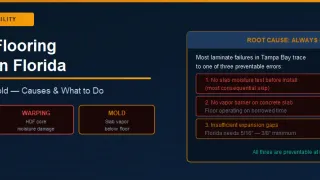
The raised ridge that forms along plank edges when a floating floor expands without room to move. In Florida the usual causes are slab moisture or a bridged expansion gap.