Is Waterproof Laminate Actually Waterproof? What Tampa Bay Homeowners Get Wrong
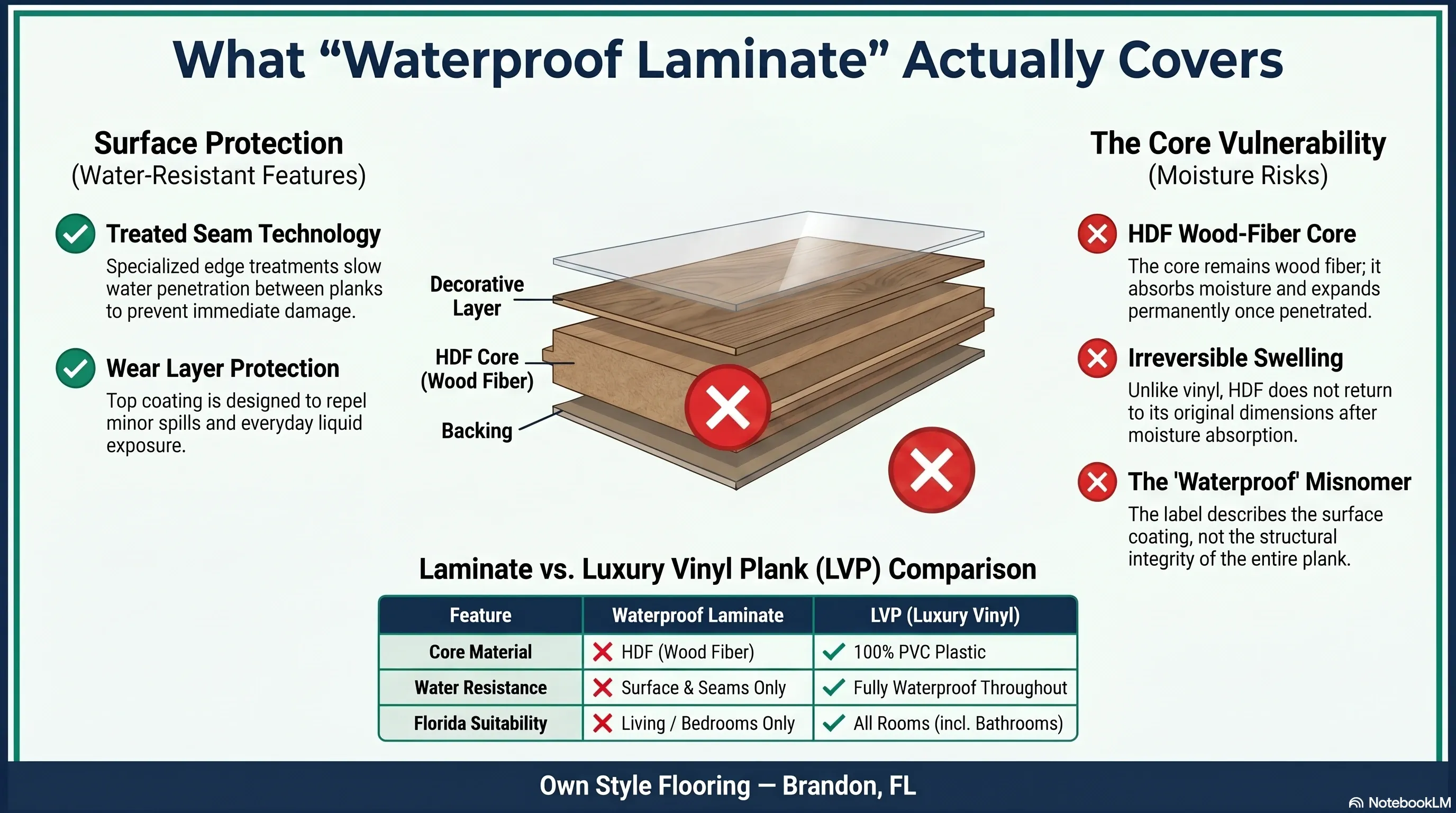
Standard laminate flooring is water-resistant, not waterproof. The surface layer repels minor spills, but water reaching the seams or edges penetrates the HDF (high-density fiberboard) core and causes irreversible swelling. In Tampa Bay, where indoor humidity cycles daily with air conditioning and the rainy season runs June through September, this distinction determines whether a floor lasts 5 years or 20.
What does “waterproof” actually mean on a laminate label?
The term “waterproof laminate” has no standardized industry definition. Manufacturers apply it to products with a waterproof wear layer on top, treated seam technology that slows water penetration, or a waterproof backing underneath. None of these features make the HDF core inside immune to water. The HDF core — the structural layer that makes laminate rigid — is compressed wood fiber that absorbs moisture and expands permanently when exposed.
In Tampa Bay flooring stores, “waterproof laminate” and “waterproof vinyl” are often used interchangeably in marketing. LVP (luxury vinyl plank) is 100% plastic with no wood fiber; waterproof laminate still has a wood-based core with a protective coating. That distinction matters in Florida’s climate.
How does water damage the HDF core in a laminate floor?
Laminate flooring has four layers: a wear layer, a decorative print layer, an HDF core, and a backing. The HDF core is the structural foundation and the product’s primary vulnerability. When water reaches the HDF core — through seams, from underneath a concrete slab, or through chronic humidity — the wood fibers swell permanently. Unlike solid hardwood, HDF does not return to its original dimensions after moisture absorption.
Affected planks warp, buckle, or cup. Click-lock joints break apart. A puddle left for 30 minutes is often recoverable; a slow refrigerator leak running two weeks is not. In Tampa Bay, the more relevant long-term threat is chronic humidity from slab vapor — not a single spill.
What does Tampa Bay’s climate do to laminate labeled waterproof?
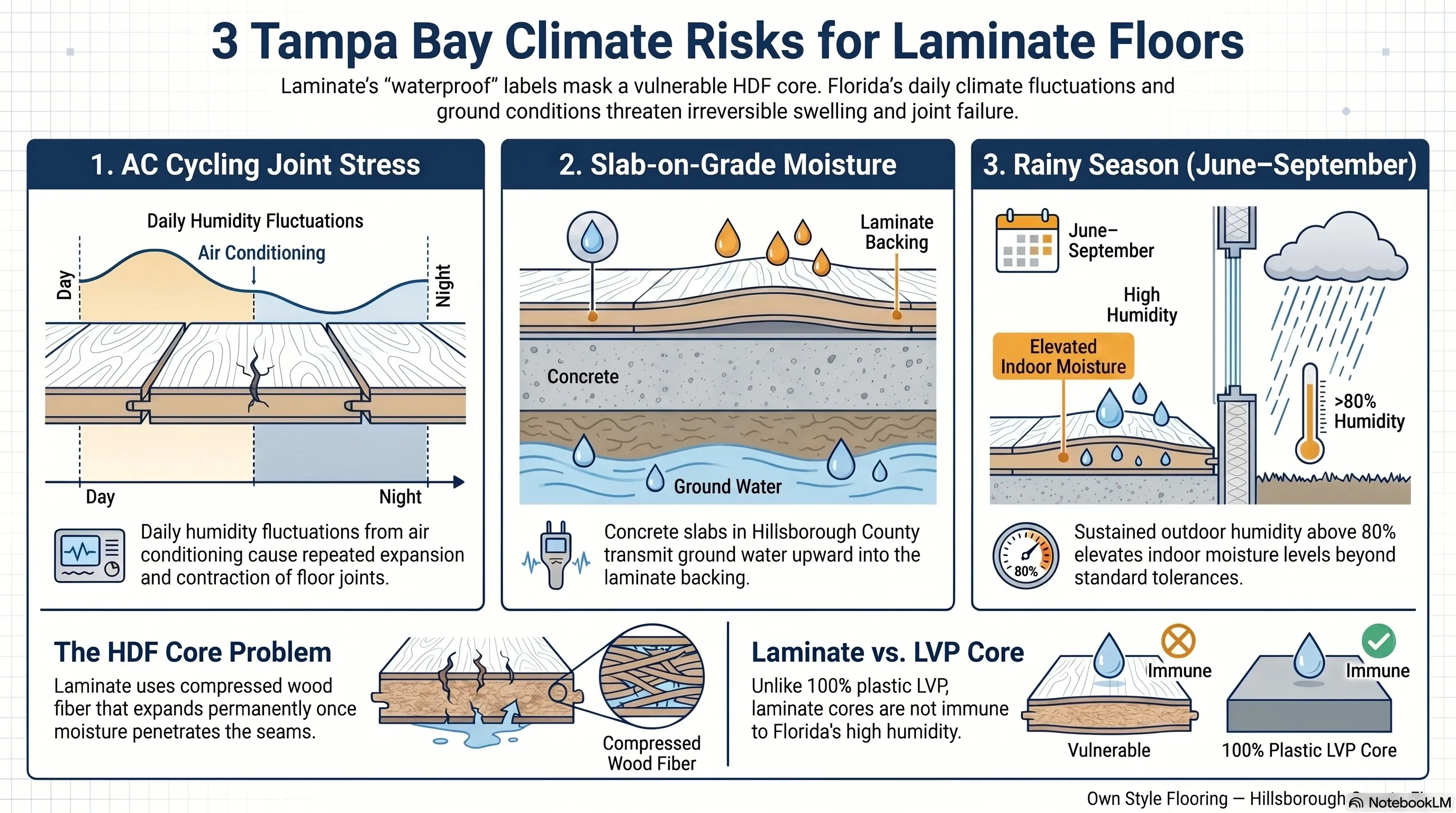
Tampa Bay’s climate attacks laminate through three mechanisms that no surface treatment addresses, because each one reaches the HDF core from a direction the wear layer does not cover. All three act continuously rather than during isolated spill events, which is why a waterproof label offers little protection here:
-
AC cycling: Florida homes run air conditioning 8–10 months per year. Every AC cycle creates a humidity swing — humidity rises when the AC is off, drops when it runs. Repeated expansion and contraction stresses click-lock joints over months, creating micro-gaps where humidity penetrates.
-
Slab-on-grade moisture: Most homes in the Tampa Bay area are built on concrete slabs that transmit ground moisture upward. Without a vapor barrier, laminate absorbs moisture from below regardless of how waterproof the top surface is.
-
Rainy season humidity: From June through September, outdoor humidity in Tampa Bay regularly exceeds 80%, elevating indoor humidity in all but the best-sealed homes.
Where does waterproof laminate fail, and where does it perform well in Florida?
Waterproof laminate succeeds or fails based on the room, not the label. The distinction that matters in Florida is between rooms where moisture arrives occasionally and gets cleaned up, and rooms where humidity stays elevated for months. The first category is safe for laminate; the second is not, regardless of product specification.
Laminate fails in: bathrooms (continuous moisture from showers and steam), laundry rooms (appliance leak risk and persistent high humidity), rooms with known subfloor moisture, and entryways with direct outdoor access and no transition zone.
Laminate performs well in: living rooms and dining rooms with central AC maintained consistently, bedrooms with stable temperature and humidity control, home offices and formal areas with low traffic and low moisture exposure, and rental properties where cost per square foot matters and moisture conditions are managed.
The deciding factor in Tampa Bay is not the waterproof label — it is whether the installation environment has chronic moisture exposure.
Does a Waterproof Rating Change How a Room Should Be Cleaned?
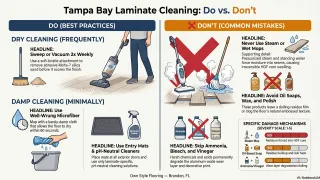
No — cleaning protocol depends on the core material, not the surface marketing term. A “waterproof” laminate still has an HDF core underneath, so the same damp-mop, never-wet rules that apply to standard laminate still apply: a well-wrung microfiber mop, prompt spill cleanup, and no steam mops regardless of what the waterproof label implies.
Treating a waterproof-labeled laminate floor as if it can be mopped like tile is one of the more common ways homeowners inadvertently void a warranty they believed the waterproof label protected.
How does waterproof laminate compare to LVP for Tampa Bay homes?
Waterproof laminate and LVP differ in the one layer that determines moisture behavior: the core. Laminate uses compressed wood fiber that swells permanently once water reaches it; LVP uses PVC, which does not absorb water at all. Every other difference between the two products follows from that single distinction:
| Feature | Waterproof Laminate | LVP (Luxury Vinyl Plank) |
|---|---|---|
| Core material | HDF (wood fiber) | 100% PVC plastic |
| Water resistance | Surface and seams only | Fully waterproof throughout |
| Moisture from below | Vulnerable | Resistant (with vapor barrier) |
| Bathrooms | Not recommended | Appropriate |
| Relative installed cost | Lower | Higher |
| Lifespan humid environment | 7–12 years | 15–25 years |
LVP costs more per square foot but delivers better ROI in humid environments because it does not fail from moisture exposure.
What should Tampa Bay homeowners ask before buying laminate marketed as waterproof?
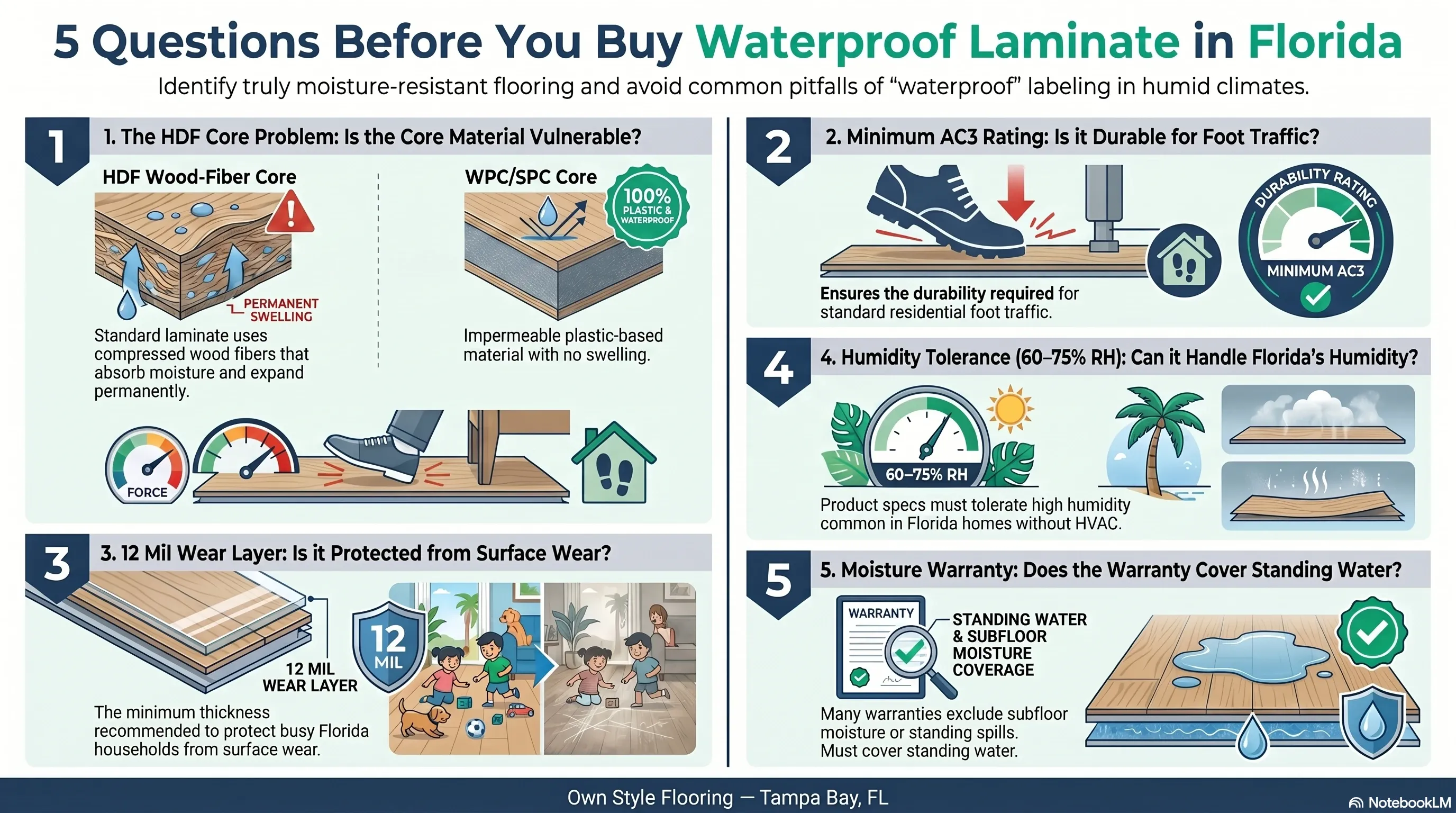
Five specific questions reveal whether a product is appropriate for a Florida home, and none of them is answered by the waterproof label on the box. Each one targets a property that determines how the floor behaves once the slab, the seasonal humidity, and daily traffic start acting on it:
- AC rating? AC3 is the minimum for residential use; AC4 for high-traffic areas — this measures durability, not waterproofing.
- Wear layer thickness? At minimum 12 mil for a busy household.
- Waterproof core (WPC or SPC) or only a waterproof surface? These are fundamentally different products.
- Manufacturer warranty on moisture damage? Many warranties explicitly exclude standing water and subfloor moisture.
- Stated humidity tolerance range? Florida homes regularly reach 60–75% relative humidity without HVAC — the product spec must tolerate that range.
Does a Longer Manufacturer Warranty Mean Better Real-World Moisture Protection?
Not necessarily, and the fine print is what actually matters. A 25-year warranty that explicitly excludes damage from standing water, subfloor moisture, or improper installation offers less real protection than a 10-year warranty with fewer exclusions, because the excluded categories are exactly where laminate fails in Florida.
Reading the exclusions list before comparing warranty length is the only way to know what coverage actually applies to a Tampa Bay installation. A warranty term printed in large type on the box rarely reflects how narrow the actual covered conditions are.
What Does “12 mil Wear Layer” Actually Protect Against?
The wear layer thickness, measured in mils (thousandths of an inch), determines resistance to surface abrasion and scratching — not moisture resistance, which is a separate property governed by the seam treatment and core composition. A 20-mil wear layer on a product with an untreated HDF core still swells when water reaches the seams.
The thick wear layer only means the surface itself resists scuffs and scratches longer. Conflating wear layer thickness with water resistance is a common misreading of product spec sheets, and it leads homeowners to select a durable-surfaced product that is no more moisture-resistant than a thinner one.
What do Tampa Bay installers verify before recommending laminate?
Concrete slabs receive a calcium chloride test or relative humidity probe measurement before any floating floor installation. Readings exceeding manufacturer limits stop the laminate recommendation regardless of how the product is labeled.
Rooms with any history of moisture issues receive an LVP recommendation regardless of budget. Living areas, bedrooms, and home offices with controlled environments qualify for quality laminate at 8 mm or thicker with a proper underlayment — a sound, cost-effective choice when the conditions support it.
Planning a flooring project in Tampa Bay? Every quote starts with a moisture reading of the slab, at no cost. Get your free photo estimate or call (813) 455-5756.
Frequently asked questions
Is waterproof laminate flooring really waterproof?
Waterproof laminate has a water-resistant surface layer and treated seams, but the core is HDF — a compressed wood product that absorbs moisture and swells permanently when exposed to standing water or chronic humidity. The waterproof label describes the surface coating, not the product as a whole.
Can I install waterproof laminate in a bathroom in Tampa Bay?
Laminate flooring is not recommended in Tampa Bay bathrooms, waterproof or not. Bathrooms have continuous moisture exposure from showers, steam, and floor-level water that exceeds what any laminate product handles long-term. LVP with a 100% plastic core is the appropriate product for Florida bathrooms.
What happens when laminate flooring gets wet?
Minor surface spills cleaned within 30 minutes typically cause no permanent damage. Water reaching the seams or edges, or standing water left for hours, penetrates the HDF core and causes irreversible swelling, warping, and joint separation. Once moisture-damaged, affected planks must be replaced.
What is the difference between waterproof laminate and LVP in Tampa Bay?
LVP is 100% PVC plastic — fully waterproof throughout the plank. Waterproof laminate has a wood-fiber HDF core with a waterproof coating on top. In Tampa Bay's humid climate, LVP is the more durable choice for moisture-prone areas. Laminate usually costs less installed than LVP.
How long does waterproof laminate last in Florida?
In a controlled indoor environment with consistent AC, quality laminate (8 mm or thicker, AC3 rating) lasts 10 to 15 years. In rooms with humidity fluctuation, slab moisture, or water exposure, lifespan drops to 5 to 8 years. Proper slab moisture testing and correct underlayment are the biggest factors.
How much does laminate flooring installation cost in Tampa Bay?
Professional laminate installation in Tampa Bay costs $2.25/sqft for labor only. Demolition of existing LVP or laminate adds $1.30/sqft, labor. Material cost varies by product and is confirmed at the photo estimate stage rather than quoted as a flat range.
Does a longer warranty mean better moisture protection for laminate?
Not necessarily. A warranty that excludes standing water and subfloor moisture damage offers less real protection than a shorter warranty with fewer exclusions — those excluded categories are exactly where laminate fails in Florida. Reading the exclusions matters more than the stated warranty length.
Does wear layer thickness (mil rating) indicate moisture resistance?
No. Wear layer thickness measures resistance to surface scratching and abrasion, a separate property from moisture resistance, which depends on seam treatment and core composition. A thick wear layer over an untreated HDF core still swells when water reaches the seams.

US standard for measuring relative humidity inside a concrete slab using in-situ probes drilled to 40% of slab depth, read after 72 hours of equilibration.
US standard for measuring moisture vapor emission from a concrete slab using anhydrous calcium chloride, expressed in pounds per 1,000 sq ft per 24 hours.
US standard practice for preparing concrete floors to receive resilient flooring. Covers flatness, cleanliness, and moisture condition before installation.
The building code in force across Florida, including moisture and structural requirements that apply to slab-on-grade residential construction.
European deep-core moisture test that reacts a slab sample with calcium carbide and reads the resulting gas pressure. Supporting knowledge: the applicable US standards are ASTM F2170 and F1869.
Supporting knowledge — not the standard we work toGerman standard series for floor screeds, source of the widely cited 2.0% CM cement and 0.5% CM anhydrite thresholds. Supporting knowledge, not the applicable US standard.
Supporting knowledge — not the standard we work toHigh-Density Fiberboard: the compressed wood-fiber core of most laminate planks. It absorbs water vapor and swells irreversibly, which is why slab moisture matters.
Stone Plastic Composite: rigid vinyl core made of limestone powder and PVC. Dimensionally stable under humidity swings and unaffected by water.
Wood Plastic Composite: vinyl core with wood flour and foaming agents. Softer and warmer underfoot than SPC, and less dimensionally stable.
Luxury Vinyl Plank: multi-layer vinyl flooring in plank format. Fully waterproof as a material, though the subfloor beneath still governs installation.
Abrasion Class rating for laminate wear resistance, from AC1 to AC6. AC4 suits normal residential use; AC5 handles heavy traffic and light commercial.
A sheet layer placed between slab and flooring to block ground moisture vapor. Required over slab-on-grade construction regardless of surface dryness.
Foundation type where the concrete slab sits directly on the ground, dominant in Florida residential construction. Ground moisture migrates upward continuously.
The permitted deviation of a subfloor across a given span. The common benchmark is 3/16 inch over 10 feet; beyond that, deviation transfers into the locking joints.
A pourable cement-based compound that flows to a level surface, used to correct slab deviation. Needs 24 to 72 hours of cure before flooring goes down.
The 8 to 10 mm clearance left between a floating floor and every fixed vertical surface, absorbing seasonal expansion. Bridging it transfers stress to the joints.
Conditioning flooring material inside the room where it will be installed, 48 to 72 hours before installation, so it reaches interior temperature and humidity.
An angle-in locking profile that joins planks without adhesive. The insertion angle is specified by the manufacturer; forcing it deforms the profile permanently.
The raised ridge that forms along plank edges when a floating floor expands without room to move. In Florida the usual causes are slab moisture or a bridged expansion gap.