Hurricane Season and Your Floors: What Tampa Bay Homeowners Need to Know Before June
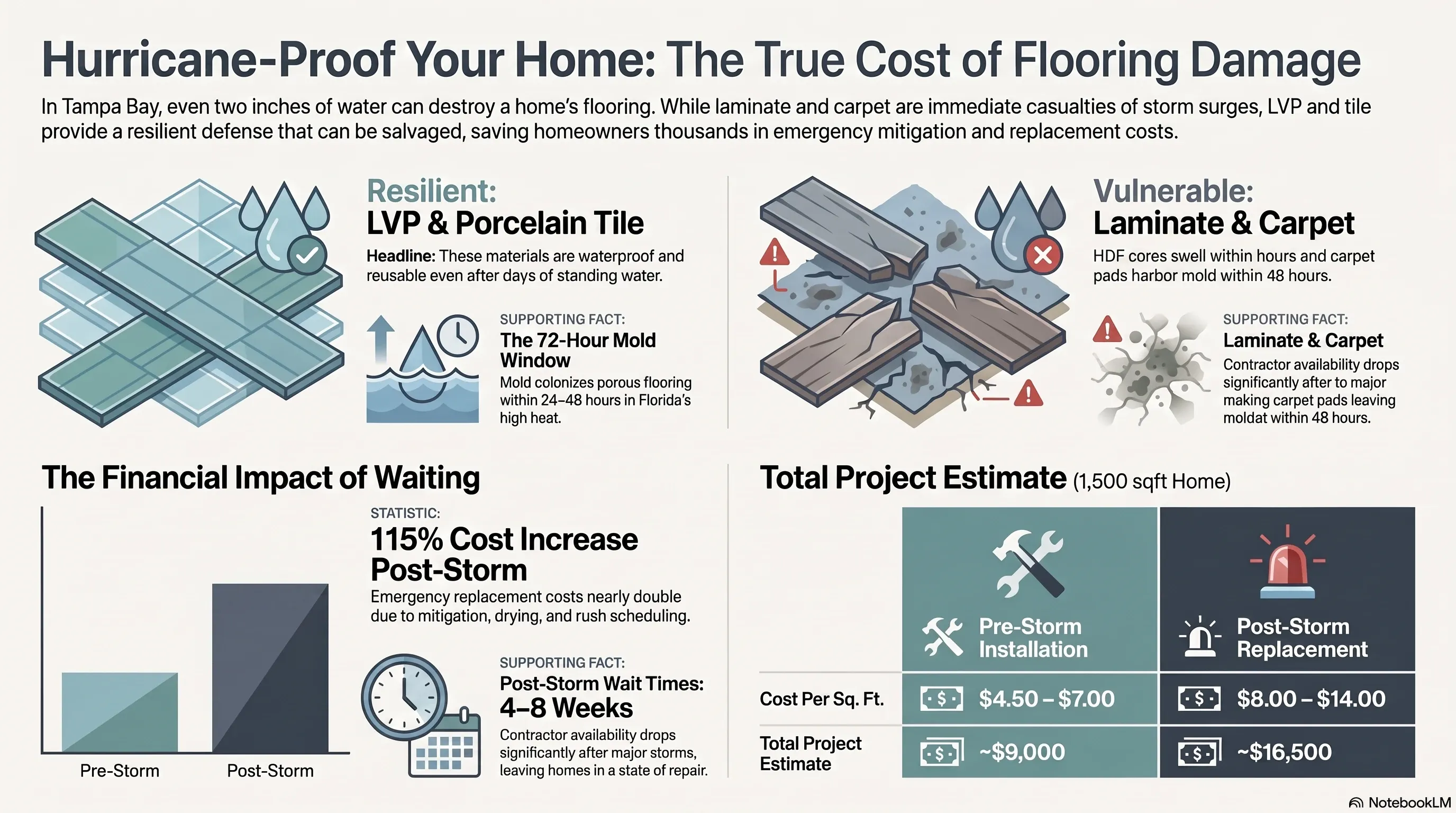
If a Tampa Bay home takes even 2 inches of water during a hurricane, the flooring is the first casualty. Laminate and carpet are destroyed; tile and LVP survive. The difference between a minor cleanup and a full-floor replacement often comes down to which material was on the ground.
Hurricane season runs June 1 through November 30, and the time to evaluate flooring is before the first named storm, not after. The sections below cover what every Tampa Bay homeowner should know before that call comes.

What happens to each flooring type during a flood?
Not all flooring fails the same way under water. The timeline and the damage pattern depend entirely on the material, ranging from total loss within hours to complete indifference for materials engineered around moisture:
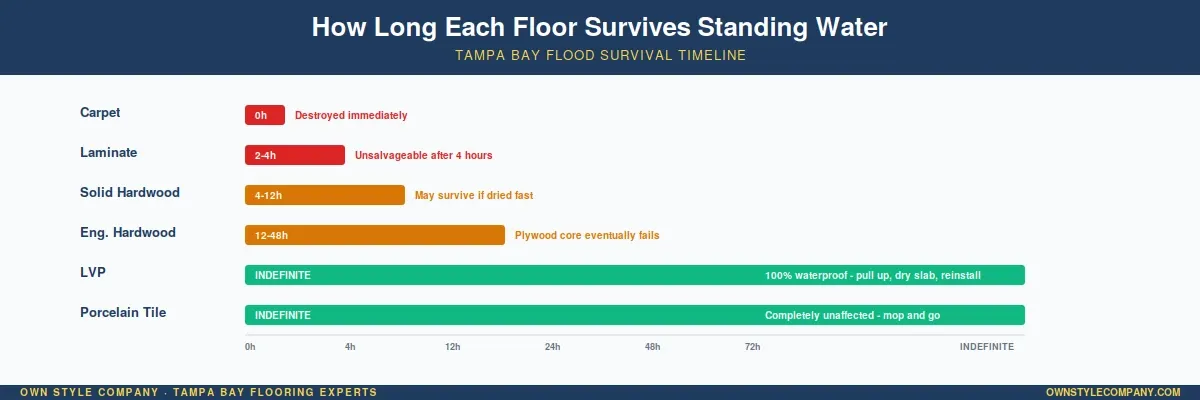
- Laminate: The HDF core absorbs water within hours. Boards swell, edges cup, seams separate. Within 24 hours of standing water, most laminate is unsalvageable. Even if the floor dries, the core is permanently expanded and weakened. Mold begins in the underlayment within 48 hours.
- Carpet: Absorbs water immediately. The carpet pad underneath is a sponge that holds moisture against the slab for days. Mold colonizes carpet pad within 24–48 hours in Florida heat. Carpet that has been flooded must be removed.
- LVP (Luxury Vinyl Plank): Waterproof. Survives standing water for days. After the water recedes, dry the subfloor, clean the surface, and the floor is fine. No swelling, no delamination, no mold in the material itself.
- Porcelain/Ceramic Tile: Completely unaffected by water. Mop it up, check the grout, done. The original Florida floor for exactly this reason.
- Solid Hardwood: Absorbs water faster than laminate. Boards cup, crown, and buckle. Can sometimes be sanded and refinished after professional drying, but often the subfloor is also damaged.
- Engineered Hardwood: Better than solid but not waterproof. Plywood core resists water longer than HDF but eventually delaminates. Not a safe bet in flood-prone zones.
| Flooring type | Time to failure in standing water | Salvageable after drying? |
|---|---|---|
| LVP | Days, effectively waterproof | Yes, almost always |
| Porcelain/ceramic tile | Unaffected | Yes, always |
| Laminate | Within 24 hours | Almost never |
| Solid hardwood | Faster than laminate | Sometimes, with professional refinishing |
| Engineered hardwood | Slower than solid, eventually delaminates | Rarely in flood-prone zones |
| Carpet and pad | Immediately | Never |
The first 72 hours after water enters your home
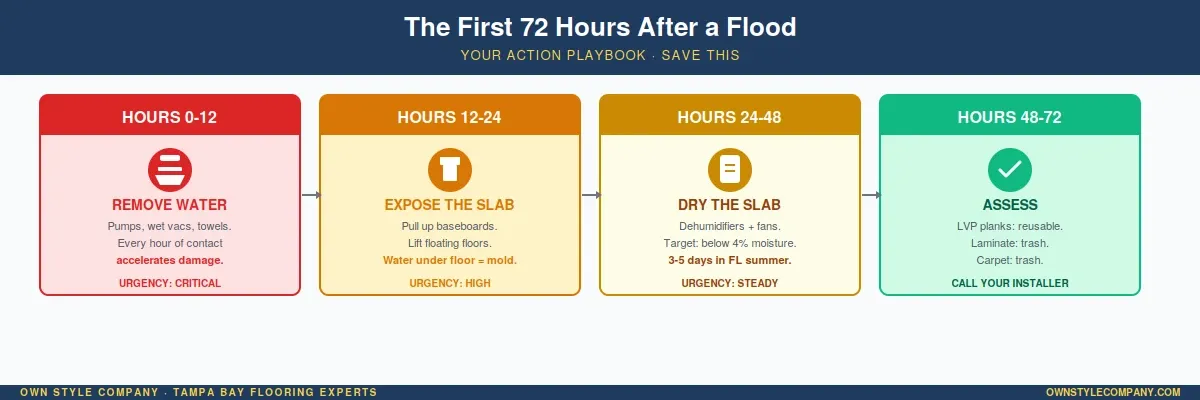
What happens in the first 72 hours decides whether the replacement covers 200 square feet or 2,000. Tampa Bay contractors, insurance adjusters, and water mitigation companies all agree on the same sequence:
- Hours 0–12: Remove standing water. Pumps, wet vacs, towels — whatever gets water off the floor fastest. Every hour of contact accelerates damage exponentially.
- Hours 12–24: Remove baseboards. Pull up any floating floor (laminate, LVP, engineered) to expose the slab. Water trapped between the floor and the slab is where mold starts. Even waterproof LVP needs to be lifted so the slab can dry.
- Hours 24–48: Run dehumidifiers and fans on the exposed slab. Target is getting slab moisture below 4 % before any flooring goes back down. In Florida summer humidity, this can take 3–5 days with commercial dehumidifiers.
- Hours 48–72: Assess what is salvageable. LVP planks: almost always reusable. Laminate: almost never. Carpet and pad: never. Tile: always fine, just clean grout lines.
Which rooms are most vulnerable in Tampa Bay homes?
Flooding does not hit every room equally. In Tampa Bay homes, water finds the same handful of entry points storm after storm, and the most common pattern looks like this:
- Ground-floor rooms facing the street or the yard drainage slope — these flood first and deepest.
- Garages and laundry rooms attached to the main floor — water enters through the garage door seal or the laundry drain.
- Kitchens and bathrooms — not from the storm, but from pipe bursts caused by storm-related pressure changes.
- Sliding glass door rooms (Florida rooms, lanais) — the track seal fails under wind-driven rain.
Second-floor rooms rarely flood from storms. If flooring is being chosen for a second floor, the hurricane calculus does not apply — humidity and A/C cycling are the bigger concerns there.
Can you hurricane-proof your floors?
No home can be made flood-proof, and no flooring material changes that. What the floor decision controls is how much the cleanup costs once water comes in, and the strategy for minimizing that cost is straightforward:
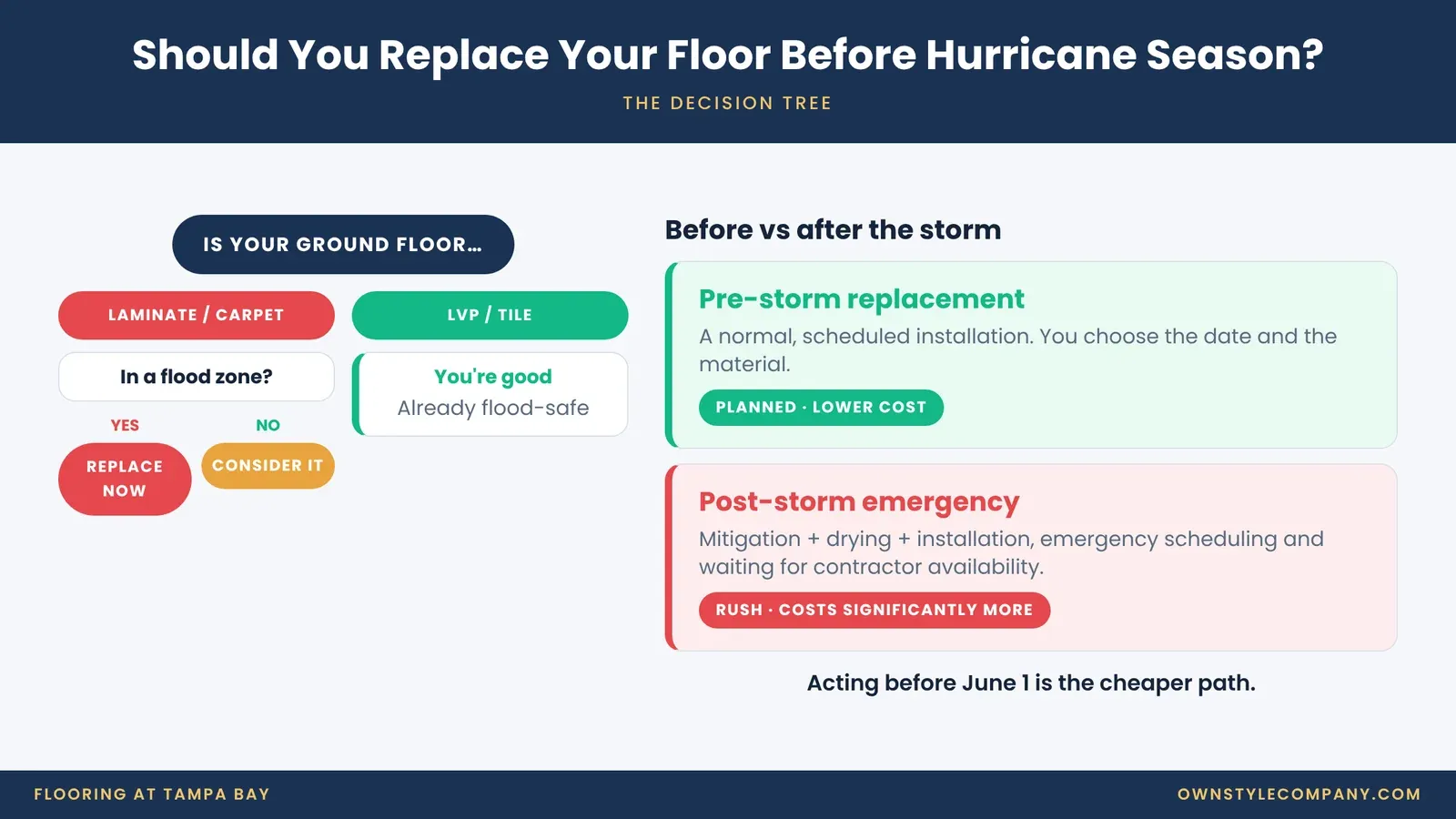
- Ground-floor rooms in flood-vulnerable areas: LVP or tile. Full stop.
- Ground-floor rooms in low-risk areas: Laminate is acceptable if installed with a proper moisture barrier and the home has flood insurance.
- If laminate or carpet is already on the ground floor in a flood zone: Consider replacing before hurricane season, not after. Pre-storm replacement is a normal, scheduled installation (see our published prices). Post-storm emergency replacement costs considerably more, because mitigation, drying, and rush scheduling are added on top.
What about flood insurance and flooring claims?
Insurance guidance here is not legal advice, and every policy should be confirmed with an agent directly. Patterns observed across Tampa Bay claims after storms repeat often enough to be worth noting:
- Standard homeowner’s insurance (HO-3) does not cover flooding. A separate flood policy (NFIP or private) is needed.
- Flood policies typically cover flooring replacement at actual cash value (depreciated), not replacement cost, unless an upgraded policy is in place.
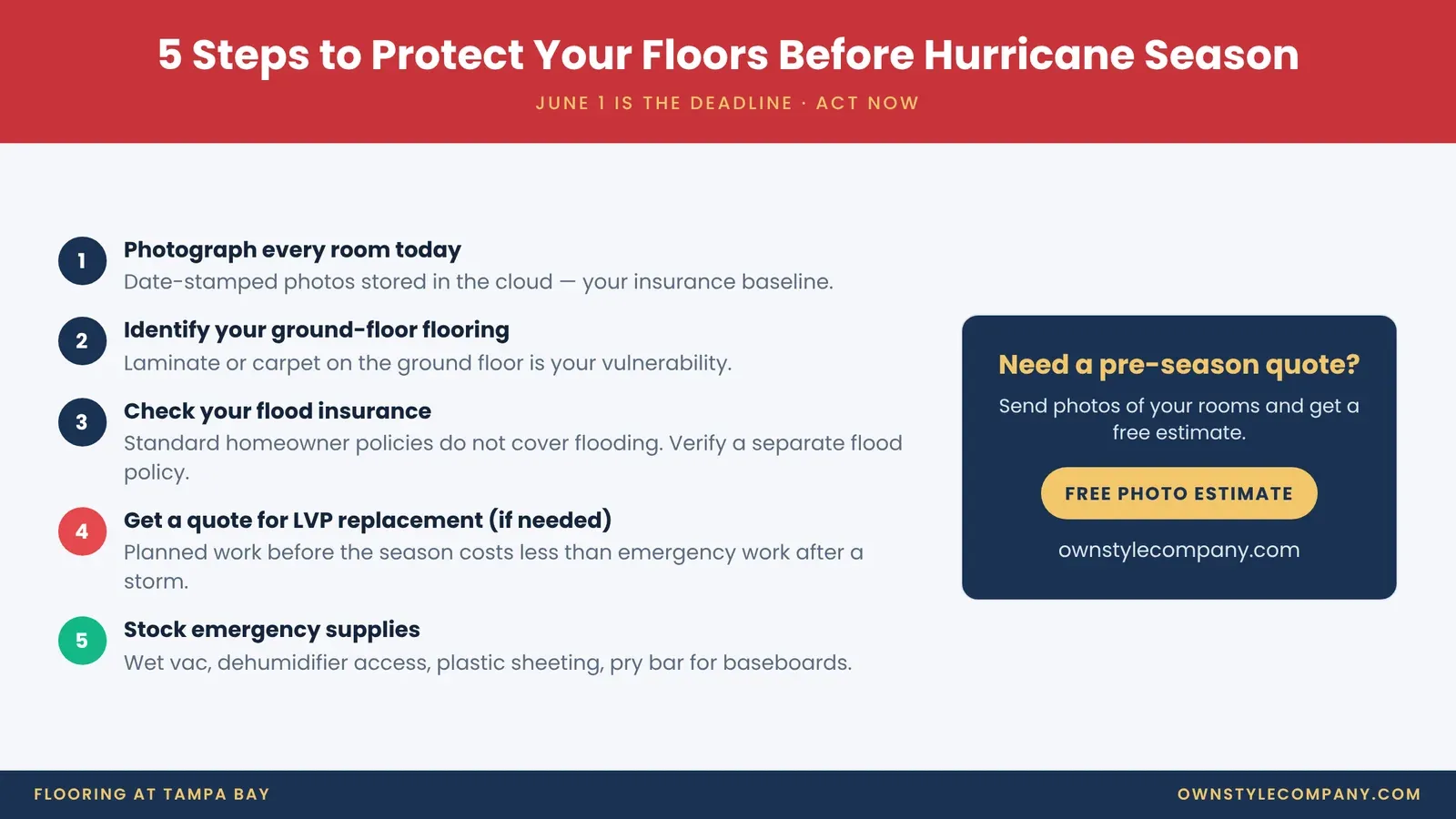
- Documentation matters enormously. Before hurricane season, photograph every room’s flooring with a date stamp. This becomes the baseline for any claim.
- Mitigation effort (removing water quickly, lifting floors, running dehumidifiers) is often required by the policy. Doing nothing and waiting for the adjuster can reduce or void a claim.
Does Storm Surge Damage Floors Differently Than Rainwater Flooding?
Both destroy laminate and carpet on contact, but salt water leaves a longer-lasting problem behind. Storm surge deposits salt residue directly onto the slab, and that residue is hygroscopic — it keeps attracting moisture from the air long after the visible water is gone, even under a floor that survived the flooding itself.
LVP and tile handle this without issue once the salt film is cleaned off the surface before reinstallation. Metal fasteners, transition strips, and any exposed hardware are more vulnerable to storm surge than to rainwater flooding, since salt accelerates corrosion in a way plain rainwater does not.
What to do now — before June 1
Walk the ground floor of a Brandon, Riverview, or Apollo Beach home. Look at what is underfoot. If it is laminate or carpet and the home has flooded before — or sits in a flood zone — the math is clear. Replacing before the storm is cheaper, faster, and eliminates the worst-case scenario entirely.
Planning a flooring project in Tampa Bay? Every quote starts with a moisture reading of the slab, at no cost. Get your free photo estimate or call (813) 455-5756.
Frequently asked questions
How long does it take to replace flooring after a hurricane?
After water mitigation, which typically takes 3 to 7 days for the slab to dry, installation itself takes 1 to 3 days. The real bottleneck is drying time combined with contractor availability — after a major storm hits Tampa Bay broadly, wait times for a crew can reach 4 to 8 weeks.
Can I save my laminate floor after a flood?
Almost never. Laminate with standing water on it for more than 2 to 4 hours develops a permanently swollen HDF core. Even if the surface looks fine once it dries, the internal structure is already compromised and the floor will fail within months as the swelling works its way to the surface.
Should I replace carpet before hurricane season?
If the carpet sits on a ground floor in a flood-vulnerable area, yes. Carpet and its pad cannot be fully decontaminated once flooded in Florida's heat and humidity, since mold colonizes the pad within 24 to 48 hours. Replacing it with LVP means carpet removal plus LVP installation; our labor is $0.80 per square foot for carpet removal and $2 per square foot for LVP installation, with material quoted separately.
Does LVP get damaged by salt water from storm surge?
The LVP planks themselves are unaffected by salt water exposure. Salt residue left on the slab should be cleaned before reinstalling the same planks, but no replacement is needed for the material itself. Salt water is far more damaging to laminate, hardwood, and carpet, all of which absorb it directly.
What is the real cost of waiting until after a storm to replace flooring?
Pre-storm LVP installation is quoted under normal scheduling, with nothing added beyond the floor itself. Post-storm replacement adds water mitigation, drying, and emergency scheduling premiums on top of the same installation, so the same floor costs considerably more once a storm has already hit.


US standard for measuring relative humidity inside a concrete slab using in-situ probes drilled to 40% of slab depth, read after 72 hours of equilibration.
US standard for measuring moisture vapor emission from a concrete slab using anhydrous calcium chloride, expressed in pounds per 1,000 sq ft per 24 hours.
US standard practice for preparing concrete floors to receive resilient flooring. Covers flatness, cleanliness, and moisture condition before installation.
The building code in force across Florida, including moisture and structural requirements that apply to slab-on-grade residential construction.
European deep-core moisture test that reacts a slab sample with calcium carbide and reads the resulting gas pressure. Supporting knowledge: the applicable US standards are ASTM F2170 and F1869.
Supporting knowledge — not the standard we work toGerman standard series for floor screeds, source of the widely cited 2.0% CM cement and 0.5% CM anhydrite thresholds. Supporting knowledge, not the applicable US standard.
Supporting knowledge — not the standard we work toHigh-Density Fiberboard: the compressed wood-fiber core of most laminate planks. It absorbs water vapor and swells irreversibly, which is why slab moisture matters.
Stone Plastic Composite: rigid vinyl core made of limestone powder and PVC. Dimensionally stable under humidity swings and unaffected by water.
Wood Plastic Composite: vinyl core with wood flour and foaming agents. Softer and warmer underfoot than SPC, and less dimensionally stable.
Luxury Vinyl Plank: multi-layer vinyl flooring in plank format. Fully waterproof as a material, though the subfloor beneath still governs installation.
Abrasion Class rating for laminate wear resistance, from AC1 to AC6. AC4 suits normal residential use; AC5 handles heavy traffic and light commercial.
A sheet layer placed between slab and flooring to block ground moisture vapor. Required over slab-on-grade construction regardless of surface dryness.
Foundation type where the concrete slab sits directly on the ground, dominant in Florida residential construction. Ground moisture migrates upward continuously.
The permitted deviation of a subfloor across a given span. The common benchmark is 3/16 inch over 10 feet; beyond that, deviation transfers into the locking joints.
A pourable cement-based compound that flows to a level surface, used to correct slab deviation. Needs 24 to 72 hours of cure before flooring goes down.
The 8 to 10 mm clearance left between a floating floor and every fixed vertical surface, absorbing seasonal expansion. Bridging it transfers stress to the joints.
Conditioning flooring material inside the room where it will be installed, 48 to 72 hours before installation, so it reaches interior temperature and humidity.
An angle-in locking profile that joins planks without adhesive. The insertion angle is specified by the manufacturer; forcing it deforms the profile permanently.
The raised ridge that forms along plank edges when a floating floor expands without room to move. In Florida the usual causes are slab moisture or a bridged expansion gap.