Self-Leveling Mortar vs. Dry Leveling: Choosing the Right Method for Florida Subfloors
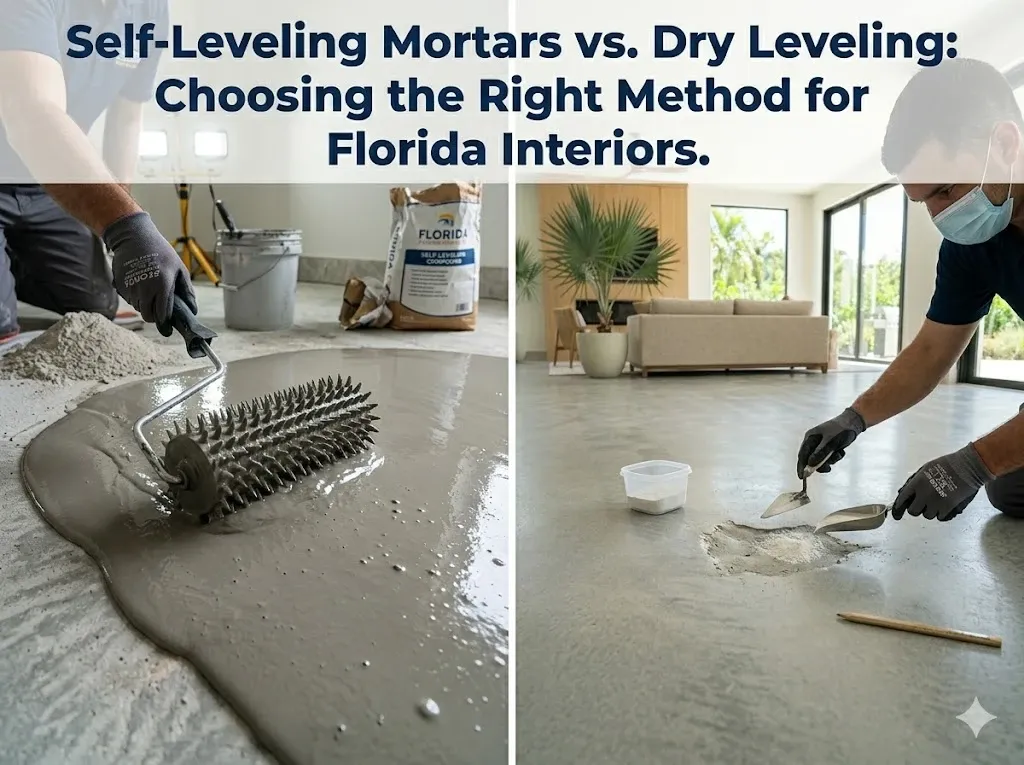
Self-leveling mortar is the correct choice when a concrete slab has widespread depressions exceeding 5 mm or slopes spanning an entire room. Dry leveling with calibrated aggregates is appropriate only for localized dips of 3–5 mm where zero moisture addition and immediate installation are priorities.
In Hillsborough County’s humid climate, the critical difference is drying time: a wet pour traps moisture that must drop below 2.0 % CM before any laminate can be laid, while a dry fill adds zero water and allows same-day installation.
The CM (calcium carbide) method is the European reference, standardized under DIN 18560-4. In the United States the governing standards are different instruments measuring different quantities: ASTM F2170 reads relative humidity inside the slab through in-situ probes set at 40% of slab depth, with a ceiling of 75% RH under ASTM F710, and ASTM F1869 measures surface moisture vapor emission with anhydrous calcium chloride, with a ceiling of 3 lb per 1,000 sq ft per 24 hours. The three readings are not convertible into one another.
Self-Leveling Mortar: The Wet Solution for Major Corrections
In older homes across St. Petersburg and Odessa, concrete slabs develop significant valleys or slopes over decades of settlement. High-flow self-leveling mortars (SLU) — polymer-modified compounds that seek the lowest points when poured — provide the most effective correction for deviations spanning entire living areas or exceeding 5 mm in depth.
The mortar bonds chemically with existing concrete, creating a monolithic surface with compressive strength exceeding 20 MPa (per manufacturer TDS) — far superior to any granular fill. Incorrect water-to-powder ratios, ambient temperatures below 10 °C, or insufficient primer application create bond failures that crack within weeks.
Technical Protocol for Mortar Application
Applying self-leveling mortar is precision engineering, not a simple pour. The protocol follows four steps, each one a common point of failure when a crew skips or rushes it on a job site.
- Priming — A bonding agent prevents the porous slab from absorbing water too quickly from the mortar, which causes surface cracking and delamination at the bond line.
- Perimeter sealing — Closed-cell foam strips seal every room edge, preventing liquid mortar from leaking into wall cavities or through floor vents.
- Air removal — Spiked rollers pass across the fresh pour to eliminate trapped air bubbles that create structural weak points and visible pockmarks.
- Thickness control — Most professional-grade SLU products have a maximum single-pour depth of 25 mm (per manufacturer TDS). Exceeding this requires multiple pours with complete 24-hour cure cycles between layers.
Dry Leveling: The Fast-Track Alternative
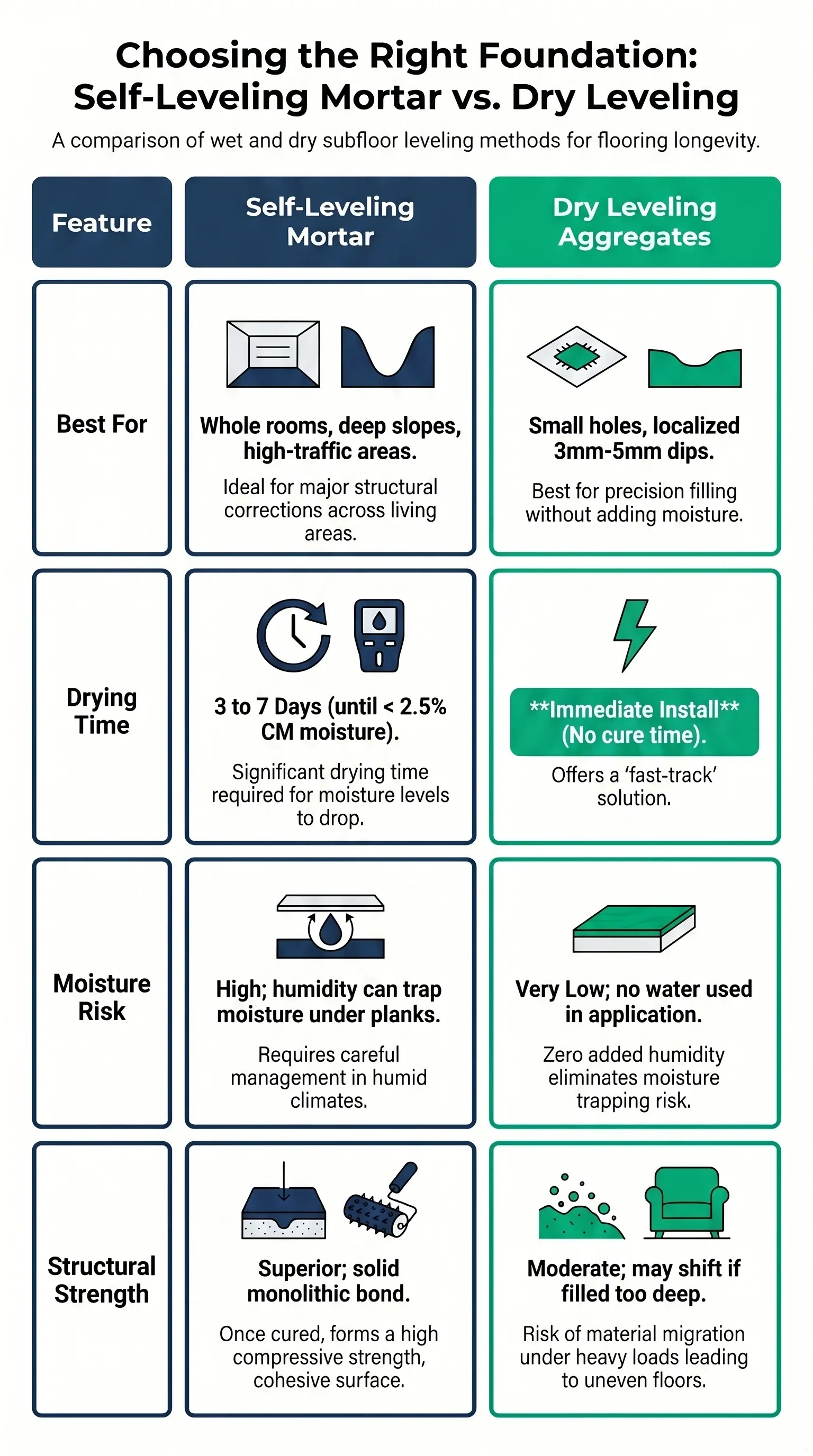
For installations on tight schedules where unevenness is minor, dry leveling with fine aggregates represents an excellent alternative. Calibrated sand or marble dust — particles screened to 0.5–2 mm diameter — fills small depressions without introducing moisture. Because there is no cure time, the underlayment and laminate can be laid the same day after compaction.
Dry leveling is ideal for slabs that measure mostly flat on a 1.5-meter straightedge but have a few isolated 3–5 mm depressions. The aggregate must be compacted with a flat tamper to prevent settling; loose fill beneath a floating floor recreates the dip. Material cost is also lower: dry aggregate typically costs less per square foot than professional-grade SLU.
The Drying Time Trap in Florida’s Humidity
The single biggest risk with wet leveling in Hillsborough County is Florida’s relentless ambient humidity. A standard pour feels firm within 4–6 hours, but surface firmness does not equal moisture readiness. If laminate is installed over mortar that still contains trapped moisture, the HDF core absorbs it through the underside and swells irreversibly.
Depending on pour thickness and local conditions, 3–7 full days are needed before residual moisture drops below the critical 2.0 % CM threshold per ASTM F1869. During Tampa Bay summers with indoor RH between 65 % and 75 % even with air conditioning, this consistently pushes toward the longer end. Verification with a professional CM test is mandatory — never by touch or visual inspection alone.
Maximum Depth Limits and Method Matching
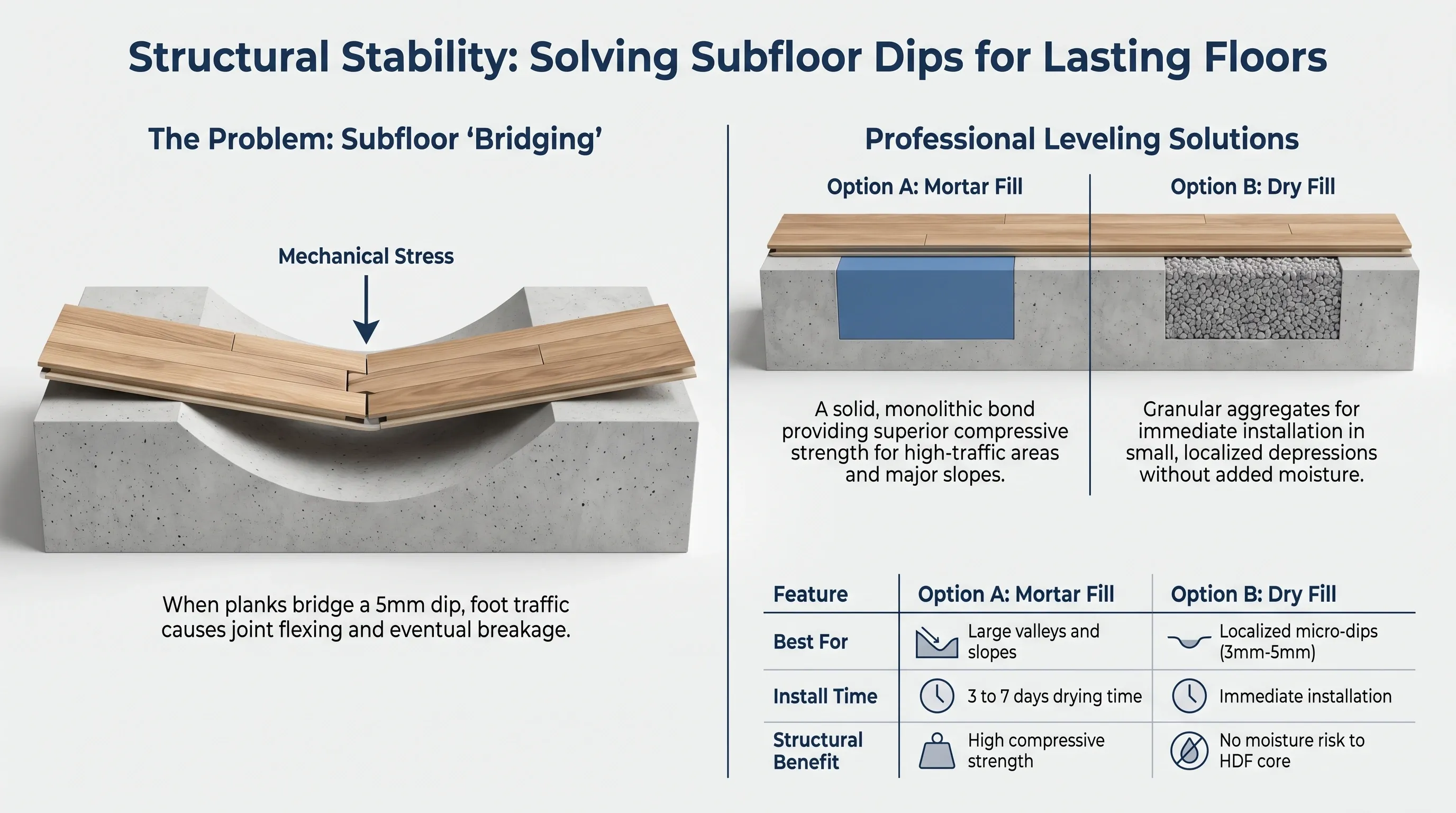
A common error is exceeding the manufacturer’s maximum recommended depth for either method, treating both as if they scale linearly with dip severity when neither does past its rated limit.
| Parameter | Self-Leveling Mortar | Dry Aggregates |
|---|---|---|
| Best for | Widespread depressions, slopes | Localized dips, time-critical projects |
| Max depth per application | 25 mm (per manufacturer TDS) | 8 mm |
| Drying time | 3–7 days (Florida humidity) | Immediate |
| Moisture risk | High — must verify < 2.0 % CM | None |
| Compressive strength | > 20 MPa | Moderate (depends on compaction) |
| Relative cost per sqft | Higher | Lower |
Applying mortar beyond 25 mm in a single pour may prevent the center from fully curing, creating a permanent moisture reservoir. Using dry aggregates beyond 8 mm allows particle migration under concentrated loads, causing the floor to settle within months.
Structural Performance and Long-Term Stability
Self-leveling mortar delivers superior compressive strength and forms a rigid, crack-resistant surface — the definitive solution for high-traffic corridors and large open-plan spaces. Dry leveling is structurally appropriate only for contained, shallow corrections in low-traffic zones.
If a significant portion of the subfloor reads out-of-tolerance across multiple straightedge passes, the long-term stability of a wet fix justifies the additional time and cost. A floor that settles six months after installation requires complete removal of all planks in the affected area, releveling, new underlayment, and reinstallation — a repair that costs far more than leveling correctly the first time.
Professional Leveling as Investment Protection
Whether a project requires a wet pour, dry fill, or hybrid approach combining both, the precision of execution determines the floor’s lifespan. Professional installation includes the technical judgment to match method to condition — laser levels, polymer primers, spiked rollers, and HEPA-filtered grinders — and the verification (straightedge planimetry + CM moisture testing) to confirm the slab is ready before a single plank is laid. Our subfloor preparation labor is $1 per square foot; see our published prices for the full list.
Can Self-Leveling Mortar and Dry Leveling Be Combined in the Same Room?
Yes, and larger rooms with mixed subfloor conditions often call for exactly this hybrid approach. A room with one section showing a widespread 6–8 mm slope and another section with only a few isolated 3–4 mm dips does not need the entire floor poured with mortar just to address the smaller, localized problem.
The mortar pour addresses the sloped zone where its structural strength and monolithic bond are actually needed, while dry aggregate handles the isolated dips elsewhere without adding unnecessary drying time or material cost to the whole project. The straightedge audit that maps the room’s peaks and valleys is what determines the boundary between the two zones, not a blanket decision made before testing.
What Happens If Self-Leveling Mortar Is Poured Without Priming?
The mortar’s bond to the slab fails, sometimes within days rather than months. An unprimed porous concrete surface pulls water out of the fresh mortar unevenly and too quickly, robbing the mix of the moisture it needs to cure to its rated compressive strength and creating a weak, chalky bond line between the two materials.
The visible result is hairline cracking radiating across the poured surface, sometimes accompanied by a hollow sound when tapped — an early indicator that the mortar layer has partially delaminated from the slab beneath it and will not provide the stable base a floating floor depends on.
Planning a flooring project in Tampa Bay? Every quote starts with a moisture reading of the slab, at no cost. Get your free photo estimate or call (813) 455-5756.
Frequently asked questions
How long must I wait after pouring self-leveler before installing laminate in Tampa Bay?
In Tampa Bay's humidity, wait at least 3–7 days. Even if the surface feels firm, a professional CM moisture test must confirm levels below 2.0 % CM before installation — otherwise the HDF core absorbs trapped moisture and swells irreversibly.
Is dry leveling as strong as self-leveling mortar?
For small, localized dips of 3–5 mm, dry aggregates provide adequate support. For large-scale corrections or high-traffic areas, mortar is significantly stronger — it forms a monolithic bond exceeding 20 MPa (≈ 3,000 PSI) that will not shift under furniture loads.
Can I use more dry aggregate if the dip in my floor is deep?
No. Dry fill beyond 8 mm depth is structurally unsafe because granular particles migrate under concentrated furniture loads, causing the floor to settle and become uneven again within months. Deep depressions require a wet mortar fix.
Does self-leveling mortar create dust or strong odors?
The pour itself is low-odor and generates minimal airborne particulate once mixed and poured. The preparation phase before that, grinding down high spots to meet tolerance, is what generates significant concrete dust. Industrial diamond grinders connected to HEPA-filtered vacuums are what control the particulate during that earlier step.
Can mortar and dry leveling be used in the same room?
Yes. A room with one sloped section and separate isolated dips doesn't need the whole floor poured with mortar. Mortar addresses the sloped zone where structural strength is needed, while dry aggregate handles the isolated dips without adding drying time to the rest of the project.
What happens if self-leveling mortar is poured without priming?
The bond to the slab fails, sometimes within days. Unprimed porous concrete pulls water out of the mortar unevenly, robbing it of the moisture needed to cure properly and creating hairline cracking or a hollow sound where the mortar has delaminated from the slab.



US standard for measuring relative humidity inside a concrete slab using in-situ probes drilled to 40% of slab depth, read after 72 hours of equilibration.
US standard for measuring moisture vapor emission from a concrete slab using anhydrous calcium chloride, expressed in pounds per 1,000 sq ft per 24 hours.
US standard practice for preparing concrete floors to receive resilient flooring. Covers flatness, cleanliness, and moisture condition before installation.
The building code in force across Florida, including moisture and structural requirements that apply to slab-on-grade residential construction.
European deep-core moisture test that reacts a slab sample with calcium carbide and reads the resulting gas pressure. Supporting knowledge: the applicable US standards are ASTM F2170 and F1869.
Supporting knowledge — not the standard we work toGerman standard series for floor screeds, source of the widely cited 2.0% CM cement and 0.5% CM anhydrite thresholds. Supporting knowledge, not the applicable US standard.
Supporting knowledge — not the standard we work toHigh-Density Fiberboard: the compressed wood-fiber core of most laminate planks. It absorbs water vapor and swells irreversibly, which is why slab moisture matters.
Stone Plastic Composite: rigid vinyl core made of limestone powder and PVC. Dimensionally stable under humidity swings and unaffected by water.
Wood Plastic Composite: vinyl core with wood flour and foaming agents. Softer and warmer underfoot than SPC, and less dimensionally stable.
Luxury Vinyl Plank: multi-layer vinyl flooring in plank format. Fully waterproof as a material, though the subfloor beneath still governs installation.
Abrasion Class rating for laminate wear resistance, from AC1 to AC6. AC4 suits normal residential use; AC5 handles heavy traffic and light commercial.
A sheet layer placed between slab and flooring to block ground moisture vapor. Required over slab-on-grade construction regardless of surface dryness.
Foundation type where the concrete slab sits directly on the ground, dominant in Florida residential construction. Ground moisture migrates upward continuously.
The permitted deviation of a subfloor across a given span. The common benchmark is 3/16 inch over 10 feet; beyond that, deviation transfers into the locking joints.
A pourable cement-based compound that flows to a level surface, used to correct slab deviation. Needs 24 to 72 hours of cure before flooring goes down.
The 8 to 10 mm clearance left between a floating floor and every fixed vertical surface, absorbing seasonal expansion. Bridging it transfers stress to the joints.
Conditioning flooring material inside the room where it will be installed, 48 to 72 hours before installation, so it reaches interior temperature and humidity.
An angle-in locking profile that joins planks without adhesive. The insertion angle is specified by the manufacturer; forcing it deforms the profile permanently.
The raised ridge that forms along plank edges when a floating floor expands without room to move. In Florida the usual causes are slab moisture or a bridged expansion gap.