The Physics of the SD > 75 m Vapor Barrier: Protecting Floors from Capillary Moisture
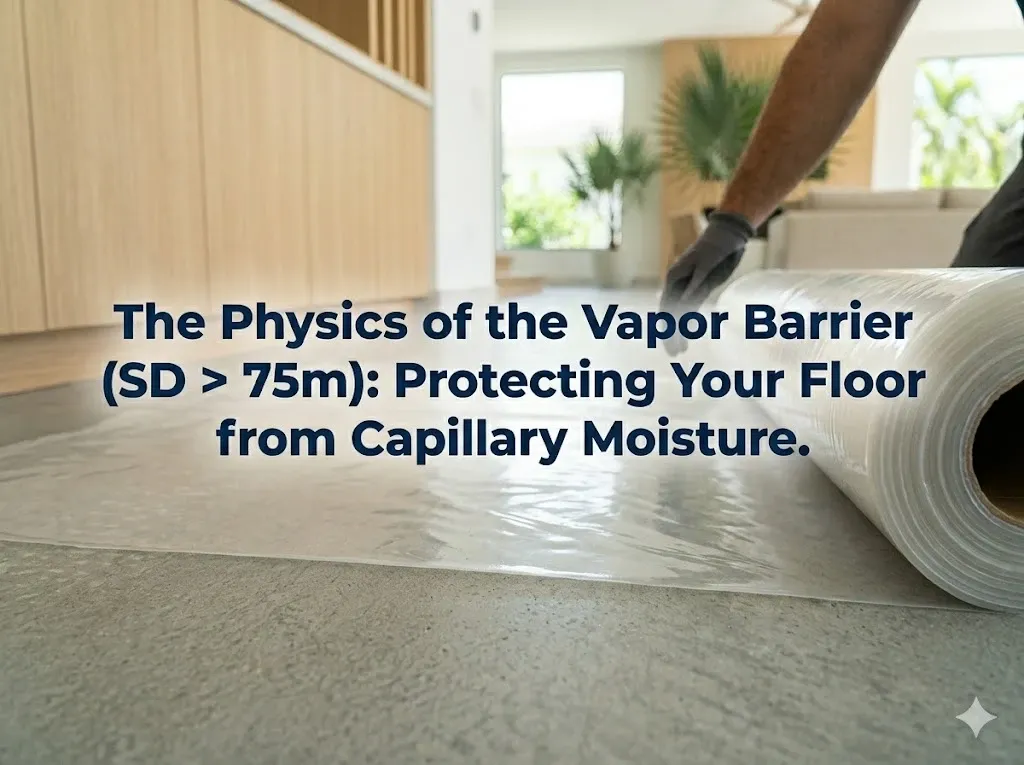
A vapor barrier with an SD value above 75 meters is the mandatory layer between a concrete slab and a laminate floor in Tampa Bay. The 0.2 mm polyethylene film blocks ground-moisture transmission equivalent to 75 meters of still air, stopping the swelling and joint peaking that destroy slab-on-grade installations within two years when the barrier is omitted.
What Is Capillary Moisture, and Why Does It Threaten Florida Floors?
Capillary moisture is groundwater that a porous concrete slab pulls upward and releases as vapor into the floor assembly above. In Tampa Bay, where the water table sits 1–2.5 meters below grade, an uncovered slab in Brandon or Tampa transmits enough vapor to warp a floating laminate floor within months.
Concrete never fully stops absorbing water, even after curing for years. During the June–September rainy season, soil saturation around Hillsborough County homes pushes vapor emission rates above 0.4 kg per square meter over 24 hours. A vapor barrier breaks the link between the damp slab and the moisture-sensitive HDF core.
Homeowners often blame the laminate brand when a floor cups, but the real cause sits underneath. A slab that reads above 2.0 % CM will damage an unprotected floating floor regardless of plank quality.
The CM (calcium carbide) method is the European reference, standardized under DIN 18560-4. In the United States the governing standards are different instruments measuring different quantities: ASTM F2170 reads relative humidity inside the slab through in-situ probes set at 40% of slab depth, with a ceiling of 75% RH under ASTM F710, and ASTM F1869 measures surface moisture vapor emission with anhydrous calcium chloride, with a ceiling of 3 lb per 1,000 sq ft per 24 hours. The three readings are not convertible into one another.
What Does an SD Value Greater Than 75 Meters Mean?
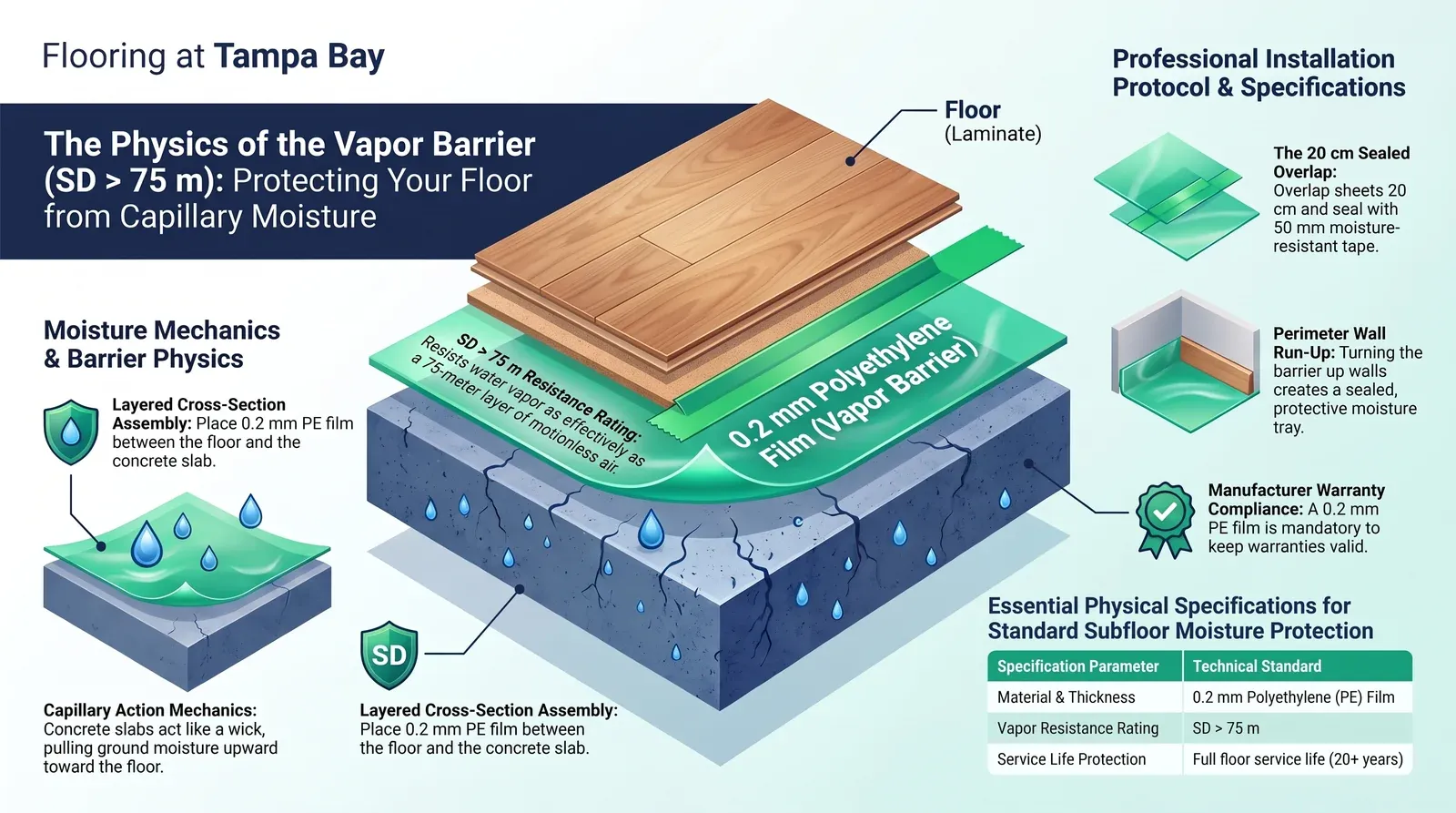
An SD value (diffusion-equivalent air-layer thickness) measures how strongly a material resists water-vapor transmission. SD 75 m means the 0.2 mm PE film resists vapor as effectively as a 75-meter column of motionless air sitting on the slab.
For HDF-core laminate over mineral subfloors, SD 75 m is the minimum engineering threshold per DIN 18365 and EN 13329. A film rated below SD 75 m in coastal Florida lets enough vapor through to trigger cupping within the first year.
| Barrier option | SD value | Slab-on-grade suitability |
|---|---|---|
| Painter’s plastic (≈ 0.05 mm) | < 10 m | Fails — not a vapor barrier |
| Standard PE film (0.1 mm) | 40–60 m | Insufficient for slab-on-grade |
| Certified PE film (0.2 mm) | > 75 m | Required minimum per DIN 18365 |
The SD rating appears on the product technical data sheet, not on retail packaging. Comparing SD values is the only reliable way to distinguish a true vapor barrier from thin plastic that offers minimal protection.
Why Is 0.2 mm the Required Thickness?
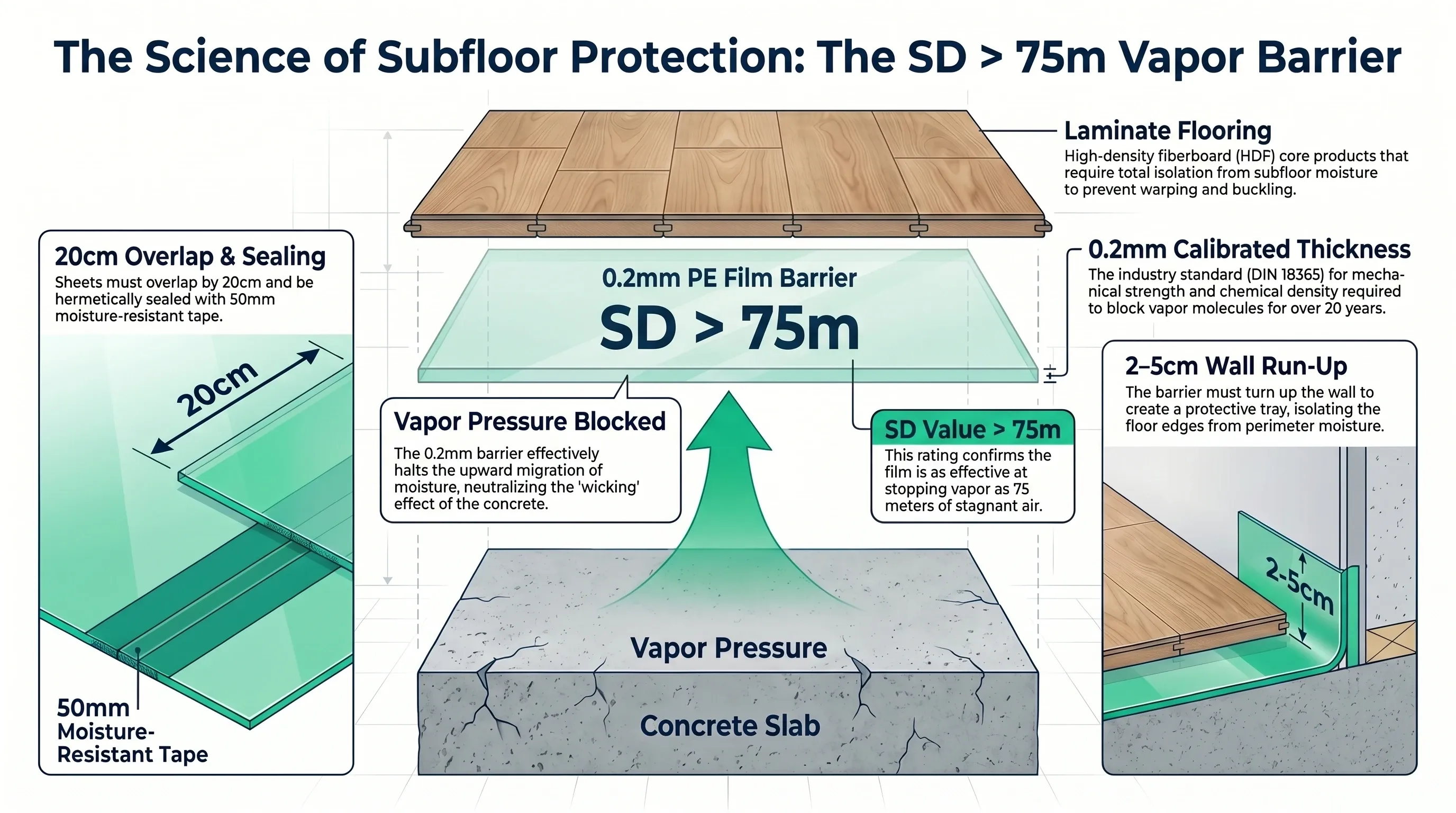
A 0.2 mm polyethylene film is the thickness calibrated to survive installation without tearing while holding its vapor resistance for a 20+ year service life. Thinner drop cloths stretch and puncture under foot traffic, opening micro-gaps that defeat the barrier.
Industry standards (EN 13329, DIN 18365) specify 0.2 mm PE for laminate over concrete. A single tear creates a localized moisture pocket that can ruin an entire room. The 0.2 mm thickness also bridges minor slab texture without tearing at high spots — something a 0.1 mm sheet cannot reliably do.
How Are Vapor Barrier Seams Overlapped and Sealed?
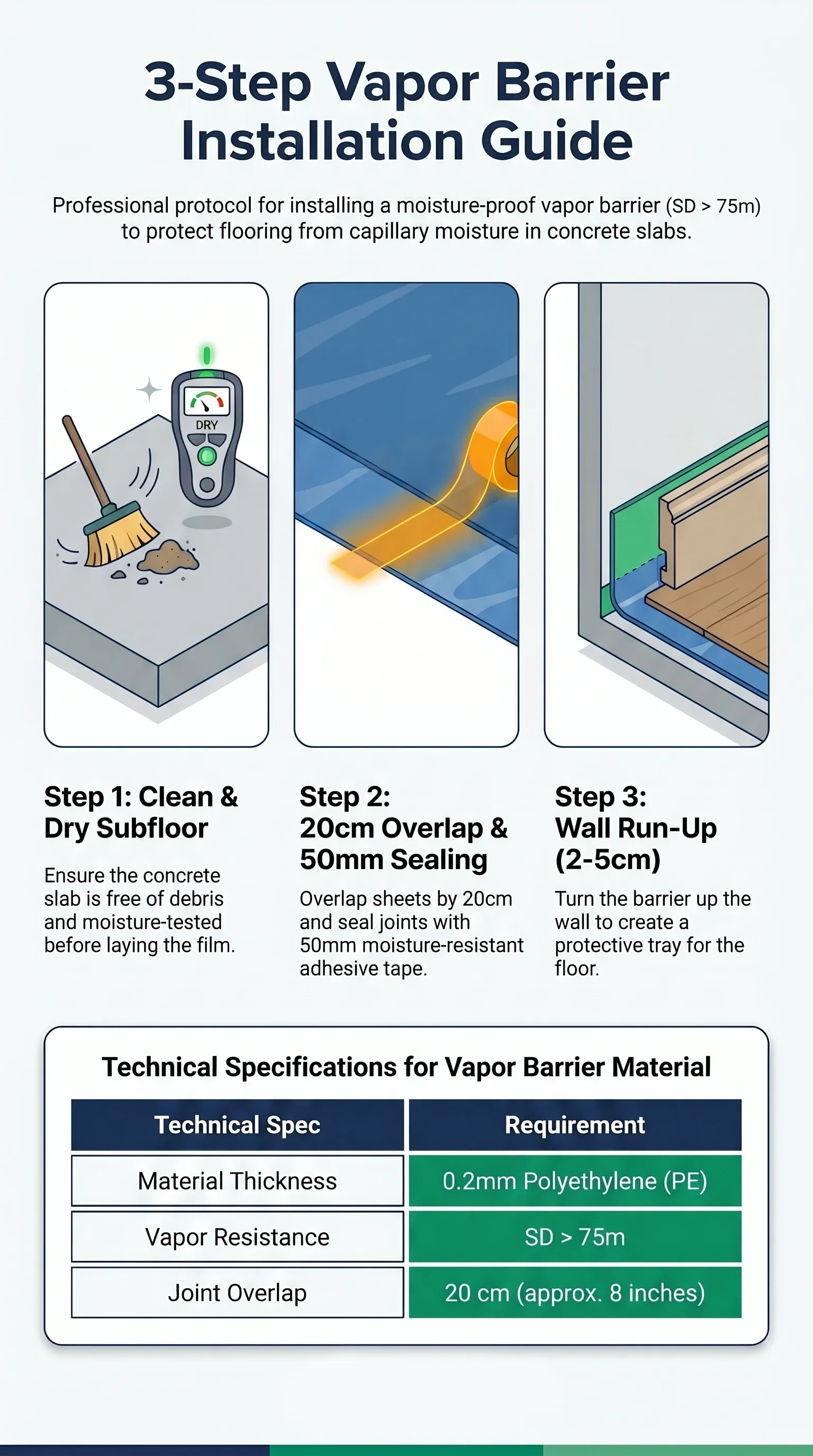
A vapor barrier performs only as well as its weakest seam. The professional protocol:
- Overlap adjoining PE sheets by at least 20 cm (≈ 8 in) before taping.
- Seal every seam end-to-end with 50 mm moisture-resistant adhesive tape.
- Maintain a 10 mm expansion gap at all walls and transitions — the film does not touch fixed structures.
Loose or untaped overlaps are the most common defect in low-cost installations. Buckled joints typically surface 3–6 months after completion.
Why Must the Barrier Run Up the Wall at the Perimeter?
Moisture follows the path of least resistance. A barrier that stops at the floor edge lets vapor migrate to the walls and attack exposed plank edges. The professional fix: turn the barrier 2–5 cm up every wall, forming a sealed “tray” around the floor.
The excess film is trimmed only after baseboards are installed, keeping the perimeter — the most vulnerable zone — fully isolated. Skipping the wall run-up leaves a moisture entry point that no surface cleaning can correct.
Are 2-in-1 Underlayments Enough on Slab-on-Grade Homes?
Many underlayments ship with a foil or plastic backing marketed as “2-in-1 vapor + cushion,” but most fall short unless the product specifically certifies SD > 75 m. A marketing label is not a substitute for the rated specification.
For first-floor slab-on-grade homes, best practice calls for a dedicated 0.2 mm PE film beneath the technical underlayment. The double-layer approach separates functions: the PE film handles vapor diffusion while the foam underlayment manages sound and minor leveling, so neither function is compromised.
What Does Skipping the Vapor Barrier Cost?
Skipping the barrier to save a few cents per square foot voids the manufacturer’s warranty. A forensic inspector checks first for the presence of a 0.2 mm PE film. Without it, cupping and crowning damage become the owner’s liability — often a full floor replacement. The barrier itself adds only a small fraction to the project total, while a failed floor costs full material + labor again, plus the disruption of a second demolition.
How Long Does a Properly Installed Vapor Barrier Last?
A certified 0.2 mm PE film rated SD > 75 m is designed to last the full service life of the floor above it, typically 20 years or more, without needing replacement or inspection. The barrier is a passive layer — it has no moving parts and does not degrade under normal slab conditions once it is sealed and covered.
The failure modes that shorten a barrier’s effective life are almost always installation errors rather than material aging: a torn seam from foot traffic during installation, an unsealed overlap, or a perimeter run-up that was trimmed too early before baseboards went in. A correctly installed barrier that survives the first 30 days of installation traffic without visible damage will typically perform for the life of the floor.
What Should Be Checked Before Covering the Vapor Barrier?
A final inspection before the underlayment and planks go down catches the defects that are cheap to fix now and expensive to fix later, once the floor is finished and the barrier is buried under two more layers of material.
- Every seam overlaps at least 20 cm and is fully taped, with no visible gaps when checked by hand
- The barrier runs up every wall by 2–5 cm, with no section left flat against the slab at the perimeter
- No punctures, tears, or footprints with visible damage remain anywhere across the covered area
- The film sits flat without trapped air pockets that could shift or wrinkle once weight is applied above it
Planning a flooring project in Tampa Bay? Every quote starts with a moisture reading of the slab, at no cost. Get your free photo estimate or call (813) 455-5756.
Frequently asked questions
Do I need a vapor barrier when installing laminate over existing tile?
A firmly bonded, non-porous, dry tile can act as its own vapor barrier, so a separate PE film is often unnecessary. However, subfloor moisture must still read below 2.0 % CM before installation, and the tile must be level and fully adhered.
What does an SD value greater than 75 m actually mean?
An SD value above 75 m means the film resists water-vapor diffusion as effectively as a 75-meter column of still air. For HDF-core laminate over a concrete slab, SD 75 m is the minimum rating per DIN 18365 that reliably blocks ground moisture.
Can I use two layers of vapor barrier for extra protection?
Yes. On concrete slabs in high-humidity areas, adding a dedicated 0.2 mm PE film beneath a 2-in-1 underlayment gives maximum protection. This double-layer approach is recommended for first-floor units and homes near bodies of water.
Should I install a plastic vapor barrier over a wood subfloor?
No. A fully sealed plastic vapor barrier over a plywood subfloor traps moisture between the two layers and can rot the wood structure from the inside over time. Wood subfloors instead require a breathable membrane that lets residual moisture escape while still protecting the laminate above from surface spills.
Keep reading

US standard for measuring relative humidity inside a concrete slab using in-situ probes drilled to 40% of slab depth, read after 72 hours of equilibration.
US standard for measuring moisture vapor emission from a concrete slab using anhydrous calcium chloride, expressed in pounds per 1,000 sq ft per 24 hours.
US standard practice for preparing concrete floors to receive resilient flooring. Covers flatness, cleanliness, and moisture condition before installation.
The building code in force across Florida, including moisture and structural requirements that apply to slab-on-grade residential construction.
European deep-core moisture test that reacts a slab sample with calcium carbide and reads the resulting gas pressure. Supporting knowledge: the applicable US standards are ASTM F2170 and F1869.
Supporting knowledge — not the standard we work toGerman standard series for floor screeds, source of the widely cited 2.0% CM cement and 0.5% CM anhydrite thresholds. Supporting knowledge, not the applicable US standard.
Supporting knowledge — not the standard we work toHigh-Density Fiberboard: the compressed wood-fiber core of most laminate planks. It absorbs water vapor and swells irreversibly, which is why slab moisture matters.
Stone Plastic Composite: rigid vinyl core made of limestone powder and PVC. Dimensionally stable under humidity swings and unaffected by water.
Wood Plastic Composite: vinyl core with wood flour and foaming agents. Softer and warmer underfoot than SPC, and less dimensionally stable.
Luxury Vinyl Plank: multi-layer vinyl flooring in plank format. Fully waterproof as a material, though the subfloor beneath still governs installation.
Abrasion Class rating for laminate wear resistance, from AC1 to AC6. AC4 suits normal residential use; AC5 handles heavy traffic and light commercial.
A sheet layer placed between slab and flooring to block ground moisture vapor. Required over slab-on-grade construction regardless of surface dryness.
Foundation type where the concrete slab sits directly on the ground, dominant in Florida residential construction. Ground moisture migrates upward continuously.
The permitted deviation of a subfloor across a given span. The common benchmark is 3/16 inch over 10 feet; beyond that, deviation transfers into the locking joints.
A pourable cement-based compound that flows to a level surface, used to correct slab deviation. Needs 24 to 72 hours of cure before flooring goes down.
The 8 to 10 mm clearance left between a floating floor and every fixed vertical surface, absorbing seasonal expansion. Bridging it transfers stress to the joints.
Conditioning flooring material inside the room where it will be installed, 48 to 72 hours before installation, so it reaches interior temperature and humidity.
An angle-in locking profile that joins planks without adhesive. The insertion angle is specified by the manufacturer; forcing it deforms the profile permanently.
The raised ridge that forms along plank edges when a floating floor expands without room to move. In Florida the usual causes are slab moisture or a bridged expansion gap.